






 By
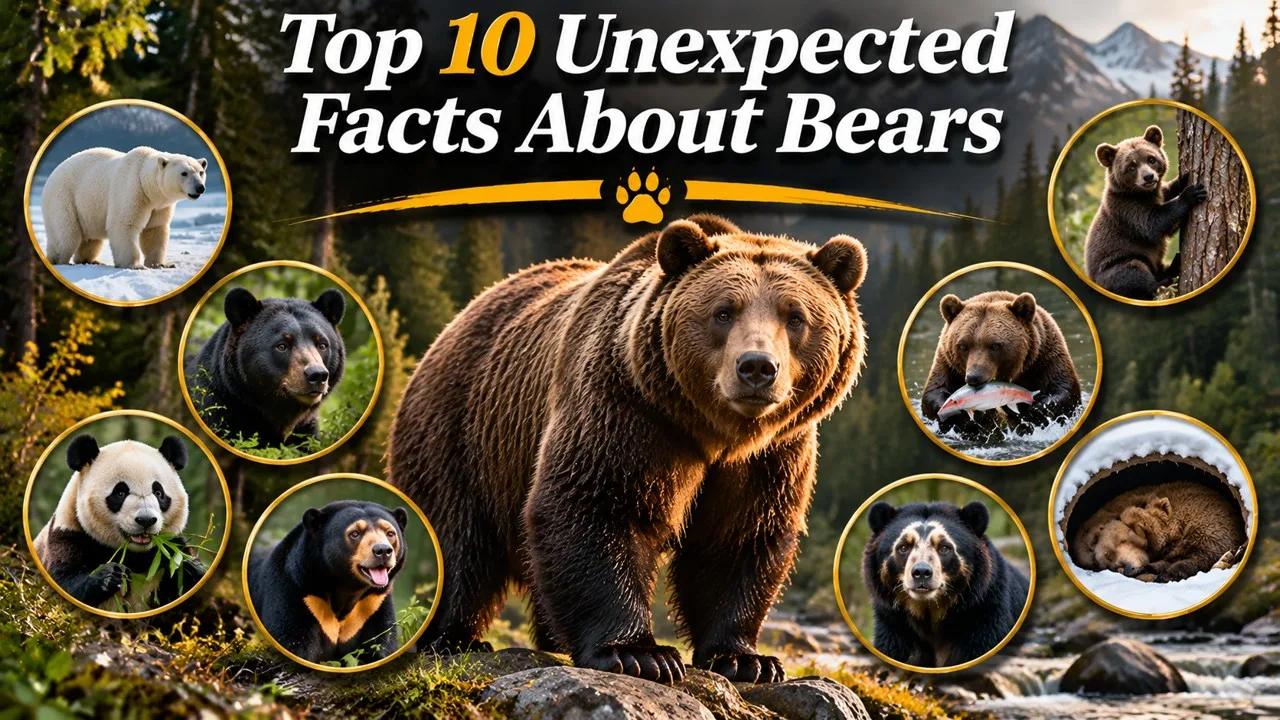
Bears have a documented odd history, from an extinct African species to a Polish Army corporal and a zoo bear that inspired a children's book. The eight living bear species, plus several extinct ones, have been studied in enough detail that some of the strangest-sounding claims can be checked: delayed births, unusual colors, tool use, and a long, unhappy period when a famous American park treated bears as a roadside attraction [1][6][9]. This list is a curated set of ten facts, not a ranking of species, and it stays with published records.
One entry involves a children's-book title. The book itself is not quoted here, and the fact is about a real black bear in London, not about a later cartoon. Another entry involves a wartime mascot; the account is limited to the documented unit history and does not dwell on the battlefield [7][8].
Key Facts
Living bears include brown, polar, American and Asiatic black bears, sun bears, sloth bears, spectacled bears, and giant pandas. Delayed implantation is common in several species. Historical color oddities usually have a biological explanation.
Ten Bear Facts at a Glance
| Rank | Fact | Species or setting | Status of the evidence |
|---|---|---|---|
| 1 | Africa once had a native bear | Atlas bear, North Africa | Extinct; historically documented |
| 2 | Hibernating bears resist some of the harm expected from long rest | Several hibernating species | Medical and physiological studies |
| 3 | Female bears can delay implantation of an embryo | Brown, black, polar, and others | Standard reproductive biology |
| 4 | A polar bear's fur can look green in some zoos | Polar bear, in captivity | Algae in hollow hairs, documented |
| 5 | Giant pandas have been seen rolling in horse manure | Giant panda | Published field observation |
| 6 | A brown bear has been recorded using a stone as a tool | Brown bear | Documented observation |
| 7 | Wojtek served as a mascot and was given a corporal's rank | Syrian brown bear, Polish II Corps | Unit and museum history |
| 8 | The name Winnie came from a real bear in London | American black bear, London Zoo | Zoo and biographical record |
| 9 | Lord Byron kept a bear at Cambridge | Historical anecdote | College and biographical record |
| 10 | Yellowstone once let visitors watch bears at garbage dumps | American black and brown bears | National Park Service history |
1. Africa Once Had Bears
The Atlas bear, Ursus arctos crowtheri, was a North African population of the brown bear, found in the Atlas Mountains and neighboring ranges into historical times [1]. It is now extinct. Accounts and later reviews place its disappearance in the late nineteenth or early twentieth century, after long hunting and habitat pressure [1]. Sub-Saharan Africa has no living bears, which is why the idea of an "African bear" sounds, to many people, like a mistake.
It was not a mistake. The Atlas bear was a real animal at the edge of a primarily northern hemisphere family, and its absence today is a historical fact, not a zoological impossibility. When a modern list says that Africa used to have bears, this is the population it is talking about.
2. Hibernating Bears Avoid Some of the Damage Long Rest Would Cause in People
Bears that hibernate can spend months with little food or movement, a lower metabolic rate, and long recumbency, and yet they do not show the same pattern of bone loss, muscle wasting, and blood-clot trouble that doctors expect in a person who lies still for a long time [2]. Researchers have studied this physiology because it may hold clues for medicine, including the way bears handle circulation and inactivity [2]. The details are still being worked out, and not every "bears don't get clots" headline is a complete clinical statement.
The careful version is already strange enough. A large mammal can remain still and unfed for a season and then walk away in spring, and parts of that trick are measurable. It is one of the better reasons bears interest physicians as well as zoologists.
Related: Top 10 Colourful Parrots of the World
3. Female Bears Can Pause a Pregnancy
In several bear species, including brown, American black, and polar bears, a fertilized egg may develop only to the blastocyst stage and then wait, unimplanted, in the uterus until conditions are right, often until the female has entered a den [3]. The process is called delayed implantation, or embryonic diapause, and it is known in other mammals too. In bears it helps to time birth for the winter den, when a small cub can be born in a sheltered place [3].
The pause is not a rumor and not a magical "paused pregnancy" in the tabloid sense. It is a documented reproductive schedule. Mating in summer and birth in midwinter can sit many months apart without the embryo growing the whole time.
4. Polar Bears Can Turn Green in Captivity
Polar bear fur is not white pigment in the usual sense. The hairs are transparent and hollow, and the coat looks white because of scattering. In some warm zoos, algae have grown inside or on those hollow hairs, giving live bears a greenish tinge that looks impossible in a photograph [4]. The animals are still polar bears; the color is a boarding organism, and it has been reported from more than one collection over the years [4].
The effect is much less a feature of wild Arctic bears, which live in colder, less algae-friendly conditions. It is a captivity-and-chemistry fact, and it is a useful warning against assuming that an odd color in a photo must be a fake.
5. Giant Pandas Have Been Seen Rolling in Horse Manure
In 2017, researchers reported that wild giant pandas in the Qinling region rolled in and smeared themselves with horse manure, especially in colder weather, and they suggested that chemicals in the manure might reduce the sensory discomfort of cold [5]. The paper, published in a scientific journal, treated the behavior as a real, observed habit, not as a joke, and it offered a chemical hypothesis that later work can test [5].
Related: Top 10 Unexpected Abilities Found in Animals
The image is easy to misread as mere messiness. It may be a form of self-anointing, a behavior known in other mammals. Until more studies confirm the function, the solid fact is the observation: pandas do this, and it has been written down in the formal literature.
6. A Brown Bear Has Used a Stone as a Tool
Most discussions of tool use in animals still start with primates and some birds. Bears appear less often. There is, however, documented observation of a brown bear using a stone in a way that researchers have treated as tool use, including a report of a bear employing a rock in a grooming or scratching context [6]. Such reports are still uncommon, and one animal is not a species-wide habit. They are enough to put "bears never use tools" on the retired-slogan list.
The right tone is modest. A brown bear can, under observation, manipulate a rock for a purpose. How widespread the habit is remains an open question.
7. Wojtek Was a Bear in a Polish Army Unit
Wojtek was a Syrian brown bear adopted as a cub by Polish soldiers in 1942, during their passage through the Middle East, and later enrolled, in a formal sense, as a soldier of the 22nd Artillery Supply Company, 2nd Polish Corps, with the rank of corporal [7]. The unit history, later museum exhibits, and a body of secondary writing describe him as a mascot who also helped to carry ammunition crates during the Italian campaign, including at Monte Cassino [7]. After the war he lived at the Edinburgh Zoo, where he died in 1963.
The story is unusual and well attested, and it needs no extra color. A bear was taken onto a unit's strength, lived with the company, and is now part of the official memory of that corps. The rank was a military joke with paperwork behind it, not a children's fable.
Related: Top 10 Longest-Living Animals on Earth
8. Winnie Was a Real Bear in the London Zoo
In 1914, a Canadian veterinarian, Lieutenant Harry Colebourn, bought a black bear cub in Ontario, named her Winnipeg, and later left her at the London Zoo when he went to the Western Front [8]. The cub, known as Winnie, became a popular exhibit. A. A. Milne and his son Christopher Robin visited the zoo, and the bear's name was later used for the bear in Milne's children's books [8].
That is a naming and zoo-history fact. It is not a claim about later films or illustrations, and those later works are not described or quoted here. The living animal in London is the documented starting point, and she is easy to verify in zoo and biographical records.
9. Lord Byron Kept a Bear at Cambridge
The poet Lord Byron kept a tame bear while he was a student at Trinity College, Cambridge, a story that appears in standard biographical accounts and in the college's own later telling [9]. The usual explanation is that Trinity forbade dogs, and Byron answered the rule with a different animal. The bear was a real pet, not a metaphor, and it became one of the more durable anecdotes of his student life [9].
Anecdotes can grow in the telling. The core — a Cambridge student, a kept bear, a rule about dogs — is not a modern invention. It is a small, well-known fact about how far a famous undergraduate was willing to push a regulation, and about how ordinary a captive bear could seem in a nineteenth-century story, however strange it seems now.
Related: Top 10 Most Dangerous Wild Animals in Canada
10. Yellowstone Once Invited Visitors to Watch Bears Eat Garbage
In the early and mid-twentieth century, Yellowstone National Park openly tolerated, and in some periods effectively staged, the watching of bears at garbage dumps and along roads [10]. Visitors gathered to see black and brown bears feed on waste, and the practice became one of the park's most famous unofficial attractions. The National Park Service later ended the dump feeding and worked to change both bear behavior and visitor habits, because the arrangement was dangerous for people and bad for the animals [10].
The reversal is part of the documentation. A park that now tells people to store food and keep their distance once let a dump become a theatre. The change in policy is one of the clearer examples of a conservation agency deciding that a popular spectacle was not compatible with its later idea of a wild place.
Conclusion
Bears attract tall stories, which is a reason to prefer the ones with papers, unit records, or park archives behind them. Africa did have a bear. Hibernation and delayed implantation are measured biology. A green polar bear and a manure-rolling panda are odd and still documented. A stone, a corporal's rank, a London zoo cub, a Cambridge pet, and a garbage-dump audience are all, in their different ways, on the record.
The living animals are strange enough without help. The historical ones are strange in a different way: they show how closely people have tried to keep, display, and sometimes exploit a family of mammals that is not designed for any of those jobs.
- ^ [1] "Atlas bear." Wikipedia. Wikipedia: Atlas bear
- ^ [2] Reviews of bear hibernation physiology in the medical and zoological literature; overview at "Hibernation" and "Bear." Wikipedia. Wikipedia: Hibernation
- ^ [3] "Embryonic diapause" and bear reproduction. Wikipedia. Wikipedia: Embryonic diapause
- ^ [4] Documented cases of green-tinged polar bears in zoos, discussed in "Polar bear" and contemporary zoo reports. Wikipedia. Wikipedia: Polar bear
- ^ [5] Zhou, W., et al., 2017, on giant pandas rolling in horse manure, reported in the scientific press and related papers. Wikipedia: Giant panda
- ^ [6] Published observations of stone use by a brown bear in the tool-use literature; overview in "Tool use by animals." Wikipedia. Wikipedia: Tool use by animals
- ^ [7] "Wojtek (bear)." Wikipedia, and Polish military museum accounts of the 22nd Artillery Supply Company. Wikipedia: Wojtek
- ^ [8] "Winnipeg (bear)" and the Colebourn/London Zoo history. Wikipedia. Wikipedia: Winnipeg the bear
- ^ [9] "Lord Byron" and Trinity College accounts of the Cambridge bear. Wikipedia. Wikipedia: Lord Byron
- ^ [10] National Park Service histories of bear management in Yellowstone, including the end of dump feeding. NPS: Yellowstone bears



















Discussion
Log in with