






 By
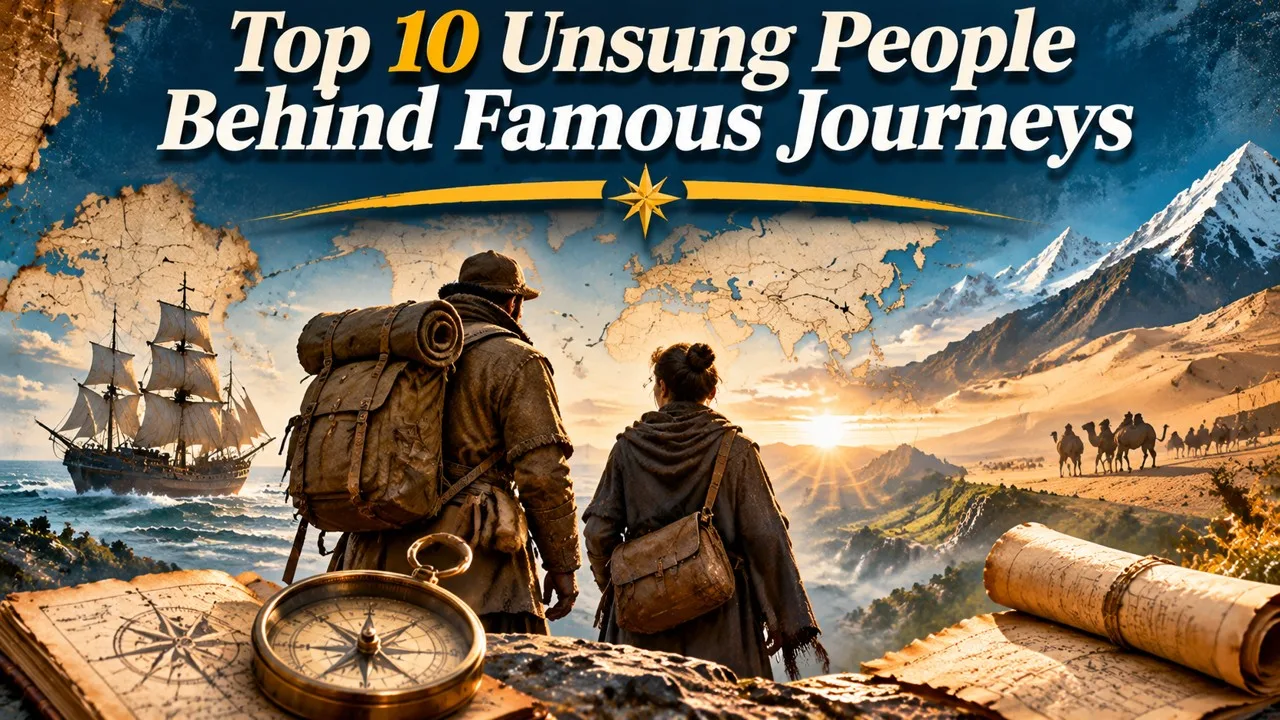
York, Tenzing Norgay, Sacagawea, Elcano and Jeanne Baret did essential work on famous journeys, and the record is clearer when the usual errors are left out. Several of the names below are famous in one country and still treated as supporting characters in another. A few popular identifications are simply wrong, and they are corrected here rather than repeated [4][8][10]. This list is a curated set of ten people, or small groups, whose work can be checked in expedition records, official histories, and standard biographies.
The entries are not a ranking of virtue. They are a reminder that a "famous journey" is often a company, and that later storytelling prefers a single leader. Where a claim is disputed, as with the 1909 North Pole party, the dispute is part of the entry [8].
Key Facts
Primary expedition journals, naval records, and later scholarly biographies are the basis for the identifications below. Where a widely repeated story does not match those sources, the story is not used.
Ten Companions and Completers at a Glance
| Rank | Person or group | Journey | Documented role |
|---|---|---|---|
| 1 | York | Lewis and Clark, 1803–1806 | An enslaved man who travelled the whole route and appears throughout the journals |
| 2 | Tenzing Norgay | First confirmed ascent of Everest, 1953 | Reached the summit with Edmund Hillary |
| 3 | Sacagawea | Lewis and Clark, 1805–1806 | Interpreter and guide figure, travelling with her infant |
| 4 | Abdullah ibn Urayqit | The Hijra, 622 | The hired guide on the road from Mecca toward Medina |
| 5 | Juan Sebastián Elcano | The Magellan expedition, completed 1522 | Brought the Victoria home, completing the circumnavigation |
| 6 | Nain Singh Rawat | Secret surveys of the Tibetan plateau, 1860s–1870s | Pundit surveyor who measured route, altitude, and Lhasa's position |
| 7 | Rustichello da Pisa | The book of Marco Polo | The writer who helped turn Polo's account into a medieval book |
| 8 | Matthew Henson and Inuit companions | Peary Arctic campaigns, 1909 claim | Long-term partners in a disputed polar claim |
| 9 | Prince Estabrook | Lexington, 19 April 1775 | An enslaved minuteman wounded on the first day of the American Revolutionary War |
| 10 | Jeanne Baret | Bougainville expedition, 1766–1769 | The first woman known to complete a circumnavigation, not a solo sailor |
1. York on the Lewis and Clark Expedition
York, an enslaved African American man held by William Clark, travelled with the Corps of Discovery from the start of the 1803–1806 expedition to the Pacific and back [1]. The journals mention him as a hunter, a laborer, and a person whose presence sometimes figured in encounters along the way. He was not a volunteer in any legal sense. His labor was commandeered, and his later attempts to secure more freedom from Clark are part of a painful, documented aftermath [1].
Popular retellings that treat the expedition as a story of two captains leave York in the margins, or turn him into a mascot. The record is plainer. He was there for the whole journey, he did skilled work, and he remained legally unfree. Any honest list of people "behind" that famous crossing has to start with that fact.
2. Tenzing Norgay on Everest
Tenzing Norgay reached the summit of Everest with Edmund Hillary on 29 May 1953, the first confirmed ascent [2]. In Nepal and India he is a national figure, not an unsung one. In mid-century British and Commonwealth storytelling, however, the climb was often narrated as Hillary's victory with a Sherpa assistant, a framing Tenzing and later historians had to push against [2]. He was an experienced high-altitude mountaineer and a full partner on the final ridge.
The "unsung" label, then, is about a Western habit, not about his actual fame. The documented point is simple and sufficient: two men stood on the summit, and only a biased story needs one of them to shrink. Hillary's own later remarks treated Tenzing as a companion, which is the right scale.
Related: Martin Luther King Jr.: The Legacy of a Civil Rights Icon
3. Sacagawea
Sacagawea, a Lemhi Shoshone woman, travelled with the Corps of Discovery in 1805 and 1806, with her infant son Jean Baptiste, after her husband Toussaint Charbonneau was hired as an interpreter [3]. She interpreted, identified country and food, and, at a crucial point, was present when the party met Shoshone groups from whom the expedition needed horses. The journals are the main source. Later statues and myths have added a great deal that the journals do not say [3].
She is not unsung in American public memory, but she is still often miscast as a lone pathfinder or as a minor wife. The documented role is already remarkable: a young woman, recently pregnant, crossing the continent in a military party, doing language work and geographic work that the captains themselves recorded.
4. Abdullah ibn Urayqit and the Hijra
When Muhammad and Abu Bakr left Mecca for Medina in 622, later Islamic historical tradition names Abdullah ibn Urayqit as the guide who led them on the road, a local expert hired for the route [4]. He is not the same person as Abdullah ibn Umm Maktum, a blind companion of the Prophet who is important in other episodes of early Islamic history but is not the Hijra's pathfinder [4]. A widely circulated version that fuses the two, or that makes a "blind companion" the desert guide, does not match the standard sources.
The correction is the reason this entry is here. A famous journey deserves its actual guide. Ibn Urayqit appears in the tradition as a skilled, even non-Muslim, hired specialist, which is a more interesting fact than a confused epithet.
5. Juan Sebastián Elcano
Ferdinand Magellan was killed in the Philippines in 1521. It was Juan Sebastián Elcano, a Basque seaman, who brought the Victoria back to Spain in 1522, completing the first recorded circumnavigation of the Earth with a surviving fraction of the original fleet [5]. Spanish royal records rewarded him; the ship's return, and the cargo of spices, are a matter of official history, not of a later guess [5].
Related: Top 20 Robin Hood Facts and Myths: The Legend vs the Evidence
Magellan's name, fairly, marks the expedition he commanded and the passage that still bears it. Elcano's name marks the completion. A list of people behind famous journeys would be odd if it omitted the man who actually closed the circle.
6. Nain Singh Rawat
Nain Singh Rawat, one of the "pundit" surveyors trained at Dehradun for the Great Trigonometrical Survey, travelled in disguise through the Himalaya and onto the Tibetan plateau in the 1860s and 1870s, counting paces, measuring altitude, and fixing, among other results, a much improved position for Lhasa [6]. The journeys were secret because the region was closed to official British surveyors. His work was later recognized with medals and is now a standard chapter in the history of mapping Asia [6].
He is less famous, in many textbooks, than European travellers who used maps that men like him had made possible. The journey was his, on foot, with a trained body as the instrument. That is as close to an "unsung famous journey" as the nineteenth century offers.
7. Rustichello da Pisa
The book known as The Travels of Marco Polo, or Il Milione, was composed after Polo's return, when he and the romance writer Rustichello da Pisa were held in Genoa, and Rustichello put Polo's memories into a literary form [7]. Scholars still argue about how much is Polo, how much is Rustichello, and how much is later interpolation, but the collaboration itself is the traditional and still central account of how the book was made [7]. Without that writing partnership, the journey would be a family story, not a medieval European bestseller.
"Ghostwriter" is a modern word, and it should be used loosely here. Rustichello was a professional writer of romances, not a hidden clerk. The point stands: a famous journey became a famous book because someone knew how to write one.
Related: Top 10 Longest-Reigning Monarchs
8. Matthew Henson and the 1909 Arctic Party
Matthew Henson, an African American explorer, was Robert E. Peary's long-time associate on Arctic expeditions and was in the small party that Peary said reached the North Pole in 1909, together with four Inuit men, often named as Ootah, Egingwah, Seegloo, and Ooqueah [8]. Peary's polar claim was disputed from the start, and later scholars have remained divided or sceptical about the exact last miles [8]. What is not in serious dispute is that Henson's skill with language, travel, and sledging, and the work of the Inuit companions, were essential to the expeditions as they were actually run.
This entry does not award a prize for "first at the Pole." It records the people who did the travelling in a famous, contested claim, and it refuses to shrink them into footnotes behind a single officer's name.
9. Prince Estabrook at Lexington
Prince Estabrook, an enslaved Black man from the Lexington area, served in the town's militia and was wounded on the morning of 19 April 1775, on Lexington Green, in the opening fighting of the American Revolutionary War [9]. His service appears in muster and casualty records; a later monument in Lexington commemorates him. He went on to serve further in the war and was later freed [9].
A "journey" here is a march and a morning, not a transcontinental trek, but it is one of the most famous days in American history, and Estabrook was on the green when it began. The unsung label has been, for a long time, almost literal. The records were there. The schoolbook versions often were not.
Related: Top 10 Women Who Changed History
10. Jeanne Baret
Jeanne Baret (also Baret) sailed on Louis-Antoine de Bougainville's expedition of 1766–1769, disguised as a man, as assistant to the naturalist Philibert Commerson, and in the course of that voyage became the first woman known to have completed a circumnavigation of the globe [10]. She did not sail alone, and she did not command a ship. A description of her as a "solo" circumnavigator is a distortion of a well-documented, already extraordinary career [10]. Her later recognition in France, including a modest pension, is also on the record.
The corrected fact is better than the inflated one. A working botanist, in disguise, on a naval expedition, collected plants around the world and came home. That is enough.
Conclusion
Famous journeys accumulate unofficial crews: enslaved men, interpreters, hired guides, surviving officers, secret surveyors, writers, polar partners, militiamen, and disguised scientists. The ten above can all be documented. A few had to be rescued from a false caption, which is a form of respect. Ibn Urayqit was not a blind pathfinder. Jeanne Baret was not a solo sailor. The 1909 Pole remains a claim.
The habit to unlearn is the habit of one name per expedition. The records are almost always more crowded, and they are more interesting when they are allowed to be. A complete journey, in the sources, is a list of people who walked, interpreted, guided, wrote, or came home.
- ^ [1] "York (explorer)" and the journals of the Lewis and Clark Expedition. Wikipedia: York
- ^ [2] "Tenzing Norgay." Encyclopaedia Britannica. Britannica: Tenzing Norgay
- ^ [3] "Sacagawea." Encyclopaedia Britannica. Britannica: Sacagawea
- ^ [4] Standard accounts of the Hijra and of Abdullah ibn Urayqit in early Islamic history; distinguish from Abdullah ibn Umm Maktum. Wikipedia: Hijrah
- ^ [5] "Juan Sebastián del Cano" (Elcano). Encyclopaedia Britannica. Britannica: Juan Sebastián del Cano
- ^ [6] "Nain Singh" and the pundits of the Great Trigonometrical Survey. Wikipedia: Nain Singh Rawat
- ^ [7] "Marco Polo" and Rustichello da Pisa. Encyclopaedia Britannica. Britannica: Marco Polo
- ^ [8] "Matthew Henson" and the Peary claim. Encyclopaedia Britannica. Britannica: Matthew Henson
- ^ [9] "Prince Estabrook." Lexington historical records and later commemorations. Wikipedia: Prince Estabrook
- ^ [10] "Jeanne Baret." Encyclopaedia Britannica and standard biographies. Wikipedia: Jeanne Baret



















Discussion
Log in with