






 By
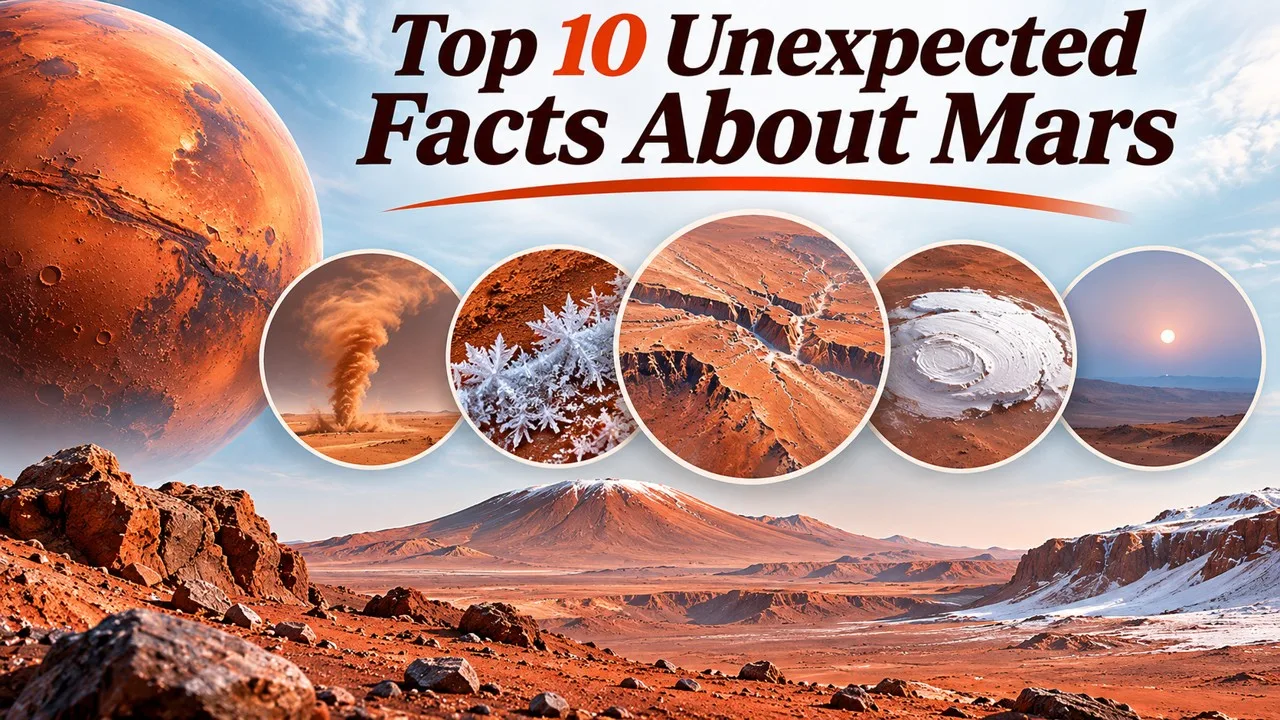
JPL engineers colored the first close-up of Mars with pastels, and a 1999 orbiter was lost to a units mix-up; a 1997 lawsuit did not give anyone the planet. Unexpected facts about Mars are a mixed genre: some are planetary, some are institutional, and some are things people have tried to do with the planet in court or on a keyboard [2][9]. A list that treats all of them as equally "weird" can still be accurate, if it corrects the details that usually travel wrong. The first close-up was colored with pastels, not crayons [10]. Dust devils can be many kilometres tall, but a single "12-mile" figure should not be treated as a surveyor's mark [3]. And aluminum from the World Trade Center flew on two rovers as a memorial, which is a fact that deserves a quiet sentence rather than a stunt [8].
A poorly documented tale of a lawyer trying for years to radio the planet is left off, in favor of a better-attested visual mistake: the "Face" in Cydonia.
Key Facts
Mars is a smaller, colder, drier world than Earth, with a thin carbon-dioxide atmosphere, and it has been explored by flybys, orbiters, landers, and rovers since the 1960s.
Ten Facts at a Glance
| Rank | Item | The careful version |
|---|---|---|
| 1 | A Mars goal in the early space age | Options were studied; the committed 1960s landing goal was the Moon |
| 2 | A 1997 lawsuit in Yemen | Three men claimed inherited ownership and accused NASA of trespass; the claim did not succeed |
| 3 | Tall dust devils | Some Martian vortices rise many kilometres, with estimates in some cases near 20 kilometres |
| 4 | The Cydonia "Face" | A mesa that looked face-like in a 1976 image is ordinary geology in later photographs |
| 5 | A musical cue on Curiosity | In 2013 the rover marked a landing anniversary with a short sequence from a lab instrument; no lyrics are quoted here |
| 6 | Mass about one-tenth of Earth's | The figure is close to 0.107 Earth masses, not a typographical "tenth" invented for a quiz |
| 7 | Olympus Mons | The volcano is enormous, but its average slopes are gentle enough that a climber might not feel a mountain |
| 8 | A memorial on two rovers | Cable guards on Spirit and Opportunity included aluminum recovered after 11 September 2001 |
| 9 | Mars Climate Orbiter | A 1999 loss after a pound-force-seconds and newton-seconds mismatch |
| 10 | Mariner 4's first picture | Engineers built a paint-by-numbers image with pastels while the official data were still coming in |
1. Mars Was Discussed; the Moon Was Chosen
Popular retellings sometimes say that President John F. Kennedy considered going to Mars before the Moon [1]. The documentary trail is more modest and more interesting. In the early 1960s, advisers and NASA officials did discuss planetary goals, including a possible human mission to Mars on a longer timetable, and later planning papers kept Mars on a list of futures [1]. The public, funded commitment that Kennedy made in 1961, and that Congress and the agency then organized around, was a landing on the Moon before the decade was out. Mars was a horizon, not the first rung that was almost selected instead.
The unexpected fact is not a secret fork in the road. It is that Mars was already in the conversation, and that the Moon was still the mission that could be argued, scheduled, and, in 1969, done.
2. A Lawsuit That Could Not Own a Planet
In 1997, as NASA's Pathfinder and Sojourner captured the public imagination, three men in Yemen, named in contemporary reports as Adam Ismail, Mustafa Khalil, and Abdullah al-Umari, filed a complaint claiming that they had inherited Mars from ancestors and that the United States was trespassing [2]. They asked, among other things, that operations stop and that the release of data be limited. News outlets treated the case as a curiosity; it did not transfer title, and it did not halt the mission [2]. International space law, including the Outer Space Treaty, does not recognize private ownership of a planet by inheritance tale.
The episode belongs on a list of unexpected facts as a legal anecdote, not as a property record.
Related: Top 25 Interesting Facts About the Solar System
3. Dust Devils Kilometres High
Mars has dust devils, spinning plumes that leave tracks on the surface and that have been photographed from orbit and from the ground [3]. Because the air is thin, a vortex can grow much taller than a typical dust devil on Earth. Estimates for some storms run to eight or ten kilometres, and some popular figures reach about twelve miles, or roughly twenty kilometres [3]. The honest statement is that Martian dust devils can be mountain-high, and that any one mileage should be read as an estimate, not a surveyed flagpole.
They are also a practical fact for engineers: dust can coat solar panels, and a passing devil has, on occasion, been credited with cleaning them.
4. A Face That Was a Trick of Light
In 1976, a Viking orbiter image of a mesa in the Cydonia region showed what, in low resolution and with a particular sun angle, looked uncannily like a human face [4]. The "Face on Mars" became a staple of speculation. Later, higher-resolution images from missions such as Mars Global Surveyor and Mars Reconnaissance Orbiter showed a natural, eroded hill with shadows and knobs, not a carved monument [4]. The unexpected fact is not that a civilization sculpted a portrait. It is how readily a poor picture and a willing eye can manufacture one.
This entry takes the place of a thinner story about a lawyer trying to raise Mars on a radio. Pareidolia has the better paper trail.
5. A Rover Marked Its Own Anniversary
In 2013, on the first anniversary of its landing, NASA used Curiosity's Sample Analysis at Mars instrument, which can click and beep as it works, to play a short musical cue often described in coverage as a birthday greeting to itself [5]. The event was a public-affairs flourish built on a real laboratory tool, not a concert, and this article will not quote lyrics or reproduce a protected melody [5]. The unexpected fact that survives the caution is technical and slightly comic: a geochemistry instrument was briefly used as a tiny, remote noisemaker, 100 million miles or more from the people who wrote the sequence.
Related: Top 10 Discoveries About Distant Worlds
It is a footnote in the mission, and a revealing one, about how a public agency talks to a public.
6. About One-Tenth the Mass of Earth
Mars has a mass close to 0.107 times that of Earth, which is why the convenient classroom fraction, one-tenth, is close enough to be useful and not close enough to be a definition [6]. Surface gravity is about 0.38 g, a different number, because gravity at the ground depends on mass and radius together [6]. The low mass is part of the reason the planet lost much of its early atmosphere and, with it, the long-term stability of surface water.
A quiz fact becomes a geological one as soon as those connections are made.
7. A Mountain You Might Not Notice
Olympus Mons is the tallest volcano, and one of the tallest mountains, known in the solar system, with a height of about 22 kilometres above the datum and a base hundreds of kilometres across [7]. Its average slopes are only a few degrees, far gentler than a typical terrestrial stratovolcano [7]. A person standing on the flank, if such a person existed, would see a rise so slow that the horizon might not announce a mountain at all. The size is the shock. The slope is the second shock, and the one that usually arrives later.
The volcano could grow so wide because Mars lacks plate tectonics of the terrestrial kind, and a hotspot can keep feeding the same edifice.
Related: Top 10 Most Bizarre Phobias: Strange Fears That Exist
8. A Quiet Memorial on Two Rovers
NASA's Jet Propulsion Laboratory has documented that the rock-abrasion tools on the Spirit and Opportunity rovers included cable shields made with aluminum recovered from the World Trade Center after the attacks of 11 September 2001 [8]. The pieces were a memorial, not a scientific instrument in themselves, and later imaging marked anniversaries of the attacks from the surface [8]. The fact is easy to turn into a clumsy boast. It is better left as what it was: a small, official act of remembrance that happens, now, to sit on another world.
This article's image brief should not turn that memorial into a flag tableau. The sentence is enough.
9. A Units Error and a Lost Orbiter
Mars Climate Orbiter, a 1998 launch intended to study weather and to relay data, was lost in 1999 during arrival at the planet [9]. An investigation found that one set of thruster data had been reported in pound-force seconds while the navigation software expected newton-seconds, a mismatch that pushed the spacecraft onto a trajectory that it did not survive [9]. The mission cost is often rounded to about 125 million dollars in contemporary figures. The unexpected fact is not that spaceflight is hard. It is that a familiar conversion, left uncaught, can destroy a spacecraft that had otherwise been built to work.
The loss became a standard lesson in engineering culture, which is the only useful afterlife of a preventable error.
Related: Top 10 Oldest Buildings in the World
10. The First Close-Up, Colored by Hand
When Mariner 4 flew past Mars in 1965 and began returning the first close-up images, the data arrived as strips of numbers [10]. At the Jet Propulsion Laboratory, engineers taped teletype printouts to a wall and colored brightness values with pastels, a paint-by-numbers portrait that could be seen before the official processed image was ready [10]. NASA still holds and describes that hand-colored print. The popular habit of calling the tools "crayons" is close and wrong. Pastels were the medium.
The picture itself, once processed, showed craters and a colder, more Moon-like Mars than many had hoped for, which is another unexpected fact: the first close look was a disappointment to the canal tradition, and a gift to modern geology.
Conclusion
Mars is strange enough in its own right, a tenth-mass world with gentle giant volcanoes and dust devils as tall as mountains, without extra invention. The human stories around it are strange in a different key: a pastel picture on a wall, a units error, a lawsuit that could not convey a planet, a memorial tucked into a rover, and a mesa that looked like a face until the resolution improved.
The corrections are part of the list. Kennedy's committed landing was the Moon. The first color-up was pastel, not crayon. A mid-crust or a birthday lyric is not required to make the planet interesting, and a radio legend is not required when Cydonia already teaches the same lesson about wanting to see a person in a rock.
- ^ [1] Historical accounts of early 1960s U.S. space-goal debates, including Kennedy's 1961 lunar commitment and later Mars planning papers. NASA History
- ^ [2] Contemporary reporting on a 1997 complaint in Yemen claiming inherited ownership of Mars, including CNN coverage. CNN, 24 July 1997
- ^ [3] NASA and scientific descriptions of Martian dust devils and their heights. NASA: Mars
- ^ [4] Later high-resolution imaging of the Cydonia mesa, showing ordinary geology rather than a carved face. NASA: Mars
- ^ [5] NASA public accounts of Curiosity's first landing-anniversary musical cue in 2013, described here without lyrics. NASA: Curiosity
- ^ [6] Planetary fact sheets for Mars mass, radius, and surface gravity. NASA planetary fact sheet
- ^ [7] Descriptions of Olympus Mons, its height, basal width, and shallow slopes. NASA: Mars
- ^ [8] JPL, "Tributes to Terrorism Victims are on Mars," on World Trade Center aluminum in Spirit and Opportunity cable guards. JPL
- ^ [9] NASA mishap investigation of the 1999 Mars Climate Orbiter loss and the pound-force-seconds versus newton-seconds error. NASA history of Mars Climate Orbiter
- ^ [10] NASA Science, "Pastels Used for the First TV Image" and "First TV Image of Mars (Hand Colored)," on the Mariner 4 pastel reconstruction. NASA Science





















Discussion
Log in with