






 By
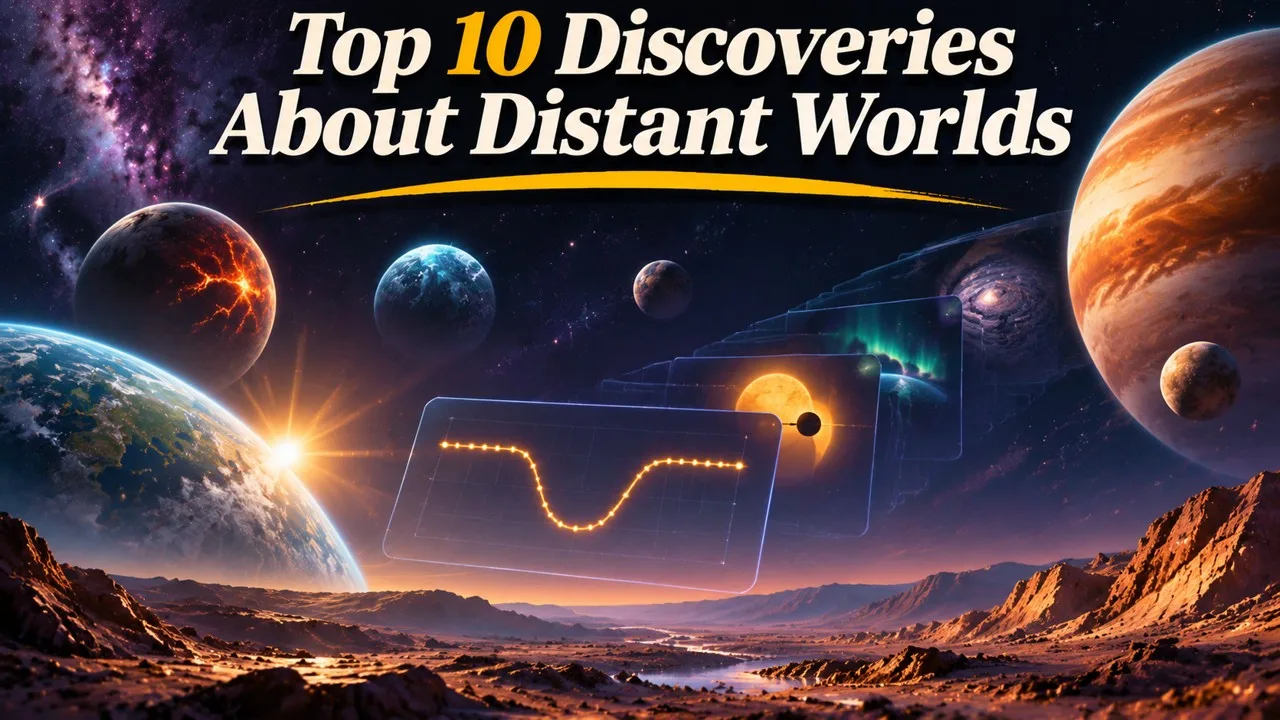
JWST has sharpened views of auroras and odd worlds, but a claimed biosignature on one sub-Neptune remains contested and is not evidence of life. The past few years have been rich in actual results: infrared images of Jupiter's auroras, dusty tails from planets that are coming apart, free-floating worlds, and a closer look at Mercury's poles [1][2][4]. They have also been rich in headlines that run ahead of the data. A possible mid-crust reservoir on Mars is not a mapped subterranean sea, and a tentative signal in the atmosphere of K2-18b is not a detection of organisms [8][10].
This list keeps those distinctions. The ten items are real observations or real debates, written so that the strongest claims are the ones the papers can actually bear.
Key Facts
A "distant world" here may be an exoplanet, a rogue planet, or a body in the solar system that is still being revealed by new instruments.
Ten Findings at a Glance
| Rank | Subject | What is reasonably established | What is not |
|---|---|---|---|
| 1 | Jupiter's auroras in infrared | JWST has resolved bright, changing auroral emission | A postcard is not a complete magnetospheric theory |
| 2 | Planets and planetesimals coming apart | Some ultra-short-period worlds shed dusty tails as they disintegrate | Every odd light curve is not a dying planet |
| 3 | Rogue, or free-floating, planets | Microlensing and direct imaging find worlds without a host star | The mass of every faint free-floater is not settled |
| 4 | Mercury's poles | Ice sits in permanently shadowed craters; new flybys have imaged the region | The ice is not a polar ocean |
| 5 | WASP-76b and metal in the air | A well-known ultra-hot Jupiter shows evidence for vaporized metals and nightside condensation | "Iron rain" is a useful shorthand, still being refined |
| 6 | Storms on Uranus and Neptune | Ice-giant storms can appear and fade faster than some Jovian counterparts | The full dynamical explanation is still being modeled |
| 7 | Planets still growing in disks | PDS 70's young planets are a benchmark for infancy | Not every disk bright spot is a planet |
| 8 | Water in the Martian crust | One 2024 seismic interpretation infers a deep, water-saturated layer | That is not a confirmed underground ocean |
| 9 | Uranus through Hubble | Long-term images track clouds, seasons, and composition | "Volatile gases swarming" is not a technical description |
| 10 | A claimed biosignature on K2-18b | Methane is robustly reported; a DMS signal is not | This is not evidence that the planet hosts life |
1. Jupiter's Auroras, Sharpened
The James Webb Space Telescope has produced infrared views of Jupiter's auroras that show structure and variability at a precision earlier facilities could not routinely match [1]. The glow is not a painted curtain. It is emission from a magnetosphere driven by the planet's rotation, its volcanic moon Io, and the solar wind, and the new images have been used to study how the lights change with time and with wavelength [1]. The pictures are spectacular, as the headlines said. Their scientific use is quieter: better constraints on energy, chemistry, and the shape of the upper atmosphere.
A telescope image can be both beautiful and quantitative. This is one of the cleaner examples, and it does not depend on a speculative biosignature to be worth describing.
2. Worlds That Are Falling Apart
A small class of ultra-short-period objects, including the Kepler-discovered worlds often cited as Kepler-1520b and K2-22b, show transit light curves that vary as if a tail of dust were trailing a body that is losing mass [2]. The picture is a planet, or a large remnant, skimming so close to its star that rock vaporizes or crumbles and the debris spreads along the orbit [2]. New candidates have continued to appear in later surveys, which is why "a dying planet falling apart in orbit" is a recurring, and sometimes accurate, announcement.
The category is real. Any single new name still has to survive the test of a repeatable, dusty transit, not only a dramatic press release.
Related: Quasars: Distant Beacons or Local Oddballs?
3. Planets without a Sun
Rogue planets, more formally free-floating planetary-mass objects, have been found by gravitational microlensing and, increasingly, by direct imaging in young star-forming regions [3]. JWST and other surveys have added faint, isolated objects that appear to have formed like planets, or like the low-mass end of failed stars, and then been left without a host, or never to have had one [3]. They do not "glide" in a science-fiction sense. They follow orbits around the Galaxy, and they are hard to weigh.
The census is growing, and it is messy at the boundary with brown dwarfs. That mess is part of the discovery, not a reason to ignore it.
4. Mercury's North Pole, in Close-Up
MESSENGER established that Mercury hides water ice in permanently shadowed craters near the poles, a result that still surprises people who think of the planet as a furnace [4]. More recently, the BepiColombo mission has returned close flyby images of the northern terrain, giving a sharper look at the geography that makes those cold traps possible [4]. The ice is radar- and neutron-bright in the shadows, mixed with dark organic-looking material in some deposits, and it is not a sea.
The "stunning snaps" are a means of studying a real polar climate on a world without an atmosphere worth the name.
5. An Extreme World and Metal Rain
WASP-76b is an ultra-hot Jupiter whose dayside is hot enough to vaporize metals. A 2020 study, and later follow-up, reported atomic iron, and perhaps other metals, in the atmosphere, with a picture of vapor rising on the day side and condensing on the cooler night side, a process popularly called iron rain [5]. Subsequent papers have refined which species are present and how the signal should be interpreted, which is normal for a difficult high-resolution spectrum [5]. The planet remains one of the best illustrations that "weather" on an exoplanet can involve materials that are rocks on Earth.
Related: Top 25 Interesting Facts About the Solar System
The shorthand is fair if the reader hears "condensation of vaporized metal," not a medieval downpour of molten coins.
6. Short-Lived Storms on the Ice Giants
Uranus and Neptune show storms and bright cloud features that can rise and fade on timescales shorter than the long-lived ovals for which Jupiter is famous [6]. Hubble monitoring, and more recently JWST infrared views, have tracked these outbreaks and the unusual seasons of Uranus, whose spin axis lies nearly in its orbital plane [6]. Why the storms are so relatively short-lived is still a research question: models point to the ice giants' different heat budgets, composition, and layered convection, but a single tidy mechanism is not yet a textbook law.
The planets are not bland, and they are not Jupiter's twins. That intermediate fact is the discovery.
7. Planets in Their Infancy
The young star PDS 70 hosts at least two giant planets still sitting inside a disk of gas and dust, a system that has become the benchmark for a world caught mid-formation [7]. The planets have been imaged directly, and they show signs of ongoing accretion, which is as close as astronomy now comes to watching infancy rather than inferring it from a finished orbit [7]. Other disks have candidate protoplanets, some of them still debated. PDS 70 remains the case that can be described without a long apology.
A newborn world, in this sense, is not a metaphor. It is a planet that has not finished growing.
Related: The Eight Planets Compared: Size, Gravity, Days and Moons
8. Water under Mars, Perhaps
In 2024, a team using seismic data from NASA's InSight lander argued that a layer in the mid-crust of Mars, many kilometres down, has properties consistent with water-saturated fractured rock [8]. If the interpretation holds, it would be a large reservoir, and it would matter for the planet's history and for any deep habitability discussion. It would not be a cavern of open ocean, it is not something a rover can drill, and it is not agreed in full by every planetary scientist who has looked at the same limited seismic record [8].
"Mars could be hiding a vast ocean" is a headline that outruns the paper. A possible deep, wet layer, inferred from speed of sound in rock, is the claim that can be defended, and only as a claim still under review.
9. Hubble's Long Look at Uranus
The Hubble Space Telescope has spent years watching Uranus as the planet has moved through seasons that last for decades, recording changing polar hoods, storms, and the makeup of a cold hydrogen-helium atmosphere spiked with methane and other ices [9]. Complementary JWST images have added a mid-infrared and reflected-light richness that Hubble alone could not supply, but Hubble's time baseline remains the reason we can talk about change rather than a single portrait [9]. "Volatile gases swarming" is not how the papers put it. Circulation, composition, and seasonal photochemistry are.
The planet is still yielding details, which is the modest, accurate version of a "new insight."
Related: Top 10 Famous Impact Craters on Earth
10. A Biosignature That Has Not Held Up
K2-18b, a sub-Neptune in the so-called habitable zone of a cool star, became a public story when a team reported carbon dioxide and methane in JWST transmission spectra and suggested a tentative detection of dimethyl sulfide, a gas that on Earth is associated with life [10]. Independent reanalyses, including work gathered in 2025 and 2026, have argued that the DMS, and related DMDS, signal is not statistically robust and depends on reduction choices and model assumptions; methane is the safer detection, and the planet does not meet ordinary standards of evidence for a biosignature, let alone for life [10]. Chemistry without biology can also, in principle, produce unusual gases.
This entry is on the list because the episode is now part of how the field talks about distant worlds, not because life has been found. The honest sentence is the dull one: a claimed hint was published, and later work has not confirmed it. That is a successful scientific process, even if it is an unsuccessful biosignature, and it is the standard this article is willing to apply.
Conclusion
Distant worlds are no longer only dots. We have infrared auroras on Jupiter, dusty tails on planets that are coming apart, ice in Mercury's shadows, metals in the air of an ultra-hot Jupiter, and young planets still feeding in a disk. Those are solid gains, and they do not need a biosignature to matter.
The two soft spots on this list are instructional. A seismic hint of deep water on Mars is a hypothesis about rock pores, not a cruise-ship ocean. A contested gas on K2-18b is a case study in how not to declare life. Astronomy will find better stories than either headline. Some of them, from dusty dying worlds to a planet still growing in its disk, are already above.
- ^ [1] NASA and ESA releases and papers on JWST imaging of Jupiter's auroras. NASA: James Webb Space Telescope
- ^ [2] Studies of disintegrating ultra-short-period planets, including Kepler-1520b and K2-22b, and their variable dusty transits. NASA Exoplanet Exploration
- ^ [3] Reviews of free-floating planets from microlensing and JWST imaging surveys of star-forming regions. NASA Exoplanet Exploration
- ^ [4] MESSENGER results on polar ice at Mercury, and BepiColombo flyby imaging of the northern polar region. NASA: Mercury
- ^ [5] Ehrenreich, D. et al., 2020, and later spectroscopic studies of WASP-76b's metal-rich atmosphere. ESO: WASP-76b
- ^ [6] Hubble and JWST monitoring of storms and seasons on Uranus and Neptune. NASA: Uranus
- ^ [7] Direct imaging and accretion studies of the planets around PDS 70. NASA Exoplanet Exploration
- ^ [8] Wright, V., Morzfeld, M. and Manga, M., 2024, and related discussions of a possible water-saturated mid-crust on Mars inferred from InSight seismology. NASA: InSight
- ^ [9] Hubble Space Telescope programs on the atmosphere and seasonal change of Uranus. NASA: Hubble
- ^ [10] Independent reanalyses of K2-18b JWST spectra arguing that claimed DMS and DMDS features are not a robust biosignature; see also the original Madhusudhan and colleagues reports for the claim being tested. NASA Exoplanet Exploration

















Discussion
Log in with