





 By
Researchers have fermented miso in orbit and found 2,000-year-old spices in Vietnam; lab-grown liver pate is a study result, not a menu item. Food is an unusually convenient laboratory: everyone already knows the ingredients, and the results can be photographed. That convenience is also a hazard. A paper that models pasta or pizza under a narrow set of assumptions is not a discovery of the "perfect" recipe, and a cultured-liver project is a piece of research and a commercial bid, not a verdict on dinner [2][9]. The ten experiments and analyses below are real. The advertising language that sometimes travels with them is not.
Where a study is modest, the entry stays modest.
Key Facts
These items are laboratory, field, or archaeological results that happen to involve food. They are not cooking advice, medical advice, or product endorsements.
Ten Studies at a Glance
| Rank | Work | What was actually shown | What it is not |
|---|---|---|---|
| 1 | A gene-edited banana that browns more slowly | Editing can reduce the browning enzyme pathway in a commercial banana | A promise that every bunch in every market is already this cultivar |
| 2 | A "perfect pasta" study | Physicists can optimize a few variables, such as water and starch behavior, under stated conditions | A single recipe that ends argument in every kitchen |
| 3 | Miso fermented on the space station | A 30-day batch in orbit was safe, recognizable, and chemically distinct | Proof that all cuisine should move to orbit |
| 4 | Aeration and flavor | Opening the mouth changes airflow and can alter retronasal aroma | A rule of manners, or a law that all food tastes better that way |
| 5 | Fats made from carbon dioxide | Labs and companies have reported butter-like fats from CO2 pathways | A supermarket staple in every country |
| 6 | A "perfect pizza" equation | A model can formalize heat, thickness, or toppings under assumptions | A closed form for every oven |
| 7 | Yogurt and garlic breath | Dairy proteins and fats can bind some sulfur volatiles in tests | Medical advice or a guarantee at the table |
| 8 | Taste-aversion memories in mice | The brain can tag a food with later illness and avoid it later | A full map of every human food-poisoning memory |
| 9 | Cultured liver tissue in the foie gras style | Researchers have grown liver cells as a pâté-like product | An ethical or culinary endorsement |
| 10 | Spices on tools from Óc Eo, Vietnam | About 2,000-year-old residues include a curry-like set of spices | A claim that "curry" had a single birthplace and date |
1. A Banana Edited against Browning
A cut banana browns because enzymes, especially polyphenol oxidase, oxidize phenolic compounds in the flesh [1]. Gene-edited cultivars, including work associated with companies such as Tropic, have been developed to slow that pathway so that the fruit stays paler after bruising or slicing [1]. Regulatory reviews in some countries have treated certain of these edits as not requiring the same process as older transgenic crops, which is a legal fact, not a claim that the biology is trivial.
The experiment is agricultural, not culinary magic. The banana is still a banana. It simply keeps a color that shoppers have been trained to read as freshness, for longer than an unedited fruit would, which is a modest change with a large effect on waste and on the look of a market stall.
2. Pasta, Optimized under Assumptions
Physicists and food scientists have published studies that treat a pot of pasta as a heat-and-starch problem: how water moves, how starch gelatinizes, and which ratios or methods reduce stickiness or waste [2]. Some of those papers have been promoted as a discovery of the "perfect" recipe. The honest version is narrower. A model or a controlled kitchen test can find a local optimum for time, salt, or water volume under the conditions the authors set [2]. It cannot close the book on taste, wheat variety, or the habits of a household.
The useful result is that a familiar dinner can be measured. The unuseful result is a headline that ends the argument.
3. Miso That Fermented in Orbit
Researchers fermented miso, the salted soybean paste, aboard the International Space Station for about 30 days and compared it with control batches on Earth [3]. The orbit-made paste was safe and recognizable as miso, and it had a distinct chemical and flavor profile, often described as nuttier or more roasted, with differences in microbes and in the mutations carried by koji mold [3]. Temperature and the station environment appear to have mattered; the point was not that space "improves" food in a general way.
Related: Top 10 Reasons Popular Foods Taste the Way They Do
Fermentation is a living process. Taking it off the planet is a way to ask which parts of that process depend on ordinary gravity, radiation, and a kitchen's ambient heat.
4. Airflow Changes What You Taste
Much of what people call taste is retronasal smell: aroma compounds reaching the nose from the back of the mouth [4]. A study, and a set of related sensory papers, has argued that eating with the mouth more open, or otherwise changing how air moves through the mouth, can change the intensity or quality of that aroma [4]. The finding is about physics and perception. It is not a commandment to abandon table manners, and it does not hold for every dish or every person.
If a result needs a caveat this large, it still may be worth reporting. It just should not be sold as a life hack with a single arrow.
5. Butter-Like Fat from Carbon Dioxide
Laboratories and start-up companies have reported making edible, butter-like fats from carbon dioxide, hydrogen, and a chemical or microbial pathway, rather than from a cow [5]. The attraction is a fat that might be produced with a smaller agricultural footprint, if the energy source and the scale ever support that claim [5]. The chemistry can be real in a reactor and still be far from a widely available staple. "Scientists create butter from carbon dioxide" is a fair popular sentence only if the reader hears "a demonstrated pathway," not "the dairy aisle has changed."
This article is not an investment note. It is a record that the pathway has been shown at least in laboratories and pilot systems.
Related: Top 10 Most Dangerous Science Experiments in History
6. Pizza, Reduced to a Model
The same impulse that produces a pasta paper has produced models of pizza: heat transfer in an oven, the thickness of a crust, the moisture of a topping, sometimes written as an equation and promoted as the "perfect" pie [6]. A model can be clarifying, especially as an educational physics exercise. It becomes misleading when the equals sign is treated as a chef's certificate. Ovens differ, flour differs, and preference is not a constant [6].
The entry is here because the work exists and because it is a good example of a food experiment that needs its humility restored.
7. Yogurt and the Chemistry of Garlic Breath
Garlic leaves behind sulfur-containing volatiles that linger in the mouth and, as they are absorbed and exhaled, on the breath [7]. Food-chemistry tests have found that yogurt, and especially some of its proteins and fats, can bind or reduce some of those compounds in the laboratory, which is the modest basis for the claim that yogurt is "the best way" to fight garlic breath [7]. "Best" is a comparative word that depends on what else was tested. The mechanism, binding of smelly molecules, is the part that can be repeated.
No one should read this as dental or medical advice. A cup of yogurt is not a therapy, even if it is a reasonable subject for a chromatograph.
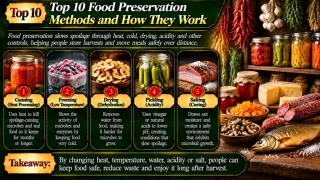
Related: Top 10 Food Preservation Methods and How They Work
8. Why a Bad Meal Can Last in Memory
Conditioned taste aversion, the tendency to avoid a food that was followed by illness, is a classic finding in psychology and neuroscience, and it is unusually strong: it can form after a single pairing and across a delay [8]. Recent mouse studies have traced more of the brain circuitry that stores that association, including work on how a vivid, lasting food-poisoning memory is assigned to a taste [8]. The leap to every human anecdote should be made carefully. The leap to "this is why a night of food poisoning can haunt a flavor" is, in outline, justified.
The experiment uses food, but it is a memory experiment. That is why it belongs with unusual science, not with recipes.
9. Liver Tissue Grown in a Lab
Teams working on cultivated meat have reported growing duck or other liver cells into a pâté-like product intended to resemble foie gras, without force-feeding a bird [9]. The work sits at a junction of tissue engineering, start-up claims, and a long animal-welfare argument about traditional foie gras [9]. This article records the research as a food experiment, not as a purchase recommendation, and not as a settlement of the welfare debate. Taste claims and scale-up claims should be read as claims.
A liver cell that divides in a tank is a biological fact. A replacement for a luxury dish is a market story still being tested.
Related: Top 10 Most Bizarre Phobias: Strange Fears That Exist
10. A 2,000-Year-Old Spice Board in Vietnam
At Óc Eo, in southern Vietnam, researchers led by a team reporting in Science Advances in 2023 identified a set of spice microremains on grinding tools dated to about 2,000 years ago, including turmeric, ginger, fingerroot, galangal, clove, nutmeg, and cinnamon [10]. The combination looks, to a modern cook, like a curry, and the authors used that word as a fair, if slightly anachronistic, shorthand for a mixed, traded, aromatic paste [10]. The find is evidence of long-distance spice trade into Southeast Asia, not a single inventor of a dish, and not a leftover bowl still steaming.
Archaeology is an unusual science experiment only in the sense that the kitchen closed centuries ago and the instruments still found the spices. A grinding stone is not a recipe card, but it can preserve the shopping list, which is more than most modern kitchens will leave behind.
Conclusion
Food science is at its best when it keeps the adjective "perfect" out of the title. A gene edit can slow a banana's browning. A pot of miso can ferment in orbit and come back chemically distinct. A grinding stone in Vietnam can still carry turmeric and clove. A mouse can teach us how a sick night becomes a lasting aversion. Those are results.
A modeled pasta or pizza, a yogurt test, a carbon-dioxide fat, and a cultured liver are results too, of a more provisional kind. They belong on the list if they are described as what they are: optimizations, pathways, and prototypes. They do not belong if they are allowed to sound like the last word on dinner, or like a substitute for a meal that already has a history, a market, and a set of arguments attached.
- ^ [1] Public descriptions of gene-edited, reduced-browning bananas and the polyphenol oxidase pathway. Britannica: Banana
- ^ [2] Physics and food-science papers that model or optimize pasta cooking variables under stated conditions. Britannica: Pasta
- ^ [3] Studies of miso fermented aboard the International Space Station, including 2024-2025 reports on flavor and microbial differences. NASA: International Space Station
- ^ [4] Sensory-science work on retronasal aroma and how oral airflow changes flavor perception. Britannica: Taste
- ^ [5] Laboratory and company reports of butter-like edible fats produced from carbon dioxide pathways. Britannica: Carbon dioxide
- ^ [6] Educational and research models of pizza heat transfer and geometry, described here as models, not as a unique perfect recipe. Britannica: Pizza
- ^ [7] Food-chemistry tests of yogurt and other dairies binding garlic sulfur volatiles. Britannica: Garlic
- ^ [8] Classic and recent work on conditioned taste aversion and its neural basis in mice. Britannica: Learning
- ^ [9] Research reports on cultivated liver tissue intended as a foie gras-style product, summarized here as research, not as an endorsement. Britannica: Foie gras
- ^ [10] 2023. "Earliest curry in Southeast Asia and the global spice trade 2000 years ago." Science Advances, on spice residues from Óc Eo, Vietnam. Science Advances




















Discussion
Log in with