






 By
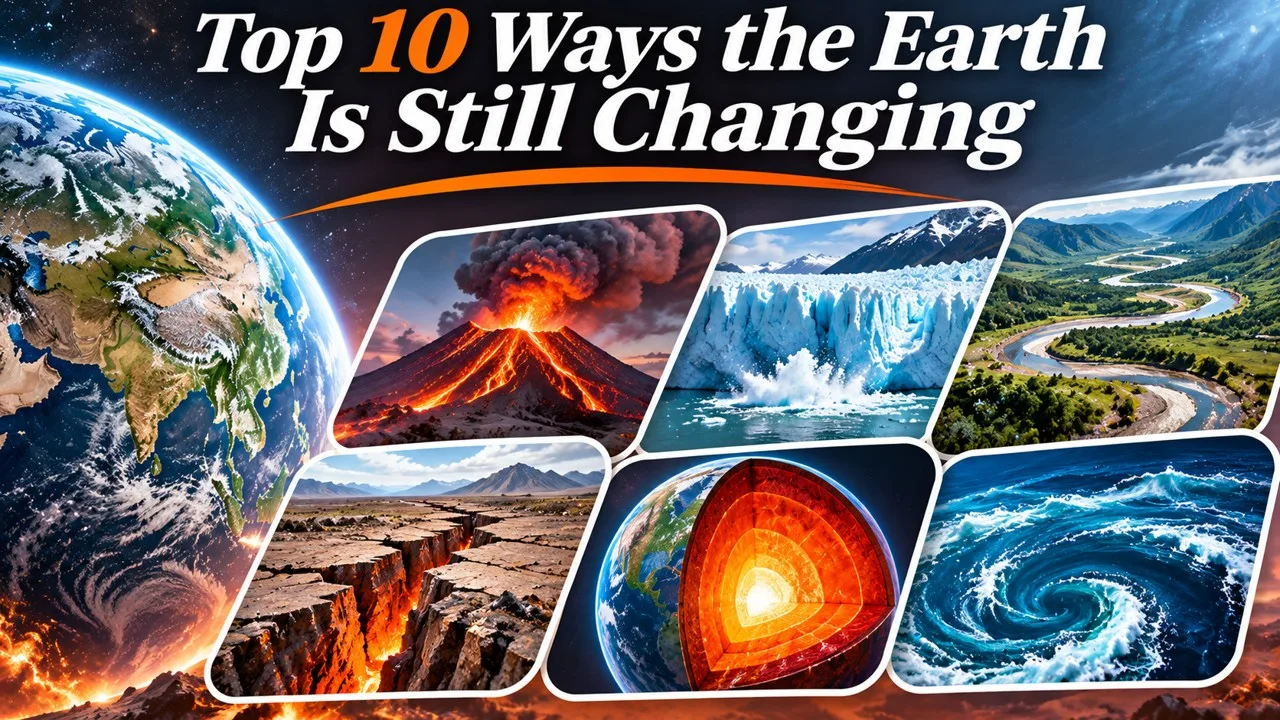
The magnetic field, ocean currents, East Africa's rift and even the length of a day are still changing, with evidence from satellites, rocks and clocks. The planet is not a finished object. Some of the changes below are geological and slow. Others, including the energy imbalance at the top of the atmosphere and a measured rise of land in South Africa, are tied to a warming climate or to the loss of water [4][8]. This list is a curated set of ten documented processes, not a forecast of sudden catastrophe, and not a claim that every headline about "the Earth evolving" is equally solid.
Where researchers still disagree — for example, how much of southern Africa's uplift is drought and how much might still be mantle support — the disagreement is part of the entry [8].
Key Facts
"Still changing" here means a process that can be measured now, or in the recent instrumental record, not a just-so story about the deep past.
Ten Ongoing Changes at a Glance
| Rank | Process | What is measured | What remains open |
|---|---|---|---|
| 1 | Weakening of the magnetic field, especially in the South Atlantic | Satellite and observatory records of field strength | Whether a reversal is underway (there is no good evidence that one is imminent) |
| 2 | Changes in the polar vortex | Winter stratospheric and tropospheric patterns | How much of the shift is forced by warming and ozone recovery |
| 3 | A weakening tendency in the Atlantic overturning | Ocean arrays, models, and paleoclimate context | The rate of future decline, and whether a collapse is likely this century |
| 4 | Motion of the magnetic and geographic poles | Compass and satellite data; motion of the spin axis | How ice and water mass will keep moving the axis |
| 5 | Continental rifting in East Africa | Geology, seismicity, and widening measurements | When, in geologic time, a new ocean would actually open |
| 6 | New kinds of rock from human waste | Plastiglomerate and other anthropogenic stones | How widely they will enter the formal rock record |
| 7 | A rising Earth energy imbalance | Satellite and in situ heat inventories | The exact mix of forcing and feedback in each year |
| 8 | Land uplift in South Africa | GPS heights, compared with drought and water storage | The share of uplift from water loss versus longer-term mantle support |
| 9 | A core "leak" into some plume lavas | Ruthenium and tungsten isotopes in Hawaiian basalts | How much metal, including gold, actually travels with that signal |
| 10 | Small changes in the length of the day | Atomic clocks and Earth-rotation measurements | How to separate tides, climate, and the fluid core |
1. A Weakening Magnetic Field
Earth's magnetic field, generated in the liquid outer core, is not constant. Observatory and satellite records, including the European Space Agency's Swarm mission, show a continuing decline in dipole strength over the past century and a persistent weak region over the South Atlantic, the South Atlantic Anomaly, where radiation belts dip closer to the planet [1]. The decline is sometimes described, wrongly, as proof that a polarity reversal is at the door. Reversals have happened in the geologic past; the present weakening, on its own, does not establish that one is underway or imminent [1].
The field is still changing, and it still matters, especially for satellites that pass through the anomaly. The useful fact is the measurement, not a movie about compasses flipping next year.
2. The Polar Vortex Is Not Fixed
The polar vortex is a large cyclonic circulation in the winter stratosphere, with effects that can descend into mid-latitude weather [2]. In recent decades, researchers have documented changes in its strength, position, and tendency to be disturbed, and they have tried to connect those changes to Arctic warming, to the state of the ozone layer, and to tropical and oceanic forcing [2]. The public phrase "the vortex is shifting" is often looser than the papers. A careful version is that the winter circulation is variable, that some of that variability is changing, and that mid-latitude cold outbreaks can follow a disrupted vortex without the vortex itself being a simple on-off switch.
The atmosphere is still rearranging its winter machinery. That is an ongoing change, and it is also an active research problem, not a finished slogan.
Related: Top 25 Interesting Facts About Earth
3. The Atlantic Overturning
The Atlantic Meridional Overturning Circulation, which includes the Gulf Stream system in the popular mind but is a deeper, basin-scale conveyor of heat and salt, has been measured directly by mooring arrays and estimated from longer temperature and salinity records [3]. Several studies find a weakening relative to the twentieth century or to earlier centuries, consistent, in models, with added freshwater and a changing surface heat budget in the North Atlantic [3]. A complete shutdown in the near term is not a consensus forecast, and some of the longer reconstructions remain debated.
The current is not a myth, and it is not guaranteed to stay as it was in the late twentieth century. "Declining" is a fair word only when it is tied to a time span and a method, which is why the arrays matter.
4. Poles That Wander
Two different "poles" are on the move. Magnetic north, the direction a compass seeks, has been drifting rapidly from the Canadian Arctic toward Siberia, a change that has already forced updates to navigation models [4]. Separately, the Earth's spin axis, and the geographic pole where that axis meets the crust, wander by meters as mass is rearranged by ice melt, groundwater, and the solid Earth [4]. Recent work has shown that the climate-driven part of that polar motion is now large enough to measure.
Neither motion is a sign that the planet is about to tip over. Both are signs that the interior and the surface are still redistributing mass and magnetism, and that a "fixed pole" is a convenience, not a physical fact.
5. A New Ocean, on Geologic Time
In the Afar region and along the East African Rift, the African plate is splitting, with volcanism, faulting, and measured extension that, if it continues, will eventually let the sea into a new ocean basin [5]. The process is a textbook example of continental rifting. It will not produce a new Atlantic next decade. It is, however, happening now, in the sense that earthquakes, dikes, and widening can be recorded in a human lifetime [5].
Related: Top 10 Most Active Volcanoes in the World
The "new ocean forming" headline is geologically fair and journalistically impatient. The change is real. The timetable is the Earth's, not a news cycle's.
6. Rocks Made with Waste
On a Hawaiian beach, and later in other places, researchers have described plastiglomerate: a stone in which melted plastic has bound together sand, rock, and debris, a material that can only form in a world with discarded polymers and a heat source, often a fire [6]. Other anthropogenic "rocks" and mineral-like materials have been catalogued in the same spirit, as candidates for a human layer in the geologic record [6]. They are not a replacement for granite. They are a new kind of clastic or composite stone, made with industrial waste.
The Earth is still making rocks. Some of the newest ones include plastic, which is a change in kind, not only in rate.
7. A Growing Energy Imbalance
Satellites that measure incoming and outgoing radiation, together with ocean heat inventories, show that Earth is taking in more energy than it emits, and that this energy imbalance has increased in the early twenty-first century [7]. The surplus goes mainly into the ocean. It is one of the cleanest ways to say that the climate system is still accumulating heat, consistent with the rise in greenhouse gases and with observed warming [7].
"Soaring" is a headline word. The papers speak of a rising imbalance and of the difficulty of attributing every year-to-year jump. The direction of the change, over the satellite era, is not in serious doubt.
Related: The Science Behind Auroras: How Solar Winds Create Colorful Skies
8. South Africa's Rising Land
GPS stations across South Africa have recorded a spatially coherent uplift, on the order of several millimeters over the 2010s, a signal once often attributed mainly to mantle flow and dynamic topography beneath the plateau [8]. A 2025 study in the Journal of Geophysical Research: Solid Earth, led by researchers including Christian Mielke and Makan Karegar, argued that drought-related loss of groundwater and surface water can explain much of the recent rise: remove the water's weight, and the crust rebounds elastically [8]. The paper compared GPS heights with GRACE-based water storage and hydrological models and found a strong geographic and temporal match with drought.
The older mantle hypothesis has not been abolished by one paper, and longer records will be needed to separate a drought bounce from a slower geodynamic lift. What has changed is the leading explanation for the recent millimeters, and it is a climate and water story as much as a deep-Earth one.
9. A Leak from the Core
Most of Earth's gold and other highly siderophile metals are thought to sit in the metallic core. In 2025, Nils Messling, Matthias Willbold, and colleagues reported in Nature that Hawaiian basalts carry a ruthenium isotope signature, together with tungsten isotopes, that is best explained by a small contribution of core material to a mantle plume [9]. Gold was not weighed in the lavas as a bullion bar; it is expected, on chemical grounds, to travel with other highly siderophile metals if core material is entrained. The amounts involved would be tiny [9].
The finding is a change in how some plumes may be thought of, and it remains a new, still-discussed result, not a mine map. "The core is leaking gold" is a fair popular sentence only if the reader hears "isotopic traces in Hawaiian lava," not "a river of metal."
Related: Top 25 Interesting Facts About the Solar System
10. The Day's Changing Length
Over geologic time, Earth's rotation has been slowing because of tidal friction, which is why a day is much longer now than it was in the Precambrian [10]. In the instrumental era, atomic clocks show that the length of the day also wobbles: the atmosphere, ocean, ice sheets, groundwater, and the fluid core all exchange angular momentum with the crust. In some recent years, climate-related mass shifts have even produced unusually short days, against the long tidal trend, a fact that has required careful accounting in timekeeping [10].
"Spin accelerating" is therefore only true in a qualified sense, for certain intervals, not as a new law of the planet. The deeper point is sharp enough: human-driven changes in ice and water are now large enough to show up in the rotation of the Earth, alongside much older, slower engines.
Conclusion
The Earth of the textbooks was always a moving object. What is new is the resolution: satellites that watch the magnetic field and the radiation budget, GPS that sees millimeters of drought uplift, isotope labs that can test a core leak, and clocks that notice a fraction of a millisecond in the length of a day. Some of these changes are ancient processes still at work. Some are the planet responding to a human energy imbalance and to water that is no longer where it was.
A responsible list keeps those categories distinct, and it keeps uncertainties in view. The field is weakening, but a reversal is not scheduled. The Atlantic conveyor shows signs of change, but not a dated collapse. South Africa has risen, and a 2025 paper says water is the main recent reason. Those are still changes. They are also still science in motion.
- ^ [1] ESA Swarm mission pages and overviews of the South Atlantic Anomaly. ESA: Swarm
- ^ [2] Reviews of the stratospheric polar vortex and its tropospheric links. Encyclopaedia Britannica. Britannica: Polar vortex
- ^ [3] RAPID and related arrays; reviews of Atlantic Meridional Overturning Circulation change. Britannica: Ocean current
- ^ [4] British Geological Survey and NOAA updates on magnetic north; studies of climate-driven polar motion. British Geological Survey: Geomagnetism
- ^ [5] "East African Rift System" and the Afar depression. Encyclopaedia Britannica. Britannica: East African Rift System
- ^ [6] Corcoran, P.L., Moore, C.J. and Jazvac, K., on plastiglomerate, and later catalogs of anthropogenic materials. Wikipedia: Plastiglomerate
- ^ [7] NASA and NOAA accounts of Earth's energy imbalance and ocean heat content. NASA: Earth climate
- ^ [8] Mielke, C.A., Karegar, M.A., Gerdener, H. and Kusche, J., 2025. "GNSS Observations of the Land Uplift in South Africa: Implications for Water Mass Loss." Journal of Geophysical Research: Solid Earth. JGR: South Africa uplift
- ^ [9] Messling, N. et al., 2025. "Ru and W isotope systematics in ocean island basalts reveals core leakage." Nature. Nature: Core leakage
- ^ [10] IERS and reviews of length-of-day variations, including climate and hydrological contributions. International Earth Rotation and Reference Systems Service





















Discussion
Log in with