




Top 20 Ossuaries and Chapels Decorated With Human Bones
 By Dhiraj Sharma · Published
Share Post
Loading…
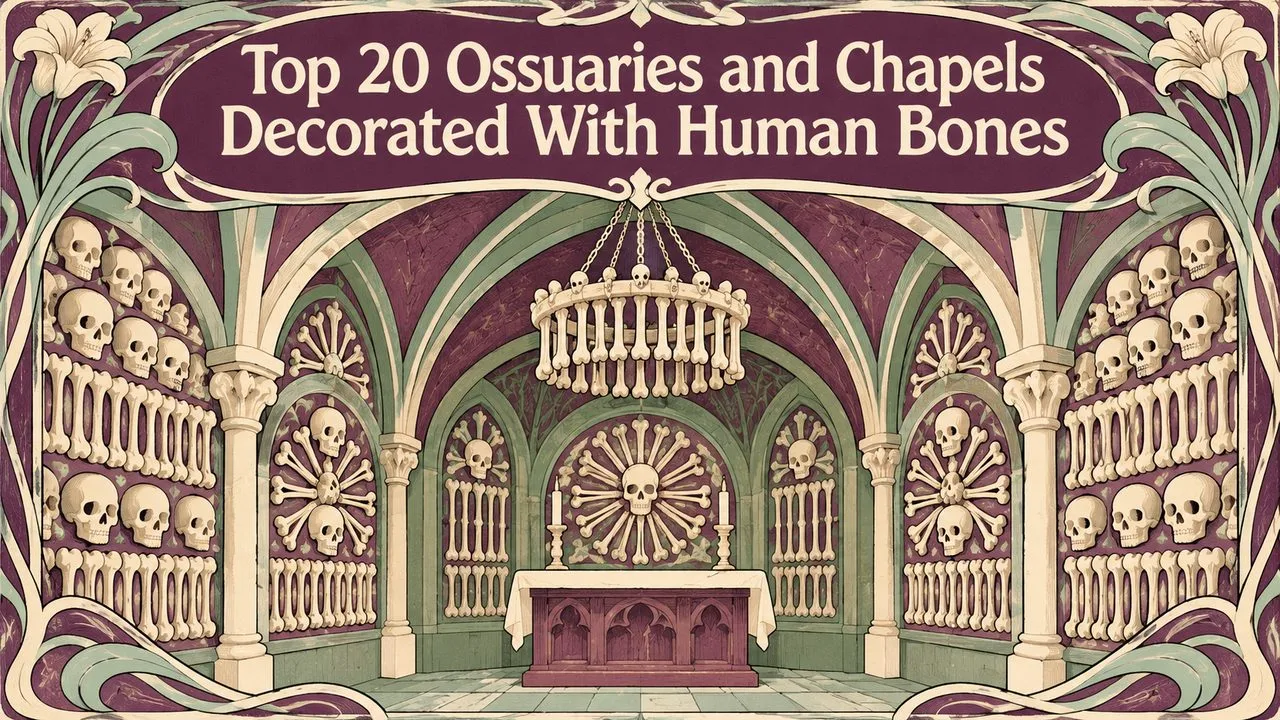
From Kutná Hora to Lima, these twenty ossuaries and chapels turned human bones into walls, chandeliers and quiet lessons about the shortness of life. Across Europe, crowded churchyards once forced parishes to dig up old graves and find somewhere to keep the remains. Most ended up in plain charnel houses, but a few communities chose to arrange skulls and long bones into patterns, altars and even lettering, so that the living would pause and think about death.
These places can look macabre to modern visitors, yet most were built as acts of care rather than shock. They kept the remains of plague victims, soldiers, friars and ordinary townspeople together on consecrated ground, and many are still working churches where prayers for the dead are said today.
For this Finepedia list we chose sites where the bones are visible and deliberately arranged, or where the scale of the collection is exceptional, and we checked each figure against the site's own information and at least one independent source. Estimates of the number of people involved vary widely, so the numbers below are rounded and should be read as approximate. The twenty entries run from England, Spain and Portugal to Serbia, Czechia, Poland, Austria, France, Germany, Italy and even Peru, and they include two war memorials alongside the parish ossuaries.
Key Facts
The table below gives a quick overview of all twenty entries before each one is described in detail.
| # | Site | Location | Estimated remains | Signature feature |
|---|---|---|---|---|
| 1 | Sedlec Ossuary | Kutná Hora, Czechia | 40,000 to 70,000 people | Bone chandelier and coat of arms |
| 2 | Capuchin Crypt | Rome, Italy | About 3,700 to 4,000 friars | Rooms of patterned bones beneath a church |
| 3 | Capela dos Ossos | Évora, Portugal | About 5,000 people | Bone-covered pillars and a warning over the door |
| 4 | Skull Chapel of Czermna | Kudowa-Zdrój, Poland | About 24,000 to 30,000 people | Walls and vault lined with skulls |
| 5 | Catacombs of Paris | Paris, France | More than 6 million people | Walls of stacked bones in former quarries |
| 6 | Hallstatt Charnel House | Hallstatt, Austria | About 2,000 skulls | Hundreds of painted, named skulls |
| 7 | San Bernardino alle Ossa | Milan, Italy | Remains of many thousands | Skull-lined walls under a painted vault |
| 8 | Golden Chamber of St Ursula | Cologne, Germany | Unknown, many thousands | Bones wired into ornaments and words |
| 9 | Brno Ossuary | Brno, Czechia | More than 50,000 people | Second-largest ossuary in Europe |
| 10 | Fontanelle Cemetery | Naples, Italy | Tens of thousands | Rows of skulls and a folk cult of the dead |
| 11 | St Leonard's Church crypt | Hythe, Kent, England | Up to about 2,000 people | Shelves of skulls and a long stack of bones |
| 12 | Holy Trinity bone crypt | Rothwell, Northamptonshire, England | About 2,500 people | Skull shelves around walls of thigh bones |
| 13 | Skull Tower | Niš, Serbia | 952 skulls originally, 58 or 59 today | Tower of rebel skulls set in lime |
| 14 | Douaumont Ossuary | Verdun, France | More than 130,000 soldiers | Bones visible through low windows |
| 15 | Wamba Ossuary | Wamba, Valladolid, Spain | Thousands of people | Chapel walls lined with skulls and long bones |
| 16 | Capela dos Ossos of the Carmo church | Faro, Portugal | 1,245 skulls | Small chapel walled with friars' bones |
| 17 | Mělník Ossuary | Mělník, Czechia | Estimated 10,000–15,000 people | Bone walls shaped into a heart, an anchor and lettering |
| 18 | Catacombs of San Francisco | Lima, Peru | At least 25,000 people | Ossuary pits of skulls and thigh bones |
| 19 | Solferino Ossuary Chapel | Solferino, Lombardy, Italy | 1,413 skulls | Wall of skulls in the apse of a war chapel |
| 20 | Santa Maria dell'Orazione e Morte | Rome, Italy | At least 8,600 burials recorded | Crypt with bone chandeliers and labelled skulls |
1. Sedlec Ossuary
The Sedlec Ossuary sits in the lower chapel of the Cemetery Church of All Saints, on the grounds of a former Cistercian abbey in a suburb of Kutná Hora.[1] Its fame began in 1278, when Abbot Henry is said to have brought back a little earth from Golgotha and scattered it over the cemetery, which made Sedlec a sought-after place to be buried. The Black Death in the fourteenth century and the Hussite Wars of the early fifteenth filled the ground with many thousands more burials.[1]
When a Gothic church was raised in the middle of the cemetery, the bones unearthed during building and later clearances were stored in its lower chapel. The present look dates from 1870, when the woodcarver František Rint was hired by the Schwarzenberg family to put the heaps in order.[1] He created a chandelier said to hold at least one of every bone in the human body, garlands of skulls, the Schwarzenberg coat of arms and even his own signature, all made of bone.
Estimates put the remains of 40,000 to 70,000 people inside. The parish notes that the building had leaned almost half a metre out of true, and a restoration that began in 2014 is expected to run until at least 2030 while the church stays open for visits and services.[2]
2. Capuchin Crypt
Beneath the church of Santa Maria della Concezione dei Cappuccini, close to the Via Veneto in Rome, lies a row of small rooms lined with the bones of Capuchin friars.[3] When the friars moved to this church in 1631, they are recorded as bringing about 300 cartloads of remains from their old friary, and the bones were later arranged along the walls and ceilings.
Burial in the crypt continued for centuries. The soil was said to have come from Jerusalem, and as each new friar died, the longest-buried body was exhumed to make room, with the reclaimed bones added to the decoration. Sources give the total as roughly 3,700 to 4,000 individuals buried between the sixteenth century and 1870, when burial under churches in the city was still allowed.[3]
Five of the six rooms display bones arranged into arches, rosettes, lamps and other shapes. A placard puts the message plainly, telling visitors that what they are now, the friars once were, and what the friars are now, visitors will be. Today the crypt is visited as part of the Capuchin Museum and Crypt, which presents it as a place of reflection on faith and mortality rather than horror.[4]
3. Capela dos Ossos
The Chapel of Bones in Évora is a small room beside the entrance of the Church of St Francis. According to the church, it was built in the seventeenth century on a model that was then popular, with the aim of making visitors reflect on how brief human life is.[5] Its walls and pillars are covered with several thousand bones and skulls taken from the burial grounds linked to the friary.
The chapel is formed by three bays about 18.7 metres long and 11 metres wide, with light entering through three small openings. Common accounts estimate that the remains of about 5,000 people were used, set in cement in careful rows and patterns.[6] The vaulted ceiling carries frescoes dated to 1810 showing biblical symbols and the instruments of the Passion, and a carved line from Ecclesiastes says that the day of death is better than the day of birth.[5][6]
A framed poem on one of the pillars, attributed to a parish priest of the 1840s, asks the visitor to think about their own existence. The City Council describes the chapel as the greatest popular curiosity of the church, which dates from the fifteenth and sixteenth centuries and once stood beside a royal palace.[7]
4. Skull Chapel of Czermna
The Skull Chapel, or Kaplica Czaszek, stands in Czermna, the oldest part of the spa town of Kudowa-Zdrój in south-western Poland. It was the work of Václav Tomášek, a Czech-born priest who took over the parish in 1764 and was shocked to find human remains lying in meadows, fields and woods around the village.[8]
The region had been crossed by the Thirty Years' War and the Silesian Wars, and had suffered plague, cholera and famine, so many people had been buried quickly in shallow mass graves. From 1776, Tomášek and his helpers spent years collecting, cleaning and arranging the bones. The chapel says the work took eight years, while other accounts give a longer period, so the exact length is uncertain.[8][9]
About 3,000 skulls and bones cover the walls and vault, and far more lie in the crypt below. The chapel estimates the total at around 30,000 people, while other sources give about 21,000 in the crypt plus the skulls on display. The priest asked for his own skull to rest there, and the skull of gravedigger J. Langer is among those placed on the altar. Photography is not allowed inside.[8]
Related: Top 10 Archaeological Sites Hidden in Deserts
5. Catacombs of Paris
The Catacombs of Paris began as a public health measure. In the late eighteenth century, the city's crowded cemeteries were causing serious problems, and the authorities chose the old Tombe-Issoire quarries beneath the plain of Montrouge as a place to move their contents.[10] Wikipedia notes that a basement wall beside the Saints-Innocents cemetery collapsed in 1780 under the weight of the graves behind it, after which burials inside the city were stopped.[11]
The first transfers, from Saints-Innocents, ran from 1785 to 1787, and the site was consecrated as the Paris Municipal Ossuary on 7 April 1786. Remains from many other cemeteries followed, and the ossuary is now thought to hold the remains of more than six million people.[10][11]
At first the bones were simply piled up. Before the site opened to the public by appointment in 1809, inspector Louis-Étienne Héricart de Thury had the bones arranged into neat walls of skulls and long bones, with carved texts, monuments and even cabinets of minerals and bone diseases.[12] The visitor route today is about 1.5 kilometres long and some 20 metres underground, reached by 131 steps down and 112 steps back up.[10]
6. Hallstatt Charnel House
Hallstatt is squeezed between a lake and steep mountains, so its churchyard has always been tiny. The parish explains that graves were reopened after a rest period, usually about 15 years, and that some remains were then moved to the charnel house in the crypt beneath St Michael's Chapel, next to the Catholic parish church.[13]
Around 2,000 skulls rest there, and more than 600 are painted and inscribed. After the bones were cleaned, a skull was left to dry and bleach under the eaves of the gravedigger's house before it was painted with the person's name and with flowers, leaves, crosses or other symbols.[13] Hallstatt's own guide says many of the skulls were decorated at the end of the eighteenth century and that skull painting was carried out mainly in the nineteenth century, with a few examples from the twentieth. A survey carried out between 1948 and 1950 recorded 2,104 skulls, painted and unpainted.[14]
The parish stresses that transfer to the charnel house only happened at the request of the dead person or their family, and that it can still be requested today, though this is now rare. Members of the Brandner family, who served as local gravediggers, rest together inside.[13]
7. San Bernardino alle Ossa
San Bernardino alle Ossa, close to Milan's Santo Stefano church, began in 1210 as a room built to hold bones when a neighbouring cemetery ran out of space.[15] A church was added in 1269. The cemetery served a hospital founded nearby in 1145, and research has linked many of the bones to patients of that hospital and to people buried in the area over the centuries, rather than to the martyrs of popular legend.[15]
The ossuary was renovated in 1679, and in 1695 the painter Sebastiano Ricci covered its vault with a fresco of souls carried upwards by angels. A fire in 1712 badly damaged the complex, and a larger church dedicated to St Bernardino of Siena was then built beside the older chapel.[15]
Inside the ossuary, skulls and long bones cover almost every wall, set into crosses, niches and doorways in a decorative style, and the light from Ricci's sky-blue vault contrasts with the pale rows of bone below. The site is still a sanctuary with regular services, as its own website shows.[16] It is one of the few decorated bone chapels in the heart of a major European city, only a short walk from Milan Cathedral, and it offers a quieter counterpoint to the crowds of the cathedral square.
8. Golden Chamber of St Ursula
The Basilica of St Ursula in Cologne stands on a Roman burial ground. When the city expanded in 1106, digging uncovered large numbers of bones, which were taken as proof of the legend of St Ursula and her companions, said to number 11,000 virgins killed for their faith.[17][18]
Historians usually treat that number as a later exaggeration. One theory suggests that an early text mentioned 11 virgins and that a later reading turned the number into 11,000. Cologne Tourism also notes that the bones much more likely come from the Roman cemetery than from any group of martyrs.[18]
The Golden Chamber, a walk-in reliquary room, was given in 1643 by Johann von Crane and his wife Verena Hegemihler.[17] Its walls carry thousands of vertebrae, leg bones and pelvic bones, fixed with small wires into diamonds, rosettes, crosses and Latin lettering. Above them sit about 118 gilded reliquary busts and shelves of skulls wrapped in cloth. The chamber survived the Second World War largely unharmed, and Cologne Tourism calls the church the city's second most visited after the cathedral.[18]
9. Brno Ossuary
For centuries the ossuary under St James Square in Brno was forgotten. A cemetery existed around the Church of St James by the early thirteenth century, but because it lay inside the city walls it could not grow, so graves were reopened after ten to twelve years and the old remains moved into underground chambers.[19]
Related: Top 10 Burials Designed to Stop the Dead From Rising
When the reforms of Emperor Joseph II closed church cemeteries for health reasons in 1784, the remains were sealed away, the cemetery wall was pulled down and old gravestones were used to pave the square. The ossuary was only found again in 2001 during an archaeological survey.[19]
The city tourist office says the ossuary has three burial chambers, probably established in the seventeenth century, and holds the remains of more than 50,000 people, including victims of the Thirty Years' War, the Swedish siege of Brno, and plague and cholera epidemics.[20] That makes it the second-largest ossuary in Europe after the Catacombs of Paris. It opened to visitors in 2012, with the bones arranged in tall stacks and music written for the site by the composer Miloš Štědroň. Groups are kept small, with a limit of about 20 people at a time.[19][20]
10. Fontanelle Cemetery
The Fontanelle Cemetery is a former tuff quarry in the Materdei area of Naples. In the sixteenth century, undertakers began moving old remains here from crowded church graves, and the great plague of 1656 brought huge numbers of victims, with contemporary estimates of the death toll in the city running into the hundreds of thousands.[21][22]
The remains lay in disorder until 1872, when the priest Gaetano Barbati, helped by local women, had the bones cleaned and arranged in the rows of skulls and long bones still seen today.[22] Almost all are anonymous. The City of Naples notes two exceptions, a count and a noblewoman of the 1790s whose remains lie in glass-fronted coffins.
A popular devotion then grew up around these unnamed dead, known as the anime pezzentelle, or poor souls. People adopted individual skulls, cleaned them, gave them names and shrines, and asked them for help, from finding a husband to winning the lottery.[22] In 1969 Cardinal Corrado Ursi, the archbishop of Naples, judged that the devotion had become fetishism and ordered the cemetery closed.[21] It has since reopened to visitors as a place of memory and local history.
11. St Leonard's Church crypt
Beneath the chancel of St Leonard's Church in Hythe, on the Kent coast, lies what the parish calls Britain's biggest and best-kept collection of ancient skulls and bones. Shelves in four arched bays hold about 1,000 skulls, while one long stack of mixed bones and skulls runs some 7.5 metres long and more than 1.8 metres high.[23] That stack was put back together on a brick plinth in 1910.[23]
Writers in 1678 and 1679 already mentioned an orderly pile of bones in the charnel house, and drawings from 1787 and 1820 show a layout much like today's.[23] Over the years the remains were blamed on Danish raiders, soldiers from the Battle of Hastings and Black Death victims. A study of the shelved skulls between 2009 and 2012 found more women than men and nearly ten per cent juveniles, which points instead to ordinary townspeople.[23]
The church now believes the earliest bones were lifted when the church was extended east over older graves in the thirteenth century, perhaps joined by bones from other local graveyards that closed by 1500. Its latest estimate is no more than 1,200 skulls in total, representing about 2,000 people.[23] St Leonard's is one of only two English churches with a surviving ossuary of this kind.[24]
12. Holy Trinity bone crypt
England's other surviving church ossuary lies under Rothwell's Holy Trinity Church in Northamptonshire. The parish describes a thirteenth-century crypt holding the remains of around 2,500 individuals.[25] Today the skulls sit on shelves around the walls, while thigh bones are stacked in a pair of big square heaps in the centre.[25]
Local legend says the crypt was forgotten until a gravedigger fell some twelve feet into the darkness and landed among the bones, an experience said to have left him permanently out of his mind.[25] Whatever the truth of that tale, the crypt has been open to visitors for generations, and guides still enjoy watching newcomers react as they step inside.[25]
The University of Sheffield has studied the chapel as one of only two Middle Ages ossuaries in England that still hold their bones in place.[26] Its research, including radiocarbon dating, aims to show who the people were and when the chapel was in use.[25][26] Most English charnel houses were later cleared, which makes Rothwell's undisturbed collection especially valuable to researchers.[26] Visits are by booking only, in small groups led by an ossuary steward.[25]
13. Skull Tower
Skull Tower, or Ćele Kula, is a grim reminder of the First Serbian Uprising. In 1809, at the Battle of Čegar near Niš, the rebel commander Stevan Sinđelić blew up his own powder magazine rather than be captured, killing himself, his men and many Ottoman soldiers.[27] Hurshid Pasha, the Ottoman commander, then ordered a tower to be built using the skulls of the dead rebels beside the road to Constantinople.[28][27]
Related: Top 10 Most Bizarre Phobias: Strange Fears That Exist
The tower is about four metres high, with 952 skulls set facing outwards in fourteen rows on each side, bound with lime and sand.[28] Local Christians took skulls away at night to bury them, and over the decades the structure crumbled.[28] After the Ottomans left Niš in 1878 it was partly restored, and a chapel was built around it between 1892 and 1894.[27]
Only 58 or 59 skulls remain today, one of them said to be Sinđelić's own, kept in a glass case.[27][29] What was meant as a warning against rebellion became a symbol of Serbian independence. Run by the National Museum in Niš, it now draws tens of thousands of visitors a year.[29][28] Unlike most entries on this list, it was built by enemies, not by a parish caring for its own dead.
14. Douaumont Ossuary
The Douaumont Ossuary stands on the battlefield of Verdun, where French and German armies fought for most of 1916. It was the idea of Charles Ginisty, then the Bishop of Verdun, who wanted a place where families could mourn the countless soldiers whose bodies could never be identified.[30] Its foundation stone was laid on 22 August 1920, and over fifteen million francs were raised from towns and private donors in France and abroad.[30]
The architects Léon Azéma, Max Edrei and Jacques Hardy gave it a length of 137 metres, with a central tower of 46 metres known as the Lantern of the Dead.[30][31] Remains were transferred in 1927 from a temporary ossuary, and President Albert Lebrun opened the monument on 7 August 1932.[30]
Inside the long cloister, tombs stand for the combat sectors of the battle, and the walls and vault carry thousands of carved names of missing men.[32] More than 130,000 unidentified French and German soldiers rest beneath them.[32][30] From outside, small windows at the base of the building let visitors see piles of bones. It is less an artistic bone chapel than a vast war grave, but it uses the same idea of showing the dead to move the living.[31]
15. Wamba Ossuary
The small village of Wamba, west of Valladolid, has a church whose oldest part dates back to the Mozarabic period of the tenth century, with Romanesque naves added in the twelfth.[33][34] The church has had protected cultural status since 1931, and Urraca of Portugal, queen to Ferdinand II of León, was buried there.[33][35]
What draws most visitors is a side chapel known simply as the Osario. Its walls are covered with human skulls and long bones, stacked from floor to ceiling around the room.[33][34] The bones come from thousands of burials made around the church between the thirteenth and eighteenth centuries, many of them linked to the religious community that once ran it.[35]
Many of the skulls were taken away for study by university students, so what survives is only part of the original collection.[35] Even so, the effect of row after row of skulls in a quiet Castilian village is striking. The chapel works in the same spirit as the better-known bone chapels of Portugal and Italy, as a quiet reminder of mortality. The regional tourist office lists set opening hours for the summer season and visits by arrangement at other times.[34]
16. Capela dos Ossos of the Carmo church
Faro's Igreja do Carmo is a Baroque church begun in 1713 for the lay Third Order of Our Lady of Mount Carmel, whose members paid for its gilded interior.[36][37] Behind it stands a small chapel of bones completed in 1816, entered through the church itself.[36]
According to Portugal's national heritage record, masons who belonged to the order built the chapel without charge, using bones from a former private cemetery beside the church. The record counts 1,245 skulls set into the walls.[36] Other accounts say the bones belonged to more than a thousand Carmelite friars, and the room measures only about four by six metres.[38][37]
Over the entrance, a Portuguese verse tells visitors to stop and consider that they too will come to this state.[37] Faro's chapel is often confused with the larger and older Capela dos Ossos in Évora, but the two belong to different orders, one Franciscan and one Carmelite.[36] Both were designed for meditation on death rather than simple storage. Faro's version is smaller and more intimate. The church beside it came through the earthquake of 1755, which wrecked much of the city, although its two-towered front was altered afterwards.[37]
17. Mělník Ossuary
In the crypt below the chancel of Mělník's Church of Saints Peter and Paul, north of Prague, lies one of the two largest ossuaries in the Czech lands, second only in fame to Sedlec.[39] The churchyard around it was too small for the town's dead, especially in plague years, so gravediggers moved old bones into the crypt from the 1530s onwards.[40][39]
Burials at the church stopped in 1775. An imperial order of 1787 required such bones to be buried, but Mělník simply walled up the crypt's windows and entrance instead.[39] The ossuary was reopened in the twentieth century and arranged between 1915 and 1919 by the anthropologist Jindřich Matiegka, regarded as the father of his discipline in the Czech lands, who also studied the remains.[40]
Related: Top 10 Oldest Buildings in the World
Matiegka built a west wall known as Calvary, and elsewhere set skulls among long bones to form an anchor and a heart, symbols of hope and love, as well as the Latin words Ecce mors, meaning behold death.[40] A plaque at the entrance reminds visitors that what they are, the dead once were, and what the dead are, the living will become. The crypt holds the remains of somewhere between 10,000 and 15,000 people, by current estimates.[40] It opens to visitors on a seasonal timetable.[39]
18. Catacombs of San Francisco
Beneath the Church and Convent of San Francisco in Lima, built between 1546 and 1672, lie the crypts that served as the city's main burial ground in colonial times. More than 25,000 people are thought to have been buried there, many of them hoping that a grave under a church would bring them closer to heaven.[41] The custom only ended after Lima opened its first general cemetery in 1808, and even then some families kept using church burials for years.[41][42]
As space in the crypts ran out, older remains were moved into pits that became ossuary wells. The sturdiest bones, mainly skulls and thigh bones, are now the most visible, and visitors see them laid out in neat rows and patterns.[41] Records are poor, so nobody knows the exact number of dead. Some researchers think it may run well beyond 25,000, possibly to over 100,000.[42]
The Franciscan galleries are only part of a wider underground network. Archaeologist Pieter Van Dalen of San Marcos University told BBC Mundo that only 30 to 40 per cent of the tunnels under the historic centre had been excavated.[42] The catacombs are now part of a museum that also holds a library of more than 20,000 old books, and they are among the most visited sights in the city.[41]
19. Solferino Ossuary Chapel
On 24 June 1859 French and Sardinian forces fought the Austrian army at Solferino, south of Lake Garda, in one of the bloodiest battles of the nineteenth century. The suffering of the wounded so shocked the Swiss businessman Henry Dunant that it led to the founding of the Red Cross.[43]
After the battle the local Solferino and San Martino Society was given the war-damaged Church of San Pietro in Vincoli by the Diocese of Mantua, so that it could hold the remains of the dead. Restored within a few years, it opened as an ossuary chapel in early June 1870. Its founders intended it as a serious warning against war.[44][43]
Inside, the apse holds 1,413 skulls together with a vast number of other bones of the fallen, arranged behind glass around the altar.[43] Busts of French generals killed in the campaign line the entrance, and a bronze bust of Napoleon III stands outside.[43] Unlike the parish ossuaries of central Europe, Solferino gathers soldiers of several nations who died in a single day. Admission to the chapel is free, and it forms part of a memorial park with a museum and the Red Cross memorial nearby.[43]
20. Santa Maria dell'Orazione e Morte
On Via Giulia, close to the river and the Palazzo Farnese, stands the church of a confraternity with an unusual mission: to bury the abandoned dead of Rome.[45] From 1552 to 1896 its members collected bodies found in the countryside or pulled from the river and buried them with proper rites. Records list at least 8,600 people buried in the crypt and in a cemetery by the riverbank.[46][47]
Most of that cemetery vanished in 1886, when the high Tiber embankment walls were built.[46] What survives is the crypt under the church, where bones and skeletons have been formed into crosses, sculptures and chandeliers.[47] Some skulls carry painted notes recording the year of death, how the person died and where the body was found, a haunting record of drownings and lonely deaths.[47]
A prayer for the departed is still painted on the crypt wall, and the confraternity continues its tradition of prayer for the dead.[46] The church is usually opened by appointment through a local association.[47] Its crypt is much smaller than the famous Capuchin Crypt across the city, but it has a sharper human story, since almost everyone there was a stranger whom nobody else came forward to bury.
Conclusion
These twenty sites show how differently communities across Europe dealt with the same problem of too many dead and too little ground. In Sedlec and Milan the solution became art, in Hallstatt it became a family tradition of painted names, and in Paris and Brno it became a vast, orderly store of millions or tens of thousands of anonymous remains. At Niš, Douaumont and Solferino, bones became a statement about war, and in Rome and Lima they record the care given to strangers and to a whole colonial city.
What links them is the idea of memento mori, the reminder that every visitor will one day share the fate of the people on the walls. Most of these places are still consecrated ground, so visitors are asked to dress and behave respectfully, and several ban photography. Treated that way, they offer a rare and thoughtful window onto how earlier generations lived with death.
- ^ [1] "Sedlec Ossuary". Wikipedia. Wikipedia
- ^ [2] "Ossuary". Roman Catholic Parish of Kutná Hora-Sedlec. Sedlec parish
- ^ [3] "Capuchin Crypt". Wikipedia. Wikipedia
- ^ [4] "Museo e Cripta dei Cappuccini". Museo e Cripta dei Cappuccini, Rome. Capuchin Museum and Crypt
- ^ [5] "A Capela dos Ossos". Igreja de São Francisco, Évora. Church of St Francis
- ^ [6] "Capela dos Ossos". Wikipedia. Wikipedia
- ^ [7] "Igreja de São Francisco e Capela dos Ossos". Câmara Municipal de Évora. Évora City Council
- ^ [8] "Jak powstała Kaplica Czaszek?". Kaplica Czaszek, Czermna. Skull Chapel
- ^ [9] "Skull Chapel". Wikipedia. Wikipedia
- ^ [10] "History". Catacombes de Paris (Paris Musées). Catacombs of Paris
- ^ [11] "Catacombs of Paris". Wikipedia. Wikipedia
- ^ [12] "The ossuary". Catacombes de Paris (Paris Musées). Catacombs of Paris
- ^ [13] "Charnel House". Parish of Hallstatt, Diocese of Linz. Hallstatt parish
- ^ [14] "Hallstatt Charnel House". Hallstatt.net. Hallstatt.net
- ^ [15] "San Bernardino alle Ossa". Wikipedia. Wikipedia
- ^ [16] "Santuario di San Bernardino alle Ossa". Santuario di San Bernardino alle Ossa, Milan. Sanctuary website
- ^ [17] "Geschichte der Kölner Ursulakirche". Archdiocese of Cologne. Archdiocese of Cologne
- ^ [18] "St Ursula: Romanesque church with the Golden Chamber". KölnTourismus. Cologne Tourism
- ^ [19] "Ossuary of St. James in Brno". VisitCzechia. VisitCzechia
- ^ [20] "Ossuary at the Church of Saint James". TIC Brno. TIC Brno
- ^ [21] "Fontanelle Cemetery". Wikipedia. Wikipedia
- ^ [22] "Cimitero delle Fontanelle". Comune di Napoli. City of Naples
- ^ [23] "Crypt (Ossuary)". St Leonard's Church, Hythe. St Leonard Hythe
- ^ [24] "St Leonard's Church, Hythe". Wikipedia. Wikipedia
- ^ [25] "Bone Crypt". Holy Trinity Church, Rothwell. Holy Trinity Rothwell
- ^ [26] "The Rothwell Charnel Chapel Project". University of Sheffield. University of Sheffield
- ^ [27] "Skull Tower". Wikipedia. Wikipedia
- ^ [28] "Skull Tower Monument". National Museum Niš. National Museum Niš
- ^ [29] "Skull Tower". Tourist Organisation of Niš. Visit Niš
- ^ [30] "The hyperbataille of Verdun: the Douaumont ossuary". Musée de l'Armée. Musée de l'Armée
- ^ [31] "Douaumont Ossuary". Wikipedia. Wikipedia
- ^ [32] "L'Ossuaire de Douaumont". Mémorial de la Bataille de Verdun. Douaumont Ossuary
- ^ [33] "Osario de Wamba". Castilla y León Film Commission. Castilla y León Film Commission
- ^ [34] "Church of Santa Maria, Wamba". Turismo Castilla y León. Turismo Castilla y León
- ^ [35] "Wamba, Valladolid". Wikipedia. Wikipedia
- ^ [36] "Church of Carmo and Chapel of Bones (Faro)". Patrimónios. Patrimónios
- ^ [37] "Igreja do Carmo e Capela dos Ossos". Faro Portugal Tourism. Faro Portugal Tourism
- ^ [38] "Capela dos Ossos (Faro)". Wikipedia. Wikipedia
- ^ [39] "Ossuary in Mělník". Church of Saints Peter and Paul, Mělník. Mělník Ossuary
- ^ [40] "Ossuary". Mělník Castle (Lobkowicz). Mělník Castle
- ^ [41] "5 facts about the Lima catacombs, one of the oldest in South America". PromPerú. Peru.travel
- ^ [42] "Las catacumbas de Lima, el impresionante cementerio subterráneo". BBC News Mundo. BBC News Mundo
- ^ [43] "In Solferino". Società Solferino e San Martino. Solferino and San Martino Society
- ^ [44] "Museo del Risorgimento, Rocca e Ossario di Solferino". Ministero della Cultura. Italian Ministry of Culture
- ^ [45] "Santa Maria dell'Orazione e Morte". Wikipedia. Wikipedia
- ^ [46] "This Rome church is devoted to burying and praying for the dead". EWTN News. EWTN News
- ^ [47] "Church of Santa Maria dell'Orazione e Morte". Turismo Roma. Turismo Roma






















Discussion
Log in with