





Top 10 Animals That Lived Alongside Tyrannosaurus Rex
 By Dhiraj Sharma · Published
Share Post
Loading…
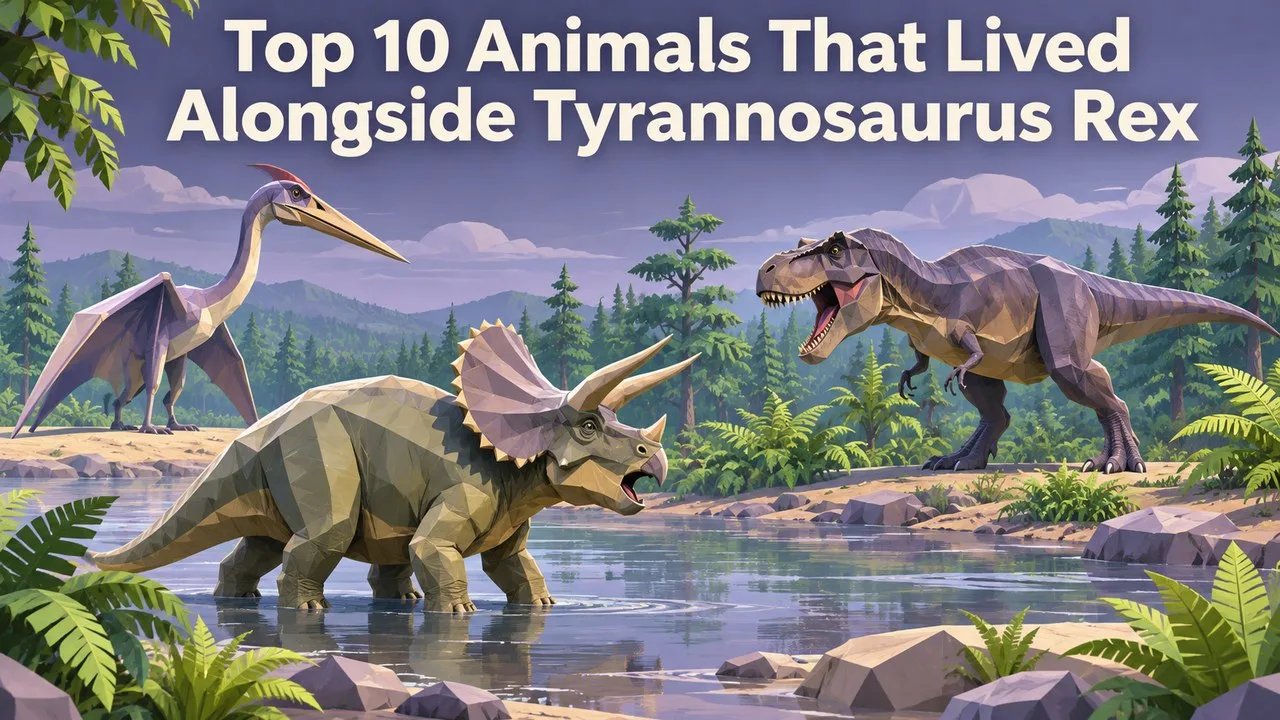
Horned giants, armoured tanks, a toothless chicken from hell and a sky-filling pterosaur: ten animals that shared the dinosaurs' final chapter with T. rex. Tyrannosaurus rex lived from about 68 million to 66 million years ago across western North America, on the island continent that geologists call Laramidia, and it was never alone.
Much of what we know about its world comes from the Hell Creek Formation, a band of mudstones and sandstones exposed across Montana, the Dakotas and Wyoming. These rocks hold some of the most famous dinosaur fossils ever found, including SUE, the largest and most complete T. rex skeleton, dug out of a bluff near Faith, South Dakota, in 1990.[1][2] Farther south, in Texas, New Mexico and Utah, rocks of the same age record a rather different cast.
For this Finepedia list we picked ten animals whose fossils come from the same latest Cretaceous rocks as Tyrannosaurus or from the same regions and time. Some were its prey, some its competitors, and some simply shared the riverbanks. Together they give a vivid picture of the last great community of non-bird dinosaurs before the asteroid struck.
Key Facts
The table below gives a quick overview of all ten entries before each one is described in detail.
| # | Animal | Type | Approximate size | Where fossils were found |
|---|---|---|---|---|
| 1 | Triceratops | Horned dinosaur | About 8 to 9 m long | Montana, the Dakotas, Wyoming, Alberta, Saskatchewan |
| 2 | Edmontosaurus | Duck-billed dinosaur | Up to about 12 m long | From Colorado to northern Alaska |
| 3 | Ankylosaurus | Armoured dinosaur | About 8 m long | Montana, Wyoming, Alberta, Saskatchewan |
| 4 | Pachycephalosaurus | Dome-headed dinosaur | About 4.5 m long | Montana, South Dakota, Wyoming, Alberta |
| 5 | Thescelosaurus | Small plant-eating dinosaur | About 3 to 4 m long | Wyoming, the Dakotas, Montana, Alberta, Saskatchewan |
| 6 | Ornithomimus | Ostrich-like dinosaur | About 4 m long | Colorado, Alberta, Montana and neighbouring areas |
| 7 | Anzu | Feathered oviraptorosaur | About 3.5 m long | North and South Dakota, Wyoming |
| 8 | Didelphodon | Early marsupial relative | Skull about 10 cm, body up to about 5 kg | Montana, the Dakotas, Wyoming, Alberta, Saskatchewan |
| 9 | Alamosaurus | Titanosaur sauropod | Around 21 to 26 m long | New Mexico, Texas, Utah |
| 10 | Quetzalcoatlus | Giant azhdarchid pterosaur | Wingspan about 10 to 11 m | Big Bend, Texas |
1. Triceratops
No animal is more closely tied to T. rex than Triceratops. It was by far the most common large dinosaur in the upper Hell Creek rocks; one well-known count of fossils there recorded twenty-two Triceratops against five Tyrannosaurus and five Edmontosaurus.[2] With a skull carrying three horns, a parrot-like beak and a frill that could reach almost a metre across, it weighed around ten tonnes, according to the Natural History Museum in London.[3]
The two animals clearly met. One partial Triceratops, unearthed in 1997, carries a horn that a Tyrannosaurus had which later healed, proof that at least some survived an attack. Other specimens show tyrannosaur tooth marks punched through the frill.[3] Puncture wounds on further frills suggest that Triceratops also fought each other with their horns, perhaps over mates.[3]
Curiously, Triceratops fossils tend to turn up singly rather than in mass bone beds, which hints that adults often lived solitary lives, unlike many of their horned relatives. Othniel Charles Marsh, who named the genus, first mistook a pair of its horn cores for those of a giant bison.[3] Today Triceratops is the best-known horned dinosaur in the world, and its rivalry with T. rex is the classic image of the Late Cretaceous.
2. Edmontosaurus
Edmontosaurus was a huge duck-billed plant eater that ranged across western North America, from Colorado to the North Slope of Alaska.[4] The late species, E. annectens, could reach around 12 metres in length, and a few exceptionally large individuals may have grown longer still.[4] Its jaws held a horny beak at the front and batteries of hundreds of grinding cheek teeth behind, which it used on tough conifer needles, cones and twigs that have been found preserved in its gut region.[5]
Edmontosaurus is also among the few dinosaurs known from mummified specimens with skin impressions. One of these, nicknamed Dakota, came out of North Dakota's Hell Creek rocks in 1999, found by Tyler Lyson.[4][5]
Related: Top 10 Common Misconceptions About Dinosaurs
Edmontosaurus provides some of the best direct evidence that T. rex hunted living prey. In 2013 a team including Robert DePalma and the Kansas palaeontologist David Burnham reported a broken T. rex tooth crown stuck fast in the tail vertebrae of a duck-billed dinosaur from South Dakota's Hell Creek beds.[6][7] New bone had grown around the tooth, so the plant eater escaped and lived on after the bite. Another specimen in Denver shows healed damage to its tail spines from what appears to be a similar attack.[4]
3. Ankylosaurus
If Triceratops was a living fortress, Ankylosaurus was a walking tank. Its broad, low body was covered in bony plates, its head carried backward-pointing horns, and its tail ended in a heavy club of fused bone. The Natural History Museum estimates a length of around 8 metres and a weight in the region of eight tonnes.[8]
Its first known bones came to light in Montana's Hell Creek rocks in 1906, on an expedition led by Barnum Brown, the same collector who had found the first Tyrannosaurus rex a few years before.[8] Even now, no complete skeleton has been discovered, and nobody knows exactly how the plates on its back were arranged. It was rare in its environment compared with Triceratops and Edmontosaurus.[2][8]
As a plant eater, Ankylosaurus had no need to use its club to hunt. Experts think it was a defensive weapon, swung powerfully from side to side at the legs of a predator such as T. rex. The animal probably plodded slowly most of the time and grazed on low-growing ferns, shrubs and fruit, perhaps eating around 60 kilograms of vegetation a day, roughly what a modern elephant needs.[8]
4. Pachycephalosaurus
Pachycephalosaurus, the thick-headed lizard, walked on two legs and carried one of the strangest skulls in dinosaur history. Its domed skull roof could be as much as 22 centimetres thick, ringed with knobs and spikes.[9][10] Estimates put it at up to about 4.5 metres long and several hundred kilograms in weight.[9]
For decades the dome was pictured as a battering ram, with rival males charging and butting heads like bighorn sheep. That idea has been challenged, since some studies argued the skull could not have absorbed such impacts and few fossils showed obvious damage. More recent work has reported injuries that do fit some form of combat, perhaps flank butting rather than head-on clashes.[9] The Natural History Museum notes that the dome may also have been used for display.[10]
The genus has a tangled history. The first fragment was found around 1860 by Ferdinand Hayden and was thought to come from an armadillo-like animal.[10] Later, two flat-headed or spiky-headed animals from the same rocks, Dracorex and Stygimoloch, were proposed as young Pachycephalosaurus, an idea that remains debated.[9] Either way, the animal survived until the very close of the Cretaceous alongside T. rex.
5. Thescelosaurus
Thescelosaurus was a modest, two-legged plant eater with a long tail, a narrow beaked snout and a body roughly 3 to 4 metres long.[11][2] It is less famous than its giant neighbours, yet it was one of the most frequently found smaller dinosaurs in Hell Creek and related rock units.[2]
Related: Top 10 Most Bizarre Dinosaurs
The genus became briefly famous at the start of this century thanks to a South Dakota specimen nicknamed Willo. In 2000 a paper in the journal Science argued that an iron-rich lump inside its chest was a fossilised four-chambered heart, more like that of a bird than a reptile.[12] The claim made headlines because it hinted at a warm-blooded metabolism.
A re-examination published in 2011 by Timothy Cleland and colleagues used modern scanning, microscopy and chemical tests and found no convincing sign of heart tissue. The mass appears instead to be a concretion formed when sand washed into the carcass and hardened.[13][12] The team did spot small cell-like structures inside it, which could have come from plant debris or from the dinosaur itself.[12] Willo remains a superb skeleton, but it is now a lesson in how carefully claims about fossil soft tissue must be tested.
6. Ornithomimus
Ornithomimus, the bird mimic, was a slender two-legged dinosaur with a small head, a toothless beak, long arms and long legs built for speed. It was covered in feathers and may have eaten both plants and small animals.[14][15] The Natural History Museum lists it as about 4 metres long, living from roughly 74 to 66 million years ago in what is now Canada and the United States.[15]
Othniel Charles Marsh named the first species, O. velox, in 1890 from a foot and part of a hand from Colorado's Denver Formation. Since then about seventeen more species have been placed in the genus at one time or another, though most have since been moved elsewhere.[14] The best fossils come from Alberta.[14]
In the Hell Creek Formation, ornithomimid remains are usually referred to Ornithomimus, and the animal appears in fossil counts alongside Thescelosaurus, Pachycephalosaurus and Ankylosaurus as one of the rarer dinosaurs.[2] For a young T. rex these fast runners would have been a tempting but difficult target. Their build suggests they relied on speed rather than horns or armour to escape trouble, much like a modern ostrich or emu on open ground.
7. Anzu
In 2014 Anzu wyliei received its name from Matthew Lamanna, Hans-Dieter Sues, Emma Schachner and Tyler Lyson, based mainly on three partial skeletons from Hell Creek rocks in the two Dakotas.[16][17] Together they make up most of the skeleton, and the fossils are among the geologically youngest of their group anywhere in the world.[16]
It was an oviraptorosaur, a group of beaked, feathered dinosaurs better known from Asia. Anzu had a toothless beak, a tall crest on its skull, long arms tipped with large curved claws and long legs. It measured about 3.5 metres and is estimated at between 200 and 300 kilograms.[17] Its bird-like look earned it the nickname chicken from hell. Lamanna could not make that phrase work in Latin or Greek, so he named it after Anzu, a bird-like demon from ancient Mesopotamian myth.[17]
Related: Top 10 Misidentified Prehistoric Animals and How Science Corrected Them
The species name honours Wylie J. Tuttle, grandson of donors who supported the Carnegie Museum of Natural History, the Pittsburgh museum where the main fossils are kept.[16][17] Anzu showed that large oviraptorosaurs, once known in North America mainly from scraps, were part of the T. rex community right up to the end.
8. Didelphodon
Mammals in the age of T. rex were small, but some were tougher than their size suggests. Didelphodon vorax was a relative of today's marsupials, known from Hell Creek and several other latest Cretaceous rock units in the northern plains of the United States and Canada.[18]
A study published in Nature Communications in 2016 described a nearly complete skull and other jaw pieces from Montana and North Dakota. The researchers estimated that adults weighed between about 2 and 5 kilograms, making it one of the largest mammals of its time.[19] They also found that, relative to its size, its bite beat that of every other mammal they measured, living or extinct. Its heavy, bulbous premolars were well suited to crushing.[19][18]
The team suggested that Didelphodon was a predator and scavenger, eating snails, fish, amphibians, lizards, turtles and other mammals. Its estimated maximum prey size of about 5 kilograms means it could even have taken baby dinosaurs.[19] Picture something like an otter or badger, scuttling around riverbanks while multi-tonne giants passed overhead.
9. Alamosaurus
Long-necked sauropods had vanished from North America for tens of millions of years before Alamosaurus appeared near the end of the Cretaceous, probably arriving from South America or Asia.[20] No other sauropod from the Late Cretaceous is known on the continent. Its name comes from Ojo Alamo, New Mexico, the place that gave up its first fossils in 1922.[21][22]
Adults probably reached about 21 to 26 metres in length.[21][20] One individual from Big Bend National Park in Texas, dug from Javelina Formation rocks, appears to have been enormous, and the park estimates it at about 100 feet long and more than 50 tons. Its bones were so heavy and the site so remote that the excavation team needed special permission to lift them out.[22]
Alamosaurus matters to the T. rex story because remains identified as Tyrannosaurus, or something very close to it, come from the same southern rock units, including the Javelina beds of Texas and Utah's North Horn rocks.[20] In the south, then, T. rex may have faced prey far larger than any Triceratops. Whether it attacked healthy adult titanosaurs is unknown, but young or sick ones would have been possible targets.
Related: Top 10 Formidable Prehistoric Predators
10. Quetzalcoatlus
Quetzalcoatlus northropi may well be the biggest animal that ever flew. Douglas Lawson, a 22-year-old geology student from the University of Texas at Austin, found its first fossils in Big Bend National Park in 1971.[23][24] It was named after the feathered serpent god Quetzalcoatl and the aircraft designer Jack Northrop.[23]
Wingspan estimates have ranged widely over the years, but modern figures centre on about 10 to 11 metres, close to 40 feet.[24][25] Standing on the ground it reached about 12 feet tall, with a neck around 6 feet long and a crested skull of about 4 feet; one researcher compared it to a stork on steroids.[25]
In 2021 the Society of Vertebrate Paleontology published a set of studies on the animal. One concluded that it could not simply run and flap to take off. Instead it crouched and sprang upward by 8 feet or more using its legs, then swept its huge wings to climb.[23][25] On the ground it probably stalked small prey, much like a modern stork or ground hornbill.[24] The Javelina Formation that yields its fossils has also produced remains of Tyrannosaurus, so T. rex may have watched this giant flier stride across the floodplain.[24]
Conclusion
These ten animals show that T. rex lived in a crowded and varied world. Horned and armoured plant eaters gave it dangerous prey, duck-bills and dome-heads offered more manageable meals, and feathered runners, crested oviraptorosaurs and hard-biting mammals filled other niches.
The fossil record also keeps changing the picture. Willo lost its heart, Anzu went from scraps to a near-complete skeleton, and Quetzalcoatlus gained a new way of taking off, all within the last few decades.
Every one of these animals vanished, along with T. rex, when an asteroid struck about 66 million years ago. Their fossils, preserved in the same rocks, let us rebuild the final chapter of the age of dinosaurs in remarkable detail.
- ^ [1] "SUE the T. rex". Field Museum. Field Museum
- ^ [2] "Hell Creek Formation". Wikipedia. Wikipedia
- ^ [3] "Triceratops". Natural History Museum. Natural History Museum
- ^ [4] "Edmontosaurus". Wikipedia. Wikipedia
- ^ [5] "Edmontosaurus". Natural History Museum. Natural History Museum
- ^ [6] "Tooth is smoking gun evidence Tyrannosaurus rex was a hunter-killer". University of Kansas. KU News
- ^ [7] "Caught in the Act: Scientists Find a T. Rex Tooth Stuck in a Hadrosaur Tail". Smithsonian Magazine. Smithsonian Magazine
- ^ [8] "Ankylosaurus". Natural History Museum. Natural History Museum
- ^ [9] "Pachycephalosaurus". Wikipedia. Wikipedia
- ^ [10] "Pachycephalosaurus". Natural History Museum. Natural History Museum
- ^ [11] "Thescelosaurus". Natural History Museum. Natural History Museum
- ^ [12] "Willo the Dinosaur Loses Heart". Smithsonian Magazine. Smithsonian Magazine
- ^ [13] "Histological, chemical, and morphological reexamination of the heart of a small Late Cretaceous Thescelosaurus". PubMed. PubMed
- ^ [14] "Ornithomimus". Wikipedia. Wikipedia
- ^ [15] "Ornithomimus". Natural History Museum. Natural History Museum
- ^ [16] "A New Large-Bodied Oviraptorosaurian Theropod Dinosaur from the Latest Cretaceous of Western North America". PLOS One. PLOS One
- ^ [17] "Anzu (dinosaur)". Wikipedia. Wikipedia
- ^ [18] "Didelphodon". Wikipedia. Wikipedia
- ^ [19] "A large carnivorous mammal from the Late Cretaceous and the North American origin of marsupials". Nature Communications. Nature Communications
- ^ [20] "Alamosaurus". Wikipedia. Wikipedia
- ^ [21] "Alamosaurus". Natural History Museum. Natural History Museum
- ^ [22] "Alamosaurus". U.S. National Park Service. Big Bend National Park
- ^ [23] "World's Largest Pterosaur Leaped Aloft to Fly". University of Texas at Austin. UT News
- ^ [24] "Quetzalcoatlus". Wikipedia. Wikipedia
- ^ [25] "Fleshing out the bones of Quetzalcoatlus, Earth's largest flier ever". UC Berkeley. Berkeley News



















Discussion
Log in with