






Top 10 Cities Rebuilt After Devastation in World War II
 By Dhiraj Sharma · Published
Share Post
Loading…
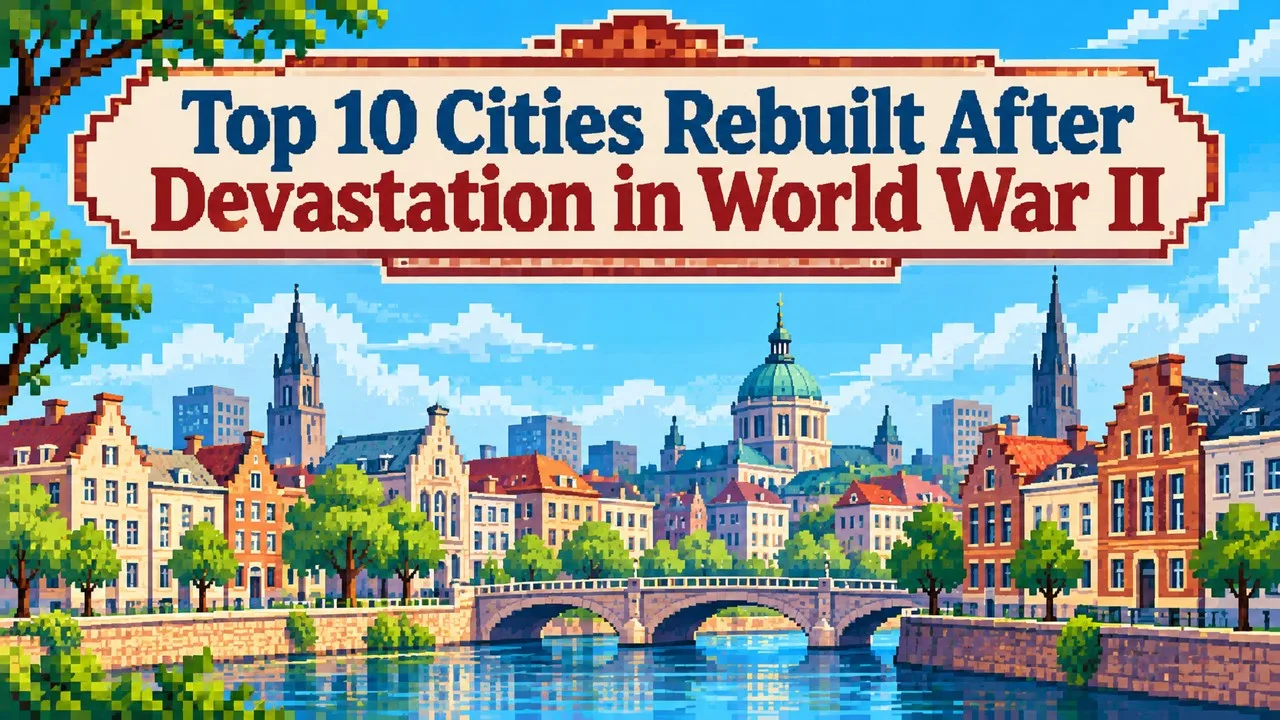
From Warsaw's painstaking replica of its Old Town to Rotterdam's bold modern centre: ten cities that rose again after devastation in World War II. The Second World War caused destruction on a scale never seen before. Bombing raids, artillery and street fighting reduced many cities to ruins, killing vast numbers of civilians and leaving millions homeless.
When the fighting ended, survivors faced enormous challenges. They had to clear rubble, house people, restore water and power and decide what kind of cities they wanted to build.
Different cities chose very different approaches. Some carefully reconstructed their historic centres, recreating lost buildings from old plans, paintings and photographs. Others seized the chance to build modern cities with new street plans and architecture.
These choices reflected practical needs, available resources and political ideologies. In the Soviet Union and its allies, reconstruction often followed state plans and expressed official ideals. In Western Europe, debates between preservation and modernisation shaped the new cities.
Reconstruction also had symbolic meaning. Rebuilt cities could represent national survival, reconciliation, peace or the triumph of a political system.
The cities in this list come from Europe and Asia. They include capitals, industrial centres, ports and historic towns.
Casualty and destruction figures for wartime cities vary between sources, and those given here are approximate.
Each entry names the city, its country and its approach to rebuilding, followed by an account of its destruction and recovery.
The entries are arranged in roughly chronological order of the destruction.
Together, they show how cities can rise from devastation, and how the choices made after the war continue to shape urban life today.
The first task in every devastated city was clearing the rubble. In Germany, much of this work was done by women, who became known as Trummerfrauen, or rubble women, because so many men had been killed or were prisoners of war. In other cities, soldiers, prisoners, volunteers and returning residents sorted bricks, salvaged materials and cleared streets by hand. In some places, mountains of rubble were piled up into new hills that still stand today, now covered with grass and trees.
Key Facts
| # | City | Country | Approach to rebuilding |
|---|---|---|---|
| 1 | Rotterdam | The Netherlands | Bold modernist rebuilding |
| 2 | Coventry | United Kingdom | Modern rebuilding with a memorial |
| 3 | Stalingrad, now Volgograd | Soviet Union, now Russia | Monumental Soviet reconstruction |
| 4 | Minsk | Soviet Union, now Belarus | Stalinist-era reconstruction |
| 5 | Le Havre | France | A unified modern design |
| 6 | Warsaw | Poland | Faithful reconstruction of the historic centre |
| 7 | Gdansk | Poland | Reconstruction of historic facades |
| 8 | Dresden | Germany | Gradual reconstruction over decades |
| 9 | Hiroshima | Japan | Rebuilding as a city of peace |
| 10 | Manila | Philippines | Slow rebuilding and later restoration |
1. A Modern Centre From the Ashes
On 14 May 1940, German aircraft bombed the centre of Rotterdam during the invasion of the Netherlands. Fires swept through the old city, destroying much of its historic centre, killing hundreds of people and leaving tens of thousands homeless [1].
Rather than recreate the old city, Rotterdam's planners chose to build a modern centre with wide streets and new architecture. The Lijnbaan, which opened in 1953, was one of the first purpose-built pedestrian shopping streets in Europe [1].
Related: Top 10 Monuments Rebuilt After War
Rotterdam's approach made it a showcase of modern architecture. The city has continued to embrace bold design, and its post-war reconstruction is often contrasted with the restoration of historic centres elsewhere.
2. A Cathedral Beside Its Ruins
On the night of 14 November 1940, German bombers launched a massive raid on Coventry, an industrial city in the English Midlands. The raid destroyed much of the city centre, including the medieval Cathedral of St Michael [2].
After the war, Coventry was rebuilt with a modern city centre, including one of Britain's first pedestrian shopping precincts. A new cathedral, designed by Basil Spence, was built beside the ruins of the old one and consecrated in 1962 [2].
The ruins of the old cathedral were preserved as a memorial. Coventry became a symbol of reconciliation, forming twin-city links with Stalingrad during the war and later with Dresden.
3. The City of a Turning Point
The Battle of Stalingrad, fought from 1942 to 1943, was one of the largest and bloodiest battles in history. The fighting reduced the city on the Volga River almost entirely to ruins [3].
After the battle, the Soviet government rebuilt the city according to a grand plan, with wide avenues, large public squares and monumental buildings. Thousands of volunteers helped with reconstruction [3].
The city was renamed Volgograd in 1961. A vast memorial complex on the hill of Mamayev Kurgan, completed in 1967, commemorates the battle, and its giant statue is among the tallest in the world.
4. A Showcase of Soviet Planning
Minsk, the capital of Belarus, suffered terribly during the German occupation from 1941 to 1944. Much of the city was destroyed, and its population fell dramatically as a result of the war and the killing of its Jewish population [4].
After liberation, the city was rebuilt largely from scratch according to Soviet plans. A grand main avenue lined with monumental buildings in the Stalinist style became its centrepiece [4].
Today, Minsk is often regarded as one of the best-preserved examples of Stalinist urban planning. Its post-war architecture reflects the ideals and ambitions of the Soviet state.
Related: Top 10 Most Bizarre Phobias: Strange Fears That Exist
5. Concrete Reborn by the Sea
The port of Le Havre in Normandy was heavily bombed by Allied forces in September 1944, as they sought to drive out German troops. The city centre was almost completely destroyed, and thousands of civilians were killed [5].
The French government entrusted the reconstruction to the architect Auguste Perret, a pioneer of reinforced concrete. From 1945 to 1964, his team rebuilt the city centre with a unified design based on a modular grid [5].
Perret's work was initially criticised by some as monotonous. But in 2005, the rebuilt centre of Le Havre was added to the UNESCO World Heritage List as an outstanding example of post-war urban planning.
6. Rebuilt From Paintings
Warsaw suffered immense destruction during the war, especially after the Warsaw Uprising of 1944. In its aftermath, German forces systematically destroyed much of what remained. By the end of the war, most of the city lay in ruins [6].
After the war, Poland decided to rebuild the historic Old Town as faithfully as possible. Planners used pre-war documentation, architectural drawings and even eighteenth-century paintings by Bernardo Bellotto, whose detailed views of Warsaw helped guide the reconstruction [6].
The reconstructed Old Town was added to the UNESCO World Heritage List in 1980. It is recognised as an exceptional example of the near-total reconstruction of a historic city.
7. A Hanseatic Port Restored
Gdansk, a historic port on the Baltic Sea, suffered heavy destruction in 1945 during fighting at the end of the war. Much of its historic centre, known as the Main Town, was left in ruins [7].
After the war, Gdansk became part of Poland, and authorities decided to rebuild the historic centre. Reconstruction focused on recreating the appearance of the old streets and facades, though many buildings behind the facades were modernised [7].
The rebuilt Main Town, with its colourful merchant houses, is now one of the most popular tourist destinations in Poland. The reconstruction has been praised for its beauty and debated for its mixture of history and recreation.
Related: Top 10 Oldest Buildings in the World
8. A Church Rebuilt From Its Own Stones
In February 1945, Allied bombing raids devastated the German city of Dresden, creating a firestorm that destroyed much of its historic centre. Around 25,000 people were killed, according to a historical commission [8].
In communist East Germany, some historic buildings were restored, but others were demolished or left in ruins. The ruins of the Frauenkirche, a famous Baroque church, were left as a war memorial for decades [8].
After German reunification, the Frauenkirche was rebuilt between 1994 and 2005, using many of its original stones. A British-made cross for its dome was a gift that symbolised reconciliation, and Dresden's historic centre has since been extensively restored.
9. A City Dedicated to Peace
On 6 August 1945, the United States dropped an atomic bomb on Hiroshima. The explosion and resulting fires destroyed much of the city, and tens of thousands of people were killed instantly, with many more dying later from injuries and radiation [9].
In 1949, Japan passed a law designating Hiroshima as a Peace Memorial City, providing support for its reconstruction. The Peace Memorial Park, designed by the architect Kenzo Tange, was built near the centre of the explosion [9].
The ruined dome of a former exhibition hall was preserved as a memorial and is now a UNESCO World Heritage Site. Hiroshima grew into a thriving modern city, known around the world as a symbol of peace.
10. A Capital Devastated in Battle
In February and March 1945, the Battle of Manila was fought between American and Filipino forces and Japanese troops. The fighting devastated the city, and around 100,000 civilians are estimated to have died [10].
The historic walled city of Intramuros, with its Spanish colonial churches and buildings, was largely destroyed. Manila was one of the most heavily devastated Allied capitals of the war [10].
Reconstruction was slow, and much of the city's historic architecture was lost. In later decades, authorities began restoring parts of Intramuros, and efforts to preserve Manila's remaining heritage continue.
Related: The Science Behind Auroras: How Solar Winds Create Colorful Skies
Conclusion
These cities show the extraordinary resilience of people who rebuilt their homes after devastation. Clearing rubble and rebuilding entire cities required enormous effort and sacrifice.
The choices made after the war differed widely. Some cities restored their historic centres, while others embraced modern architecture and planning.
Reconstruction often carried symbolic meanings, from national survival in Warsaw to peace in Hiroshima and reconciliation in Coventry and Dresden.
Debates about how to rebuild continue today, as architects and historians assess the successes and failures of post-war reconstruction.
Many rebuilt cities now attract visitors from around the world, drawn by both their restored heritage and their modern architecture.
Lessons from post-war reconstruction remain relevant for cities affected by war and disaster today.
For anyone interested in history and architecture, these cities offer powerful reminders of the costs of war and the determination of people to rebuild.
Many of the people who rebuilt these cities had lost family members, homes and livelihoods. Their labour, often carried out in hunger and hardship, laid the foundations for the recovery of their countries. Memorials, museums and preserved ruins in these cities help ensure that the human cost of the war, and the effort of rebuilding, are not forgotten by later generations.
International aid also played a part in some cities. In Western Europe, the American-funded Marshall Plan supported economic recovery from 1948, helping to finance industry and infrastructure on which reconstruction depended.
- ^ [1] Accounts of Rotterdam. Wikipedia: Rotterdam Blitz Wikipedia: Lijnbaan
- ^ [2] Accounts of Coventry. Wikipedia: Coventry Blitz Wikipedia: Coventry Cathedral
- ^ [3] Accounts of Stalingrad. Wikipedia: Battle of Stalingrad Wikipedia: Mamayev Kurgan
- ^ [4] Accounts of Minsk. Wikipedia: Minsk Wikipedia: Stalinist architecture
- ^ [5] Accounts of Le Havre. Wikipedia: Le Havre Wikipedia: Auguste Perret
- ^ [6] Accounts of Warsaw. Wikipedia: Warsaw Old Town Wikipedia: Bernardo Bellotto
- ^ [7] Accounts of Gdansk. Wikipedia: Gdansk Wikipedia: Long Market
- ^ [8] Accounts of Dresden. Wikipedia: Bombing of Dresden Wikipedia: Frauenkirche, Dresden
- ^ [9] Accounts of Hiroshima. Wikipedia: Hiroshima Peace Memorial Park Wikipedia: Hiroshima
- ^ [10] Accounts of Manila. Wikipedia: Battle of Manila (1945) Wikipedia: Intramuros





















Discussion
Log in with