






 By
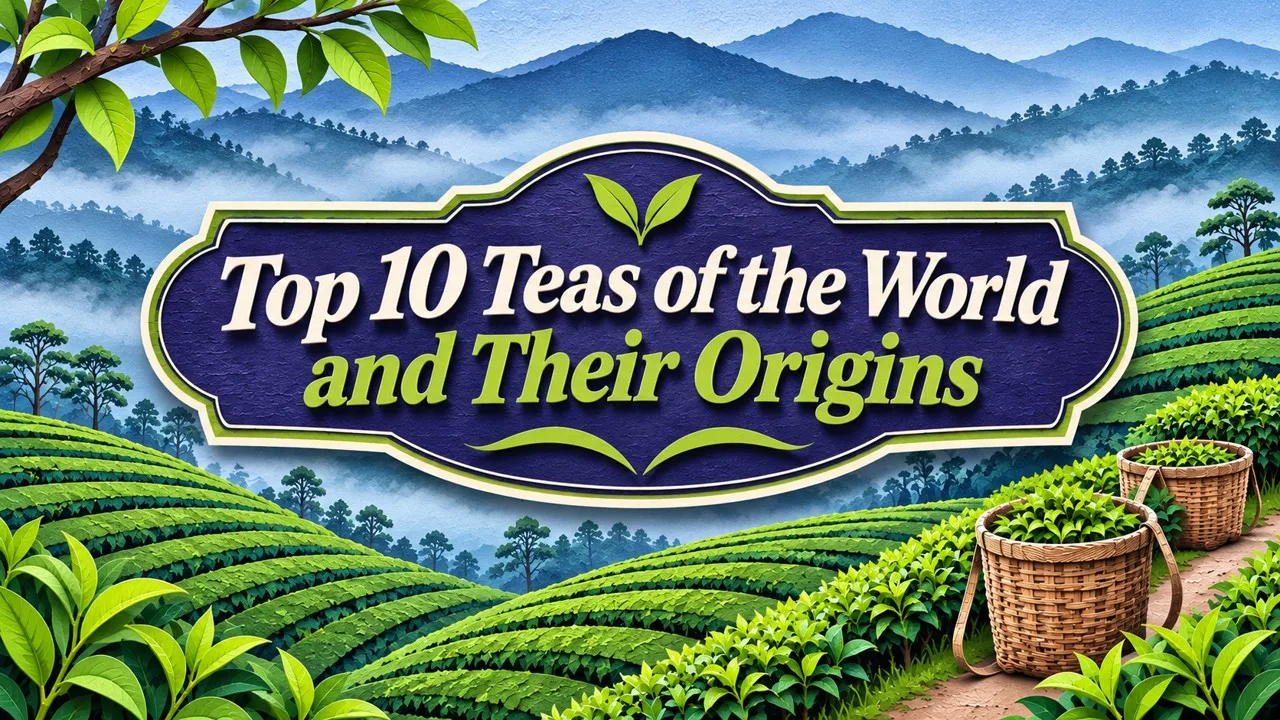
From Darjeeling's misty slopes to Japan's bright green matcha, these ten teas of the world and their origins show how one plant became a global drink. All true tea comes from one plant, Camellia sinensis, an evergreen shrub native to East and South Asia. Differences in where the leaves are grown and how they are processed, from quick drying to long fermentation, produce thousands of distinct teas.
This list picks ten famous teas, including regional classics and widely loved styles. It explains where each tea comes from and how it is made. After water, tea is often described as the most widely consumed drink in the world.
Key Facts
The ten teas below come from India, Sri Lanka, China, Japan and Britain's tea-drinking tradition.
Famous Teas at a Glance
| # | Tea | Origin | Type | What makes it special |
|---|---|---|---|---|
| 1 | Darjeeling Tea | West Bengal, India | Black and other styles | Muscatel flavour and GI status |
| 2 | Assam Tea | Assam, India | Black | Strong, malty breakfast tea |
| 3 | Ceylon Tea | Sri Lanka | Mostly black | Bright, brisk flavour from island highlands |
| 4 | Matcha | Japan | Powdered green tea | Whole leaf ground to powder |
| 5 | Sencha | Japan | Steamed green tea | Japan's everyday tea |
| 6 | Longjing | Hangzhou, China | Pan-fired green tea | Flat jade leaves |
| 7 | Tieguanyin Oolong | Fujian, China | Oolong | Partly oxidised and rolled |
| 8 | Pu-erh | Yunnan, China | Fermented, aged tea | Improves with age |
| 9 | Earl Grey | Britain | Flavoured black tea | Scented with bergamot |
| 10 | Masala Chai | India | Spiced milk tea | Brewed with spices, milk and sugar |
1. Darjeeling Tea
Darjeeling tea is grown on estates in the hills of the Darjeeling district of West Bengal, at elevations up to about 2,000 metres. Tea planting there began in the 1840s and 1850s under British rule. [1]
It is often called the champagne of teas because of its light colour and delicate, fruity aroma, sometimes described as muscatel. The flavour varies with each harvest, or flush, from the fresh first flush in spring to the fuller second flush in summer. [1]
In 2004 Darjeeling tea became the first product in India to receive Geographical Indication status, meaning only tea from approved estates in the region can use the name.
Although usually sold as black tea, Darjeeling estates also produce green, white and oolong teas.
The region produces only a small share of India's tea, which helps explain its high prices.
Key Figures
- Region: Darjeeling district, West Bengal
- Nickname: the champagne of teas
- GI status: India's first, in 2004
- Main harvests: first and second flush
Why It Made the List
Darjeeling is one of the world's most prestigious teas. Its GI status protects a flavour that comes from a unique mountain setting.
2. Assam Tea
Assam tea comes from the Brahmaputra valley in north-eastern India, one of the largest tea-growing regions in the world. It is made from a local variety of the tea plant, Camellia sinensis var. assamica. [2]
In 1823 the Scottish trader Robert Bruce was shown wild tea plants growing in Assam. This discovery led the British to establish tea plantations in India, reducing their dependence on China. [2]
Assam tea is known for its strong, bold, malty taste and deep colour. It is widely used in breakfast tea blends and in Indian masala chai.
Most Assam tea is grown at low elevations in a hot, humid climate, which helps the bushes grow quickly.
Assam produces more than half of India's tea.
Key Figures
- Region: Brahmaputra valley, Assam
- Plant variety: Camellia sinensis var. assamica
- Wild tea reported: 1823
- Typical use: breakfast blends and chai
Why It Made the List
Assam tea is the backbone of many everyday teas. Its discovery transformed tea from a Chinese monopoly into a global industry.
Related: Top 10 Most Bizarre Phobias: Strange Fears That Exist
3. Ceylon Tea
Ceylon tea is grown in Sri Lanka, known as Ceylon until 1972. The island was a major coffee producer until a fungal disease called coffee rust devastated plantations from 1869. [3]
Planters switched to tea, and James Taylor's estate at Loolecondera, begun in 1867, is often credited as the first commercial tea plantation on the island. [3]
Ceylon tea is grown in several regions at different heights, such as Nuwara Eliya, Dimbula and Uva, each giving a different character. High-grown teas are light and fragrant, while low-grown teas are stronger.
Sri Lanka is one of the world's largest tea exporters, and tea is one of its most important exports.
The Lion Logo on packets certifies tea packed in Sri Lanka.
Key Figures
- Former name of the country: Ceylon
- First commercial estate: Loolecondera, 1867
- Main regions: Nuwara Eliya, Dimbula, Uva
- Trigger for tea planting: coffee rust from 1869
Why It Made the List
Ceylon tea turned an agricultural disaster into a global brand. It remains central to Sri Lanka's economy and identity.
4. Matcha
Matcha is a powdered green tea made from leaves called tencha, which are grown in shade for several weeks before harvest. Shading increases chlorophyll and amino acids, giving the tea its bright colour and rich taste. [4]
The leaves are steamed, dried and stone-ground into a fine powder. Instead of steeping leaves and throwing them away, drinkers whisk the powder into hot water and consume the whole leaf. [4]
Powdered tea was brought from China to Japan by Buddhist monks, and the Zen monk Eisai promoted tea drinking in the twelfth century. Matcha became central to the Japanese tea ceremony, or chanoyu.
Uji near Kyoto and Nishio in Aichi are famous matcha-producing areas.
Today matcha is used in lattes, ice cream, sweets and baking around the world.
Key Figures
- Leaf type: shade-grown tencha
- Preparation: whisked with a bamboo whisk
- Promoter in Japan: the monk Eisai
- Famous region: Uji, near Kyoto
Why It Made the List
Matcha is the heart of Japan's tea ceremony. Its global popularity has made it a symbol of Japanese tea culture.
5. Sencha
Sencha is the most popular tea in Japan, making up a large share of the country's tea production. Unlike matcha, it is made from whole leaves that are steeped in water. [5]
The leaves are steamed soon after picking, which stops oxidation and keeps their green colour and fresh, grassy taste. They are then rolled into thin needle-like shapes and dried. [5]
The steaming method was developed in the eighteenth century, and Nagatani Soen is often credited with refining the process in 1738.
Related: Top 10 Oldest Buildings in the World
Shizuoka prefecture, near Mount Fuji, is Japan's largest tea-growing area.
The first harvest of the year, called shincha or new tea, is especially prized.
A related tea called gyokuro is shaded before harvest like matcha leaves, giving it a sweeter, richer taste than ordinary sencha.
Key Figures
- Processing: steamed and rolled
- Main region: Shizuoka
- Method refined: 1738, Nagatani Soen
- Prized harvest: shincha
Why It Made the List
Sencha is Japan's everyday green tea. Its steaming method gives a fresh taste quite different from Chinese green teas.
6. Longjing
Longjing, or Dragon Well tea, is one of China's most famous green teas. It is grown around West Lake in Hangzhou, Zhejiang province. [6]
The leaves are pan-fired by hand in large woks, which stops oxidation and presses them into a distinctive flat, smooth shape. The tea has a gentle, chestnut-like flavour. [6]
Longjing has a long history of royal patronage. Legend says the Qianlong emperor of the Qing dynasty visited the tea fields in the eighteenth century and gave special status to eighteen tea bushes.
The best Longjing is picked in early spring before the Qingming festival and fetches very high prices.
The tea is usually brewed in glass so drinkers can watch the leaves unfold.
Key Figures
- Region: West Lake, Hangzhou
- Processing: pan-fired by hand
- Leaf shape: flat and smooth
- Prized harvest: before the Qingming festival
Why It Made the List
Longjing represents the finest tradition of Chinese green tea. Its handmade processing is a craft passed down for generations.
7. Tieguanyin Oolong
Oolong teas are partly oxidised, falling between green and black tea. Tieguanyin, from Anxi county in Fujian province, is one of the most famous. [7]
Its name means Iron Goddess of Mercy, after the Buddhist bodhisattva Guanyin, and several legends describe how the tea was discovered. [7]
The leaves are bruised, partly oxidised, then rolled tightly into small balls that unfold when brewed. The tea has a floral aroma and can be steeped many times.
Oolong is often prepared in the gongfu style, using small pots and cups and short, repeated infusions.
Related: 10 Sikh Gurus: The Pillars of Sikhism Who Shaped Faith, Equality, Courage, and Humanity
Taiwan is also famous for high-mountain oolongs, grown on the island's slopes.
Oolong is made in many styles, from lightly oxidised, green-tasting teas to dark, roasted ones. This range makes it one of the most varied types of tea. Some oolongs are roasted over charcoal to add a deeper, toasty character.
Key Figures
- Origin: Anxi, Fujian
- Name meaning: Iron Goddess of Mercy
- Oxidation: partial
- Brewing style: gongfu
Why It Made the List
Tieguanyin shows the skill of oolong making. Its complex aroma has won fans around the world.
8. Pu-erh
Pu-erh tea comes from Yunnan province in south-western China and is named after the market town of Pu'er. It is made from the broad-leaved tea trees of the region. [8]
Pu-erh is fermented and often aged for years, sometimes decades. It is frequently pressed into cakes or bricks, which made it easier to carry along the ancient Tea Horse Road to Tibet. [8]
There are two main types: raw pu-erh, which ages slowly, and ripe pu-erh, which undergoes accelerated fermentation and develops an earthy, mellow flavour.
Like fine wine, aged pu-erh can become highly valuable, and collectors pay large sums for rare cakes.
The tea is popular in southern China and Hong Kong, where it is often served at dim sum.
Key Figures
- Region: Yunnan, China
- Form: pressed cakes or bricks
- Types: raw and ripe
- Historic route: the Tea Horse Road
Why It Made the List
Pu-erh is one of the few teas that improves with age. Its trade shaped routes across south-western China and Tibet.
9. Earl Grey
Earl Grey is a black tea flavoured with oil from the rind of the bergamot orange, a citrus fruit grown mainly in Calabria, Italy. [9]
It is named after Charles Grey, the 2nd Earl Grey, who was British prime minister from 1830 to 1834. The exact link between him and the blend is uncertain, and several stories exist. [9]
Earl Grey became popular in the nineteenth century and remains one of the best-known tea blends in the world. Variations include Lady Grey, which adds other citrus flavours.
Related: General Knowledge Facts About the Banyan Tree: Botany, Records and Culture
It is usually drunk without milk, sometimes with a slice of lemon.
The tea also appears in desserts, cocktails and baking.
The British tea company Twinings is among those that claim a connection to the original blend.
Key Figures
- Flavouring: bergamot orange oil
- Named after: Charles Grey, 2nd Earl Grey
- His time as prime minister: 1830 to 1834
- Bergamot region: Calabria, Italy
Why It Made the List
Earl Grey is one of the world's most famous flavoured teas. Its citrus aroma makes it instantly recognisable.
10. Masala Chai
Masala chai is a sweet, milky tea brewed with spices such as cardamom, ginger, cinnamon, cloves and black pepper. In India it is simply called chai and is sold everywhere by street vendors called chaiwalas. [10]
Spiced drinks have a long history in India, but tea drinking became widespread only in the twentieth century, after campaigns by the Indian Tea Association encouraged local consumption. [10]
Chai is usually made by boiling strong black tea, often Assam, with milk, water, sugar and spices. Every family and vendor has its own recipe.
Chai is served in small glasses or traditional clay cups called kulhads, especially at railway stations.
It has spread worldwide, though Western chai lattes are often quite different from the Indian original.
Key Figures
- Typical spices: cardamom, ginger, cinnamon, cloves
- Usual tea: strong black tea, often Assam
- Sellers: chaiwalas
- Traditional cup: the kulhad
Why It Made the List
Masala chai is India's everyday drink. It shows how tea became part of national life and identity.
Conclusion
These ten teas show the remarkable variety that can come from a single plant. Climate, altitude, soil and processing all shape the final cup.
From the tea ceremony in Japan to street chai in India, tea is woven into daily life and tradition across the world. Exploring different teas is one of the easiest ways to travel through taste.
- ^ [1] "Darjeeling Tea". Wikipedia. Wikipedia: Darjeeling tea Wikipedia: Geographical indication
- ^ [2] "Assam Tea". Wikipedia. Wikipedia: Assam tea Wikipedia: Robert Bruce (trader)
- ^ [3] "Ceylon Tea". Wikipedia. Wikipedia: Ceylon tea Wikipedia: James Taylor (tea planter)
- ^ [4] "Matcha". Wikipedia. Wikipedia: Matcha Wikipedia: Japanese tea ceremony
- ^ [5] "Sencha". Wikipedia. Wikipedia: Sencha Wikipedia: Shizuoka Prefecture
- ^ [6] "Longjing". Wikipedia. Wikipedia: Longjing tea Wikipedia: West Lake
- ^ [7] "Tieguanyin Oolong". Wikipedia. Wikipedia: Tieguanyin Wikipedia: Oolong
- ^ [8] "Pu-erh". Wikipedia. Wikipedia: Pu'er tea Wikipedia: Tea Horse Road
- ^ [9] "Earl Grey". Wikipedia. Wikipedia: Earl Grey tea Wikipedia: Citrus bergamia
- ^ [10] "Masala Chai". Wikipedia. Wikipedia: Masala chai Wikipedia: Tea






















Discussion
Log in with