






 By
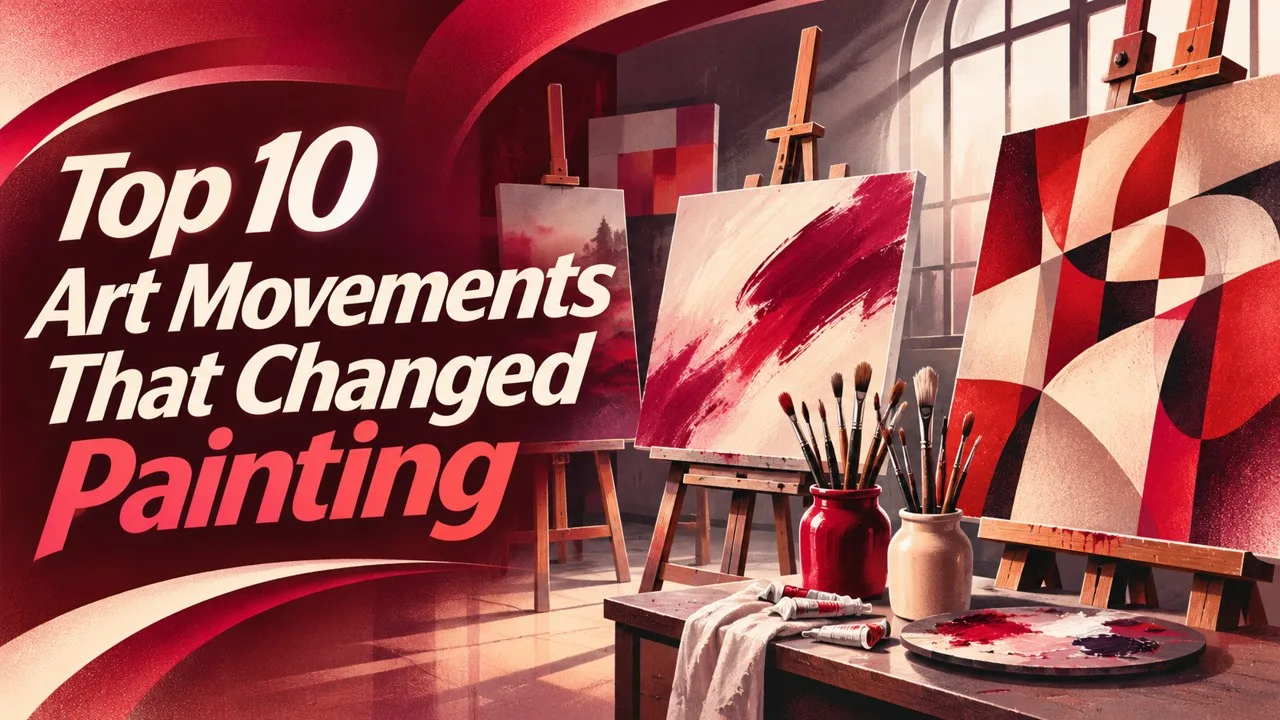
From Impressionism to Pop Art, these ten art movements that changed painting broke old rules about colour, form and subject and reshaped how we see art today. An art movement is a style or approach shared by a group of artists over a period of time, often with a common goal or manifesto. From the late nineteenth century onwards, movements followed one another rapidly as artists questioned what a painting should show and how.
This list picks ten movements that changed the direction of painting. They are listed roughly in the order they appeared, mostly in Europe and the United States, and the key artists named are among the best-known members of each.
Key Facts
The ten movements below span about a century of artistic revolution.
Influential Art Movements at a Glance
| # | Movement | Began | Key artists | Big idea |
|---|---|---|---|---|
| 1 | Impressionism | 1874 | Claude Monet, Pierre-Auguste Renoir, Berthe Morisot | Capturing light and fleeting moments |
| 2 | Post-Impressionism | 1880s | Vincent van Gogh, Paul Cezanne, Paul Gauguin | Personal vision and structure |
| 3 | Fauvism | 1905 | Henri Matisse, Andre Derain | Wild, expressive colour |
| 4 | Expressionism | 1905 | Ernst Ludwig Kirchner, Wassily Kandinsky, Edvard Munch | Inner emotion over appearance |
| 5 | Cubism | 1907 | Pablo Picasso, Georges Braque | Many viewpoints at once |
| 6 | Futurism | 1909 | Umberto Boccioni, Giacomo Balla | Speed, machines and modern life |
| 7 | Dada | 1916 | Marcel Duchamp, Hannah Hoch, Hugo Ball | Art against reason |
| 8 | Surrealism | 1924 | Salvador Dali, Rene Magritte, Max Ernst | Dreams and the unconscious |
| 9 | Abstract Expressionism | 1940s | Jackson Pollock, Mark Rothko, Willem de Kooning | Gesture and pure colour |
| 10 | Pop Art | 1950s | Andy Warhol, Roy Lichtenstein, Richard Hamilton | Art from popular culture |
1. Impressionism
Impressionism began in France in the 1870s, when a group of artists rejected by the official Paris Salon organised their own exhibition in 1874. A critic mocked the title of Claude Monet's painting Impression, Sunrise, and the name stuck. [1]
The Impressionists painted outdoors, or en plein air, to capture changing light and atmosphere. They used quick, visible brushstrokes and bright, unmixed colours rather than smooth finishes and dark tones. [1]
Their subjects were everyday modern life: cafes, boating parties, railway stations and city streets, as well as landscapes. New paints sold in portable tubes made outdoor painting much easier.
At first the public and critics were often hostile, but by the end of the century Impressionism had become hugely popular. Monet later painted series of the same subject, such as haystacks and water lilies, at different times of day.
Key Figures
- First group exhibition: 1874, Paris
- Name source: Monet's Impression, Sunrise
- Key technique: painting outdoors
- Other key artists: Edgar Degas, Camille Pissarro
Why It Made the List
Impressionism opened the door to modern art. It showed that how something looks in a moment could matter more than fine detail.
2. Post-Impressionism
Post-Impressionism describes artists who built on Impressionism in the 1880s and 1890s but went in new directions. The term was coined by the English critic Roger Fry for an exhibition in London in 1910. [2]
Vincent van Gogh used thick paint and swirling brushwork to express emotion, as in The Starry Night of 1889. Paul Cezanne broke natural forms into simple shapes and planes, which later inspired the Cubists. [2]
Paul Gauguin used flat areas of strong colour and symbolic subjects, while Georges Seurat developed pointillism, painting with tiny dots of pure colour.
These artists did not share one style, but all of them moved painting away from simply recording what the eye sees.
Van Gogh sold very little work in his lifetime and died in 1890, but within a few decades he became one of the most famous artists in the world.
Key Figures
- Term coined by: Roger Fry, 1910
- Famous painting: The Starry Night, 1889
- Pointillism pioneer: Georges Seurat
- Influence on: Cubism and Expressionism
Why It Made the List
Post-Impressionism turned painting towards personal expression and structure. It was the bridge between Impressionism and twentieth-century modernism.
3. Fauvism
Fauvism emerged in Paris in 1905, when a group of painters showed brightly coloured works at the Salon d'Automne. The critic Louis Vauxcelles called them fauves, meaning wild beasts. [3]
Related: Top 10 Most Popular Artists of All Time
Led by Henri Matisse and Andre Derain, the Fauves used intense, unnatural colours straight from the tube to express feeling rather than describe reality. A face might be painted green or a sky red. [3]
The movement lasted only a few years, but its bold use of colour influenced Expressionism and later abstract art.
Matisse went on to become one of the most important artists of the century, later creating large paper cut-outs in his final years.
Other artists linked to the group included Maurice de Vlaminck, Raoul Dufy and Georges Braque, who soon moved on to help create Cubism. Many Fauvist works were painted in sunny southern French towns such as Collioure, where Matisse and Derain worked together in the summer of 1905.
Key Figures
- First shown: Salon d'Automne, 1905
- Name meaning: wild beasts
- Leaders: Henri Matisse and Andre Derain
- Lasted: only a few years
Why It Made the List
Fauvism freed colour from the job of copying nature. That idea became central to modern painting.
4. Expressionism
Expressionism developed mainly in Germany in the early twentieth century. Artists aimed to show inner emotions and anxieties rather than outward appearances. [4]
The group Die Brucke, meaning The Bridge, was founded in Dresden in 1905 by artists including Ernst Ludwig Kirchner. Der Blaue Reiter, The Blue Rider, was formed in Munich in 1911 by Wassily Kandinsky and Franz Marc. [4]
Expressionist works used distorted forms, harsh colours and dramatic brushwork. The Norwegian painter Edvard Munch, whose The Scream dates from 1893, was an important forerunner.
Expressionism also influenced film, theatre, architecture and literature. The Nazi regime later condemned much Expressionist art as degenerate.
Kandinsky went on to paint some of the first fully abstract pictures, arguing that colours and shapes could affect the viewer like music. His ideas made Expressionism a bridge to abstract art.
Key Figures
- Dresden group: Die Brucke, 1905
- Munich group: Der Blaue Reiter, 1911
- Forerunner: Edvard Munch's The Scream, 1893
- Later persecution: labelled degenerate by the Nazis
Why It Made the List
Expressionism made emotion the main subject of art. Its influence spread far beyond painting.
5. Cubism
Cubism was developed by Pablo Picasso and Georges Braque in Paris from about 1907. Picasso's Les Demoiselles d'Avignon of that year is often seen as a starting point. [5]
Cubist painters broke objects into geometric shapes and showed them from several viewpoints at once. This rejected the single fixed viewpoint used in Western painting since the Renaissance. [5]
Related: Top 10 Most Famous Paintings in the World
In its later phase, called Synthetic Cubism, artists added pieces of newspaper, wallpaper and other materials to their works, inventing collage as a fine art technique.
Cubism inspired many later movements, including Futurism and abstract art, and changed how artists thought about space.
Early Cubism, about 1909 to 1912, is called Analytic Cubism, with muted browns and greys and objects broken into many small facets. Juan Gris and Fernand Leger were among the other major Cubist painters.
Key Figures
- Began: about 1907
- Founders: Pablo Picasso and Georges Braque
- Key early work: Les Demoiselles d'Avignon
- New technique: collage
Why It Made the List
Cubism was one of the most radical changes in the history of painting. It opened the way to abstraction.
6. Futurism
Futurism was launched by the Italian poet Filippo Tommaso Marinetti, whose Futurist Manifesto was published in the French newspaper Le Figaro in 1909. [6]
The Futurists celebrated speed, technology, cars, aeroplanes and the energy of the modern city. They wanted to break with the past and its museums. [6]
Painters such as Umberto Boccioni and Giacomo Balla tried to show movement by repeating forms and using dynamic lines, as in Balla's Dynamism of a Dog on a Leash of 1912.
The movement also involved sculpture, music and design. Its enthusiasm for war and links with Italian Fascism have made its legacy controversial.
Boccioni's sculpture Unique Forms of Continuity in Space, made in 1913, became one of the best-known Futurist works. Several Futurists, including Boccioni, died during the First World War, which weakened the movement.
Key Figures
- Manifesto published: 1909, Le Figaro
- Founder: Filippo Tommaso Marinetti
- Key painters: Boccioni and Balla
- Main themes: speed and machines
Why It Made the List
Futurism tried to capture the speed of modern life in art. Its ideas fed into design, advertising and later movements.
7. Dada
Dada began in Zurich in 1916 at the Cabaret Voltaire, a club where artists and writers who had fled the First World War staged absurd performances. [7]
Dadaists rejected logic and traditional art, which they linked to the society that had produced the war. They used chance, nonsense poetry, collage and photomontage. [7]
Related: Top 10 Famous Street Art Works
Marcel Duchamp submitted a factory-made urinal signed R. Mutt, titled Fountain, to an exhibition in New York in 1917. This ready-made challenged the idea that art must be crafted by the artist.
Dada spread to Berlin, Paris and New York and led directly to Surrealism.
Artists linked to Dada included Jean Arp, Tristan Tzara, Kurt Schwitters and Man Ray. The name itself was said to have been picked at random from a dictionary, fitting the movement's love of chance.
Key Figures
- Founded: Zurich, 1916
- Venue: Cabaret Voltaire
- Famous ready-made: Duchamp's Fountain, 1917
- Techniques: chance, collage, photomontage
Why It Made the List
Dada questioned what art could be. Its ideas underpin conceptual art and much contemporary practice.
8. Surrealism
Surrealism was founded in Paris by the writer Andre Breton, who published the first Surrealist Manifesto in 1924. It grew out of Dada and was influenced by Sigmund Freud's ideas about the unconscious. [8]
Surrealist artists painted dreamlike scenes and strange combinations of objects. Salvador Dali's The Persistence of Memory of 1931, with its melting clocks, is one of the most famous examples. [8]
Rene Magritte created witty images that questioned reality, such as a painting of a pipe with the words This is not a pipe. Max Ernst and Joan Miro used techniques that relied on chance.
Surrealism spread worldwide and influenced film, fashion, photography and advertising.
Women artists such as Leonora Carrington, Dorothea Tanning and Meret Oppenheim were also central to the movement, and the Mexican painter Frida Kahlo was often linked with it, although she rejected the label.
Key Figures
- Manifesto: 1924
- Founder: Andre Breton
- Famous painting: The Persistence of Memory, 1931
- Key influence: Freud's ideas on the unconscious
Why It Made the List
Surrealism brought the world of dreams into art. Its imagery still shapes popular culture.
9. Abstract Expressionism
Abstract Expressionism developed in New York in the 1940s and 1950s. It was the first American movement to achieve worldwide influence and helped shift the centre of the art world from Paris to New York. [9]
Jackson Pollock dripped and poured paint onto canvases laid on the floor, creating energetic webs of colour. Critics called this action painting. [9]
Mark Rothko painted large, glowing rectangles of colour meant to create a deep emotional experience. Willem de Kooning combined abstract brushwork with figures.
Related: Top 10 Misconceptions in Art and Architectural History
The works were often very large, inviting viewers to feel surrounded by the painting.
The movement grew partly from European artists who fled to the United States during the Second World War, bringing Surrealist ideas about chance and the unconscious with them. Women painters such as Lee Krasner, Joan Mitchell and Helen Frankenthaler also made major contributions.
Key Figures
- Centre: New York
- Period: 1940s and 1950s
- Action painting: Jackson Pollock
- Colour field: Mark Rothko
Why It Made the List
Abstract Expressionism made New York the capital of modern art. It showed that painting could be about the act of painting itself.
10. Pop Art
Pop Art emerged in Britain in the mid-1950s and in the United States in the late 1950s and 1960s. It took its images from advertising, comic books, celebrities and consumer products. [10]
Andy Warhol's Campbell's Soup Cans of 1962 and his silkscreen portraits made everyday images into art. Roy Lichtenstein painted enlarged comic-strip panels with their dots and speech bubbles. [10]
In Britain, Richard Hamilton and the Independent Group explored the same ideas. Pop artists questioned the line between high art and mass culture.
Pop Art's bright colours and familiar images made it one of the most widely recognised movements in history.
Warhol called his New York studio the Factory and used assistants and printing methods to mass-produce images, echoing the factories that made the products he painted. Pop Art paved the way for later movements that mixed art with commerce.
Key Figures
- British origins: mid-1950s
- Famous work: Warhol's Campbell's Soup Cans, 1962
- Comic-strip style: Roy Lichtenstein
- Main sources: advertising and mass media
Why It Made the List
Pop Art brought everyday images into museums. It changed how people think about art, fame and consumer culture.
Conclusion
These ten movements show how quickly painting changed between the 1870s and the 1960s. Artists moved from capturing light to expressing emotion, breaking forms apart, exploring dreams and borrowing from advertising.
Each movement reacted to the one before and to the world around it, including war, technology and mass media. Together they explain much of what visitors see in modern art museums today.
- ^ [1] "Impressionism". Wikipedia. Wikipedia: Impressionism Wikipedia: Impression, Sunrise
- ^ [2] "Post-Impressionism". Wikipedia. Wikipedia: Post-Impressionism Wikipedia: Paul Cézanne
- ^ [3] "Fauvism". Wikipedia. Wikipedia: Fauvism Wikipedia: Henri Matisse
- ^ [4] "Expressionism". Wikipedia. Wikipedia: Expressionism Wikipedia: Die Brücke
- ^ [5] "Cubism". Wikipedia. Wikipedia: Cubism Wikipedia: Les Demoiselles d'Avignon
- ^ [6] "Futurism". Wikipedia. Wikipedia: Futurism Wikipedia: Filippo Tommaso Marinetti
- ^ [7] "Dada". Wikipedia. Wikipedia: Dada Wikipedia: Fountain (Duchamp)
- ^ [8] "Surrealism". Wikipedia. Wikipedia: Surrealism Wikipedia: The Persistence of Memory
- ^ [9] "Abstract Expressionism". Wikipedia. Wikipedia: Abstract expressionism Wikipedia: Jackson Pollock
- ^ [10] "Pop Art". Wikipedia. Wikipedia: Pop art Wikipedia: Campbell's Soup Cans


















Discussion
Log in with