





 By
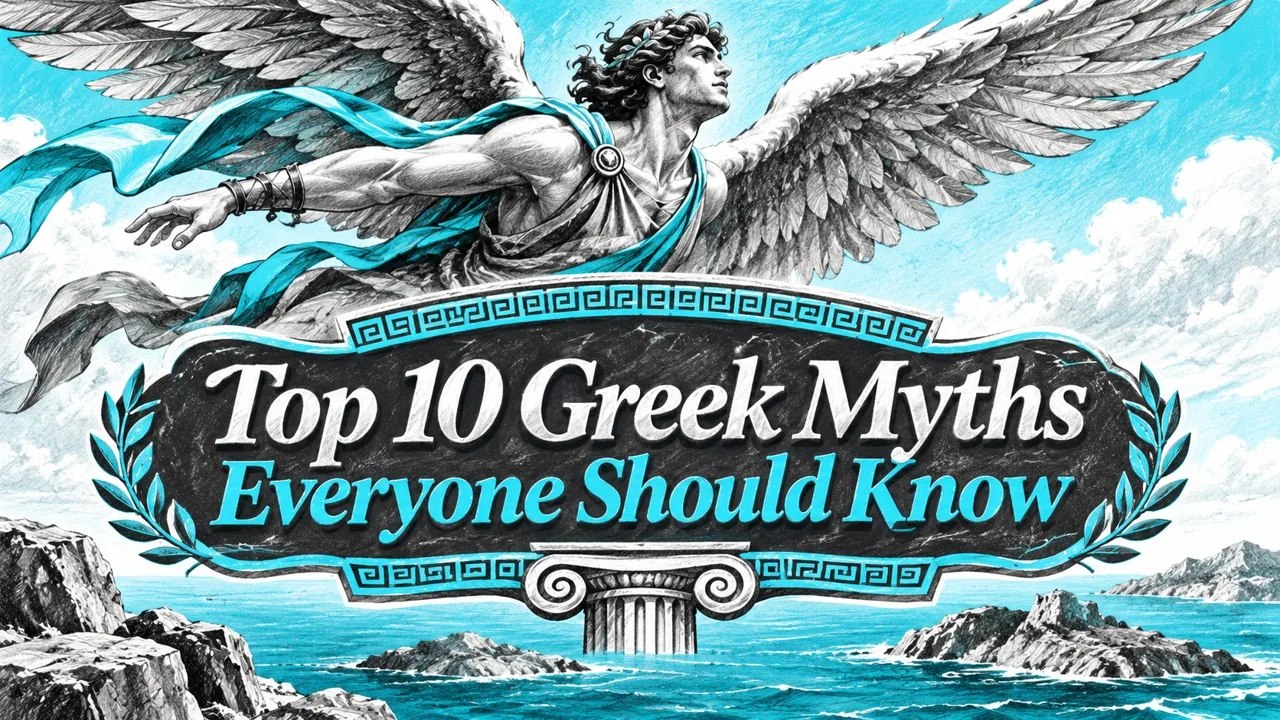
From Prometheus stealing fire to the Trojan Horse, these ten Greek myths everyone should know still shape our words, art and stories thousands of years later. Greek myths are the traditional stories of the ancient Greeks about their gods, heroes and monsters. They were told by poets such as Homer and Hesiod, performed in plays and painted on pottery, and they helped people explain the world and pass on values.
This list picks ten myths that remain widely known and have left a clear mark on language, art and modern storytelling. Many have several ancient versions, so the summaries follow the most familiar forms.
Key Facts
The ten myths below cover gods, heroes, lovers and warnings about pride.
Famous Greek Myths at a Glance
| # | Myth | Main characters | Main theme | Lasting legacy |
|---|---|---|---|---|
| 1 | Prometheus and the Gift of Fire | Prometheus, Zeus | Defiance and sacrifice | Symbol of human progress |
| 2 | Pandora's Jar | Pandora, Zeus, Epimetheus | Curiosity and hope | Phrase Pandora's box |
| 3 | Persephone and the Seasons | Persephone, Demeter, Hades | Loss and renewal | Explanation of the seasons |
| 4 | Orpheus and Eurydice | Orpheus, Eurydice, Hades | Love and loss | Inspired many operas |
| 5 | Icarus and Daedalus | Icarus, Daedalus | Overreaching ambition | Byword for reckless pride |
| 6 | Theseus and the Minotaur | Theseus, Ariadne, Minos | Courage and cleverness | Labyrinth as a symbol |
| 7 | Perseus and Medusa | Perseus, Medusa, Athena | Heroism with divine help | Medusa's head in art |
| 8 | The Trojan Horse | Odysseus, the Greeks, the Trojans | Cunning in war | Phrase Trojan horse |
| 9 | Narcissus and Echo | Narcissus, Echo | Vanity and unrequited love | Words narcissism and echo |
| 10 | King Midas and the Golden Touch | Midas, Dionysus | Greed | Phrase Midas touch |
1. Prometheus and the Gift of Fire
In Greek myth, the Titan Prometheus stole fire from the gods and gave it to humans, against the wishes of Zeus. Fire allowed people to cook, make tools and develop crafts, so the theft was seen as the start of human civilisation. [1]
Zeus punished Prometheus by chaining him to a rock in the Caucasus mountains, where an eagle came every day to eat his liver, which grew back each night. He was eventually freed by the hero Heracles. [1]
The story was told by Hesiod and dramatised in the play Prometheus Bound, traditionally attributed to Aeschylus. Mary Shelley later subtitled her novel Frankenstein as The Modern Prometheus.
In ancient Athens, Prometheus was honoured by craftsmen, especially potters and metalworkers, and torch races were held in his honour during festivals.
Key Figures
- Ancient sources: Hesiod and Prometheus Bound
- Punishment: an eagle eating his liver each day
- Rescuer: Heracles
- Modern echo: Frankenstein, or The Modern Prometheus
Why It Made the List
Prometheus became a symbol of rebellion and human progress. The myth asks how far knowledge should be pursued, and at what cost.
2. Pandora's Jar
According to Hesiod, Pandora was the first woman, created by the gods on Zeus's orders as part of his revenge for the theft of fire. She was given a jar, and when she opened it, evils such as sickness and hardship escaped into the world. [2]
Only hope remained inside when she closed the lid. In the original Greek the container was a large storage jar called a pithos. The idea of a box comes from a later mistranslation, often traced to the Renaissance scholar Erasmus. [2]
Today opening Pandora's box means starting something that causes many unexpected problems. The myth also raised questions about why suffering exists in the world.
Hesiod presented Pandora in a harsh light, but later writers and artists often reimagined her as a more sympathetic figure, a symbol of curiosity rather than blame.
Key Figures
- Ancient source: Hesiod's Works and Days
- Original container: a pithos, a large jar
- What remained inside: hope
- Modern phrase: opening Pandora's box
Why It Made the List
Pandora's story gave a famous explanation for human troubles. Its phrase remains part of everyday speech.
3. Persephone and the Seasons
Persephone, daughter of the harvest goddess Demeter, was carried off by Hades, god of the underworld, to be his wife. Grieving Demeter searched for her daughter and stopped the crops from growing, bringing famine to the earth. [3]
Related: Top 10 Lesser-Known Greek Gods Beyond Olympus
Zeus finally ordered Hades to release Persephone. But because she had eaten pomegranate seeds in the underworld, she had to return there for part of every year. [3]
The myth explained the seasons. When Persephone was below, Demeter mourned and the land was barren, and when she returned, spring came again. The story was central to the Eleusinian Mysteries, secret religious rites held near Athens.
In some versions Persephone ate six seeds and spent six months below, while others give different numbers, but the link between her absence and winter is always the same.
Key Figures
- Main characters: Persephone, Demeter and Hades
- Key detail: pomegranate seeds
- Explains: the cycle of the seasons
- Linked rites: the Eleusinian Mysteries
Why It Made the List
This myth gave a powerful story to the yearly cycle of growth and decay. It also explored grief, love and return.
4. Orpheus and Eurydice
Orpheus was a legendary musician whose songs could charm animals, trees and even stones. When his wife Eurydice died from a snake bite, he travelled to the underworld to bring her back. [4]
His music moved Hades and Persephone, who allowed Eurydice to leave on one condition: Orpheus must not look back at her until they reached the world above. Just before the end he turned around, and she vanished forever. [4]
The story inspired some of the earliest operas, including Monteverdi's L'Orfeo of 1607 and Gluck's Orfeo ed Euridice of 1762. It remains one of the most retold love stories in Western culture.
Orpheus was also linked to a set of religious beliefs and hymns known as Orphism, which taught ideas about the soul and life after death.
Key Figures
- Hero's gift: music that charmed all nature
- Condition: not to look back
- Early opera: Monteverdi's L'Orfeo, 1607
- Later opera: Gluck's Orfeo ed Euridice, 1762
Why It Made the List
Orpheus and Eurydice is a timeless tale of love and loss. It shaped the history of opera and music.
5. Icarus and Daedalus
Daedalus was a brilliant inventor held captive on the island of Crete with his son Icarus. To escape, he made two pairs of wings from feathers held together with wax. [5]
He warned Icarus not to fly too close to the sea, where the wings would get wet, or too near the sun, where the wax would melt. Thrilled by flight, Icarus soared higher and higher until his wings fell apart and he plunged into the sea. [5]
Related: Top 10 Mythical Creatures in World Mythology - That Inspired Myths Across Civilizations (unchanged)
The Roman poet Ovid told the story in his Metamorphoses. The sea where Icarus fell is still called the Icarian Sea, and the myth has inspired paintings, poems and the idea of flying too high.
Daedalus survived the flight and reached Sicily. In the myths he was also credited with building the labyrinth of King Minos, linking this story to the tale of Theseus.
Key Figures
- Inventor: Daedalus
- Material of the wings: feathers and wax
- Famous retelling: Ovid's Metamorphoses
- Place name: the Icarian Sea
Why It Made the List
The fall of Icarus is the classic warning against overconfidence. It also celebrates the dream of human flight.
6. Theseus and the Minotaur
King Minos of Crete kept the Minotaur, a monster half man and half bull, in a labyrinth built by Daedalus. Athens was forced to send young men and women to be fed to it. [6]
The Athenian hero Theseus volunteered to go. Minos's daughter Ariadne gave him a ball of thread, which he unwound as he entered the labyrinth. He killed the Minotaur and followed the thread back out. [6]
On the way home Theseus forgot to change his black sails to white, so his father Aegeus thought he had died and threw himself into the sea, which was later called the Aegean. The labyrinth remains a powerful symbol of complex problems.
Archaeologists exploring the palace of Knossos on Crete in the early twentieth century found a maze-like complex of rooms and images of bull-leaping, which some linked to the legend.
Key Figures
- Monster: the Minotaur
- Helper: Ariadne and her thread
- Builder of the labyrinth: Daedalus
- Place name legend: the Aegean Sea
Why It Made the List
This myth combines bravery, ingenuity and tragedy. Its thread and labyrinth are still used as images for solving problems.
7. Perseus and Medusa
Medusa was a Gorgon whose gaze could turn people to stone. The hero Perseus was sent to bring back her head, an apparently impossible task. [7]
With help from the gods, including a polished shield from Athena and winged sandals, Perseus approached Medusa by watching her reflection and cut off her head. Pegasus, the winged horse, sprang from her body. [7]
Related: Top 10 Mythical Creatures of Indian and Asian Mythology
On his way home Perseus used the head to rescue Andromeda from a sea monster. Medusa's head became a protective image in Greek art and still appears in design and fashion.
Several constellations are named after figures in this story, including Perseus, Andromeda, Cassiopeia, Cepheus and Cetus, the sea monster, so the myth is written across the night sky as well.
Key Figures
- Weapon against her gaze: a reflecting shield
- Divine helpers: Athena and Hermes
- Born from Medusa: the winged horse Pegasus
- Rescued princess: Andromeda
Why It Made the List
Perseus is one of the great monster-slayers of myth. His story still shapes how heroes and monsters are pictured.
8. The Trojan Horse
After ten years of fighting at Troy, the Greeks built a huge wooden horse and hid soldiers inside. They pretended to sail away, leaving the horse as an apparent offering. [8]
The Trojans pulled the horse into their city. That night the hidden soldiers climbed out and opened the gates to the returning Greek army, and Troy was destroyed. The plan is credited to the cunning hero Odysseus. [8]
The story is told most fully in Virgil's Aeneid and is mentioned in Homer's Odyssey. Today a Trojan horse means a trick that hides danger inside a gift, and the term is used for harmful computer programs.
Historians still debate whether a real war lies behind the legend. Excavations at Hisarlik in Turkey revealed a city destroyed several times, which many identify as Troy, but no evidence of a wooden horse has been found.
Key Figures
- Length of the war: ten years
- Credited planner: Odysseus
- Main ancient sources: Virgil's Aeneid and Homer's Odyssey
- Modern meaning: malicious software disguised as useful
Why It Made the List
The Trojan Horse is the most famous trick in legend. Its name lives on in both everyday speech and computer security.
9. Narcissus and Echo
Narcissus was a beautiful young man who rejected everyone who loved him, including the nymph Echo. Echo had been cursed by the goddess Hera so that she could only repeat the last words spoken to her. [9]
As punishment for his pride, Narcissus fell in love with his own reflection in a pool. Unable to leave it, he wasted away, and a flower, the narcissus, grew where he died. Echo faded until only her voice remained. [9]
Related: Top 10 Historical Myths and the Texts That Started Them
Ovid's version in the Metamorphoses made the story famous. It gave English the words narcissism, for excessive self-love, and echo, for a repeated sound.
The narcissus, the plant group that includes daffodils, often grows beside water and bends its head downwards, which fits the image of a youth gazing into a pool.
Key Figures
- Curse on Echo: repeating others' last words
- Flower named after him: narcissus
- Famous version: Ovid's Metamorphoses
- Modern words: narcissism and echo
Why It Made the List
This myth explains two common words and warns against self-obsession. It remains a popular subject in art and psychology.
10. King Midas and the Golden Touch
King Midas of Phrygia did a favour for the god Dionysus and was offered a wish. He asked that everything he touched would turn to gold. [10]
At first he was delighted, but soon he found that his food and drink also turned to metal, and he could not eat. In some versions even his daughter turned to gold. He begged Dionysus to take back the gift and was told to wash in the river Pactolus. [10]
The river's sands were said to contain gold ever after, which ancient writers used to explain the wealth of nearby Lydia. Today the Midas touch means the ability to make money from anything.
Another myth about Midas tells how Apollo gave him donkey's ears after he judged a music contest unfairly, a story about poor taste rather than greed.
Key Figures
- Kingdom: Phrygia
- God who granted the wish: Dionysus
- Cure: washing in the river Pactolus
- Modern phrase: the Midas touch
Why It Made the List
Midas is the classic story about greed. Its lesson that wealth cannot feed us still feels relevant.
Conclusion
These ten myths have lasted because they deal with timeless themes such as love, pride, courage, curiosity and loss. They gave the ancient Greeks ways to explain the seasons, the origins of suffering and the dangers of arrogance.
Their influence is everywhere today, in words such as narcissism and echo, phrases like the Midas touch, and countless novels, films and paintings. Knowing them makes much of Western art and literature easier to understand.
- ^ [1] "Prometheus and the Gift of Fire". Wikipedia. Wikipedia: Prometheus Wikipedia: Prometheus Bound
- ^ [2] "Pandora's Jar". Wikipedia. Wikipedia: Pandora Wikipedia: Pandora's box
- ^ [3] "Persephone and the Seasons". Wikipedia. Wikipedia: Persephone Wikipedia: Eleusinian Mysteries
- ^ [4] "Orpheus and Eurydice". Wikipedia. Wikipedia: Orpheus Wikipedia: Eurydice
- ^ [5] "Icarus and Daedalus". Wikipedia. Wikipedia: Icarus Wikipedia: Daedalus
- ^ [6] "Theseus and the Minotaur". Wikipedia. Wikipedia: Theseus Wikipedia: Minotaur
- ^ [7] "Perseus and Medusa". Wikipedia. Wikipedia: Perseus Wikipedia: Medusa
- ^ [8] "The Trojan Horse". Wikipedia. Wikipedia: Trojan Horse Wikipedia: Trojan War
- ^ [9] "Narcissus and Echo". Wikipedia. Wikipedia: Narcissus (mythology) Wikipedia: Echo (mythology)
- ^ [10] "King Midas and the Golden Touch". Wikipedia. Wikipedia: Midas Wikipedia: Pactolus





















Discussion
Log in with