



 By
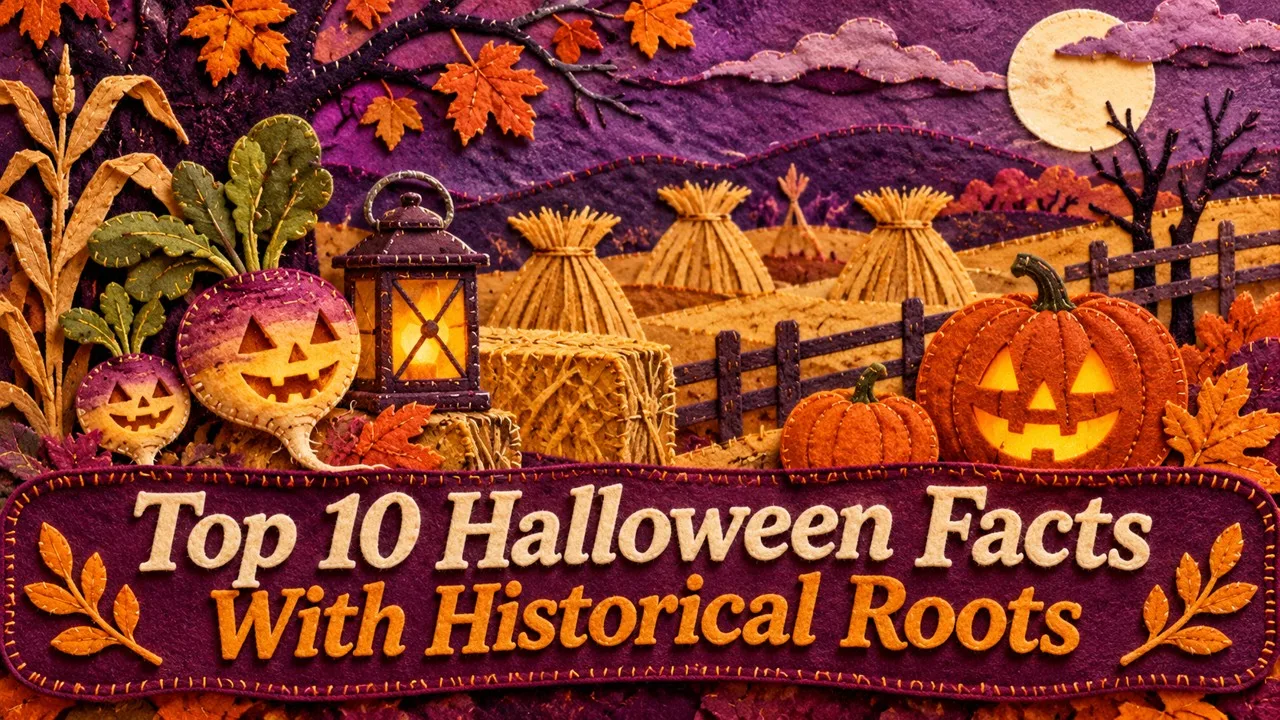
Turnip lanterns, soul cakes, marriage fortunes and a town that tamed its pranksters: ten Halloween customs and the history that lies behind them. Halloween is celebrated on 31 October in many countries, with costumes, carved pumpkins, sweets, parties and spooky decorations. For many people, it is simply a fun night of dressing up and collecting treats.
Yet many Halloween customs have deep historical roots. They draw on ancient festivals, medieval religious practices, folk traditions and the experiences of immigrants who carried their customs to new lands.
The history of Halloween is complex, and scholars debate how much it owes to pre-Christian festivals and how much to Christian traditions. The holiday developed over many centuries, combining influences from different sources.
Some familiar customs are much more recent than people assume. Trick-or-treating, for example, became widespread only in the twentieth century.
Other customs have changed dramatically over time. Lanterns once carved from turnips became pumpkins, and fortune-telling games became party entertainment.
The customs in this list come mainly from Ireland, Scotland, England and North America, where Halloween developed its modern form.
Where the origins of a custom are uncertain or debated, that is noted.
Each entry names the custom or fact, where it began and its historical roots, followed by an account of its history.
The entries are arranged in roughly chronological order of their origins.
Together, they show how a single night of the year carries layers of history, from ancient festivals to modern marketing.
Folklorists in the nineteenth and early twentieth centuries collected many descriptions of Halloween customs in rural Ireland, Scotland, Wales and the Isle of Man. Their records describe bonfires on hillsides, special foods such as barmbrack and colcannon with hidden charms that foretold the future, and games played by families gathered around the hearth. In Wales, the night before 1 November was known as Nos Calan Gaeaf, the first night of winter, and had its own traditions of bonfires and stories of spirits.
Key Facts
| # | Custom or fact | Where it began | Historical roots |
|---|---|---|---|
| 1 | Samhain | Ireland and Scotland | Gaelic seasonal festival |
| 2 | The name Halloween | Western Christianity | All Hallows' Eve |
| 3 | Souling | England and other parts of Britain | Medieval prayers for the dead |
| 4 | Guising | Scotland and Ireland | Folk customs of disguise |
| 5 | The jack-o'-lantern | Ireland and Britain | Folk lanterns and legends |
| 6 | Divination games and apple bobbing | Scotland, Ireland and England | Folk divination |
| 7 | The black cat as a Halloween symbol | Europe and North America | Early modern witchcraft beliefs |
| 8 | Candy corn | United States | Nineteenth-century confectionery |
| 9 | Community Halloween celebrations | Anoka, Minnesota | Early twentieth-century reforms |
| 10 | Trick-or-treating | North America | Twentieth-century custom |
1. A Festival at Summer's End
Samhain was a Gaelic festival marking the end of the harvest season and the beginning of winter. It was celebrated in Ireland, Scotland and the Isle of Man around 1 November, beginning on the evening before [1].
Medieval Irish literature describes Samhain as a time of gatherings and feasts. It was also seen as a time when the boundary between the human world and the otherworld was thin, allowing spirits and supernatural beings to cross over. Bonfires were lit in many places [1].
Many writers have linked Halloween to Samhain, and the connection is widely accepted. However, scholars debate how directly modern customs descend from the ancient festival, since much of the evidence comes from later sources.
Related: Brazil: A Comprehensive Overview of the South American Giant
2. The Evening Before All Saints
The name Halloween comes from All Hallows' Eve, the evening before All Hallows' Day, also known as All Saints' Day, on 1 November. Hallow is an old word for a saint or holy person [2].
In the medieval church, All Saints' Day honoured all saints, while All Souls' Day on 2 November was dedicated to praying for the souls of the dead. Together, these days formed a period devoted to remembering the dead [2].
Over time, the evening before All Saints' Day became known as All Hallows' Even, which was shortened to Halloween. The Scottish poet Robert Burns helped popularise the name with his poem Halloween, published in 1786.
3. Cakes for the Souls of the Dead
In medieval and early modern England, people, often the poor or children, went from door to door around All Souls' Day. They offered to pray for the souls of the dead in exchange for small cakes known as soul cakes [3].
The practice, called souling, combined charity with religious belief in praying for souls in purgatory. Songs associated with souling were recorded in later centuries in parts of England [3].
Some writers see souling as a forerunner of trick-or-treating, since both involve going door to door for food. The connection is plausible, although modern trick-or-treating developed much later and from several influences.
4. Disguises at the Door
In Scotland and Ireland, children and young people traditionally went door to door at Halloween in disguise, a practice known as guising. They performed songs, poems or jokes in exchange for food, coins or other treats [4].
Wearing disguises may have been linked to older beliefs about spirits being abroad at this time of year, though the exact origins are uncertain. Records of guising in Scotland date back to at least the late nineteenth century [4].
Guising is still practised in parts of Scotland, where children are often expected to perform a trick or a joke before receiving treats. The custom influenced Halloween traditions in North America.
5. Lanterns Carved From Turnips
In Ireland and parts of Britain, people traditionally carved lanterns from turnips, swedes or mangel-wurzels at Halloween. The lanterns, sometimes carved with faces, were used to light the way or to ward off spirits [5].
Related: Top 10 Reasons Why the World Loves Coffee
The name jack-o'-lantern was originally used for a will-o'-the-wisp, a mysterious light seen over marshes. An Irish folk tale tells of Stingy Jack, a man who tricked the devil and was doomed to wander the earth with only a coal in a hollowed turnip to light his way [5].
When Irish and Scottish immigrants brought the custom to North America, they found that pumpkins were larger and easier to carve. Carved pumpkins became the iconic symbol of Halloween.
6. Fortune-Telling for Love
Halloween was traditionally a time for fortune-telling, especially about love and marriage. Young people played games to discover who their future spouse might be [6].
Robert Burns's poem Halloween describes many of these customs, such as pulling kale stalks and roasting nuts in a fire to see whether a couple would stay together. Another custom involved peeling an apple in a single long strip and throwing the peel over one's shoulder to see what letter it formed [6].
Apple bobbing, in which players try to catch apples floating in water using only their teeth, was also associated with Halloween and fortune-telling. It remains a popular party game, although its divinatory meaning has largely been forgotten.
7. Black Cats and Witches
Black cats are among the most familiar symbols of Halloween. Their association with the holiday comes from older beliefs linking cats, particularly black cats, with witches and bad luck [7].
In early modern Europe, during the period of witch trials, cats were sometimes described as the familiars or companions of witches. Such ideas contributed to superstitions about black cats [7].
When Halloween developed its modern imagery in the late nineteenth and early twentieth centuries, witches and black cats became standard decorations on postcards and in shop displays. Today, animal welfare groups sometimes take precautions around Halloween to protect black cats.
8. A Sweet With a Long History
Candy corn, a small tricoloured sweet shaped like a kernel of corn, is one of the most famous Halloween treats in the United States. It dates back to the late nineteenth century [8].
Related: Top 10 Halloween Towns in America
According to commonly cited accounts, it was created in the 1880s by a confectioner working for a candy company in Philadelphia. Another company began producing it on a large scale in the following decades. It was originally made by hand, pouring layers of coloured syrup into moulds [8].
Candy corn was originally associated with autumn and harvest themes rather than specifically with Halloween. It became a Halloween staple as trick-or-treating grew popular in the twentieth century.
9. A Town That Turned Pranks Into Parades
In the late nineteenth and early twentieth centuries, Halloween in North America was often associated with pranks and vandalism. Young people overturned outhouses, let animals loose and played other tricks that sometimes caused real damage [9].
In 1920, the town of Anoka, Minnesota, organised a Halloween celebration with a parade and activities to keep young people out of trouble. The town claims to have held one of the first organised Halloween celebrations in the United States [9].
Other communities followed with parties, parades and organised activities. These efforts helped transform Halloween from a night of mischief into a family-friendly festival.
10. The Phrase Trick or Treat
The phrase trick or treat appeared in print in North America in the 1920s. One of the earliest known uses comes from a newspaper report from Alberta, Canada, in 1927, describing children demanding treats [10].
The custom spread in the 1930s, but sugar rationing during the Second World War limited it. After the war, trick-or-treating became widespread, encouraged by the growth of suburbs and by appearances in popular culture, including cartoons and children's magazines [10].
Today, trick-or-treating is the central Halloween activity for many children in North America, and it has spread to other countries. It brings together older traditions of guising and souling with modern consumer culture.
Conclusion
These customs show how Halloween developed over centuries, combining Gaelic, Christian and folk traditions with modern innovations.
Related: Top 10 Facts About Greenland
Many familiar customs, such as carved pumpkins and trick-or-treating, are adaptations of older practices brought by immigrants to North America.
Some aspects of Halloween's history remain debated, including how much it owes to ancient festivals such as Samhain.
The holiday has continued to evolve, absorbing new influences from popular culture, commerce and different communities.
Halloween is now celebrated in many countries, often with local variations that blend imported customs with national traditions.
The commercial importance of Halloween has grown enormously, with costumes, decorations and sweets generating large sales each year.
For those who celebrate it, understanding Halloween's history adds a new layer of meaning to a night of costumes, lanterns and treats.
Halloween also has a quieter side that is easy to forget. For many Christians, the following days of All Saints and All Souls remain a time for visiting graves, lighting candles and remembering family members who have died, linking the modern festival to its older purpose.
Historians continue to search old newspapers, diaries and letters for early references to Halloween customs, and new finds sometimes push the known history of a tradition further back in time.
- ^ [1] Accounts of Samhain. Wikipedia: Samhain Wikipedia: Halloween
- ^ [2] Accounts of All Hallows' Eve. Wikipedia: All Saints' Day Wikipedia: All Souls' Day
- ^ [3] Accounts of souling. Wikipedia: Souling Wikipedia: Soul cake
- ^ [4] Accounts of guising. Wikipedia: Guising Wikipedia: Halloween costume
- ^ [5] Accounts of the jack-o'-lantern. Wikipedia: Jack-o'-lantern Wikipedia: Will-o'-the-wisp
- ^ [6] Accounts of Halloween divination. Wikipedia: Halloween (poem) Wikipedia: Apple bobbing
- ^ [7] Accounts of black cats. Wikipedia: Black cat Wikipedia: Familiar
- ^ [8] Accounts of candy corn. Wikipedia: Candy corn Wikipedia: Confectionery
- ^ [9] Accounts of Anoka's celebration. Wikipedia: Anoka, Minnesota Wikipedia: Parade
- ^ [10] Accounts of trick-or-treating. Wikipedia: Trick-or-treating Wikipedia: Rationing in the United States



















Discussion
Log in with