




 By
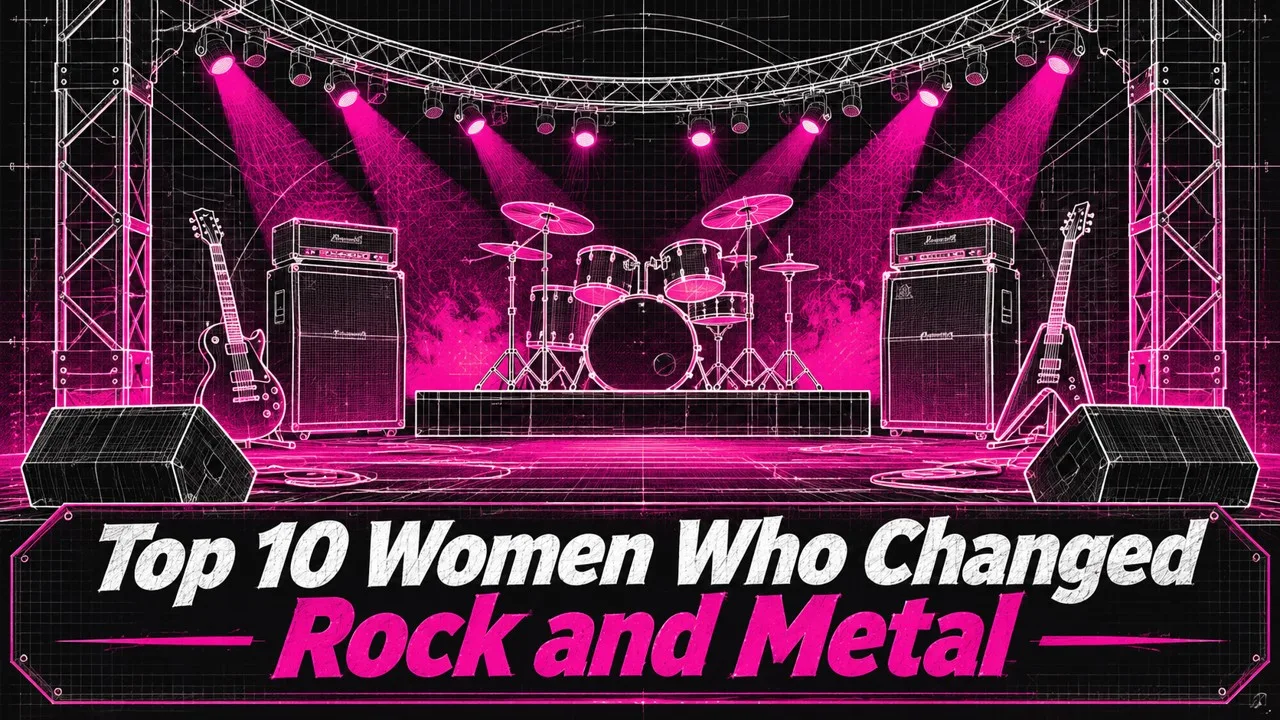
From the gospel guitarist who inspired rock and roll to the growling frontwoman of a death metal band: ten women who changed rock and metal. Rock and metal have often been portrayed as male-dominated genres. Bands, guitar heroes and frontmen have filled magazine covers, while women were frequently treated as exceptions or novelties.
Yet women have been part of rock music from its very beginnings. Some of them helped create the sound that became rock and roll, while others broke barriers in genres that had few female role models.
The women in this list include guitarists, singers, bassists and bandleaders. They came from the United States, Britain and Germany, and their careers span from the 1940s to the twenty-first century.
Many of them faced prejudice, condescension and pressure to fit narrow images of how women performers should look and behave. Several were dismissed as gimmicks before proving their talent to audiences and critics.
Their influence can be measured in hit records, but also in the musicians they inspired. Many later artists, both women and men, have named these performers as major influences.
Several of them have since been inducted into the Rock and Roll Hall of Fame, a recognition that in some cases came decades after their most important work.
This list is not a ranking. It is a selection of influential figures from different eras and styles, and many other women could have been included.
Each entry names the musician, what she is best known for and the era of her breakthrough, followed by an account of her career and influence.
The entries are arranged in chronological order of their breakthroughs.
Together, they show that the history of rock and metal cannot be told without the women who helped shape it.
Key Facts
| # | Musician | Known for | Breakthrough era |
|---|---|---|---|
| 1 | Sister Rosetta Tharpe | Electric gospel guitar | 1930s and 1940s |
| 2 | Wanda Jackson | Rockabilly singing | 1950s |
| 3 | Grace Slick | Jefferson Airplane | 1960s |
| 4 | Janis Joplin | Blues rock singing | 1960s |
| 5 | Suzi Quatro | Leading a rock band on bass | 1970s |
| 6 | Ann and Nancy Wilson | Heart | 1970s |
| 7 | Joan Jett | Punk and hard rock | 1970s and 1980s |
| 8 | Girlschool | All-female heavy metal | Late 1970s and early 1980s |
| 9 | Doro Pesch | German heavy metal | 1980s |
| 10 | Angela Gossow | Extreme metal vocals | 2000s |
1. The Godmother of Rock and Roll
Sister Rosetta Tharpe was a gospel singer and guitarist who became one of the first popular recording artists to combine spiritual lyrics with an energetic, amplified guitar style. Born in Arkansas in 1915, she began performing in church as a child. In the late 1930s, she gained wide popularity with recordings and performances in New York [1].
Her 1944 recording Strange Things Happening Every Day is often cited as an early forerunner of rock and roll. Her distorted electric guitar playing and showmanship influenced many later performers. Musicians including Chuck Berry, Elvis Presley and Little Richard have been linked to her influence [1].
Related: Top 10 Chance Meetings That Formed Famous Bands
For years after her death in 1973, Tharpe was largely overlooked in popular histories of rock. Renewed interest led to her induction into the Rock and Roll Hall of Fame in 2018. She is now widely known as the godmother of rock and roll.
2. The Queen of Rockabilly
Wanda Jackson began her career as a country singer in Oklahoma in the 1950s. After touring with Elvis Presley in the mid-1950s, she was encouraged to try the new rockabilly style. Her powerful, raw voice proved ideal for it [2].
Songs such as Let's Have a Party, released in 1960, made her one of the few women performing rockabilly at the time. Her energetic style was unusual for a female performer of the era, and she became known as the Queen of Rockabilly [2].
Jackson continued performing for decades and enjoyed a revival in later life, recording with younger musicians. She was inducted into the Rock and Roll Hall of Fame in 2009.
3. The Voice of Psychedelic Rock
Grace Slick joined the San Francisco band Jefferson Airplane in 1966. Her powerful voice and stage presence made her one of the leading figures of the psychedelic rock movement. The band became one of the most prominent groups of the counterculture [3].
Two songs she brought to the band, Somebody to Love and White Rabbit, became hits in 1967. White Rabbit, which she wrote, drew on imagery from Alice in Wonderland and became an anthem of the era [3].
Slick continued with the later bands Jefferson Starship and Starship, which had several hits in the 1970s and 1980s. She was inducted into the Rock and Roll Hall of Fame with Jefferson Airplane in 1996.
4. The Blues Shouter
Janis Joplin grew up in Port Arthur, Texas, and moved to San Francisco in the 1960s. As the singer of Big Brother and the Holding Company, she became famous after a celebrated performance at the Monterey Pop Festival in 1967. Her intense, raw vocal style was unlike that of any other rock singer of the time [4].
Joplin later pursued a solo career and performed at the Woodstock festival in 1969. She became one of the biggest stars of her generation and a symbol of the era's rebellion [4].
She died in 1970 at the age of 27. Her recording of Me and Bobby McGee became a number one hit in the United States after her death. She was inducted into the Rock and Roll Hall of Fame in 1995.
Related: Top 10 Most Bizarre Phobias: Strange Fears That Exist
5. The Bass-Playing Frontwoman
Suzi Quatro, born in Detroit, moved to Britain in the early 1970s and became a star there. She sang and played bass guitar at the front of her band, dressed in a leather jumpsuit. At the time, very few women led rock bands while playing an instrument [5].
Her single Can the Can reached number one in the United Kingdom in 1973, followed by other hits. She also gained fame in the United States through her role as the character Leather Tuscadero in the television series Happy Days [5].
Quatro has been cited as an important influence by later women in rock, including Joan Jett. She showed that a woman could be a rock bandleader and instrumentalist rather than only a singer.
6. The Sisters Who Rocked Arenas
Sisters Ann and Nancy Wilson led the band Heart, which emerged from the Pacific Northwest in the 1970s. Ann was the band's powerful lead singer, while Nancy played guitar and sang. They were among the first women to lead a hard rock band to major commercial success [6].
Songs such as Crazy on You and Barracuda became hard rock classics. The Wilsons wrote or co-wrote much of the band's material, at a time when female rock songwriters were rare [6].
Heart had further hits in the 1980s and continued performing for decades. The band was inducted into the Rock and Roll Hall of Fame in 2013.
7. The Runaway Who Loved Rock and Roll
Joan Jett co-founded the all-female band the Runaways in Los Angeles in 1975, while still a teenager. The band, which also included the guitarist Lita Ford, played hard rock and helped open doors for women in the genre [7].
After the Runaways split, Jett formed Joan Jett and the Blackhearts. Their version of I Love Rock and Roll spent seven weeks at number one in the United States in 1982 [7].
Jett also founded her own record label with her producer, Kenny Laguna, after major labels rejected her. She was inducted into the Rock and Roll Hall of Fame with the Blackhearts in 2015.
Related: Top 10 Oldest Buildings in the World
8. Heavy Metal From London
Girlschool was formed in London in 1978 and became one of the first all-female bands in heavy metal. The band was part of the new wave of British heavy metal, a movement that revitalised the genre at the end of the 1970s [8].
Girlschool toured with Motorhead, and in 1981 the two bands released a joint record that reached the top five of the British singles chart. The collaboration brought the band to a wider audience [8].
Girlschool continued recording and touring for decades, making it one of the longest-running all-female rock bands. It showed that women could succeed in one of the loudest and most aggressive styles of rock.
9. The Metal Queen
Doro Pesch rose to fame in the 1980s as the singer of the German heavy metal band Warlock. The band's album Triumph and Agony, released in 1987, brought international attention. Pesch became one of the few women fronting a major heavy metal band in that decade [9].
After Warlock, she continued under her own name, Doro, recording many albums and touring widely. She has been nicknamed the Metal Queen [9].
Pesch has remained active in heavy metal for decades and is often cited as an inspiration by later female metal vocalists. She helped establish a place for women in a genre often seen as male territory.
10. The Growl That Broke Expectations
Angela Gossow, a German singer, joined the Swedish melodic death metal band Arch Enemy in 2000. She performed using harsh, growled vocals typical of extreme metal. Many listeners were surprised to learn that the voice belonged to a woman [10].
Arch Enemy achieved international success with Gossow as its vocalist, and she became one of the most prominent women in extreme metal. Her success challenged assumptions about who could perform such vocals [10].
Gossow left the vocalist role in 2014 and moved into managing the band. She was succeeded by another female vocalist, Alissa White-Gluz, and many other women have since performed extreme metal vocals.
Related: The Evolution of Stranger Things: Seasons, Themes, and Characters
Conclusion
These women changed rock and metal by proving that talent, energy and creativity had nothing to do with gender. Each opened a door for those who followed.
Some, like Sister Rosetta Tharpe, helped create the sound of rock and roll itself. Others broke barriers in specific styles, from rockabilly to death metal.
Many of them faced prejudice and were underrated in their time. Recognition such as Hall of Fame inductions often came years or decades later.
Their influence can be heard in the many women who now play every style of rock and metal, as singers, guitarists, bassists, drummers and songwriters.
The history of popular music is still being rewritten as researchers and fans rediscover the contributions of women who were overlooked.
Women remain underrepresented in many parts of the music industry, but the path these artists forged has made it easier for new generations to pick up instruments and microphones.
For music fans, exploring the recordings of these pioneers is a rewarding way to hear how rock and metal developed, and who helped shape them.
Music journalists and historians have increasingly revisited the role of women in rock, through books, documentaries and museum exhibitions. These projects have highlighted performers who were famous in their day but later left out of the standard story, as well as session musicians, songwriters and producers whose names rarely appeared on record sleeves. The result is a richer and more accurate picture of how rock and metal grew from rhythm and blues, gospel and country into the many styles heard today.
- ^ [1] Accounts of Sister Rosetta Tharpe. Wikipedia: Sister Rosetta Tharpe Wikipedia: Rock and Roll Hall of Fame
- ^ [2] Accounts of Wanda Jackson. Wikipedia: Wanda Jackson Wikipedia: Rockabilly
- ^ [3] Accounts of Grace Slick. Wikipedia: Grace Slick Wikipedia: Jefferson Airplane
- ^ [4] Accounts of Janis Joplin. Wikipedia: Janis Joplin Wikipedia: Monterey International Pop Festival
- ^ [5] Accounts of Suzi Quatro. Wikipedia: Suzi Quatro Wikipedia: Can the Can
- ^ [6] Accounts of Heart. Wikipedia: Heart (band) Wikipedia: Ann Wilson
- ^ [7] Accounts of Joan Jett. Wikipedia: Joan Jett Wikipedia: The Runaways
- ^ [8] Accounts of Girlschool. Wikipedia: Girlschool Wikipedia: New wave of British heavy metal
- ^ [9] Accounts of Doro Pesch. Wikipedia: Doro Pesch Wikipedia: Warlock (band)
- ^ [10] Accounts of Angela Gossow. Wikipedia: Angela Gossow Wikipedia: Arch Enemy




















Discussion
Log in with