

 By
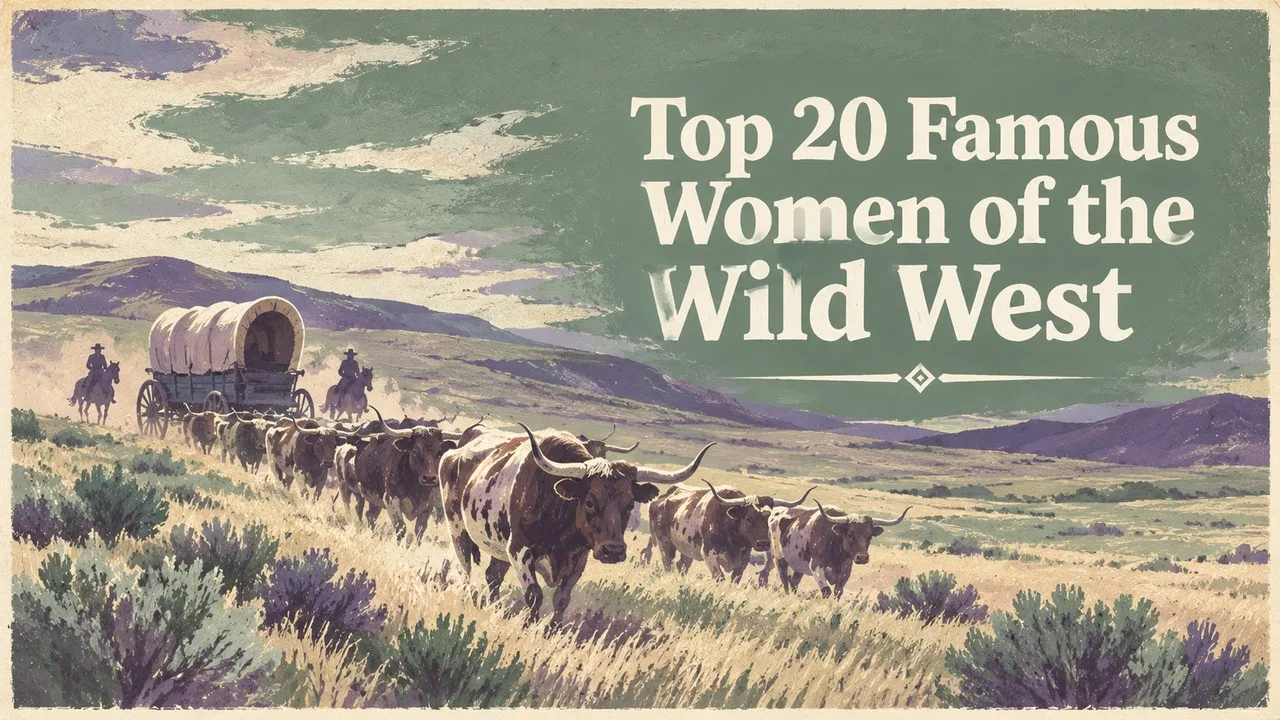
Sharpshooters, outlaws, gamblers, ranchers and pioneers, these twenty women of the Wild West lived lives as bold as any of the men around them. Popular films long cast women on the frontier as schoolteachers, saloon girls or settlers' wives, but the real history is far more varied.
Women ran businesses in mining towns, carried the mail across mountains, dealt cards in saloons and fought to defend their homelands. Some became famous in their own lifetimes thanks to newspapers, dime novels and travelling shows, which often exaggerated their adventures.
For this Finepedia list we chose twenty women active in the American West between the 1830s and the early 1900s, from a Santa Fe casino owner and an Oregon Trail missionary to a rodeo champion and a Texas cattle queen, drawing on museum, park service and historical society records. For each we separate the documented facts from the legends that grew up around them, because in several cases the myth became far more famous than the woman herself.
Key Facts
The table below gives a quick overview of all twenty entries before each one is described in detail.
| # | Entry | Real name | Born–died | Known for | Main region |
|---|---|---|---|---|---|
| 1 | Annie Oakley | Phoebe Ann Moses | 1860–1926 | Sharpshooting and show business | Ohio and touring worldwide |
| 2 | Calamity Jane | Martha Jane Canary | c. 1852/1856–1903 | Frontier legend and storyteller | Wyoming, Dakota Territory |
| 3 | Belle Starr | Myra Maybelle Shirley | 1848–1889 | The Bandit Queen | Missouri, Indian Territory |
| 4 | Pearl Hart | Pearl Taylor | c. 1871–uncertain | Stagecoach robbery | Arizona Territory |
| 5 | Mary Fields | Mary Fields, Stagecoach Mary | early 1830s–1914 | First Black woman Star Route mail carrier | Montana |
| 6 | Poker Alice | Alice Ivers Tubbs | 1851–1930 | Professional gambler | Colorado, Dakota Territory |
| 7 | Etta Place | Unknown (alias Ethel or Etta Place) | unknown | Companion of the Sundance Kid | Wyoming, New York, Argentina |
| 8 | Lozen | Lozen | c. 1840–1889 | Apache warrior and seer | New Mexico, Arizona |
| 9 | Nellie Cashman | Ellen Cashman | 1845–1925 | Miner, businesswoman and philanthropist | Arizona, Yukon, Alaska |
| 10 | Sarah Winnemucca | Thocmetony | 1844–1891 | Author, interpreter and activist | Nevada, Oregon |
| 11 | Biddy Mason | Bridget Mason | 1818–1891 | Won her freedom in court, then built a fortune | California |
| 12 | Eleanor Dumont | Probably Simone Jules | c. 1829–1879 | Card dealer known as Madame Moustache | California, Nevada, Montana |
| 13 | Laura Bullion | Laura Bullion, alias Della Rose | c. 1876–1961 | Member of the Wild Bunch | Texas, Montana, Tennessee |
| 14 | Ellen Watson | Ellen Liddy Watson, called Ella | 1860/1861–1889 | Homesteader lynched and branded Cattle Kate | Wyoming Territory |
| 15 | Esther Hobart Morris | Esther Hobart McQuigg | 1814–1902 | Pioneering woman judge in South Pass City | Wyoming Territory |
| 16 | Lucille Mulhall | Lucille Mulhall | 1885–1940 | Champion roper and one of the first cowgirls | Oklahoma |
| 17 | Margaret Borland | Margaret Heffernan | 1824–1873 | Led her own cattle drive to Kansas | Texas, Kansas |
| 18 | Sally Scull | Sarah Jane Newman | 1817–unknown | Pistol-carrying horse trader and freighter | Texas, Mexican border |
| 19 | Narcissa Whitman | Narcissa Prentiss | 1808–1847 | Missionary and early overland traveller | Oregon Country |
| 20 | Doña Tules | María Gertrudis Barceló | c. 1800–1852 | Monte dealer and casino owner | Santa Fe, New Mexico |
1. Annie Oakley
The most famous sharpshooter of the age was born Phoebe Ann Moses in Darke County, Ohio, on 13 August 1860. The Buffalo Bill Center of the West explains that she came from a poor family and learned to shoot to help feed them.[1]
Her talent soon took her far. A shooting match against the marksman Frank Butler, whom she later married, set her on the road to fame.[2] In 1884 she befriended the Lakota leader Sitting Bull, who admired her skill and her modest manner.[1]
In 1885 she joined Buffalo Bill's Wild West show, where she was its only female performer and was billed as the World's Champion Markswoman.[2] She and Butler stayed with the show for seventeen years. In 1887 the show travelled to England for Queen Victoria's Golden Jubilee, and Annie's skill drew huge attention in the British press.[1]
Annie Oakley never lived in the Wild West in the traditional sense. She was a performer who presented the frontier to the world. Yet her accuracy and showmanship made her one of the most recognisable American women of her time, and her life later inspired the musical Annie Get Your Gun.
2. Calamity Jane
Calamity Jane is the best example of a frontier woman whose legend outgrew her life. Born Martha Jane Canary in Missouri, she is usually given a birth date of 1 May 1852, although some records suggest a later year.[3]
WyoHistory.org, published by the Wyoming State Historical Society, explains that many of the most famous stories about her, such as her work as a professional army scout or her supposed romance with Wild Bill Hickok, are probably exaggerations of her real reputation for generosity and boisterous spirit.[4]
Her fame took off in October 1877, when she appeared as a heroine in Edward Wheeler's dime novel Deadwood Dick, The Prince of the Road. In 1896 she published a short autobiographical booklet to sell at fairs and public appearances, adding further to the myth.[4]
Calamity Jane did travel with a wagon train that included Hickok in 1876, and she spent time in the mining town of Deadwood.[3] She died in 1903 and, according to her wishes, was buried in Deadwood's Mount Moriah Cemetery beside Wild Bill.[3]
3. Belle Starr
Belle Starr, known as the Bandit Queen, was born Myra Maybelle Shirley in Jasper County, Missouri, on 5 February 1848. The Oklahoma Historical Society notes that she was educated at a girls' academy in Carthage, Missouri.[5]
Her life was closely linked with outlaws. In 1866 she married James C. Reed, a former member of the Confederate guerrilla band known as Quantrill's Raiders, but she left him because of his involvement in robberies, and he was killed in 1874. In 1880 she married Sam Starr, and the couple settled at a place called Youngers' Bend in the Cherokee Nation, near present-day Eufaula, Oklahoma.[5]
Their cabin became a hideout for outlaws during the early 1880s. Yet despite her fearsome reputation, the society states that her only documented crime was the theft of a horse in 1882.[5]
Belle's legend was created largely by newspapers and sensational books after her death. On 3 February 1889, she was shot in the back by an unknown attacker, and her killing has never been solved. She was buried at Youngers' Bend.[5]
4. Pearl Hart
Pearl Hart became famous for one of the last stagecoach robberies in the American West. On 30 May 1899, she and a man known as Joe Boot held up the coach between Globe and Florence, Arizona, at a spot near Cane Springs Canyon.[6]
The Sharlot Hall Museum in Prescott explains that Pearl later claimed she needed money to visit her seriously ill mother, and that the pair had first tried to raise funds by working Boot's small mining claim.[7] The robbery was poorly planned, and the two were soon caught.
Pearl and Boot were convicted and sent to Yuma Territorial Prison. The museum notes that, despite a popular myth, she was not the only woman held there, but the warden enjoyed the publicity she brought, and she was allowed to receive visitors and reporters and pose for photographs.[7]
She was released on parole in 1902 and then largely disappeared from the record. Rumours that she would star in a play about her own life never seem to have come true.[7] Many details of her life are contradictory, and accounts of where and when she died still differ.[6]
Related: Top 10 Women Who Changed History
5. Mary Fields
Mary Fields was born into slavery in Tennessee in the early 1830s, and little is known about her early life. The National Park Service explains that after emancipation she worked on Mississippi steamboats before joining an Ursuline convent in Toledo, Ohio.[8]
She later followed the Ursuline nuns to St Peter's Mission in Montana, where she carried out heavy work around the mission. She was known for her strength and independence, and she refused to take on the domestic roles that society expected of Black women.[8]
In 1895 she won a contract as a Star Route Carrier for the US Post Office Department, becoming the first African American woman to hold such a role. Star Route carriers were independent contractors who delivered mail by stagecoach to remote areas, and Mary delivered mail between the town of Cascade and the mission.[8]
The Park Service notes that although she enjoyed some freedoms on the frontier, she was never fully accepted because of her gender and race.[8] She spent the rest of her life in the Cascade area, died there in 1914 and was buried at St Peter's Mission.[8]
6. Poker Alice
Alice Ivers was born in England on 17 February 1851 and moved to the United States with her family. The South Dakota State Historical Society explains that she was well educated and became fascinated with gambling after marrying her first husband, Frank Duffield.[9]
When Duffield died in a mining accident, gambling became her living. She followed the booms to mining camps and cattle towns across the West, and after breaking the bank in a game at Silver City, New Mexico, she began dealing faro, the classic card game of the frontier.[9]
The society describes her as a skilled dealer with an expressionless face who dressed smartly, always carried a gun, chewed a thick cigar and refused to work on Sundays.[9] In Deadwood she earned the nickname Poker Alice and met her second husband, Warren G. Tubbs, a rival dealer.
After Tubbs died around 1910, she opened a gambling house and brothel near Sturgis that served soldiers from nearby Fort Meade. She still kept it closed on Sundays.[9][10] She died in 1930 and was buried at Sturgis.[9]
7. Etta Place
Etta Place is the most mysterious woman on this list. She was the companion of Harry Longabaugh, better known as the Sundance Kid, who rode with Butch Cassidy's Wild Bunch, but her real name, origins and fate have never been established.
HistoryNet explains that in early 1901 Sundance and Ethel, as she was then known, travelled to Buffalo and New York with Butch Cassidy. On 3 February they posed for a portrait at the DeYoung Studio on Broadway, possibly as a wedding memento, while Butch bought a gold watch at Tiffany's.[11]
The Pinkerton detectives soon tracked down the photograph. A letter dated July 1901 shows the agency sent copies to its offices, and the image became one of the best-known pictures of the outlaws.[11] The Hot Springs County Museum in Wyoming holds one of the original copies, which came from an album donated after the death of a local woman in 1940.[12]
By the end of 1900 the outlaws had decided to settle in Argentina, and Ethel went with them.[11] She is believed to have returned to the United States, but after that she vanished from the record, inspiring endless theories about who she really was.
8. Lozen
Lozen was a Chiricahua Apache woman from the Warm Springs band in what is now New Mexico, and the sister of the famous leader Victorio. The New-York Historical Society explains that she learned to ride at the age of seven and became one of the best riders in her band.[13]
Apache society had strict gender roles, with men as warriors. But during her coming-of-age ceremony, Lozen received a spiritual calling that gave her the power to sense the location of enemies, and she joined the men on raids.[13] The Sharlot Hall Museum describes the legend that she would stretch out her arms and turn with the sun until her palms tingled, revealing the direction of the enemy.[14]
She rode beside Victorio during the wars against the United States and Mexico, and later fought alongside Geronimo. One famous story tells how she left her band to help a woman give birth while soldiers were nearby, and then stole a horse from a Mexican camp to bring the mother and baby to safety.[13]
Lozen was taken prisoner after the Apache surrender and imprisoned at Mount Vernon Barracks in Alabama, where she died of tuberculosis on 17 June 1889.[13]
9. Nellie Cashman
Ellen Cashman, known as Nellie, was born in Midleton, County Cork, Ireland, in 1845. The National Park Service explains that her family joined the mass emigration from Ireland after the Great Famine, settling first in Boston in the early 1850s.[15]
Related: Top 10 Women Who Disguised Themselves to Serve in Armies
Nellie went west and made a career of running boarding houses and restaurants in mining boom towns. She became best known in Tombstone, Arizona, where she is still remembered for her generosity and business sense.[15] She raised money for charitable causes and became known locally as the Angel of Tombstone.
Her adventures did not stop there. She crossed the Chilkoot Pass to the Klondike gold rush and reached Dawson City, where she opened a restaurant and worked a gold claim. She later moved deep into Alaska and acquired at least 11 claims on Nolan Creek in the Koyukuk region, near the present-day Gates of the Arctic National Park.[15]
After more than 30 years of prospecting, she died in Victoria, British Columbia, on 4 January 1925, in a hospital run by a Catholic order of nuns that she had helped to fund years before.[15]
10. Sarah Winnemucca
Sarah Winnemucca was born in 1844 into the Northern Paiute people of present-day Nevada, and her family called her by the Paiute name Thocmetony. The National Park Service explains that she worked as an interpreter and negotiator between American Indian tribes and the US Army during the wars that followed the Civil War.[16]
She became a powerful voice for her people. In 1880 she met President Rutherford B. Hayes, asking that the Paiute be allowed to return from the Yakama reservation where they were being held.[16] She also lectured widely on the treatment of Native Americans.
In 1883 she published Life Among the Piutes: Their Wrongs and Claims, which described Paiute culture and criticised the harsh treatment of her people. It is often described as the first book written by a Native American woman.[17]
In her final years she founded a school for Paiute children in Nevada, where pupils were taught in their own language and in English and did not have to leave their families.[16][17] In 2005 the state of Nevada gave a statue of her to the US Capitol, where it stands among the nation's honoured figures.[17]
11. Biddy Mason
Born enslaved in 1818, Biddy Mason spent her early life on plantations in the American South. Her last enslaver, Robert Smith, converted to the Mormon faith and in 1847 forced Mason and her three daughters to walk west behind his wagons, first to Utah and then, in 1851, to San Bernardino in California.[18]
California had entered the country as a free state, yet Smith kept the family in bondage and later planned to take them to Texas, where slavery was legal. With help from free Black neighbours and local officials, Mason challenged him. On 21 January 1856 Judge Benjamin Hayes approved her petition, freeing Mason along with thirteen of her relatives.[18]
She settled in Los Angeles and earned her living as a midwife and nurse, winning respect for her knowledge of herbal medicine and her care for the poor. By careful saving she bought land on Spring Street and was among the earliest Black women to own property in the city, and its value rose sharply as Los Angeles grew.[19]
Mason used her wealth generously. In 1872 she helped found the First African Methodist Episcopal Church, the city's oldest Black congregation, whose first meetings took place in her home.[18][19] She died in 1891, and a park in downtown Los Angeles now carries her name.
12. Eleanor Dumont
In 1854 a well-dressed young woman stepped off a stagecoach in Nevada City, California, and opened a gambling parlour called Vingt-et-Un, named after the card game she dealt. She called herself Eleanor Dumont and played on the fashion for French glamour, though historians think she was probably born Simone Jules, perhaps in New Orleans.[20][21]
Her parlour was a success. Miners crowded in to play against the rare woman dealer, and newspapers later recalled that men felt more satisfaction in losing to her than in winning anywhere else. She was known for dealing a fair game and for keeping her customers at a polite distance.[21]
When the gold ran low she moved on, following booms to mining camps across the West, from Montana and Nevada to Deadwood and Tombstone. Somewhere along the way a line of dark hair appeared on her upper lip, and she gained the unkind nickname Madame Moustache.[20]
Her later years were harder. She lost money to a man who swindled her, and she also ran brothels for a time. On 8 September 1879 her body was found a mile outside Bodie, California. She had taken her own life with morphine after a heavy loss at the tables, leaving a note with instructions for her belongings.[21]
13. Laura Bullion
Laura Bullion was raised in Texas, the daughter of a man who had himself been an outlaw. As a girl of about thirteen she met William Carver and Ben Kilpatrick, two future members of Butch Cassidy's gang, the Wild Bunch, and she was soon drawn into their world.[22]
Related: Top 10 Old West Slang Terms and Their Meanings
The gang called her Della Rose, and she became known as the Rose of the Wild Bunch. She was not a famous gunfighter. Instead, she helped the outlaws by selling stolen goods, forging signatures and buying supplies, and there were rumours that she sometimes dressed as a man to join a robbery.[23]
On 3 July 1901 the gang robbed a Great Northern train in Montana. Bullion and Kilpatrick fled east, and in November she was arrested in St Louis carrying thousands of dollars in stolen banknotes. She was sentenced to five years and left the Missouri State Penitentiary in 1905.[22][23]
Unlike most of the gang, who died violently, Bullion went straight. She moved to Memphis, used a new name, passed herself off as a war widow, and worked as a seamstress and dressmaker. She died in 1961, one of the last people closely linked to the Wild Bunch, and her grave marker calls her The Thorny Rose.[23]
14. Ellen Watson
For more than a century, Ellen Watson was remembered as Cattle Kate, a rustler who traded favours for stolen cattle. Modern research tells a very different story. Born in Canada and raised in Kansas, she left an abusive marriage and in 1886 joined Jim Averell, a storekeeper on the Sweetwater River in Wyoming Territory.[24]
Watson filed her own homestead claim, built a cabin, fenced pasture and bought cattle. Her claim, and Averell's, sat on land and water that the wealthiest rancher in the area, Albert Bothwell, wanted for his own herds.[25] The dispute was about grazing and water rights, not stolen cattle.[24]
On 20 July 1889 six cattlemen seized Watson and Averell and hanged them from a tree in a gulch near the river. Their bodies stayed on the tree for about two days.[25] The killers made no real effort to hide their part in the hanging, because they wanted the deaths to serve as a warning.[24]
Early newspaper reports from Cheyenne, friendly to the cattle interests, painted Watson as a thief and a prostitute, and those false claims spread across the country. Only in the 1990s did writers who went back to local papers and land records show that she had been a homesteader killed over land and water.[24]
15. Esther Hobart Morris
In December 1869 the young Wyoming Territory passed a law giving women the right to vote. Soon afterwards the gold-mining town of South Pass City lost its justice of the peace, who resigned, reportedly in protest at the suffrage law, and county officials appointed a 55-year-old woman named Esther Hobart Morris to replace him.[26]
She took office on 14 February 1870 and became the first woman in the country to hold that post. When news of her appointment went out, the county clerk telegraphed that Wyoming had given women equal rights in action as well as in words.[26]
Morris served for nearly nine months and decided about seventy cases, including nine criminal cases. Only two of her rulings were appealed, and both were upheld by the higher court.[27] Her husband reportedly opposed the appointment so loudly that she had him jailed for disrupting her court.
Popular stories later credited her with persuading lawmakers to pass the suffrage law, but she never claimed that honour herself and credited the legislator William Bright instead.[26] Since 1960 a bronze figure of Morris has been one of the two statues Wyoming has placed in the Capitol's Statuary Hall collection in Washington.[27]
16. Lucille Mulhall
Lucille Mulhall grew up on her family's ranch in Oklahoma Territory, where she picked up riding and roping as a child. Her father, Zack Mulhall, ran a Wild West show, and she began performing in it in 1899, while still a teenager.[28]
The National Cowgirl Museum and Hall of Fame describes her as the most famous Western performer of her day, noting that she was called a cowgirl before the word was in wide use. Unlike many women in arena shows, she did not simply perform tricks. She entered steer roping and riding contests against men and often beat them.[29]
Her skill won national attention. Performers from her father's show appeared at the 1901 inauguration of President William McKinley, and in 1903 she set a steer-roping record by bringing down and tying a steer in just thirty seconds at a contest in Texas. She went on to headline with the Miller Brothers' 101 Ranch show, started a troupe of her own in 1913 and staged a rodeo under her own name three years later.[28]
Mulhall retired to the family ranch in the early 1920s and died in a car accident near her home in 1940. Honours followed long after her death: the Rodeo Hall of Fame admitted her in 1975, and the National Cowgirl Hall of Fame did so in 1977, recognised for helping make women a lasting part of rodeo.[28][29]
17. Margaret Borland
Margaret Heffernan was born in Ireland in 1824 and came to Texas as a child with Irish colonists who settled at San Patricio. Her life on the frontier was marked by loss. She was widowed three times, and epidemics took several of her children and grandchildren.[30]
After her third husband, Alexander Borland, died in 1867, she took full control of the family estate in Victoria County. She left most of the heavy work to hired hands but did her own buying and selling of livestock, and by 1873 she owned more than 10,000 head of cattle.[30]
Related: Top 10 Old West Slang Terms and Their Meanings
Texas cattle then sold for about 8 dollars a head, while buyers in Kansas paid nearly three times as much, so she decided to drive part of her herd north along the Chisholm Trail and act as her own trail boss.[31] In the spring of 1873 Borland set out from Victoria at the head of a drive of about 2,500 cattle, taking with her two young sons, a seven-year-old daughter, a granddaughter and a crew of trail hands.[30]
Historians describe her as the only woman on record who ran her own cattle drive as trail boss. The herd reached Wichita, Kansas, but Borland fell ill soon after arriving and died there on 5 July 1873. Her family carried her body back to Victoria for burial.[30]
18. Sally Scull
Sarah Jane Newman, later known as Sally Scull or Sally Skull, arrived in Texas as a child with the first settlers of Stephen F. Austin's colony. The Handbook of Texas notes that she became famous for her many husbands, her horse trading, her aim with the two pistols she wore and her forceful language.[32]
She married five times, and her personal life was the subject of local gossip and court cases. In the early 1850s she set up a base at Banquete, west of Corpus Christi, and built a business trading horses and hauling freight through the rough country between the coast and the Rio Grande.[32]
A European traveller in the 1850s described her as a woman who could handle a revolver and a bowie knife as well as any man, who drove wild horses to market and took her ox wagons through dangerous border country. During the American Civil War she switched to hauling cotton to Mexico for shipment to Europe, running wagon trains along the so-called cotton road.[32]
Her end is a mystery. The last written record of her dates from 1866, when she was acquitted of perjury in a Goliad court. Stories claim that her last husband killed her for her gold, or that she quietly moved away, but no one knows for certain.[32]
19. Narcissa Whitman
Narcissa Prentiss grew up in New York State and decided as a teenager that she wanted to be a missionary. Mission boards would not send an unmarried woman, so in February 1836 she married the doctor Marcus Whitman, and the next day the couple set off for the Oregon Country.[33][34]
She and her fellow missionary Eliza Spalding became the first two white women known to cross the continent overland. Narcissa kept a detailed journal of the journey, later published and widely read in the East, which helped convince other families that women could make the trip.[33]
The Whitmans built a mission among the Cayuse people near present-day Walla Walla, and it grew into a stopping point for travellers on the Oregon Trail. Relations with the Cayuse became strained as more settlers arrived on their land, and as early as 1841 a Cayuse leader had tried to make the missionaries leave.[34]
In 1847 a measles epidemic swept through the Cayuse, killing many children, while most of the settlers survived. Some Cayuse blamed Dr Whitman. On 29 November 1847 a small group attacked the mission, killing Narcissa, her husband and eleven men.[33] Their deaths shocked the nation and led to war, and they remain a painful and contested chapter in the history of the Pacific Northwest.
20. Doña Tules
María Gertrudis Barceló, known as La Tules or Doña Tules, was born around 1800 in Sonora in what was then New Spain. Her family moved north to New Mexico, and in the 1820s she began dealing the card game monte in a gold-mining town, where she quickly won a reputation as a skilful and successful dealer.[35]
In the 1830s she moved to Santa Fe, at the end of the busy Santa Fe Trail. There she opened a lavish gambling hall on Burro Alley, decorated with chandeliers, mirrors and imported furnishings carried in by wagon. Sources differ on the opening year, with dates given as 1835 or 1839.[36][35]
Barceló dealt at her own tables and was widely regarded as the finest monte dealer in the Southwest. She invested her winnings in real estate and other ventures and became one of the wealthiest people in Santa Fe. During the Mexican–American War she reportedly helped the arriving Americans with information and money.[36]
American visitors often wrote about her with hostility, calling her a woman of shady character, and these accounts shaped her later image as a frontier madam. Historians now see her as a shrewd businesswoman. When she died in 1852, her will listed several houses and provided for her family and adopted daughters.[35]
Conclusion
These twenty women show how varied life on the American frontier really was. They included performers and outlaws, businesswomen and gamblers, a former slave who carried the mail and another who won her freedom in court, a rancher who led her own cattle drive, the first woman to sit as a justice of the peace, and Native American women who fought and wrote to defend their people.
Many of their stories were twisted by dime novels, newspapers and later films, so separating fact from legend remains a challenge. Yet the records kept by museums, park services and historical societies show that women played a central part in the history of the American West.
- ^ [1] "Annie Oakley (Anne Marie Shriver)". Buffalo Bill Center of the West. Buffalo Bill Center of the West
- ^ [2] "Annie Oakley, 1984 honoree". National Cowgirl Museum and Hall of Fame. National Cowgirl Museum
- ^ [3] "Calamity Jane". Wikipedia. Wikipedia
- ^ [4] "Calamity Jane: Heroine of the West or Ordinary Woman?". WyoHistory.org, Wyoming State Historical Society. WyoHistory.org
- ^ [5] "Starr, Myra Maybelle Shirley (1848–1889)". Oklahoma Historical Society, Encyclopedia of Oklahoma History and Culture. Oklahoma Historical Society
- ^ [6] "Pearl Hart". Wikipedia. Wikipedia
- ^ [7] "How a woman robber became a famous outlaw". Sharlot Hall Museum. Sharlot Hall Museum
- ^ [8] "Mary Fields". US National Park Service. National Park Service
- ^ [9] "Dakota Images: Alice Ivers Tubbs". South Dakota State Historical Society, South Dakota History. South Dakota History
- ^ [10] "Poker Alice". Wikipedia. Wikipedia
- ^ [11] "Butch, Sundance and Ethel Place Spent Time and Money in New York". HistoryNet. HistoryNet
- ^ [12] "Sundance and Ethel: Every Picture Tells a Story". Hot Springs County Museum and Cultural Center. Hot Springs County Museum
- ^ [13] "Lozen (c. 1840–1889)". New-York Historical Society, Women and the American Story. New-York Historical Society
- ^ [14] "Nevertheless She Persisted! Lozen, the Woman Warrior". Sharlot Hall Museum. Sharlot Hall Museum
- ^ [15] "Nellie Cashman". US National Park Service, Gates of the Arctic. National Park Service
- ^ [16] "Sarah Winnemucca". US National Park Service. National Park Service
- ^ [17] "Sarah Winnemucca". US Capitol Visitor Center. US Capitol Visitor Center
- ^ [18] "Biddy Mason". US National Park Service. National Park Service
- ^ [19] "Biddy Mason". Wikipedia. Wikipedia
- ^ [20] "Eleanor Dumont". Wikipedia. Wikipedia
- ^ [21] "The Pistol-Packing Gold Rush Gambler Who Beat Men at Their Own Game". KQED. KQED
- ^ [22] "Laura Bullion". Wikipedia. Wikipedia
- ^ [23] "Laura Bullion, 1876–1961 and Pearl Hart, c1871–unknown". Women's History Network. Women's History Network
- ^ [24] "Covering Cattle Kate: Newspapers and the Watson-Averell Lynching". WyoHistory.org, Wyoming State Historical Society. WyoHistory.org
- ^ [25] "Ellen Watson". Wikipedia. Wikipedia
- ^ [26] "Esther Hobart Morris". US National Park Service. National Park Service
- ^ [27] "Esther Hobart Morris". Wikipedia. Wikipedia
- ^ [28] "Lucille Mulhall". Wikipedia. Wikipedia
- ^ [29] "Lucille Mulhall, 1977 honoree". National Cowgirl Museum and Hall of Fame. National Cowgirl Museum
- ^ [30] "Borland, Margaret Heffernan". Texas State Historical Association, Handbook of Texas. Handbook of Texas
- ^ [31] "Margaret Borland". Wikipedia. Wikipedia
- ^ [32] "Scull, Sarah Jane Newman [Sally]". Texas State Historical Association, Handbook of Texas. Handbook of Texas
- ^ [33] "Narcissa Whitman". US National Park Service. National Park Service
- ^ [34] "Narcissa Whitman". Wikipedia. Wikipedia
- ^ [35] "Maria Gertrudis Barceló, Doña Tules". New Mexico Historic Women Marker Program. New Mexico Historic Women
- ^ [36] "La Tules, María Gertrudis Barceló". US National Park Service. National Park Service

















Discussion
Log in with