





Top 10 Burials Designed to Stop the Dead From Rising
 By Dhiraj Sharma · Published
Share Post
Loading…
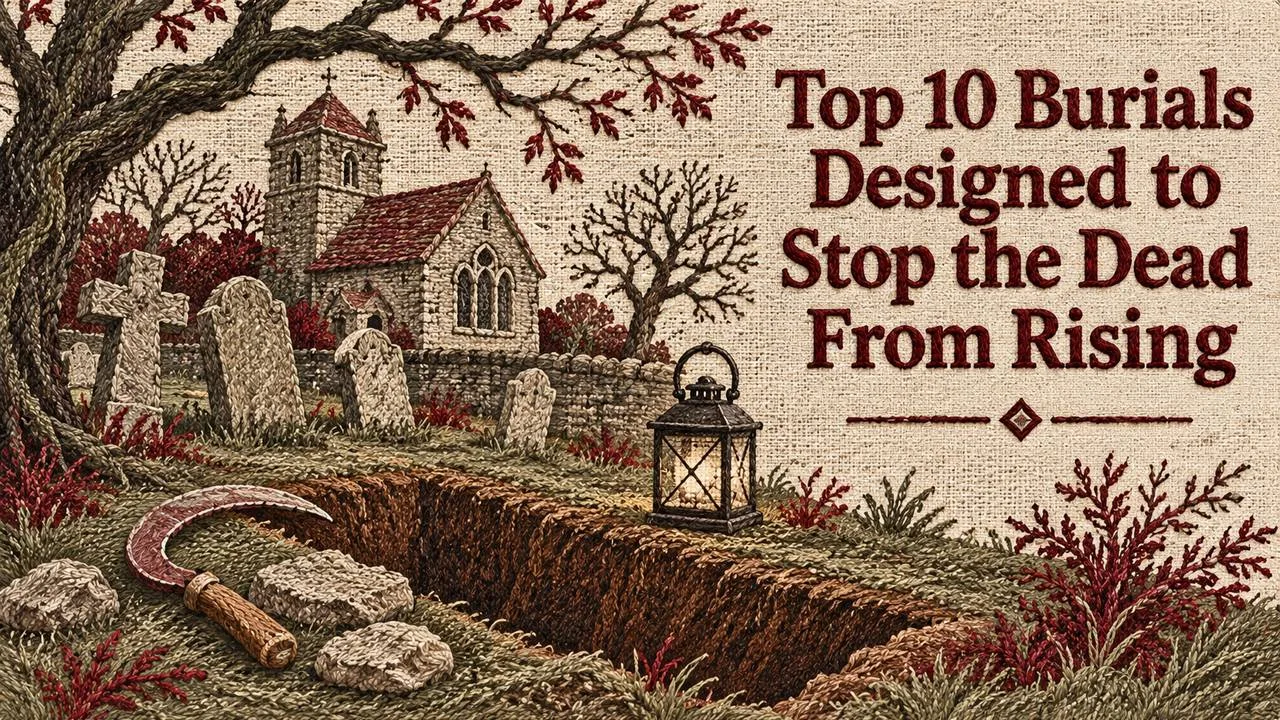
Stones in the mouth, sickles at the throat and iron rods through the chest: ten real graves where the living tried to keep the dead from coming back. Fear of the restless corpse is far older than the word vampire, and archaeologists keep finding the physical traces it left behind in cemeteries across Europe and North America.
Many cultures honoured their dead with gifts, feasts and careful rites. The burials on this list are the opposite side of that coin. In each case a community, or a frightened family, did something to a body that it would never do to an ordinary grave. Some acted at the funeral itself, while others came back months or years later, dug up the corpse and dealt with it again.
For this Finepedia list we chose ten burials that have been excavated or documented in detail, running from the late Roman world to the 1890s. Where scholars disagree about what a grave really means, we say so. The pattern that emerges is surprisingly consistent: epidemics, sudden deaths and unpopular neighbours were the usual triggers for these measures.
Key Facts
The table below gives a quick overview of all ten entries before each one is described in detail.
| # | Burial | Place | Period | Measure used |
|---|---|---|---|---|
| 1 | Headless burials at Fleet Marston | Buckinghamshire, England | Late Roman, about 250 to 450 AD | Head removed and placed by the legs or feet |
| 2 | The Vampire of Lugnano | Umbria, Italy | Mid-5th century AD | Stone wedged into a child's mouth |
| 3 | Stones in the mouth at Kilteasheen | County Roscommon, Ireland | 8th century AD | Large stones forced between the jaws |
| 4 | Iron rods at Sozopol | Black Sea coast, Bulgaria | 14th century | Metal bars driven through the chest |
| 5 | The brick-mouthed woman of Lazzaretto Nuovo | Venice, Italy | 16th century | Brick placed in the mouth |
| 6 | The padlocked woman of Pień | Kuyavian-Pomeranian, Poland | 17th century | Sickle across the neck and a padlock on the toe |
| 7 | The sickle graves of Drawsko | Greater Poland, Poland | 17th to 18th centuries | Sickles at the neck and stones under the jaw |
| 8 | The heads between the legs at Gliwice | Silesia, Poland | Undated, probably early modern | Heads severed and laid on the legs |
| 9 | JB 55 of Griswold | Connecticut, United States | 1830s | Skull and thigh bones rearranged after exhumation |
| 10 | Mercy Brown and the burned heart | Exeter, Rhode Island, United States | 1892 | Heart and liver burned, ashes given to the sick |
1. Headless burials at Fleet Marston
Archaeologists working ahead of the HS2 rail line near Aylesbury uncovered a small Roman town at Fleet Marston, together with the largest late Roman cemetery yet known in Buckinghamshire. Around 425 people had been buried there, and roughly one in ten had been decapitated.[1] In several graves the head had been laid between the legs or beside the feet instead of at the top of the body.[1][2]
Romano-British cemeteries contain quite a few graves of this type, so the find was striking more for its scale than its novelty. One reading is that these were criminals or outcasts. HS2's own statement, however, stressed that removing the head seems to have been an accepted, if minority, burial custom in late Roman Britain.[1]
Cambridge archaeologist Rob Wiseman, commenting on the discovery, noted that it is often impossible to tell whether the head came off before or after death. He suggested two very different motives. Relatives may have believed the soul could only pass on if the head stayed close to the body, or they may have feared that the corpse would reassemble itself and return.[2] Either way, moving the head was a deliberate act carried out at the graveside, which is why sites like Fleet Marston feature in almost every study of so-called deviant burial.
2. The Vampire of Lugnano
In 2018 a team from the University of Arizona, Stanford University and Italian partners excavated a child of about ten at a site known as the Cemetery of the Babies, near Lugnano in Teverina in Umbria. The child, whose sex could not be determined, was lying on its side, and a stone had been pushed into its mouth after death.[3] Locals quickly nicknamed the find the Vampire of Lugnano.[3][4]
The cemetery dates to the middle of the fifth century, when a lethal outbreak of malaria swept the area. Earlier digs there had found more than fifty burials of infants, toddlers and unborn babies, and until this discovery a girl of about three had been the oldest person known from the site.[3] Some of those earlier graves already looked unusual, with raven talons, toad bones and sacrificed puppies, and the three-year-old had been laid out with stones pressing on her hands and feet.[3]
Related: Top 10 Lost Cities That Were Rediscovered
Researchers think the stone in the older child's mouth was meant to contain both the body and the disease, so that the dead could not rise and spread the fever further. Project archaeologist David Soren, who had worked at the site since 1987, said he had never seen anything quite like it. The burial is one of the earliest clear examples of anti-revenant treatment from Roman Italy.
3. Stones in the mouth at Kilteasheen
Between 2005 and 2009 archaeologists from the Institute of Technology, Sligo, and Saint Louis University dug a burial ground at Kilteasheen, close to Lough Key. They recovered 137 skeletons from a site that may hold around 3,000 burials laid down over several hundred years.[5][6]
Two of those skeletons stood out. Both were men, one older and one young adult, buried side by side but at different times during the 700s. Each had a large stone jammed into his mouth. In one case the stone had been driven in so hard that the jaws were nearly forced out of joint.[5] Team leader Chris Read at first suspected a Black Death plague pit, but radiocarbon dates placed the pair roughly seven centuries earlier.[5]
Because the burials are far older than European vampire belief, Read linked them instead to the fear of revenants, the walking dead of early Irish and wider European tradition. The mouth was widely seen as the doorway through which the soul left the body and through which something else might enter, so blocking it made sense to a frightened community.[6] Read has stressed that the theory cannot be proved, but the deliberate, repeated treatment of two men in the same spot shows the burials were no accident.
4. Iron rods at Sozopol
In June 2012 archaeologists digging beside a church in Sozopol, on the Black Sea coast, found two skeletons, both men, each pinned with a metal object through the chest. Among more than 600 ordinary graves, one had a heavy iron piece resembling a ploughshare thrust through the left side of the ribs.[7][8] Local museum head Dimitar Nedev dated both burials to the fourteenth century.[7]
Bozhidar Dimitrov, director of Bulgaria's National History Museum, explained that people thought to have been wicked in life were pierced after death so they could not climb out of the grave at midnight and prey on the living. He added that the custom survived in some Bulgarian villages into the early twentieth century, and that around a hundred similar graves were already known in the country.[8]
Dimitrov later proposed that the better known skeleton belonged to a local noble named Krivich, a former pirate blamed for failing to defend the town against a Genoese attack.[9] That identification is a hopeful guess rather than a proven fact. The skeleton was taken to Sofia and placed on display at the National History Museum, where it became one of the best-known examples of a Balkan anti-vampire burial.[9]
5. The brick-mouthed woman of Lazzaretto Nuovo
Lazzaretto Nuovo, an island in the Venetian lagoon, served as a quarantine station and burial ground for plague victims in the sixteenth and seventeenth centuries. During excavations there in 2006 and 2007, forensic archaeologist Matteo Borrini of the University of Florence uncovered the remains of an older woman with a brick wedged inside her mouth.[10][11]
Related: Top 10 Overlooked Ancient Mysteries
Borrini linked the find to a belief that spread widely during epidemics. Gravediggers who reopened mass graves to add new bodies sometimes saw corpses whose shrouds had sunk into the mouth and torn. The cause was ordinary decay, as fluid from the body soaked the cloth, but many people concluded that the dead were chewing their wrappings and spreading pestilence. German writers called such a creature a Nachzehrer.[10]
Putting a brick or stone into the mouth was meant to stop the chewing for good. Not every expert accepts the interpretation. Other Italian anthropologists argued that the brick, just one of countless bricks on the site, could simply have ended up near the jaw.[12] Borrini's team concluded from the position of the body and the brick that it was placed on purpose, and the woman is still widely described as the first plague vampire studied with modern forensic methods.[10]
6. The padlocked woman of Pień
On 30 August 2022 a team led by Dariusz Poliński of Nicolaus Copernicus University in Toruń uncovered grave 75 in an unmarked cemetery at Pień in north-central Poland.[13] It held a young woman with an iron sickle laid across her throat, its blade facing her neck, and a triangular padlock fastened around the big toe of her left foot.[14]
Later analysis, published in 2026, suggested the two objects were placed at different times. The padlock went on at burial, and the grave appears to have been reopened afterwards so that the sickle could be added as a second safeguard.[14] Traces of silk and gold thread from an expensive cap pointed to a woman of high status, perhaps a noblewoman, rather than a poor outsider. The researchers, who nicknamed her Zosia, think the community may have blamed her for disease or famine.[14]
Poliński has been careful about the vampire label. He prefers to call the measures anti-demonic precautions, aimed at keeping a feared person in the ground, rather than proof that anyone believed she drank blood.[14] The pairing of sickle and padlock in a single grave had not been reported before, which makes Pień one of the most closely studied anti-revenant burials in Europe.
7. The sickle graves of Drawsko
The cemetery at Drawsko in western Poland produced 333 burials, and six of them were treated in an unusual way. Some of these people had sickles laid across the neck or throat, while others had stones placed under the jaw.[15][16] The idea, according to folklore, was that a corpse trying to sit up would cut its own throat on the blade, and a weighted jaw could not open to feed.[15]
Researchers first suspected that the six were outsiders, people whose foreign origin made them objects of suspicion. In 2014 Lesley Gregoricka, Tracy Betsinger and colleagues tested that idea by measuring strontium isotopes in the teeth, which record where a person grew up. All six turned out to be locals.[16][15]
Related: Top 10 Ancient Sites That Keep Yielding New Finds
The team proposed a different explanation. Waves of cholera swept through the region during this period, and people did not understand how the disease spread. Those who died first in an outbreak, or who died in unusual ways, may have been blamed for the deaths that followed and buried with protective objects.[16] Drawsko is a useful reminder that anti-vampire burials were not always reserved for strangers. Fear could fall on a neighbour as easily as on a newcomer.
8. The heads between the legs at Gliwice
In 2013 road builders near Gliwice in southern Poland ran into a group of graves. The area was better known for the remains of soldiers from the Second World War, so archaeologists were surprised by what they found: skeletons whose heads had been cut off and placed on or between their legs.[17][11]
The arrangement matches a widespread custom recorded in Slavic folklore. A dead person suspected of returning would be beheaded and the head put somewhere out of reach, usually by the legs, under an arm or above the body. Some believed a revenant that could not find its own head would be powerless.[11][17]
Dating the Gliwice graves has proved difficult. Archaeologist Jacek Pierzak reported that the bodies had no jewellery, buckles, buttons or other objects that could fix the period of burial.[17] That uncertainty is common with deviant graves, which were often dug at the edge of a cemetery and given few goods. Even so, the site belongs to a long line of Polish finds, alongside places such as Drawsko, Kałdus and Sanok, that show how seriously rural communities took the threat of the restless dead.[11]
9. JB 55 of Griswold
In 1990 children playing near a gravel pit in Griswold, Connecticut, turned up human skulls from a forgotten family burial ground. Most of the graves were ordinary, but one coffin lid carried brass tacks spelling out JB 55, probably the man's initials and age at death.[18][19]
Inside, the skeleton had been badly disturbed. The skull had been separated from the spine and laid on the opened, broken chest, with the thigh bones arranged beneath it in a skull-and-crossbones shape. Researchers think the body had lain in the ground for about five years before someone dug it up and tried to reach the heart.[18] Study of his bones later confirmed that the man had suffered from tuberculosis.[18]
For decades nobody knew who he was. In 2019 scientists used Y-chromosome DNA and genealogical records to identify him as John Barber, a farmer. A nearby coffin marked NB 13 fitted a 12-year-old Nicholas Barber, whose 1826 obituary named his father as John Barber.[18] JB 55 remains the only physical evidence archaeologists have recovered of the New England vampire practice, which folklorists have traced through dozens of documented exhumations.[18]
Related: Top 10 Things That Existed While Woolly Mammoths Were Still Alive
10. Mercy Brown and the burned heart
Mercy Lena Brown died of tuberculosis in January 1892 at the age of nineteen. Her mother and elder sister had already died of the same disease, and her brother Edwin was now gravely ill.[20][19] Neighbours persuaded her father, George Brown, that one of the dead women might be draining the life from the family.
On 17 March 1892 a group of men exhumed the bodies while the family doctor and a newspaper reporter looked on. The mother and sister were little more than bones, but Mercy had been buried in winter about two months earlier and was well preserved.[19] Her heart and liver were cut out and found to hold clotted blood, which the villagers took as proof. They burned the organs on a nearby rock, mixed the ashes into a tonic and gave it to Edwin, who was dead within two months.[19][20]
The case was reported in newspapers across the United States and helped bring the New England vampire panic to the attention of scholars. It remains one of the best documented exhumations carried out to banish the undead.[20] Mercy's grave in Exeter's Chestnut Hill Cemetery still attracts visitors, some of whom leave plastic fangs and trinkets on the stone.[19]
Conclusion
Taken together, these burials span roughly sixteen centuries, yet the methods repeat themselves. Blocking the mouth, pinning the chest, separating the head and weighing down the limbs all aimed at the same goal of keeping a dangerous body in the ground.
The triggers repeat too. Malaria at Lugnano, plague in Venice, cholera at Drawsko and tuberculosis in New England all produced deaths that people could not explain, and the dead themselves became the obvious suspects. Modern science has since explained the swollen bodies, fresh-looking blood and torn shrouds that once seemed like proof.
What remains is a moving record of fear and grief. Behind every stone, sickle and iron bar was a community trying, with the knowledge it had, to protect the living.
- ^ [1] "HS2 archaeologists reveal secrets of small Roman town excavated near Aylesbury". HS2 Ltd. HS2 Media Centre
- ^ [2] "Dozens of Decapitated Skeletons Found at Roman Cemetery in England". Smithsonian Magazine. Smithsonian Magazine
- ^ [3] "Vampire Burial Reveals Efforts to Prevent Child's Return from Grave". University of Arizona. University of Arizona News
- ^ [4] "Lugnano in Teverina". Wikipedia. Wikipedia
- ^ [5] "Skeletons reveal our ancestors' fear of the undead". Irish Examiner. Irish Examiner
- ^ [6] "Stones in the mouth: zombie fears in early Ireland (Discovery News)". NBC News. NBC News
- ^ [7] "Vampire-Proofing Your Village". Archaeology Magazine. Archaeology Magazine
- ^ [8] "Vampire skeletons found in Bulgaria near Black Sea". BBC News. BBC News
- ^ [9] "Bulgarian Archaeologists Identify Vampire as Pirate, Evil Mayor of Sozopol". Novinite. Novinite
- ^ [10] "Plague Vampire Exorcism". Archaeology Magazine. Archaeology Magazine Archive
- ^ [11] "Vampire burial". Wikipedia. Wikipedia
- ^ [12] "Vampire Burials and Vampire Protection". Live Science. Live Science
- ^ [13] "Female skeleton from 17th century found with padlocked toe and a sickle around her neck". Science in Poland. Science in Poland
- ^ [14] "Why Was This 17th-Century Polish Woman Buried With a Padlock on Her Toe and an Iron Sickle Across Her Neck?". Smithsonian Magazine. Smithsonian Magazine
- ^ [15] "Mystery of Vampire Burials Solved". Live Science. Live Science
- ^ [16] "Apotropaic Practices and the Undead: A Biogeochemical Assessment of Deviant Burials in Poland (Drawsko)". PLOS One. PLOS One
- ^ [17] "Vampire Grave Uncovered in Poland". Live Science. Live Science
- ^ [18] "New England Vampire Was Likely a Farmer Named John". Smithsonian Magazine. Smithsonian Magazine
- ^ [19] "The Great New England Vampire Panic". Smithsonian Magazine. Smithsonian Magazine
- ^ [20] "Mercy Brown vampire incident". Wikipedia. Wikipedia
























Discussion
Log in with