





 By
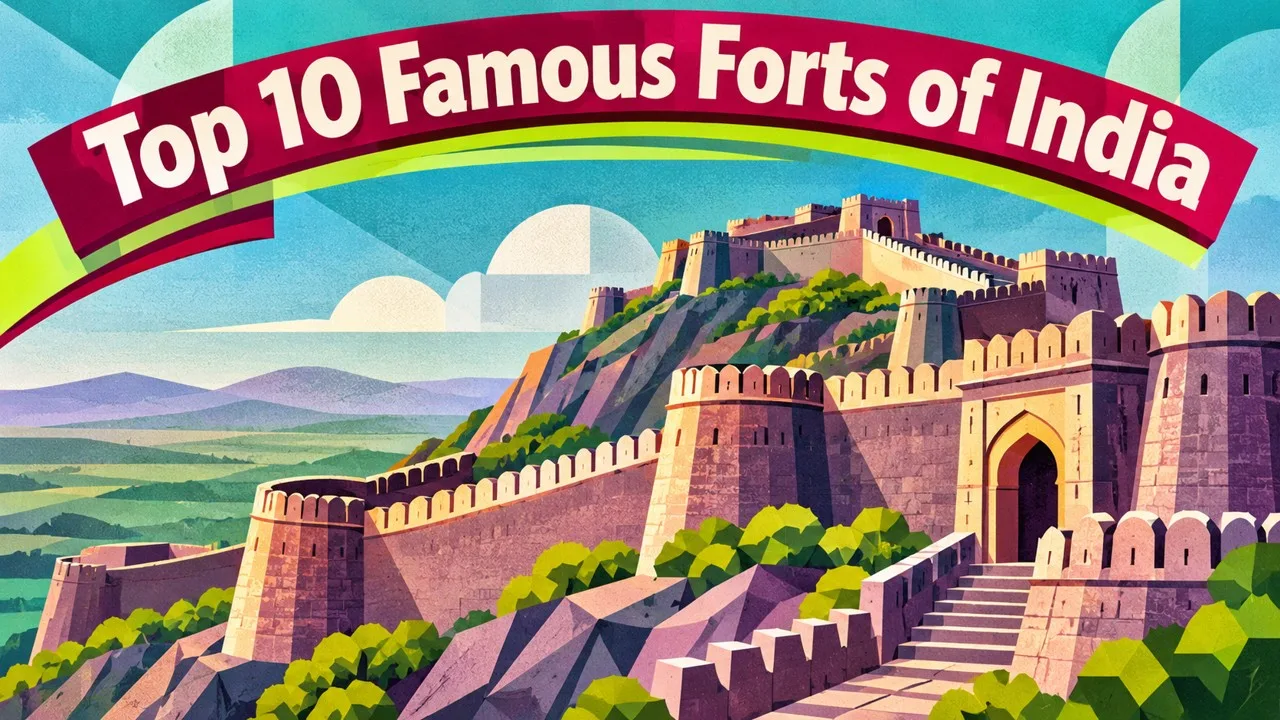
From Rajasthan's desert strongholds to the Deccan's hill citadels, these ten famous forts of India tell stories of kings, sieges, trade and great engineering. India has hundreds of forts, built by rulers who needed to protect their capitals, trade routes and treasure. They range from hilltop citadels and desert strongholds to great palace-forts in the heart of cities.
This list picks ten of the most famous, chosen for their history, size and architecture. Several are part of UNESCO World Heritage Sites, and many can be visited today. Dates refer to the main period of construction, as most forts were expanded over centuries.
Key Facts
The ten forts below span more than a thousand years of Indian history and several regions of the country.
Famous Indian Forts at a Glance
| # | Fort | State | Built or rebuilt | Known for |
|---|---|---|---|---|
| 1 | Mehrangarh Fort | Rajasthan | From 1459 | Towering cliff-top walls above Jodhpur |
| 2 | Amber Fort | Rajasthan | From 1592 | Palace-fort of the Kachwaha rulers |
| 3 | Chittorgarh Fort | Rajasthan | 7th century onwards | One of India's largest forts |
| 4 | Kumbhalgarh Fort | Rajasthan | 15th century | One of the world's longest walls |
| 5 | Jaisalmer Fort | Rajasthan | From 1156 | A living fort in the Thar Desert |
| 6 | Golconda Fort | Telangana | 16th century expansion | Capital of the Qutb Shahi kingdom |
| 7 | Gwalior Fort | Madhya Pradesh | 8th century onwards | Called the pearl among fortresses |
| 8 | Red Fort | Delhi | 1639 to 1648 | Symbol of Indian independence |
| 9 | Agra Fort | Uttar Pradesh | From 1565 | Mughal power centre near the Taj Mahal |
| 10 | Daulatabad Fort | Maharashtra | 12th century onwards | Hill fort with a spiral maze |
1. Mehrangarh Fort
Mehrangarh Fort stands on a rocky hill about 120 metres above the city of Jodhpur. It was founded in 1459 by Rao Jodha, the Rathore ruler who also founded the city, and was expanded by later rulers over several centuries. [1]
Its walls rise up to about 36 metres high in places, and the fort is entered through a series of gates, including Jai Pol, built to celebrate victories. Inside are palaces with finely carved stone screens and decorated rooms. [1]
Today the fort is run as a museum by a trust and displays royal palanquins, weapons, paintings and textiles. Its dramatic setting has made it a favourite location for films.
The blue-painted houses of old Jodhpur spread out below the fort, giving the city its nickname, the Blue City.
Key Figures
- Founded: 1459
- Founder: Rao Jodha
- Height above the city: about 120 metres
- City below: Jodhpur, the Blue City
Why It Made the List
Mehrangarh is one of the largest and most impressive forts in India. Its setting and museum make it a showcase of Rajput history.
2. Amber Fort
Amber Fort, also called Amer Fort, stands on a hill near Jaipur. Its main structures were begun in 1592 by Raja Man Singh I, a leading general at the court of the Mughal emperor Akbar. [2]
Built of pale sandstone and marble, it combines Rajput and Mughal styles. Its highlights include the Sheesh Mahal, a hall decorated with thousands of small mirrors, and courtyards that overlook Maota Lake. [2]
Amber was the capital of the Kachwaha rulers until Jaipur was founded in 1727. A long fortified wall connects it to Jaigarh Fort on the hill above.
In 2013 Amber was included in the UNESCO World Heritage Site Hill Forts of Rajasthan, along with five other forts.
Key Figures
- Main construction began: 1592
- Builder: Raja Man Singh I
- Famous hall: Sheesh Mahal, the mirror palace
- UNESCO listing: 2013, Hill Forts of Rajasthan
Why It Made the List
Amber Fort is a beautiful blend of fortress and palace. It is one of the most visited monuments in Rajasthan.
Related: Top 10 Famous Opera Houses of the World
3. Chittorgarh Fort
Chittorgarh Fort covers a long, flat-topped hill near the town of Chittorgarh and is one of the largest forts in India, spread over about 280 hectares. It was the capital of the kingdom of Mewar for centuries. [3]
The fort was besieged three times, by Alauddin Khalji in 1303, by Bahadur Shah of Gujarat in 1535 and by the Mughal emperor Akbar in 1567 to 1568. These sieges are remembered in Rajasthani tradition for acts of resistance and sacrifice. [3]
Inside are palaces, temples and water reservoirs, along with two towers: the Vijay Stambha, or Tower of Victory, built in the fifteenth century by Rana Kumbha, and the older Kirti Stambha.
Chittorgarh is part of the Hill Forts of Rajasthan UNESCO World Heritage Site, listed in 2013.
Key Figures
- Area: about 280 hectares
- Famous sieges: 1303, 1535 and 1567 to 1568
- Tower of Victory: Vijay Stambha
- UNESCO listing: 2013
Why It Made the List
Chittorgarh is a powerful symbol of Rajput history and courage. Its scale and monuments make it one of India's great forts.
4. Kumbhalgarh Fort
Kumbhalgarh Fort was built in the fifteenth century by Rana Kumbha of Mewar in the Aravalli hills. It is famous for its outer wall, which stretches for about 36 kilometres around the fort and its surroundings. [4]
The wall is often described as one of the longest continuous walls in the world. It encloses many temples, both Hindu and Jain, along with farmland and water tanks. [4]
The fort was so hard to attack that it was rarely captured. According to tradition, Maharana Pratap, the famous ruler of Mewar, was born here in 1540.
Kumbhalgarh is also part of the Hill Forts of Rajasthan World Heritage Site, and it hosts an annual festival celebrating local music and dance.
Key Figures
- Builder: Rana Kumbha
- Length of outer wall: about 36 kilometres
- Famous ruler born here: Maharana Pratap, 1540
- UNESCO listing: 2013
Why It Made the List
Kumbhalgarh's great wall makes it unique among Indian forts. It shows the engineering effort that went into defending Mewar.
5. Jaisalmer Fort
Jaisalmer Fort was founded in 1156 by Rawal Jaisal on Trikuta Hill in the Thar Desert. Built of yellow sandstone, it is often called Sonar Quila, the Golden Fort, because of the way it glows in sunlight. [5]
Related: Top 10 Great Personalities of India
The fort controlled caravan routes that crossed the desert between India and Central Asia, and wealthy merchants built elaborate houses called havelis in the city. [5]
Unlike most forts, Jaisalmer is still lived in. Thousands of people live and work inside its walls, among shops, temples and homes. This makes it one of the few living forts in the world.
Water use and drainage problems have damaged parts of the old structure, and conservation work has been carried out to protect it. It is part of the Hill Forts of Rajasthan World Heritage Site.
Key Figures
- Founded: 1156
- Founder: Rawal Jaisal
- Nickname: Sonar Quila
- Residents inside the walls: several thousand
Why It Made the List
Jaisalmer Fort is a rare example of a historic fort that is still home to a living community. Its desert setting makes it unforgettable.
6. Golconda Fort
Golconda Fort lies on the western edge of Hyderabad. It began as a mud fort and was greatly expanded by the Qutb Shahi dynasty, which made it their capital in the sixteenth century. [6]
The region was famous for its diamond trade, and diamonds from the nearby Kollur mines were sold at Golconda. The name Golconda became a byword for great wealth. [6]
The fort is known for its clever acoustics: a clap made at the main gate can be heard at the highest point of the citadel, which was used as a warning system. It also had an advanced system for raising water to the upper levels.
The Mughal emperor Aurangzeb captured Golconda in 1687 after a long siege, ending the Qutb Shahi kingdom.
Key Figures
- Rulers: the Qutb Shahi dynasty
- Famous trade: diamonds
- Captured by Aurangzeb: 1687
- Special feature: acoustic warning system
Why It Made the List
Golconda combines history, wealth and engineering. Its name still stands for riches around the world.
7. Gwalior Fort
Gwalior Fort sits on a long sandstone hill above the city of Gwalior. It has existed in some form since at least the eighth century and was held by many dynasties over the centuries. [7]
Related: Top 10 Famous Domes of the World
The Mughal emperor Babur reportedly called it the pearl among the fortresses of India. The Man Singh Palace, built by the Tomar ruler Man Singh Tomar around the late fifteenth century, is decorated with blue, green and yellow tiles. [7]
A small temple at the fort, the Chaturbhuj temple, contains an inscription dated to 876 that includes one of the earliest known uses of the zero symbol written as a circle.
The fort also contains the Teli ka Mandir, a tall early medieval temple, and large rock-cut Jain sculptures carved into the hillside.
Key Figures
- Earliest structures: at least the 8th century
- Famous palace: Man Singh Palace
- Zero inscription: dated 876
- Babur's description: pearl among fortresses
Why It Made the List
Gwalior Fort holds layers of Indian history, from early temples to a landmark in mathematics. Few forts tell so many stories.
8. Red Fort
The Red Fort in Delhi was built by the Mughal emperor Shah Jahan between 1639 and 1648 as the palace of his new capital, Shahjahanabad. It is named after its massive red sandstone walls. [8]
Inside were halls of public and private audience, marble palaces, gardens and a canal called the Nahr-i-Bihisht, the stream of paradise. The famous Peacock Throne was once kept in the Diwan-i-Khas. [8]
After the rebellion of 1857, the British occupied the fort and damaged many of its buildings. Since 1947, the Prime Minister of India has raised the national flag there and given a speech every Independence Day.
The Red Fort Complex became a UNESCO World Heritage Site in 2007.
Key Figures
- Built: 1639 to 1648
- Builder: Shah Jahan
- Independence Day speech: held there since 1947
- UNESCO listing: 2007
Why It Made the List
The Red Fort is both a Mughal masterpiece and a national symbol. It links India's past with its modern independence.
9. Agra Fort
Agra Fort was rebuilt in red sandstone by the Mughal emperor Akbar from 1565. Later emperors, especially Shah Jahan, added marble palaces and mosques inside its walls. [9]
The fort stands about two and a half kilometres from the Taj Mahal. According to tradition, Shah Jahan spent his last years confined in the fort by his son Aurangzeb, looking out towards the tomb of his wife Mumtaz Mahal. [9]
Related: Nalanda University: History of Ancient India's Great Mahavihara
Its walls are about two and a half kilometres around, and it contains buildings such as the Jahangiri Mahal, the Khas Mahal and the Diwan-i-Am, the hall of public audience.
Agra Fort was named a UNESCO World Heritage Site in 1983, the same year as the Taj Mahal.
Key Figures
- Rebuilt by Akbar: from 1565
- Distance from the Taj Mahal: about 2.5 kilometres
- Famous resident: Shah Jahan in his final years
- UNESCO listing: 1983
Why It Made the List
Agra Fort was the heart of Mughal power for generations. Its palaces show the change from Akbar's sandstone to Shah Jahan's marble.
10. Daulatabad Fort
Daulatabad Fort, near Aurangabad, was originally called Devagiri and was the capital of the Yadava dynasty. It stands on a cone-shaped hill whose lower slopes were cut away to make the cliffs almost impossible to climb. [10]
Its defences included a moat, spiked gates and a dark spiral tunnel that attackers had to climb through. These features made it one of the strongest forts in the Deccan. [10]
In 1327 the Delhi sultan Muhammad bin Tughluq renamed it Daulatabad, meaning city of fortune, and ordered many people from Delhi to move there as part of a plan to make it a capital. The move failed, and the capital returned to Delhi.
The fort also contains the Chand Minar, a tower built in the fifteenth century, which rises about 30 metres.
Key Figures
- Original name: Devagiri
- Renamed: 1327 by Muhammad bin Tughluq
- Defence features: moat, steep cliffs and a dark tunnel
- Tower: Chand Minar, about 30 metres
Why It Made the List
Daulatabad was designed to be almost impossible to capture. Its story of a failed capital move is one of the most famous in Indian history.
Conclusion
These ten forts show how Indian rulers combined defence, beauty and engineering. From desert fortresses to Mughal palace-forts, each one reflects the needs and ambitions of its builders.
Many are now protected monuments and museums that tell the stories of kings, sieges and everyday life. Visiting them is one of the best ways to understand the long and varied history of India.
- ^ [1] "Mehrangarh Fort". Wikipedia. Wikipedia: Mehrangarh Wikipedia: Jodhpur
- ^ [2] "Amber Fort". Wikipedia. Wikipedia: Amber Fort Wikipedia: Hill Forts of Rajasthan
- ^ [3] "Chittorgarh Fort". Wikipedia. Wikipedia: Chittor Fort Wikipedia: Vijay Stambha
- ^ [4] "Kumbhalgarh Fort". Wikipedia. Wikipedia: Kumbhalgarh Wikipedia: Rana Kumbha
- ^ [5] "Jaisalmer Fort". Wikipedia. Wikipedia: Jaisalmer Fort Wikipedia: Jaisalmer
- ^ [6] "Golconda Fort". Wikipedia. Wikipedia: Golconda Fort Wikipedia: Qutb Shahi dynasty
- ^ [7] "Gwalior Fort". Wikipedia. Wikipedia: Gwalior Fort Wikipedia: Chaturbhuj Temple, Gwalior
- ^ [8] "Red Fort". Wikipedia. Wikipedia: Red Fort Wikipedia: Shahjahanabad
- ^ [9] "Agra Fort". Wikipedia. Wikipedia: Agra Fort Wikipedia: Akbar
- ^ [10] "Daulatabad Fort". Wikipedia. Wikipedia: Daulatabad Fort Wikipedia: Muhammad bin Tughluq





















Discussion
Log in with