


 By
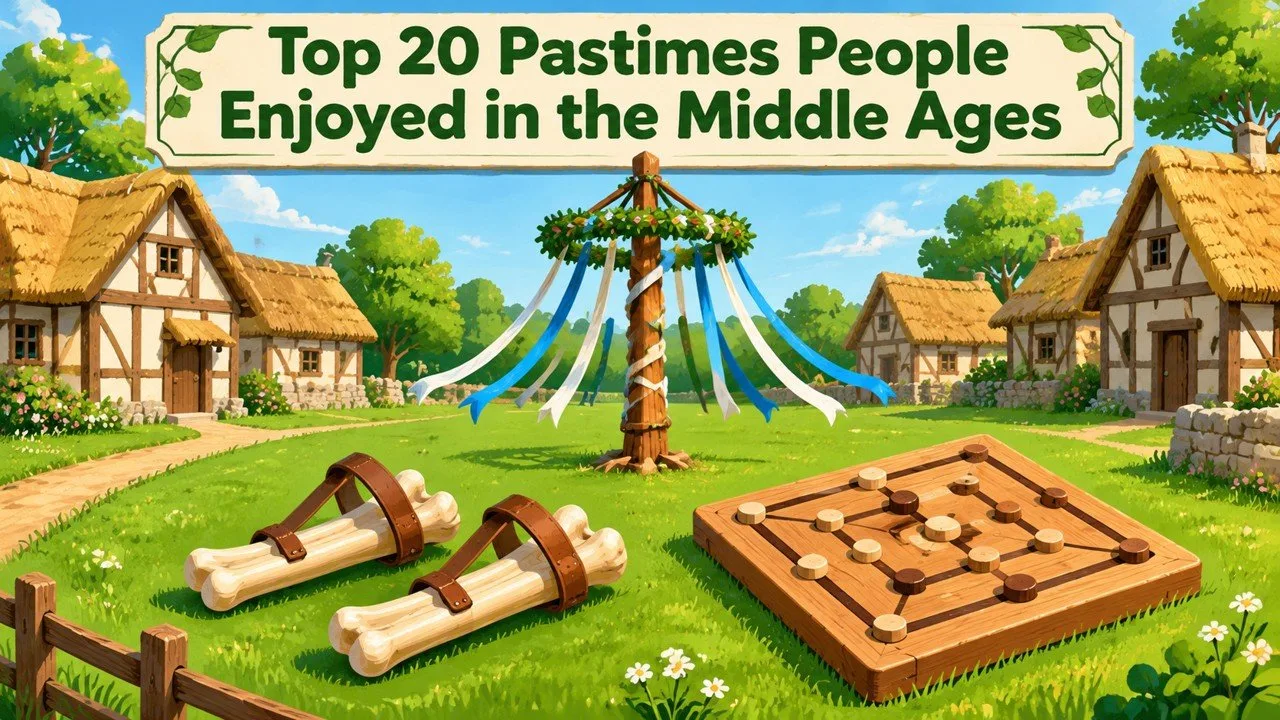
Life in the Middle Ages was hard, but these twenty pastimes show that people still found time for football, chess, dancing, hunting, skating and festivals. The popular picture of the era is one of plague, war and endless toil, yet the surviving records are full of games, sports and celebrations enjoyed by every level of society.
Much of our evidence comes from the people who disapproved. Kings banned football, bishops condemned clerical pranks and town councils outlawed card games, and their complaints tell us exactly what ordinary people were doing in their free time. Other pastimes are recorded in game books, hunting treatises, town accounts and the surviving playing pieces themselves.
This Finepedia list covers twenty pastimes from roughly the twelfth to the fifteenth century, mostly in England and western Europe. They range from the sports of knights and kings to the street games of apprentices. For each we explain how it was played and what the evidence shows.
Key Facts
The table below gives a quick overview of all twenty entries before each one is described in detail.
| # | Entry | Pastime | Who took part | First good evidence | Key source |
|---|---|---|---|---|---|
| 1 | Mob football | Team sport | Townspeople, apprentices, villagers | 1170s | Royal and civic bans |
| 2 | Tournaments | Martial sport | Knights and nobles | 12th century | Histoire de Guillaume le Maréchal |
| 3 | Chess | Board game | Nobles, clergy, merchants | 10th–12th centuries | Lewis chess pieces |
| 4 | Tables | Board game | All classes | 11th–13th centuries | Libro de los juegos |
| 5 | Falconry and hawking | Hunting sport | Kings, nobles, wealthy townspeople | 13th century treatises | Frederick II |
| 6 | Mystery plays | Religious drama | Craft guilds and townspeople | 1370s | York cycle |
| 7 | Archery practice | Sport and training | Men of all classes | 14th century | Royal orders |
| 8 | The Feast of Fools | Festival | Junior clergy, choirboys | 12th century | Church condemnations |
| 9 | May Day | Seasonal festival | Villagers and townspeople | Middle Ages | Later court records and complaints |
| 10 | Playing cards | Card games | All classes | 1370s | Town bans and chronicles |
| 11 | Dice and the game of hazard | Gambling game | All classes, despite repeated bans | 13th–15th centuries | Game books and moral complaints |
| 12 | Jeu de paume, the ancestor of tennis | Court ball game | Nobles, students, later town players | 13th century onward | French and English court records |
| 13 | Hunting with hounds | Field sport | Kings, nobles, household staff | 13th–14th century treatises | Gaston III's hunting book |
| 14 | Caroles and circle dances | Social dance | Villagers, townspeople, courtly companies | 12th–14th centuries | Songs, sermons and romances |
| 15 | Nine men's morris | Board game | All classes | 13th century books; boards cut into stone | Alfonso X's game book; surviving boards |
| 16 | Wrestling | Competitive sport | Young men, fair-goers, sometimes formal champions | 12th century onward | Town and festival evidence, including London |
| 17 | Ice skating on bone skates | Winter sport | Townspeople, especially the young | Late 12th century London | William Fitzstephen's account of London |
| 18 | Kayles and early bowling | Skittle game | Townspeople, soldiers, ale-house players | Later Middle Ages | Surviving names and later skittles |
| 19 | Mumming and disguising | Costume visiting and play | Households, guilds, later town companies | 14th–15th centuries | Court and civic records |
| 20 | Church ales | Parish festival | Villagers and town parishioners | Later Middle Ages | Parish accounts and later complaints |
1. Mob football
Football in the Middle Ages looked very different from the modern game. Matches were often played between whole towns or parishes, with no fixed limit on numbers, and the aim was to force a ball, sometimes an inflated pig's bladder, to a goal at one end of town by almost any means. Dunning describes these early matches as loosely organised and rough, played riotously through streets and across open country.[1]
The historian E. G. Dunning, writing in History Today, notes that the earliest likely reference comes from William Fitzstephen around 1175, who described a famous game of ball played in London at Shrovetide.[1] Games were rough, and serious injury and even death were common.
The authorities hated it. In 1314 a proclamation issued in the name of Edward II banned the game in London, complaining of the great noise caused by people scrambling over large balls and warning that offenders would be imprisoned.[1][2]
The bans did not work. Dunning shows that almost all the evidence for football over the next three centuries consists of fresh prohibitions, issued either because the game disturbed the peace or because it distracted men from archery.[1] Some traditional town games, played each Shrovetide, still survive in England today, preserving a little of the chaos of the original sport.
2. Tournaments
For the knightly class, the most exciting pastime was the tournament. In its early form, it was not the neat jousting contest of films but a mass mock battle, the melee, fought across open country between teams of mounted knights who tried to capture opponents for ransom.[3]
The scholar Larry Benson, writing for Harvard's Geoffrey Chaucer website, explains that tournaments in the twelfth century were crude and bloody affairs, forbidden by the Church and suppressed by any ruler strong enough to enforce a ban.[3] Benson adds that English kings from William the Conqueror onwards tried to keep the sport out of their realm, and that one chronicler saw tournaments held under King Stephen as a sign of his weakness.[3]
The sport was too popular to stop. Benson notes that King Richard I finally made tournaments legal in England in the 1190s, and the best early accounts of real tournaments come from the biography of William Marshal, a knight who made his fortune on the tournament circuit.[3]
Over time tournaments became grand festivals of display. Individual jousting with lances grew in importance, along with heralds, pageantry and noble spectators, until the events became more about chivalric ceremony than practice for war.[3]
3. Chess
Chess reached Europe from the Islamic world, through Spain and Italy, and by the twelfth century it had become a favourite game of the European nobility. It was seen as a test of intelligence and a fitting skill for a well-educated lord or lady.
The most famous surviving chess pieces from the period are the Lewis chessmen, a hoard found on the Isle of Lewis in Scotland. National Museums Scotland explains that the hoard contained 93 gaming pieces from at least four chess sets and other games, probably carved in Norway in the late twelfth or early thirteenth century.[4]
Most were made from walrus ivory, probably obtained in Greenland. Their carving style links them to Norway, and the figures include kings, queens, bishops, knights and warders, many with comically worried expressions.[4]
The game was also studied in writing. The Libro de los juegos, completed in 1283 for King Alfonso X of Castile, contains the earliest European treatise on chess, along with lavish pictures of people playing.[5] The modern rules, including the powerful queen, only developed at the end of the fifteenth century.
4. Tables
Before backgammon, there was tables, a family of board games played with counters and dice on a board marked with points. It combined luck and skill, and it was played by everyone from kings to tavern customers.
The Libro de los juegos of 1283, commissioned by Alfonso X of Castile, describes three kinds of game: chess, as a game of pure skill; dice, as a game of pure chance; and tables, which combines the two.[5] It is the oldest document on tables games in Europe.[5]
Related: Top 10 Unusual Sports and How Their Contests Work
Many board games of the period involved gambling, which made them a frequent target of church and civic laws. Archaeologists have found gaming boards scratched into stone at sites across Scotland, including 35 from the monastery at Inchmarnock, which suggests that even monks may have played in idle moments.[4]
Tables pieces, round discs often carved from bone or ivory, have been found at many sites. The Lewis hoard itself included pieces for games other than chess.[4] The family of tables games survived for centuries and eventually produced the modern game of backgammon, which takes its name from a seventeenth-century English variant.
5. Falconry and hawking
Hunting with trained birds of prey was one of the great passions of the aristocracy. Falcons and hawks were costly to buy, train and keep, so owning them was a powerful sign of status, and nobles often carried their birds with them on social occasions.
The most famous book on the subject was written by an emperor. Frederick II, Holy Roman Emperor and King of Sicily, composed his Latin treatise On the Art of Hunting with Birds in the 1240s and claimed to have spent thirty years gathering material for it.[6]
Frederick's work was remarkable for its time because it relied heavily on direct observation of birds rather than just older authorities. A richly illustrated copy made for his son Manfred, now in the Vatican Library, includes hundreds of accurate pictures of birds and additions by Manfred himself.[6]
Falconry was not only for men. Noblewomen also hunted with hawks, and many surviving images and seals show ladies carrying birds on their wrists. The sport remained popular among the European elite until firearms made hunting with guns more practical in later centuries.
6. Mystery plays
In many towns, the biggest entertainment of the year was a cycle of plays telling the story of the Bible from the Creation to the Last Judgement. Known as mystery plays, they were performed by members of local craft guilds, often on wagons that moved through the streets.
York had one of the most famous cycles. The York Mystery Plays organisation explains that the plays were performed as part of the Corpus Christi festival, with 48 plays staged by 48 different guilds. The whole cycle could last up to 20 hours and might be spread over several days.[7]
Guilds often chose stories linked to their trade. In York, the shipwrights performed the building of Noah's Ark. The wagons followed a set route through the city, stopping at stations where crowds gathered to watch each play in turn.[7]
The plays combined devotion with comedy, music and spectacle, and they gave guilds a chance to show off their wealth. After the Protestant Reformation, they were suppressed, and the last production of the original cycle in York took place in 1569.[7] They were revived in the twentieth century and are still performed today.
7. Archery practice
Archery was both a sport and a legal duty in England during the later Middle Ages. The English longbow had won great victories, and kings wanted to make sure there would always be skilled archers ready for war.
The London Letter Books, published by British History Online, record that in June 1363 King Edward III sent a writ to the sheriffs of London ordering them to encourage archery as a pastime in place of football, cockfighting and similar games.[8] A similar order quoted by History Today told able-bodied men to use bows and arrows on feast days and banned stone-throwing, handball, football and other vain games of no value.[1]
The royal complaint was that people were neglecting the bow in favour of idle amusements, leaving the realm likely to be without archers.[1]
As a result, archery practice became a common weekend activity for men in towns and villages. Many places had open fields known as butts where people practised shooting at targets, and competitions often accompanied festivals and fairs.
8. The Feast of Fools
Around Christmas and the New Year, some churches turned the normal order upside down. During the Feast of Fools, held mainly on 1 January, lower-ranking clergy took over the services, elected a mock bishop or archbishop and parodied church ceremonies.[9]
Related: Will Smith: Life, Music, Films and Career
The first church reference to the feast dates from around 1160 to 1164 in Paris, in the writings of John Beleth.[9] The festivities could include noise, dressing up and comic sermons, and they spread from southern France across much of Europe.
A related custom was the boy bishop. A boy, often chosen from among the cathedral choristers, was elected on the feast of St Nicholas, the patron saint of children, and played the part of the bishop until Holy Innocents' Day on 28 December, when the adult clergy symbolically gave up their places.[10]
Church leaders repeatedly condemned these festivals as disorderly. The Council of Basel, which opened in 1431, forbade the Feast of Fools, and the theologians of the University of Paris condemned it again in 1444.[9] The boy bishop proved more resilient. In England it was abolished by Henry VIII in 1542, revived by Mary I and finally abolished under Elizabeth I.[10]
9. May Day
The arrival of summer was celebrated on 1 May with dancing, games and greenery. According to the Early Modern England Encyclopedia, May Day had become a popular festival in England by the Middle Ages, celebrated in the countryside and in growing towns alike.[11]
Young people went out to the woods to gather flowering branches to decorate homes and streets, a custom known as bringing in the May. The centrepiece was often a maypole. The encyclopedia explains that its origin was a decorated tree, with the tallest tree in the forest being cut down and set up in the town or village square.[11]
May Day activities included dancing around the maypole, Morris dancing, choosing a May Queen and King, and plays and games, sometimes performed by hired entertainers.[11]
Not everyone approved. Puritan reformers later attacked May Day for encouraging immoral behaviour, and maypoles were banned during the Interregnum before being restored under Charles II.[11] Many English villages still hold May Day celebrations today, keeping alive traditions that stretch back hundreds of years.
10. Playing cards
Playing cards arrived in Europe surprisingly late in the Middle Ages, most likely from the Islamic world. The World of Playing Cards, a leading reference on card history, lists the earliest reliable European references in the 1370s.[12]
The Catalan word naip, meaning playing cards, appears in a rhyme dictionary compiled by the poet Jaume March in 1371. In Florence, a decree banned a game called naibbe, implying it had only recently arrived.[12] A chronicle from Viterbo in Italy records that the game of cards was brought there in 1379 from the Saracens, the term then used by Christians for Arabs or Muslims.[12]
Cards spread rapidly. Within a few years they are mentioned in Paris, Siena, Germany and Switzerland, very often in laws that banned them on working days or forbade gambling with them.[12]
The early decks were hand-painted and expensive, but printing with woodblocks soon made them cheap enough for ordinary people. Card games quickly became one of the most popular pastimes in Europe and remain so today.
11. Dice and the game of hazard
Dice are among the oldest gaming tools in Europe, and in the later centuries of the Middle Ages they were everywhere: in taverns, army camps, great halls and, to the scandal of preachers, sometimes in churchyards after a feast. The most famous English dice game of the period is hazard, a complicated game of chances and called numbers that later helped to shape the modern game of craps.[13] Alfonso X's thirteenth-century book of games, already used above for tables, also gave serious space to dice play, which is a sign of how established the pastime was at court as well as in the street.[5]
The same popularity explains the complaints. Moralists treated dice as a snare that led to blasphemy, debt and brawling, and town authorities periodically tried to restrict play in public. Those bans, like the football bans already mentioned, are useful evidence: people do not keep outlawing a game that nobody is playing.
Hazard in particular rewarded a cool head and a knowledge of the odds, but it also ruined the careless. For this list the important point is simpler. Long before printed playing cards arrived in western Europe, a cup of dice could start a game almost anywhere, from a palace window-seat to a tavern bench.
Related: Top 10 Most Famous Athletes in the World
12. Jeu de paume, the ancestor of tennis
Jeu de paume, "the game of the palm," began as a bare-handed or gloved ball game in French courtyards and cloisters and gradually became a specialised indoor sport, played with a bound or strung implement in a walled court.[14][15] By the later Middle Ages it was fashionable among nobles and well-off townspeople in France, and it crossed to England, where later royal courts still kept dedicated indoor courts. The indoor game known today as real tennis is its direct descendant.[16]
The early sport was noisy, energetic and not always genteel. Players struck the ball against roofs, penthouses and openings in the wall, and betting often went with the match. Kings both played and tried, at times, to regulate the game, which is usually a sign that too many useful men were on the court when they were supposed to be at work or at practice with the bow.
Modern lawn tennis, with its open grass and simpler scoring, is a nineteenth-century offshoot, not a creation of the Middle Ages. What the earlier centuries contributed was the court, the idea of striking a bound ball over a line or roof, and a taste for a fast indoor game that could occupy a prince on a wet day.[15]
13. Hunting with hounds
Falconry, already on this list, was only one way to hunt. Stag, boar and hare hunting with running hounds was a still larger affair, with horses, kennels, reserved parks and a specialised vocabulary for every stage of the chase.[17] It was a sport of the rich, because it needed land and a staff, but it also employed large numbers of ordinary servants, kennelmen and foresters, who knew the work from the inside.
The fullest surviving guide is the hunting book written in the 1380s by Gaston III, Count of Foix, often called Gaston Phoebus, a copy of which is now among the treasures of the Bibliothèque nationale de France.[18][17] Gaston went through the animals of the chase one by one, described how to breed and handle hounds, and treated hunting as both a noble pleasure and a serious craft. His book was copied and later translated, which helped to fix a standard picture of aristocratic hunting for the next two centuries.
The chase was not only about meat. It displayed horsemanship, hierarchy and control of the landscape, and it could shade into politics when a park was closed or a right of warren was granted. For those who took part, though, it was first of all an all-day sport, noisy, dangerous and eagerly followed.
14. Caroles and circle dances
The great social dance of the period was the carole, a chain or circle in which people held hands, stepped to a song, and often had a leader who sang the verse while the rest took the refrain. It could be danced in a village yard, in a town street or, in a more polished form, in a hall. Romances and lyric poems mention it constantly, and preachers mention it too, usually to complain that people would rather dance than listen to a sermon.
No single rule-book survives, because the carole was a living custom rather than a courtly invention with a named inventor. The basic shape is still clear: a linked line or ring, a repeated step, and a song that kept everyone together. From that simple form later European chain dances and seasonal folk dances grew, even where the old French word itself faded.
Dancing also accompanied weddings, spring festivals and church ales, which is why it belongs beside those entries on this list. It was one of the few pastimes in which men and women, and often several ages at once, took part together in public, which helps to explain both its popularity and the suspicion it sometimes attracted.
15. Nine men's morris
Nine men's morris, also called merels, is a board game in which each player has nine pieces and tries to form a row of three, which then entitles him or her to remove an opponent's piece.[19] The board is a simple grid of squares and diagonals and can be scratched almost anywhere: on a wooden table, a stone bench, a cloister seat or a slab of trodden earth. That is why examples survive in churches and castle ruins as well as in luxury game books.
Alfonso X's book of games, already cited for tables and dice, also recorded merels and related mills, which shows that the game was played at court as well as in the street.[5][19] The rules are quick to learn and a match can be short, so it suited a pause in a journey, a watch in a guardroom or an evening in a tavern just as well as a royal chamber.
Of all the board games on this list, this one probably had the widest social reach, because it needed so little equipment. A knife to scratch the lines and a handful of pebbles or bones would do. It is a reminder that not every pastime of the Middle Ages required a falcon, a horse or a painted set of pieces.
16. Wrestling
Wrestling was one of the most straightforward sports of the age: two people trying to throw each other, often at fairs, holidays and informal meetings of young men. William Fitzstephen, writing about London in the late twelfth century, already listed wrestling among the city's popular exercises, alongside more seasonal amusements.[20] Later regional styles, with their own holds and rules, grew out of that widespread habit of grappling in public.
The sport could be informal and muddy, or it could be staged as a spectacle with a prize and a crowd. Church ales and fairs were natural venues, because they already gathered people in a holiday mood. Serious injuries happened, and moralists sometimes frowned, but wrestling never carried the same official hostility as dice or street football.
It also crossed ranks more easily than hunting or tournaments. A strong miller or butcher could make a name on a holiday green, and a gentleman might still be pleased to win a fall. In that sense wrestling was a pastime of the body rather than of costly gear, and it has remained a fairground and village sport in some regions ever since.
Related: Ukraine: A Historical Overview of Eastern Europe's Heartland
17. Ice skating on bone skates
When the marshes and ditches of a northern town froze, people went out on the ice. The most vivid early account comes from William Fitzstephen's late-twelfth-century picture of London, in which he describes young men strapping animal bones under their feet and sliding on the frozen Moorfields, pushing themselves along with iron-tipped poles.[20][21] Those bone skates, made from the leg bones of horses, cattle or deer, are also known from archaeology, so the written scene is not a lone fancy.
This was not yet the bladed skating of later centuries, which uses a metal edge to cut and push without a pole. It was closer to a guided slide, fast enough to be dangerous and comic, and it belonged to the short season when ordinary ground became a playground.[21] Fitzstephen treats it as one of the city's winter sports, in the same cheerful catalogue as summer games in the fields.
The passage matters because it shows urban pleasure, not only village custom, and because it can be told without later romantic inventions about "ice fairs" that belong to other centuries. On a hard freeze, Londoners already knew how to turn a marsh into a game.
18. Kayles and early bowling
Kayles, a cousin of the later game of skittles, was a throwing or rolling game in which the aim was to knock down a set of pins, sometimes with a stick, sometimes with a ball.[22] It could be set up in an alley, a yard or a stretch of firm ground, and it needed little more than a few standing pins and a missile. That simplicity made it a natural ale-house and fairground sport, and a useful amusement for soldiers in camp.
The written record is patchy because such games were too ordinary, for a long time, to deserve a fine illustrated book. Names shift from place to place, and later indoor bowling and ninepins grew out of the same family rather than from a single invented ancestor.[22] What remains constant is the pleasure of watching a tidy row of pins collapse.
By placing kayles here, beside cards, dice and football, we get a more balanced picture of everyday fun. Not every pastime of the period was courtly, and not every game has a royal treatise. Some of the most familiar modern pub sports are only tidier versions of these pin games.
19. Mumming and disguising
Mumming, in the later Middle Ages, usually meant a visit in disguise. A company might arrive at a hall in masks or borrowed clothes, offer a dance, a game of dice, a short spoken scene or a gift, and then move on.[23] At court these disguisings could be expensive and carefully staged; in towns they could be rougher, and they sometimes made the authorities nervous, because a mask is useful for crime as well as for play.
The later English mummers' play, with its combat, doctor and comic revival of a fallen fighter, is better recorded in early modern and folk-life sources than in the High Middle Ages, and it should not be pushed too far backwards as a single unchanging play-text.[23] What does belong firmly to this period is the habit of seasonal disguise itself, especially around Christmas and other winter feasts, in both great households and civic companies.
Mumming sits naturally beside mystery plays and the Feast of Fools, already on this list. All three show how readily people used costume, role-play and a little licensed disorder as a form of public entertainment.
20. Church ales
A church ale, or parish ale, was a local festival at which ale was brewed and sold, often in or beside the church house, to raise money for the parish and to give people a day of music, dancing and company.[24] It was a pastime and a fundraiser at once. Parish accounts that list malt, brewing and receipts are among the best evidence we have for ordinary celebration in English villages and small towns.
The events could be orderly and profitable, or they could grow rowdy, which is why later reformers sometimes attacked them. That later hostility, much of it after the period covered here, should not hide how common the ales had been, or how useful they were to churches that needed a roof mended or a poor fund replenished.[24]
As a pastime, the church ale belongs with May Day and the Feast of Fools: a calendar gathering in which entertainment, religion and local business were not yet neatly separated. For many people it may have been the merriest public day of the year, and it needed no knightly equipment, only a parish that knew how to brew.
Conclusion
These twenty pastimes show that people in the Middle Ages knew how to enjoy themselves. Football, chess, tournaments, dancing, hunting, plays and festivals brought communities together and offered a release from the hard work of daily life.
Many of these activities left a lasting mark. Modern football, tennis, bowling, card games, theatre and seasonal festivals all have roots in the games and celebrations of the period. The bans and complaints of kings and bishops now give us some of the best evidence of how ordinary people spent their free time.
- ^ [1] "Football in its Early Stages (E. G. Dunning, 1963)". History Today. History Today
- ^ [2] "The History of Football in England (Montagu Shearman)". Elfinspell. Elfinspell
- ^ [3] "The Tournament in the Romances of Chrétien de Troyes and L'Histoire de Guillaume le Maréchal (Larry Benson)". Harvard's Geoffrey Chaucer Website. Harvard University
- ^ [4] "The story of the Lewis chess pieces". National Museums Scotland. National Museums Scotland
- ^ [5] "Libro de los juegos". Wikipedia. Wikipedia
- ^ [6] "On the Art of Hunting with Birds: a treatise by Frederick II". Facsimile Finder. Facsimile Finder
- ^ [7] "History of the plays and York Festival Trust". York Mystery Plays. York Mystery Plays
- ^ [8] "London Letter Books, Folios cxi–cxx: June 1363". British History Online. British History Online
- ^ [9] "Feast of Fools". Wikipedia. Wikipedia
- ^ [10] "Boy bishop". Wikipedia. Wikipedia
- ^ [11] "May Day in Early Modern England". Early Modern England Encyclopedia, University of Victoria. LEMDO
- ^ [12] "Early History of Playing Cards". The World of Playing Cards. World of Playing Cards
- ^ [13] "Hazard (game)". Wikipedia. Wikipedia
- ^ [14] "Jeu de paume". Wikipedia. Wikipedia
- ^ [15] "tennis". Encyclopaedia Britannica. Encyclopaedia Britannica
- ^ [16] "Real Tennis". Historic Royal Palaces. Historic Royal Palaces
- ^ [17] "Gaston III, Count of Foix". Wikipedia. Wikipedia
- ^ [18] "Livre de chasse". Bibliothèque nationale de France. Gallica, Bibliothèque nationale de France
- ^ [19] "Nine men's morris". Wikipedia. Wikipedia
- ^ [20] "William Fitzstephen". Wikipedia. Wikipedia
- ^ [21] "Ice skate". Wikipedia. Wikipedia
- ^ [22] "Skittles (sport)". Wikipedia. Wikipedia
- ^ [23] "Mummers' play". Wikipedia. Wikipedia
- ^ [24] "Parish ale". Wikipedia. Wikipedia




















Discussion
Log in with