





 By
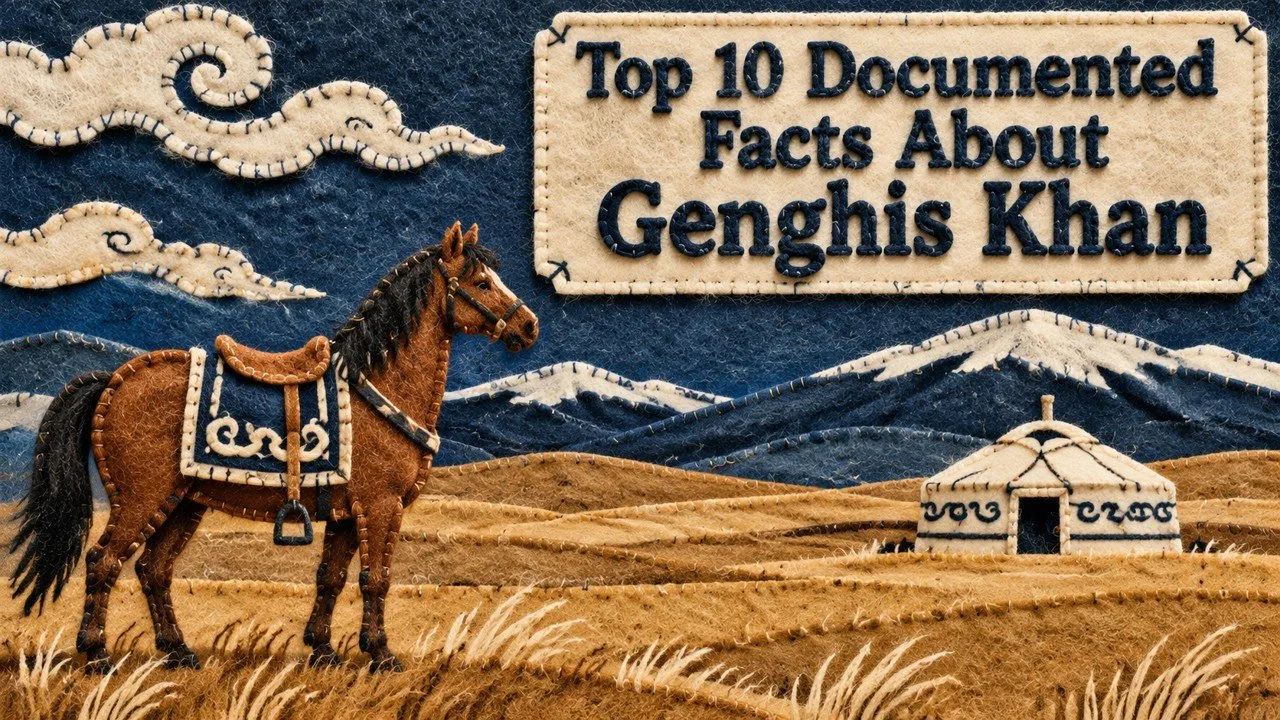
From a 1206 assembly to an unmarked grave, these ten documented facts about Genghis Khan cut through later myths without relying on disputed body counts. Temüjin, later titled Chinggis or Genghis Khan, was the founder of the Mongol Empire, the largest contiguous land empire in history, and he died in 1227 while on campaign.[1][2] Around that bare outline a huge later literature has grown, much of it vivid and some of it unprovable.
This Finepedia list keeps to points that can be anchored in early sources or in a clear scholarly consensus. It does not offer a single figure for the dead of the conquests, because published estimates vary widely and are still argued over. It also treats later colourful stories, including precise claims about his private life or a fully reconstructed law code, with caution.
The ten facts run from his family background and the 1206 assembly to the secret of his grave. Together they show a political and military organiser as well as a conqueror, without softening the violence of the campaigns that followed the assembly on the Onon.
Key Facts
The table below gives a quick overview of all ten entries before each one is described in detail.
| # | Fact | Date or period | Best evidence | Why it matters |
|---|---|---|---|---|
| 1 | The 1206 assembly and a new title | 1206 | Secret History and later official histories | The Mongol state begins here |
| 2 | A childhood of abandonment and early violence | c. 1162, with a birth-year range | The Secret History | The later conqueror was not born secure |
| 3 | An army organised by tens, hundreds and thousands | From the 1206 reforms onward | Early Mongol and Chinese accounts | Tribal armies were broken up |
| 4 | The yam, a relay network across the empire | Built under Genghis, enlarged by his heirs | Travellers' accounts and official practice | Messages and officials could move at speed |
| 5 | A court that heard more than one religion | Lifetime of Genghis, continued by his heirs | Native and foreign accounts | Policy, not a modern idea of tolerance |
| 6 | Siege specialists taken from conquered states | Campaigns against Xia, Jin and Khwarazm | Chinese and Persian narrative sources | The Mongols did not rely on cavalry alone |
| 7 | The Secret History is the chief native source, and it is not a modern biography | After 1227, with later transmission | The text itself, in later copies | Every popular story should be tested against it |
| 8 | Merchants and envoys were a trigger for war, and later a protected traffic | Especially 1218–1221 and after | Persian and Chinese accounts | Trade was a cause and a tool |
| 9 | A successor was named, and the family remained the state | Ögedei recognised; enthroned 1229 | Secret History and official histories | The empire was built to outlast one man |
| 10 | He died in 1227, and the grave was hidden | August 1227 | Official dates; burial place unknown | The secret is historical, not a modern invention |
1. The 1206 assembly and a new title
In 1206 a great assembly, or kurultai, of the peoples Temüjin had united on the Mongolian plateau proclaimed him Genghis Khan, a title whose exact meaning is still debated by scholars.[1][3][2] He was already a successful war leader; the assembly made him the recognised ruler of a new, wider community and gave later official history a founding date.
The meeting was not a modern election, and it did not come out of nowhere. It followed years of alliance, betrayal and war among the tribes of the steppe, and it bound those groups to the ruling family in a new way. From this point it becomes reasonable to speak of a Mongol empire rather than of a single successful clan.[4]
Everything else on this list follows from that act of recognition. The decimal army, the relay network and the wars in China and Central Asia were tools of a ruler who now claimed more than the leadership of his father's people.
2. A childhood of abandonment and early violence
Temüjin was the eldest son of the chieftain Yesugei and his wife Hö'elün. His birth is usually placed around 1162, though serious estimates range from the mid-1150s to the mid-1160s.[1][2] When he was still a child his father died, and the family was abandoned by its people and reduced to a hard, poor life on the margins of the tribe.[5]
The Secret History, the principal native narrative, does not present this as a gentle pastoral childhood. It records that Temüjin later killed his older half-brother Behter in a struggle over the family's position, and that his wife Börte was kidnapped by raiders and had to be recovered with the help of allies, including Jamukha and Toghrul.[6][7] Those episodes, even if shaped by later telling, belong to the earliest layer of the story, not to modern invention.
Related: Top 10 Famous Obelisks Around the World
The point is not to turn the child into a legend of destiny. It is to note that the adult khan's ruthlessness and his talent for attracting followers both had a documented beginning in a childhood of insecurity, hunger and clan war.
3. An army organised by tens, hundreds and thousands
One of Genghis Khan's most important reforms was to organise his fighting men in a decimal structure of tens, hundreds, thousands and units of ten thousand, often called tumens, and to mix men from different tribal backgrounds inside those units.[1][8] The aim was political as well as military. A commander whose men came from many groups would find it harder to peel away as a tribal faction.
Promotion could follow ability as well as birth, which later writers summed up as a kind of merit rule in the service of the ruling family.[1] That should not be romanticised: the royal family still stood at the top, and discipline was severe. But the reform does help to explain how a steppe cavalry force could be directed, replaced and moved as a single instrument across enormous distances.
The same structure also made it easier to absorb new groups after a victory. A conquered or allied set of warriors could be enrolled in the existing ladder of units rather than left intact as a potential rival horde.
4. The yam, a relay network across the empire
The Mongol state kept a network of relay stations, known as the yam, at which riders could change horses, rest and pass on official messages or authorised travellers.[9][8] The idea of a horse post was not unique to the Mongols, but they built it on an imperial scale and tied it to written passes that showed a rider's right to use the stations.
The network was already being formed in Genghis Khan's lifetime and was extended under Ögedei and later khans, until it ran across much of the width of Eurasia.[9] Foreign visitors, including later European travellers, were astonished by the speed with which news and orders could move when the passes were in order.
The yam was a tool of government, not a public letter office in the modern sense. Unauthorised use was punished, and ordinary merchants did not simply ride the posts as they pleased. Even so, it is one of the clearest signs that the empire was administered, not only looted, and it belongs among the documented facts about the founder who first required such a network.
5. A court that heard more than one religion
Genghis Khan himself belonged to the sky-and-spirit world of the Mongol steppe and took shamans seriously enough to treat a later shamanic challenge as a political crisis.[1] He did not convert to a world religion, and his wars were not missionary wars. At the same time, he and his immediate heirs were prepared to hear, use and sometimes exempt holy men of several traditions, including Buddhist, Taoist, Christian and Muslim teachers, when it seemed useful or respectful to do so.[8][1]
Related: Martin Luther King Jr.: The Legacy of a Civil Rights Icon
The most famous personal episode is his meeting, late in life, with the Taoist master Qiu Chuji, who was invited to travel to the khan's camp to discuss long life and government. The visit is recorded on both the Chinese and the Mongol sides of the tradition and is not a late folk tale.
This was not "tolerance" in a modern legal sense, and it did not stop the sack of cities whose rulers had refused terms. It was a practical court style, in which a ruler could honour a holy man without accepting his faith, and it became a durable habit of the early empire.
6. Siege specialists taken from conquered states
Popular images of Mongol warfare stress horse archers on the open steppe, and those horsemen were indeed the core of the army. The great wars of Genghis Khan, however, also involved the taking of walled cities in northern China and in Central Asia, and for that work the Mongols made regular use of engineers, artisans and siege crews drawn from the peoples they had already conquered.[1][2] Chinese specialists, and later others from the Muslim world, appear in the sources as the men who built and worked the engines.
The campaign against the Jin, which reached a climax with the fall of Zhongdu in 1215, and the later war in the Khwarazmian lands after Genghis's envoys were killed, both required more than a cavalry raid.[1] Cities were isolated, bombarded and starved, and skilled captives were moved to where they were needed.
This fact cuts through two opposite myths: that the Mongols were only destructors, and that they were naturally unstoppable horsemen who never needed help. They were formidable riders who also borrowed technical knowledge, very quickly, from the settled states they attacked.
7. The Secret History is the chief native source, and it is not a modern biography
The Secret History of the Mongols is the oldest surviving substantial work in a Mongolic language, written for the royal family some time after Genghis Khan's death in 1227, and later partly transmitted through a Ming-period copy in which the Mongol words were written out in Chinese characters to help interpreters.[7] It recounts Temüjin's life, his rise, his wars and the early reign of Ögedei, in a mixture of narrative, genealogy, praise and blame.
Related: Top 10 Famous Tombs and Mausoleums
It is the single most important native account of the founder, and it is also a court text, not an independent report.[7][1] It can be vivid, partisan and silent where a modern reader wants detail. Other early sources, in Chinese, Persian and later European languages, add facts and also bring their own biases, especially where they describe the destruction of cities.
A documented approach to Genghis Khan starts here: not by discarding the Secret History, and not by quoting it as if it were a newspaper. Many later legends shrink, or at least have to be footnoted, once this text and the other early chronicles are given priority.
8. Merchants and envoys were a trigger for war, and later a protected traffic
The war against the Khwarazmian Empire is the clearest example of how seriously Genghis Khan treated the safety of his envoys and the merchants who moved under his protection. After a caravan was seized and his envoys were killed at Otrar, he launched a campaign that toppled the Khwarazmian state and laid waste to rich cities in Transoxiana and Khorasan.[1][2] Whatever else the war became, it began as a ferocious reply to that insult and loss.
In the longer run the empire, under Genghis and still more under his successors, also made long-distance trade easier in some regions by holding the roads, issuing passes and punishing banditry, a peace that later writers would call, perhaps too neatly, a Mongol peace across Eurasia.[4][8] The same state could destroy a city and, a few years later, want its markets working again.
The documented fact is therefore double. Merchants were not irrelevant to the conqueror, and their mistreatment could bring catastrophe on a kingdom. They were also among the people the later empire had a strong interest in moving, taxing and keeping reasonably safe.
9. A successor was named, and the family remained the state
Genghis Khan did not leave the succession to chance in the final sense. After tensions among his sons, especially between Jochi and Chagatai, the third son Ögedei was recognised as heir, and after a two-year interval he was placed on the throne in 1229.[1][7] The choice favoured a man known for a more conciliatory temper, not the most purely military of the brothers.
The deeper fact is that the empire was already a family enterprise. Senior wives, sons and trusted sons-in-law held commands and pastures, and the 1206 settlement had been designed to serve that family as much as any abstract "nation." Genghis's own death, therefore, was a crisis but not an end.
Related: Marco Polo (2014): The Netflix Series that Explores the Mongol Empire
Ögedei's later drinking and the later civil wars among descendants belong to another chapter. What belongs here is the founder's documented attempt to make a transfer of power possible at all, in a political world that often broke apart at the death of a strong khan.
10. He died in 1227, and the grave was hidden
Genghis Khan died in August 1227, during a campaign to put down the Western Xia, who had rebelled against Mongol authority.[1][2] The year is firm. The exact cause is not. Later writers mention illness, injury or a fall from a horse, and none of those stories can be chosen with confidence. It is better to say that he died on campaign, at about sixty years of age if the usual birth date is close to the truth.
His burial place was kept secret, and it has not been identified. Stories of a hidden grave, a closed valley, and escorts who were silenced along the way have circulated for centuries; some are later embroidery, but the core fact of an unmarked, guarded burial is consistent with early practice and with the continuing failure of modern searches.[1]
That secret has tempted legend more than almost any other part of his life. It is also, in its bare form, one of the best attested facts we have: the founder of the empire died in 1227, his body was not given a public tomb, and no later discovery has yet unsettled that silence.
Conclusion
These ten facts do not make Genghis Khan a smaller figure. They make him a clearer one. A rejected child became the ruler recognised in 1206, organised an army and a relay network, borrowed siege skills, listened to more than one kind of holy man, and left an empire that could survive his death even though his grave could not be visited.
What they leave out, on purpose, are the huge round numbers and the later folk tales that cannot be tied to early evidence. The conquests were real and often terrible; the evidence is simply too uneven for a single body count to be offered here as a fact. For a wider view of ambitious campaigns that came apart for more ordinary reasons, see Top 10 Armies Defeated by Their Own Supply Problems.
- ^ [1] "Genghis Khan". Wikipedia. Wikipedia
- ^ [2] "Genghis Khan". Encyclopaedia Britannica. Encyclopaedia Britannica
- ^ [3] "Kurultai". Wikipedia. Wikipedia
- ^ [4] "Mongol Empire". Wikipedia. Wikipedia
- ^ [5] "Yesugei". Wikipedia. Wikipedia
- ^ [6] "Börte". Wikipedia. Wikipedia
- ^ [7] "Secret History of the Mongols". Wikipedia. Wikipedia
- ^ [8] "Mongol empire". Encyclopaedia Britannica. Encyclopaedia Britannica
- ^ [9] "Yam (route)". Wikipedia. Wikipedia























Discussion
Log in with