




 By
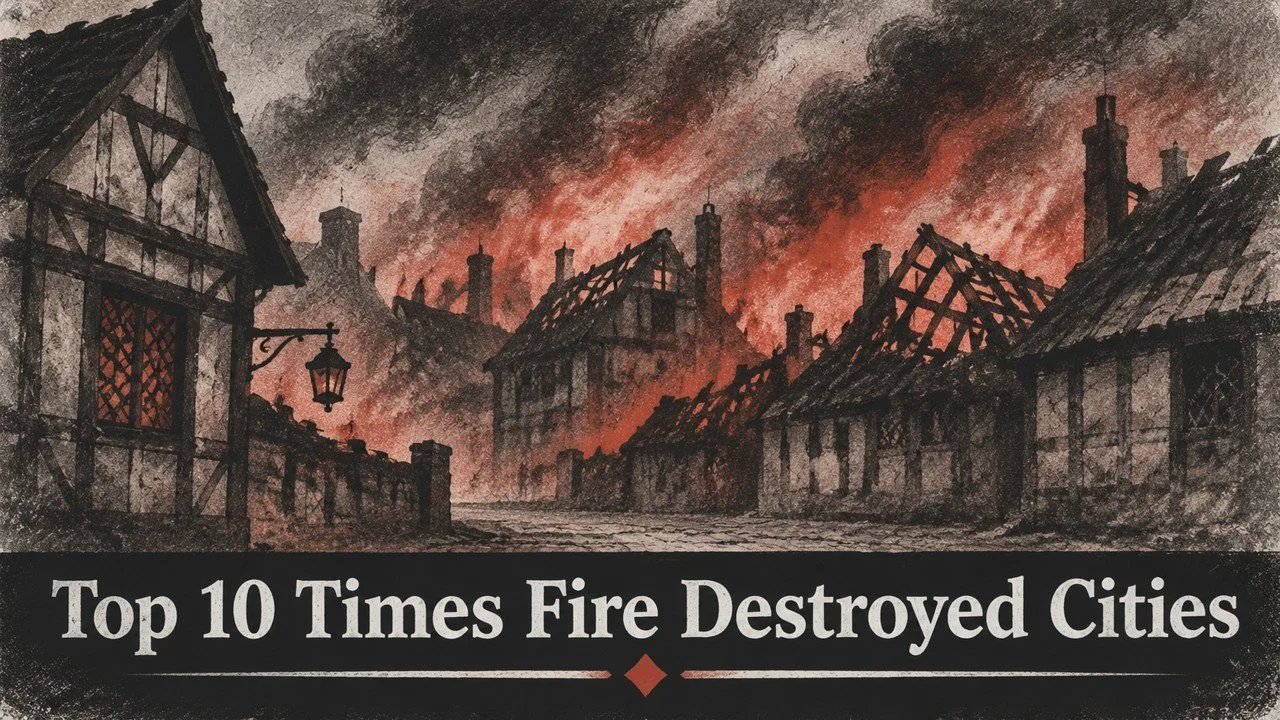
From Rome in 64 AD to Tokyo in 1923, these ten city fires began by accident or disaster, not by wartime bombing, and remade the streets that followed. A wooden city, a dry wind and a single neglected hearth have always been a dangerous combination. The fires on this list were not air raids. They started in a bakery, a barn, a kitchen, a shaken stove, or, in one still-argued case, in a city already being abandoned to an advancing army.
The official death rolls are often strangely small, because many of the poorest dead were never counted, or because people escaped a famous fire only to be missed in a less famous one nearby. Where estimates disagree, the range is given. Later legends, such as a cow kicking over a lantern, are treated as stories unless the record supports them.
This Finepedia list is confined to urban fires that destroyed a large part of a city and left a clear mark on its later plan, building rules or memory. Bombing campaigns of the twentieth century are omitted on purpose, as a different kind of disaster.
Key Facts
The table below gives a quick overview of all ten entries before each one is described in detail.
| # | Fire | Place | Date | Usual starting point | What was lost |
|---|---|---|---|---|---|
| 1 | The Great Fire of Rome | Rome | 64 AD | Shops near the Circus Maximus | Large parts of the ancient city |
| 2 | The Great Fire of London | London | 2–6 September 1666 | A bakery in Pudding Lane | The old City within the walls, later rebuilt |
| 3 | The Meireki fire | Edo (Tokyo) | 1657 | A city of timber and wind, later wrapped in legend | Much of the shogun's capital |
| 4 | The fire of Moscow | Moscow | September 1812 | A disputed origin as Napoleon entered the city | Most of the old capital |
| 5 | The Great Chicago Fire | Chicago | 8–10 October 1871 | A barn on the city's West Side | The downtown and much of the North Side |
| 6 | The Peshtigo fire | Peshtigo, Wisconsin, and nearby settlements | 8 October 1871 | Drought, logging slash and a firestorm | A town almost wiped out, with a huge rural death roll |
| 7 | San Francisco, 1906 | San Francisco | 18 April 1906 and the days following | An earthquake, then broken water mains and many fires | Most of the central city |
| 8 | The Great Kantō disaster | Tokyo and Yokohama | 1 September 1923 and after | An earthquake at lunchtime, then firestorms | The heart of two cities |
| 9 | The Great Fire of Turku | Turku, Finland | 4–5 September 1827 | A wooden provincial capital in late summer | Most of the historic city |
| 10 | The Great Fire of Thessaloniki | Thessaloniki | 18 August 1917 and the following days | A kitchen fire, then a dry wind | The commercial and Jewish heart of the city |
1. The Great Fire of Rome
The fire that broke out in Rome in July 64 AD began, according to Tacitus, among shops in the low ground near the Circus Maximus, and it burned for the better part of a week, in more than one outburst.[1][2] A large share of the city's districts was destroyed or badly damaged, including temples, public buildings and crowded tenement areas. The disaster is one of the best documented urban fires of the ancient world, even though no official damage list in the modern sense survives.
Blame was immediate and political. A rumour later held that the emperor Nero had started the fire to clear ground for his new palace; Tacitus reports the rumour and also Nero's efforts at relief, and he records that Christians were accused and cruelly punished as scapegoats.[1] Modern historians do not treat Nero's guilt as proved, and this list does not repeat that charge as fact. What is clear is that the fire became a political event as well as a physical one.
The rebuilding that followed included wider streets and more use of stone and brick in places, a pattern that will recur on this list. Rome was not abandoned. It was changed, and the argument about who was to blame has lasted almost as long as the rebuilt city.
2. The Great Fire of London
In the early hours of 2 September 1666 a fire began at a bakery in Pudding Lane, in the City of London, and a strong wind drove it through streets of closely packed timber houses.[3][4] Over the next four days it destroyed most of the old City within the walls, including old St Paul's Cathedral, dozens of parish churches and more than 13,000 houses. The recorded death toll was tiny, almost certainly an undercount, but the loss of buildings was almost total in the heart of the city.
The Museum of London and the later Monument still tell the story through the diaries of Samuel Pepys and John Evelyn, the desperate pulling-down of houses to make fire-breaks, and the king's appearance in the streets.[4] Foreigners and religious minorities were briefly in danger from frightened crowds looking for someone to blame, a grim sidenote to the civic disaster.
Related: Top 10 Forgotten American Disasters
The city was rebuilt on a recognisably older street plan, but in brick and stone, with new building rules and a new St Paul's. London's great fire is the model of the type: a small accident, a dry season, a wooden city, and a rebuilding that later generations took as the start of a more modern capital.
3. The Meireki fire
The Meireki fire of 1657 was one of the worst peacetime disasters in the history of Edo, the city that later became Tokyo. In early March a fire, driven by a strong wind through a capital built largely of wood and paper, burned for about three days and destroyed a huge part of the city, including parts of Edo Castle and countless common houses.[5] Later estimates of the dead have often been put at around 100,000, a figure that should be treated as a traditional order of magnitude rather than a precise census.
A later story blamed the fire on a cursed kimono, repeatedly cut down and rededicated, then finally put to the flames. That tale is folklore, not a contemporary investigation, and it is not needed to explain the disaster. A dry day, a dense wooden city and a hard wind are quite enough.[5]
Edo was rebuilt, still as a wooden city, and it would burn again. The Meireki fire remains a turning point in the capital's memory, and a reminder that some of the deadliest urban fires in history happened far from Europe and long before industrial factories or electrical wiring.
4. The fire of Moscow
When Napoleon's army entered Moscow in September 1812, the city soon burned, and by the time the fires subsided most of the capital had been destroyed.[6][7] The cause is still argued. Some accounts blame a deliberate Russian decision to leave the invader nothing; others point to accidents among empty houses, looting and a breakdown of ordinary fire-fighting. It may well have been some combination of the two. What is not in doubt is the result.
For the Grande Armée the fire was a military disaster as well as a civic one. The expected winter quarters, stores and shelter largely vanished, and the army's later retreat, already discussed in Finepedia's list of armies undone by their own supply problems, began from a burned city rather than from a secure prize.[7] For the city's people, many of whom had fled, it was the loss of homes, archives, churches and whole districts.
Moscow was rebuilt, and the fire entered both Russian and French memory as a symbol as much as a fact. On this list it stands as a rare case in which a city fire, whatever its exact spark, decided the fate of a campaign.
5. The Great Chicago Fire
The Chicago fire of 8–10 October 1871 began in or near a barn on the West Side, in dry, windy weather, and swept through the wooden central city, crossing the river and consuming much of the downtown and the North Side.[8][9] Some 17,000 to 18,000 buildings were destroyed, a huge share of the population was made homeless, and at least 300 people were killed. The Chicago History Museum still treats the disaster as a founding event in the city's modern story.
Related: Top 10 Historical Facts That Sound Fake but Are True
The tale that Mrs O'Leary's cow kicked over a lantern is a later popular story, not a finding that historians now accept as proved.[9] The official starting point remains a barn in that neighbourhood; the exact spark does not have to carry a punchline. Like London, Chicago was a dense wooden city waiting for a hard wind.
The rebuilding was rapid and ambitious, and it helped to make later Chicago a city of brick, stone and steel-framed buildings. The fire is famous, sometimes too famous, because another, deadlier fire burned in the same region on the same night and is still much less well known.
6. The Peshtigo fire
On the same day as the Chicago fire, 8 October 1871, a still more lethal fire consumed the timber town of Peshtigo, Wisconsin, and a wide belt of settlements and forest around the bay of Green Bay.[10] A long drought, piles of logging slash and a sudden, violent firestorm combined to produce what is often called the deadliest wildfire in American history. Estimates of the dead commonly range from about 1,200 to 2,500, far higher than Chicago's toll, and the true number will never be known exactly.
Peshtigo itself was almost completely destroyed. Survivors later described a roar of fire, a darkness of smoke, and people taking refuge in the river. Whole families in outlying farms left no one to report them missing, which is one reason the count is so uncertain.[10]
The same dry weather helped to feed other fires in the Upper Midwest that week. Peshtigo's obscurity beside Chicago is itself part of the history: a rural and small-town disaster, however large the death roll, was easier for newspapers and later schoolbooks to overlook than the burning of a already famous city.
7. San Francisco, 1906
In the early morning of 18 April 1906 a severe earthquake shook San Francisco. The shaking did great damage, but the fires that followed did more.[11][12] Broken chimneys, fallen stoves and ruptured gas lines started blazes across the city, and broken water mains made them almost impossible to fight in the usual way. The fire burned for three days, consuming much of the central city and leaving a huge displaced population.
Related: Top 10 Roman Emperors Who Shaped History
Death estimates are often given at around 3,000, though the figures have been revised over time and remain incomplete, especially for the poorest districts.[11] The U.S. National Park Service, which interprets the disaster at the city's former Presidio, still stresses the chain from earthquake to fire, rather than treating the event as a simple shake followed by a single accidental blaze.[12]
The rebuilding of San Francisco, like that of Chicago and London, became a civic legend of resilience. The documented lesson was more practical: a city can survive a great earthquake and still be lost to the fires that come after, if its water and its chimneys fail together.
8. The Great Kantō disaster
The Great Kantō earthquake struck at lunchtime on 1 September 1923, when many kitchen stoves were alight, and it was followed by fires that tore through Tokyo, Yokohama and neighbouring towns.[13] Wooden houses, a strong wind and broken water supplies produced firestorms, including a terrible concentration of deaths in an open space in downtown Tokyo where people had gathered to escape. The total death roll is usually put at more than 100,000, most of them killed by fire rather than by falling buildings.
The disaster also had a dark social aftermath: in the confusion, mobs killed many ethnic Koreans and others, an atrocity that is part of the historical record and should not be folded silently into the casualty figures of the fire itself.[13] The two events happened together, but they were not the same thing.
Tokyo and Yokohama were rebuilt, and 1 September remains a disaster-prevention day in Japan. On this list the Kantō fire stands as the deadliest modern example of a city destroyed not by bombs, but by an earthquake that arrived at the worst possible hour.
9. The Great Fire of Turku
On 4 September 1827 a fire broke out in Turku, then the largest city in Finland, and burned through the night and into the next day, destroying most of the closely built wooden town.[14] The cathedral and the buildings of the academy were badly damaged, and a large part of the population was left without a house. In a small country the blow was national, not only local, even though the official capital had already been moved to Helsinki.
The later rebuilding followed a more regular street plan, with wider intervals between wooden houses, the same lesson already learned in London and in other burnt cities.[14] Turku never quite regained its old rank, which is why the fire is still treated as a turning point in Finnish urban history and not only as a local misfortune.
Related: Top 10 Most Bizarre Phobias: Strange Fears That Exist
Compared with Tokyo or Chicago the absolute numbers are smaller, but the proportional loss was huge. A whole historic centre, with its records, workshops and parish life, had to be started again from a grid of new streets.
10. The Great Fire of Thessaloniki
On 18 August 1917 a fire began in a kitchen in the lower town of Thessaloniki and, driven by a dry wind, spread for a day and more through one of the great port cities of the eastern Mediterranean.[15] Greece was already involved in the First World War, and Allied soldiers were present in the city, but this was not a bombardment. It was an accidental urban fire in a densely built town of timber and plaster, and it destroyed a huge part of the historic centre, including much of the Jewish quarter and the commercial core. Some 70,000 people were made homeless.
The rebuilding, carried out under a modern plan, changed the face of Thessaloniki. A city that had grown in layers through Ottoman and earlier centuries received a new street pattern and a new waterfront, and many of the burned communities never returned to the same houses or the same streets.[15]
The Thessaloniki fire is less famous in the English-speaking world than London or Chicago, which is one reason to include it. It shows the same ingredients, a kitchen, a wind, a wooden city, at work in a different corner of Europe, with consequences that the city's later plan still records.
Conclusion
These ten fires, from Nero's Rome to Taisho-era Tokyo, show how fragile a wooden or closely packed city can be, and how often the official spark is smaller than the legend that later attaches to it. A bakery, a barn, a kitchen or a shaken stove can unmake a capital, especially when the wind is up and the water mains or the buckets fail.
They also show that rebuilding is part of the same history. London, Chicago, San Francisco, Edo, Turku and Thessaloniki all used the empty ground to change their building rules or their street plans. The cost of that chance was paid, first of all, by the people who had lived in the houses that burned. For a wider Finepedia view of how cities have suffered and changed, see Top 10 Most Powerful Earthquakes Ever Recorded, which includes other disasters in which fire sometimes followed the shaking.
- ^ [1] "Great Fire of Rome". Wikipedia. Wikipedia
- ^ [2] "Great Fire of Rome". Encyclopaedia Britannica. Encyclopaedia Britannica
- ^ [3] "Great Fire of London". Wikipedia. Wikipedia
- ^ [4] "The Great Fire of London". Museum of London. Museum of London
- ^ [5] "Great Fire of Meireki". Wikipedia. Wikipedia
- ^ [6] "Fire of Moscow (1812)". Wikipedia. Wikipedia
- ^ [7] "Fire of Moscow". Encyclopaedia Britannica. Encyclopaedia Britannica
- ^ [8] "Great Chicago Fire". Wikipedia. Wikipedia
- ^ [9] "Fire of 1871". Encyclopedia of Chicago, Chicago History Museum. Encyclopedia of Chicago
- ^ [10] "Peshtigo fire". Wikipedia. Wikipedia
- ^ [11] "1906 San Francisco earthquake". Wikipedia. Wikipedia
- ^ [12] "1906 Earthquake". U.S. National Park Service, Golden Gate. U.S. National Park Service
- ^ [13] "1923 Great Kantō earthquake". Wikipedia. Wikipedia
- ^ [14] "Great Fire of Turku". Wikipedia. Wikipedia
- ^ [15] "Great Thessaloniki Fire of 1917". Wikipedia. Wikipedia























Discussion
Log in with