




 By
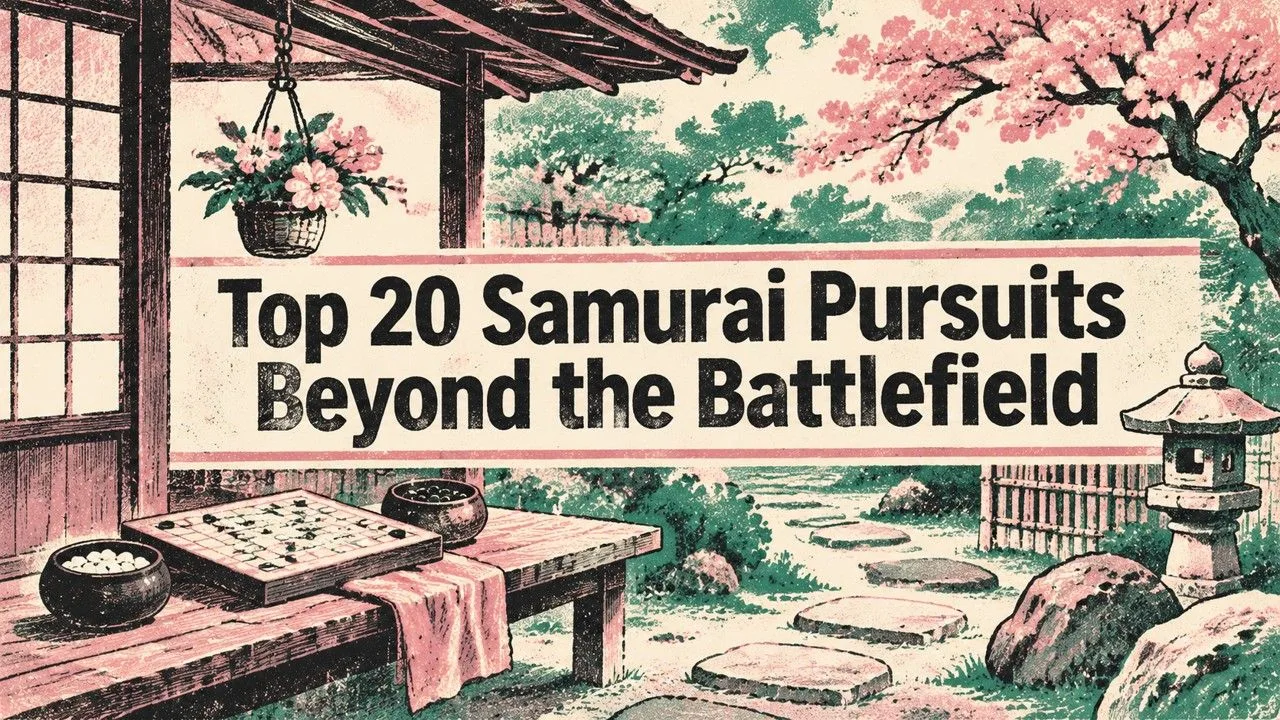
Samurai are remembered for swords and armour, yet these twenty pursuits show how many spent their days on tea, poetry, board games, gardens and government. Japan's warrior class ruled the country for about seven centuries, and for much of that time, especially during the long peace of the Edo period, most samurai rarely or never fought in a battle.
The Japanese had a phrase for the ideal balance: bun and bu, the arts of peace and the arts of war. The Asian Art Museum in San Francisco notes that by the seventeenth century, the shogun's regulations for military houses actually required samurai to master both.[1]
For this Finepedia list we chose twenty activities that filled the lives of samurai beyond fighting, from the tea room and the go board to the government office. We focus on documented examples and famous figures, and we note where popular legends go beyond the evidence. Not every samurai practised every art; many of these pursuits were most common among the wealthy upper ranks.
Key Facts
The table below gives a quick overview of all twenty entries before each one is described in detail.
| # | Entry | Pursuit | Japanese term | Peak period | Famous samurai linked to it |
|---|---|---|---|---|---|
| 1 | The way of tea | Tea ceremony | Chanoyu, chadō | 16th–19th centuries | Oda Nobunaga, Toyotomi Hideyoshi |
| 2 | Noh theatre | Theatre and dance | Nōgaku, sarugaku | 14th–19th centuries | Toyotomi Hideyoshi |
| 3 | Poetry | Poetry | Waka, renga, jisei | 12th–19th centuries | Kusunoki Masatsura, Hosokawa Yūsai |
| 4 | Calligraphy and ink painting | Visual art | Shodō, sumi-e | 14th–19th centuries | Miyamoto Musashi |
| 5 | Zen Buddhism | Religion and meditation | Zen | 13th–16th centuries | Hōjō Tokiyori |
| 6 | Schools and Confucian study | Education | Hankō, Shōheikō | 17th–19th centuries | Hayashi Razan |
| 7 | Government and administration | Public office | Bugyō and domain offices | 17th–19th centuries | Edo period officials |
| 8 | Garden design | Landscape art | Karesansui, stroll gardens | 15th–17th centuries | Ashikaga Yoshimasa, Kobori Enshū |
| 9 | Incense appreciation | Scent art | Kōdō | 15th–19th centuries | Ashikaga Yoshimasa, Oda Nobunaga |
| 10 | Falconry | Hunting | Takagari | 12th–19th centuries | Tokugawa Ieyasu, Toyotomi Hideyoshi |
| 11 | The game of go | Board game | Igo, weiqi | From the Heian period; peak in Edo | Tokugawa household, castle players |
| 12 | Shogi, Japan's own chess | Board game | Shōgi | Sengoku and Edo periods | Domain lords and castle professionals |
| 13 | The way of flowers | Flower arranging | Ikebana, kadō | Muromachi to Edo periods | Warrior patrons of Ikenobo and later schools |
| 14 | Kemari, the court kick-ball | Cooperative ball game | Kemari | Heian and Kamakura periods, later revival | Court nobles, then samurai |
| 15 | Connoisseurship of swords | Art collecting and appraisal | Kantei, tōsōgu | Muromachi to Edo periods | Hon'ami appraisers, daimyo collectors |
| 16 | Hanami, viewing the cherry blossom | Seasonal gathering | Hanami | Heian court onward; grand warrior feasts in the 16th century | Toyotomi Hideyoshi |
| 17 | Kyogen, the comic counterpart of Noh | Comic theatre | Kyōgen | Muromachi to Edo periods | Domain troupes and samurai audiences |
| 18 | Rangaku, Dutch learning | Scholarship | Rangaku | 18th–19th centuries | Shogunate translators and samurai scholars |
| 19 | Dakyu, a mounted ball game | Equestrian sport | Dakyu | Court origins; later warrior practice | Court and military households |
| 20 | Bonseki, landscapes on a tray | Miniature landscape art | Bonseki | Edo period flourishing | Tea and literary circles around samurai houses |
1. The way of tea
Few activities were as closely tied to samurai life as the tea ceremony. The Samurai Museum Berlin explains that powdered green tea reached Japan from China in the twelfth century through the Zen monk Eisai, who used it to stay alert during long meditation.[2]
By the sixteenth century, tea had become a tool of power. The warlord Oda Nobunaga gave famous tea utensils to his followers as rewards, and a precious bowl could be valued more highly than a whole province.[2][1] Tea gatherings also provided a quiet setting in which lords could negotiate in private.
The tea master Sen no Rikyū served Toyotomi Hideyoshi and developed the simple, rustic style of tea that still shapes the ceremony today.[3] Hideyoshi also staged the Great Kitano Tea Ceremony of 1587, which was open to everyone.[2]
The relationship ended in tragedy. In 1591 Hideyoshi ordered Rikyū to take his own life, for reasons historians still debate. According to the Samurai Museum Berlin, Rikyū prepared a final tea for friends and wrote a death poem before he died.[2] His descendants founded the main tea schools that survive today.[3]
2. Noh theatre
Noh, the slow, masked dance-drama of Japan, became the favourite theatre of the warrior class. Its plays often draw on classical literature and Buddhist ideas, focusing on a character overwhelmed by love, anger or grief.[1]
Some warlords did not just watch; they performed. The Asian Art Museum notes that Toyotomi Hideyoshi studied Noh and acted in plays himself, even during military campaigns.[1]
Under the Tokugawa shoguns, Noh became the official ceremonial entertainment of the government. The Japan Arts Council explains that the shogunate supported the established troupes, while regional lords invited actors to perform exclusively for them, so that Noh and its comic partner Kyogen became performing arts of the samurai class.[4]
The commitment was costly. According to a scholar quoted by the Asian Art Museum, every lord's household in the Edo period was expected to keep a full set of Noh robes, masks and musical instruments, and lords competed to sponsor actors and build stages.[1] Because it became the ceremonial art of the shogunate, ordinary people had fewer chances to see full performances, although chanting Noh verses became a popular hobby across many classes.[4]
3. Poetry
Writing poetry was a vital social skill for elite samurai. The Asian Art Museum explains that by the late thirteenth century, writing poems and reading classical Chinese and Japanese texts had become a normal part of warrior life. Samurai attended gatherings where poems were recited, written and exchanged, and they even used verse to pray for victory.[1]
The museum highlights the sixteenth-century lord Hosokawa Yūsai, who was praised as a complete man combining arts and arms, and who could recite the secret teachings of Japanese poetry from memory.[1]
Poetry also accompanied death. Many samurai wrote a farewell poem, known as a jisei, before battle or ritual suicide. The Samurai Museum Berlin notes that a samurai about to perform seppuku often recited a death poem expressing his state of mind.[5]
One of the most famous examples belongs to Kusunoki Masatsura, a fourteenth-century warrior loyal to Emperor Go-Daigo. The Walters Art Museum explains that before his final battle, he used an arrow to inscribe a poem on the door of the emperor's memorial temple, saying that if he did not return, he would leave his name among those killed by bows.[6]
4. Calligraphy and ink painting
For samurai, writing was not only practical but also an art. The Asian Art Museum points out that literacy was essential for governing: to draft documents, a samurai needed at least basic skill in calligraphy and knowledge of literary conventions.[1]
Beautiful brushwork was admired as a sign of a disciplined mind. Many samurai collected paintings and calligraphy, and warrior patronage helped painters and craftsmen flourish across the centuries of military rule. Lords filled their castles with painted screens, including scenes of battles and pastimes such as falconry.[1]
Related: Top 10 Most Bizarre Phobias: Strange Fears That Exist
The most famous swordsman-artist was Miyamoto Musashi, the duellist who wrote The Book of Five Rings. The Samurai Museum Berlin describes him as a recognised painter and calligrapher whose ink paintings, often of birds and Zen figures, show the same economy of movement as his swordsmanship.[7]
Musashi's calligraphy often featured Zen sayings and was valued by both samurai and monks. Some of his works are now considered national treasures in Japan, while others survive only as copies.[7] His career shows how, for some samurai, the brush and the sword were two expressions of the same training.
5. Zen Buddhism
Zen Buddhism, with its focus on meditation and direct experience, found powerful supporters among the warrior rulers of Japan. Its Rinzai branch, brought from China, took root in the shoguns' capital of Kamakura in the thirteenth century.
A key moment came in 1253, when the regent Hōjō Tokiyori, effective ruler of the Kamakura shogunate, founded Kenchō-ji in Kamakura. The temple's own association explains that Tokiyori wanted to establish a true Rinzai monastery in the capital and invited the Chinese master Lanxi Daolong to serve as its first abbot.[8] Kenchō-ji became one of the leading Zen temples in the country.
Zen's appeal to warriors is often explained by its stress on discipline, calm in the face of death and living fully in the present. It also shaped samurai culture, influencing tea, gardens, calligraphy and ink painting.[2]
Historians caution that Zen was not the religion of every samurai. Many warriors followed other Buddhist schools, and Zen's strongest support came from the shoguns and great lords. Even so, the image of the meditating swordsman, seen in figures such as Musashi, became one of the most lasting symbols of samurai culture.[7]
6. Schools and Confucian study
In the peaceful Edo period, samurai were expected to study as well as train. Japan's Ministry of Education explains that domain lords invited Confucian scholars to lecture their chief retainers and encouraged lower-ranking samurai to cultivate learning alongside martial arts.[9]
Domain lords founded their own schools in their castle towns. Only a few existed at first, but their numbers grew quickly from the middle of the period, reaching about 270 by its end.[9] The Tokyo Metropolitan Library notes that from the eighteenth century these schools were set up in almost every domain to train capable officials for government reform.[10]
Lessons focused on Confucian classics such as the Analects and the Great Learning, which taught loyalty, duty and good government.[10] The most important school was the Shōheizaka Gakumonjo in Edo, which grew from the private academy of the Confucian scholar Hayashi Razan and came under direct government control in 1797.[9]
This education made samurai one of the most literate groups in Japan. When the samurai class was abolished after 1868, many former samurai became teachers, officials and leaders in the new modern state.
7. Government and administration
For most samurai of the Edo period, a working day meant administration rather than combat. After the wars ended in the early seventeenth century, the Tokugawa peace lasted for more than 250 years, and the warrior class had to find another role.
The Samurai Museum Berlin describes them as bureaucrats with swords. They kept records, supervised markets and settled disputes for the shogun and the regional lords.[11] Most samurai lived in castle towns and received a fixed stipend from their lord rather than income from their own land.
The Asian Art Museum notes that this shift began much earlier, because samurai needed cultural and written skills to govern the lands they had won in war.[1] By the Edo period, offices handled taxes, roads, police, justice and the management of villages and towns.
The change worried some traditionalists. The Samurai Museum Berlin suggests the famous samurai text Hagakure should be read as a protest against this peaceful, office-bound life, written to preserve a warrior spirit at a time when few samurai were actually fighting.[11]
8. Garden design
Some of Japan's most celebrated gardens were created by or for samurai rulers. The Samurai Museum Berlin describes how the shogun Ashikaga Yoshimasa withdrew into artistic projects during the chaos of the Ōnin War in the fifteenth century, building the Silver Pavilion in Kyoto and designing gardens while the city burned.[12]
Related: Top 10 Oldest Buildings in the World
The museum calls the Muromachi period the golden age of classical Japanese aesthetics, when Noh, tea, ink painting and Zen dry-landscape gardens all flourished under warrior patronage.[12]
The most famous samurai garden designer was Kobori Enshū, a lord who held a domain in Ōmi province and was also a tea master, poet and painter.[13] Japan's Nara National Research Institute for Cultural Properties records that he designed the dry landscape garden at Konchi-in temple in Kyoto, with its crane and tortoise islands.[14] He also carried out an extensive renovation of the garden of the Ninomaru Palace at Nijō Castle in 1626.[15]
Enshū taught the tea ceremony to the third Tokugawa shogun, Iemitsu, and his style still survives as a school of tea.[13]
9. Incense appreciation
The art of appreciating fragrant wood, known as kōdō, the way of incense, grew up among court nobles and samurai. Participants describe the practice as listening to incense, and it includes guessing games in which players try to identify different scents.[16]
According to the magazine Discover Japan, incense culture spread widely among the samurai class during the Muromachi period. The shogun Ashikaga Yoshimasa played a key role in turning it into a formal art, alongside the incense masters Shino Sōshin and Sanjōnishi Sanetaka, the founders of the two main schools.[17][16]
The most famous piece of incense in Japan is Ranjatai, a huge block of aromatic wood kept in the Shōsōin treasury at Tōdai-ji in Nara. Discover Japan explains that Yoshimasa was given permission to cut a piece of it, and that Oda Nobunaga did the same in 1574 as a demonstration of his power.[17] The names of those who cut it, including Yoshimasa, Nobunaga and the Meiji Emperor, are recorded on the wood.[17]
Incense also had a place on campaign. Warriors are said to have purified their minds and bodies with the smoke of fragrant wood before going into battle, linking this refined art directly to the life of a fighting man.[16]
10. Falconry
Hunting with trained hawks was one of the most prestigious pastimes of the samurai. A 2025 exhibition leaflet from Nijō Castle in Kyoto explains that falconry was once practised by emperors, but from the twelfth century onward it was taken up mainly by warriors, partly as a form of military training.[18]
Hawks and the birds they caught were also used as diplomatic gifts that confirmed loyalty and friendship. In 1591, after a falconry tour, Toyotomi Hideyoshi returned to Kyoto with more than 150 falconers and several hundred mounted soldiers, displaying over 37,000 animals caught on the hunt as he passed the imperial palace.[18]
The greatest enthusiast was Tokugawa Ieyasu, founder of the Tokugawa shogunate. The castle's curators note that he was known for his love of hawks and went falconry more than a thousand times in his life.[18] In 1612 the shogunate even banned court nobles from keeping hawks, a decision with clear political meaning.
Hawks became symbols of military power. Painted hawks and eagles appear on the walls of Nijō Castle, and warrior pastimes such as falconry were favourite subjects for folding screens.[18][1]
11. The game of go
Go, known in Japan as igo, is a territory game played with black and white stones on a ruled board. It was invented in China more than two thousand years ago and reached Japan by the early centuries AD, where it first took hold at court and in Buddhist temples before spreading among the warrior class.[19][20] By the late sixteenth and seventeenth centuries it was a recognised samurai accomplishment, played in castle halls as a test of patience and judgement rather than of force.
The Tokugawa shogunate gave the game official standing. Four great houses, led by the Honinbo school, received stipends to teach, play and contest an annual castle game before the shogun. Professional grades and famous match records date from this official patronage, which treated go as part of a warrior's cultivated education, not a pastime for idlers.[19]
The point, for a samurai household, was the same as with tea or poetry. A calm, visible command of a difficult art advertised self-control. The board also offered a peaceful way for rivals to take each other's measure. Many of the most celebrated players of the Edo period came from, or were employed by, military families.
Related: 10 Sikh Gurus: The Pillars of Sikhism Who Shaped Faith, Equality, Courage, and Humanity
12. Shogi, Japan's own chess
Shogi is the Japanese member of the chess family, played on a nine-by-nine board with pieces that can change their rank. Its most distinctive rule is that a captured piece may be returned to the board later as part of the captor's own force, which makes the end of a game sharper and more open than in Western chess.[21][22] The game was already popular during the wars of the sixteenth century and became a standard recreation in Edo-period castle towns.
Like go, shogi attracted official support. Professional players held titles such as meijin, and daimyo kept strong amateurs or stipended experts in their households. The game could be taught, recorded and discussed in the same serious tone as swordwork or letter-writing, which is why manuals and famous match collections survive in such numbers.[21]
For samurai who might never see a battlefield, shogi offered a model of attack, defence and sacrifice that still felt properly martial. It was also, more simply, a pleasure that could fill a wet afternoon in a castle or a barracks without breaking the rules of a respectable house.
13. The way of flowers
Ikebana, also called kadō, the way of flowers, grew from Buddhist altar offerings and from the custom of placing flowers in the alcove of a formal room. It is counted with tea and incense as one of the three classical Japanese arts of refinement.[23][24] The Ikenobo lineage, based at the Rokkakudo temple in Kyoto, became the central school, and its formal rikka style, with a carefully built upright structure, was already being taught in the sixteenth century.[25]
Samurai households took to the art because it belonged in the same formal rooms as tea and hanging scrolls. A well-made arrangement showed restraint, seasonal awareness and a command of space, all qualities a senior warrior was expected to display as a host. Daimyo and their retainers became patrons and pupils, not only monks and courtiers.
The contrast with a crowded Western bouquet is the point the schools still stress: empty space, a few stems and a clear line. For the warrior class that patronage mattered almost as much as the flowers themselves. It tied military households to Kyoto taste and to a peaceful skill that could be practised indoors, year after year, in a long peace.
14. Kemari, the court kick-ball
Kemari is a kick-ball game in which a circle of players try to keep a small deerskin ball in the air, passing it with the feet. There is no opposing side and no score in the usual sense. The game flourished at the Heian court and in the Kamakura period, and over time it spread from aristocrats to samurai and well-off townspeople.[26] Players wore formal hunting-style robes, and the correct kick and stance were treated as matters of etiquette as much as of sport.
The appeal for warriors was partly social. To be invited into a kemari circle was to share a courtly art, and the game rewarded control rather than force. It could be played in palace yards and later in shrine precincts, and it survived as a ceremonial display long after it had ceased to be an everyday amusement.[26]
Modern demonstrations, still seen at shrines in the Kansai region, use costumes modelled on Heian dress. They are a reminder that samurai culture borrowed heavily from the older court, and that not every ball game in Japanese history was a form of combat training.
15. Connoisseurship of swords
A samurai's sword was a weapon, but in peacetime it was also an object of study, gift-giving and collection. Specialist appraisers, above all the Hon'ami family, examined blades, judged their makers and issued written papers on their quality, while fittings such as guards, menuki and scabbards became a field of art in their own right.[27][28] Great households kept catalogues of their swords much as they kept lists of paintings and tea bowls.
This was not the same thing as fencing. A senior retainer might spend more hours looking at the grain of a blade in good light, or choosing a guard for a formal occasion, than he ever spent striking a blow in anger. Swords moved as official gifts between lords, and a famous maker's name could raise the standing of a whole armoury.[27]
The aesthetic study of blades also had a moral tone in later writing, which treated the sword as a mirror of the owner's character. Historians treat that rhetoric with care. What the documents clearly show is a peace-time culture of connoisseurship, with its own experts, certificates and fashions, standing beside the older use of the sword in war.
16. Hanami, viewing the cherry blossom
Hanami, the practice of gathering to look at flowering cherry trees, was already a court custom in the Heian period and became a wider spring pleasure in later centuries, complete with food, drink, poems and borrowed or planted trees.[29] Samurai took to it as readily as nobles had done. A blossom party was a chance to display taste, hospitality and, in a lord's case, the scale of his resources.
The most famous warrior example is the great cherry-blossom gathering given by Toyotomi Hideyoshi at Daigo-ji in Kyoto in 1598, near the end of his life. The temple still treats the event as a landmark in its history, and later painters and writers returned to the scene of richly dressed guests under the trees.[30][29] It was politics as well as pleasure: a ruler showing that he could convene the realm's elite in a peaceful, magnificent setting.
Ordinary retainers marked the season more simply, with outings along castle moats and river banks. In that sense hanami belonged to the same calendar of seasonal arts as tea and incense. It asked for attention, not for a fight, and it is still one of the most recognisable habits left by the culture that samurai shared with the rest of urban Japan.
Related: General Knowledge Facts About the Banyan Tree: Botany, Records and Culture
17. Kyogen, the comic counterpart of Noh
Kyogen is the short comic play performed in the same theatres, and often on the same day, as Noh. Where Noh is slow, masked and tragic or lyrical, kyogen is spoken, earthy and funny, with servants outwitting masters, petty thieves and muddled priests.[31][32] The two arts grew up together from the fourteenth century, and the great kyogen houses, including the Okura and Izumi lines, were supported by the same military patronage that kept Noh alive.
Samurai were the core audience for this official stage, and some domains maintained or hired troupes as part of their cultural establishment. A lord who sponsored Noh almost inevitably sponsored kyogen as well, because the comic play cleared the air between the heavier pieces and completed the day's programme.[31]
The humour is often at the expense of the powerful, which might seem a risky taste for a warrior audience. In practice the plays are stylised and brief, and they formed part of a respected tradition rather than a street farce. Together with Noh, already discussed above, kyogen shows how far theatrical life reached into samurai households in peacetime.
18. Rangaku, Dutch learning
Rangaku, or Dutch learning, was the study of Western science, medicine, maps and languages that reached Japan through the tightly controlled Dutch trading post at Dejima in Nagasaki. For more than a century after the shogunate restricted other European contacts, Dutch books were almost the only official window on European knowledge, and much of the work of translation and experiment was done by samurai scholars and government offices.[33][34]
A landmark was the 1774 anatomical book Kaitai Shinsho, produced by Sugita Genpaku and his colleagues after they compared a Dutch textbook with a real dissection. The shock of that match helped to set off a wider fashion for European medicine, astronomy, military science and geography among literate warriors who would never leave Japan.[33]
Rangaku was not a hobby in the light sense. It could advance a career in official service, and it prepared the ground for the late-Edo reforms and for the next generation's turn towards wider Western studies. It also shows a side of the samurai often missed in sword-centred portraits: they were, by the eighteenth century, a bureaucratic class hungry for useful knowledge.
19. Dakyu, a mounted ball game
Dakyu is a mounted game in which riders use a long-handled net or stick to drive a ball towards a target, often compared to polo, and like polo it seems to have arrived from the Asian continent and been taken up at the Japanese court.[35] In later centuries it was also practised by warriors as a way of keeping horsemanship sharp in times of peace, when there might be little other reason to train in the saddle as a group.
The game rewards horsemanship, timing and teamwork rather than a blow against an enemy. That made it a suitable public sport for a military class that still defined itself by the horse, even when its daily work was administrative. Ceremonial displays continued in some elite circles, and modern demonstrations still appear at a few shrines and public events.[35]
Set beside kemari, which is played on foot and has no opposing goal, dakyu looks much closer to a martial exercise. It still belongs on a list of peacetime pursuits, because its point was display and training, not the taking of a field.
20. Bonseki, landscapes on a tray
Bonseki is the art of building a tiny landscape of white sand, stones and small figures on a lacquered tray, often a seashore, island or garden scene, to be contemplated and then swept away.[36] It shares a spirit with garden design and with tea, but it is an indoor, temporary art: the scene exists for a gathering or a quiet hour, not as a permanent park.
The practice appealed to the same cultivated warrior households that already cared about incense, flowers and borrowed scenery in the tea room. A tray landscape could suggest a famous shore or a mountain path with a few well-chosen stones, and it asked for the same eye for empty space as ikebana. Edo-period teachers and manuals treated it as a respectable accomplishment rather than a toy.[36]
Bonseki is less famous today than the tea ceremony or full-scale garden making, both already on this list, which is one reason to include it. It shows how far the peacetime samurai taste for landscape could go, even when there was no ground to plant and no battle to fight.
Conclusion
These twenty pursuits show that the samurai were far more than fighters. Tea, theatre, poetry, board games, flowers, gardens and incense were not idle hobbies but ways to display status, build alliances and train the mind. During the long Edo peace, most samurai spent more time with brushes, game boards and account books than with swords.
That combination of war and culture left a remarkable legacy. Many of the arts most closely associated with Japan today, from the tea ceremony and go to flower arranging and Zen gardens, owe their survival and development to the patronage of the warrior class. For related Finepedia reading on Japanese food traditions, see Top 10 Iconic Dishes of Japanese Cuisine and Top 10 Teas of the World and Their Origins.
- ^ [1] "Bu and Bun: The Arts of War and Peace". Asian Art Museum, San Francisco. Asian Art Museum
- ^ [2] "Tea Ceremony: Why Sen no Rikyū Convinced the Samurai to Drink Tea". Samurai Museum Berlin. Samurai Museum Berlin
- ^ [3] "Japanese tea ceremony". Wikipedia. Wikipedia
- ^ [4] "A Thriving and Classical Theatre Form". Japan Arts Council, Invitation to Nohgaku. Japan Arts Council
- ^ [5] "Seppuku: history and ritual". Samurai Museum Berlin. Samurai Museum Berlin
- ^ [6] "Tsuba with Kusunoki Masatsura's Death Poem". The Walters Art Museum. Walters Art Museum
- ^ [7] "Miyamoto Musashi: Life, Duels and The Book of Five Rings". Samurai Museum Berlin. Samurai Museum Berlin
- ^ [8] "Kenchoji Temple". Joint Council for Japanese Rinzai and Obaku Zen. Rinzai-Obaku Zen
- ^ [9] "Education within Samurai Families". Ministry of Education, Culture, Sports, Science and Technology, Japan. MEXT
- ^ [10] "Shōheizaka Gakumonsho: The Highest Educational Institution for the Samurai Class". Tokyo Metropolitan Library, Edo Tokyo Digital Museum. Tokyo Metropolitan Library
- ^ [11] "Everyday life in the Edo period". Samurai Museum Berlin. Samurai Museum Berlin
- ^ [12] "The Kamakura and Muromachi periods". Samurai Museum Berlin. Samurai Museum Berlin
- ^ [13] "Kobori Enshū". Wikipedia. Wikipedia
- ^ [14] "Garden at Konchiin temple". Nara National Research Institute for Cultural Properties. Nabunken
- ^ [15] "Garden at Ninomaru palace of Nijō castle". Nara National Research Institute for Cultural Properties. Nabunken
- ^ [16] "Kōdō". Wikipedia. Wikipedia
- ^ [17] "The History of Fragrance: Kamakura to Sengoku Period". Discover Japan. Discover Japan
- ^ [18] "The Shogun's Hawk (exhibition leaflet, 2025)". Nijo-jo Castle, City of Kyoto. Nijo-jo Castle
- ^ [19] "Go (game)". Wikipedia. Wikipedia
- ^ [20] "go". Encyclopaedia Britannica. Encyclopaedia Britannica
- ^ [21] "Shogi". Wikipedia. Wikipedia
- ^ [22] "shogi". Encyclopaedia Britannica. Encyclopaedia Britannica
- ^ [23] "Ikebana". Wikipedia. Wikipedia
- ^ [24] "ikebana". Encyclopaedia Britannica. Encyclopaedia Britannica
- ^ [25] "What is Ikenobo?". Ikenobo official site. Ikenobo
- ^ [26] "Kemari". Wikipedia. Wikipedia
- ^ [27] "Japanese sword". Wikipedia. Wikipedia
- ^ [28] "Japanese swords". Encyclopaedia Britannica. Encyclopaedia Britannica
- ^ [29] "Hanami". Wikipedia. Wikipedia
- ^ [30] "Hideyoshi's Cherry Blossom Viewing". Daigo-ji Temple. Daigo-ji
- ^ [31] "Kyōgen". Wikipedia. Wikipedia
- ^ [32] "Kyōgen". Encyclopaedia Britannica. Encyclopaedia Britannica
- ^ [33] "Rangaku". Wikipedia. Wikipedia
- ^ [34] "rangaku". Encyclopaedia Britannica. Encyclopaedia Britannica
- ^ [35] "Dakyu". Wikipedia. Wikipedia
- ^ [36] "Bonseki". Wikipedia. Wikipedia





















Discussion
Log in with