




 By
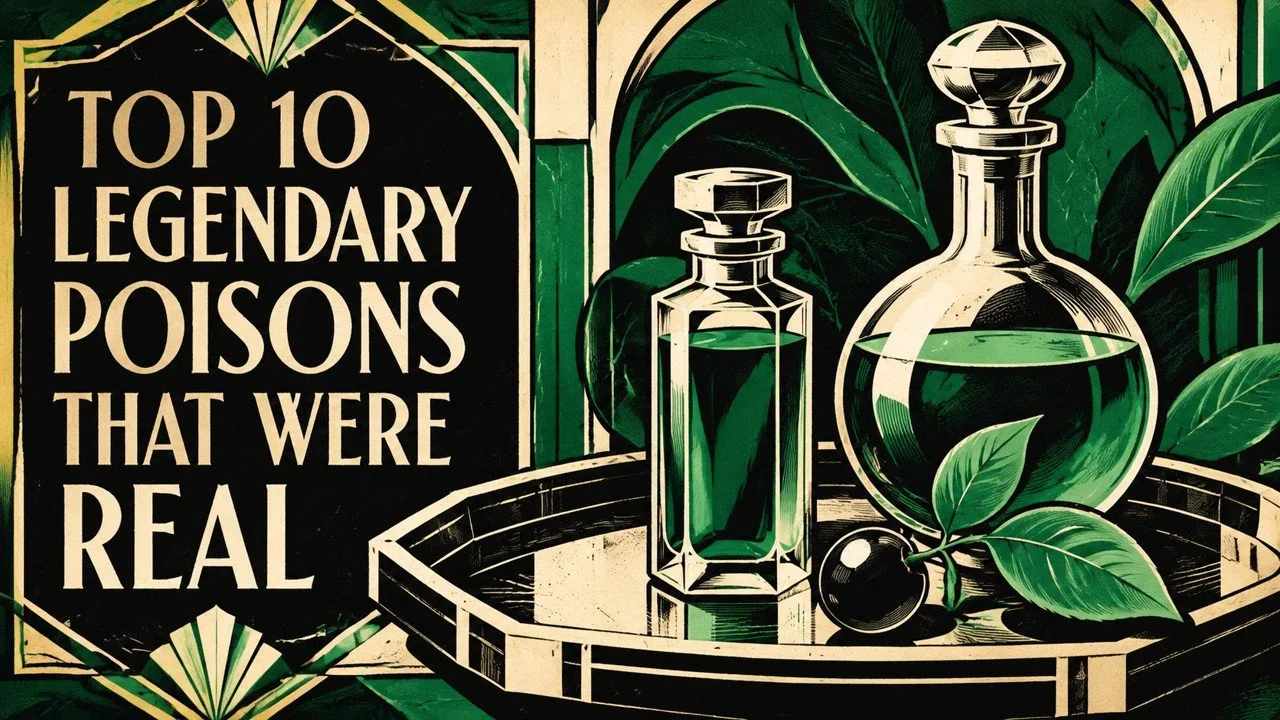
From Aqua Tofana and Locusta's draughts to ricin and polonium, these ten legendary poisons were real and can be traced in the historical record. Rumour has always loved a secret potion, and many of the most famous names in this field, from cantarella to the poisoned shirt of legend, remain weakly sourced or later inventions. The ten cases below are different. Each can be tied to a preparation, a toxin, a trial, a laboratory test or an official inquiry.
This Finepedia list is about historical poisons and famous cases, not a catalogue of dangerous plants. A companion Finepedia article already surveys the world's most poisonous plants, including hemlock and aconite, so those species are not repeated here as stand-alone entries.[1] Where a plant toxin appears, it is because of a documented human use or a famous crime, not because of the botany alone.
The entries run from ancient Pontus and imperial Rome to a London hospital in 2006. Uncertain details, including the exact body counts attached to some early modern cases, are flagged. Nothing here is offered as a method, only as history.
Key Facts
The table below gives a quick overview of all ten entries before each one is described in detail.
| # | Poison or case | When and where | What it was | Why it became legendary |
|---|---|---|---|---|
| 1 | Aqua Tofana | Sicily and Rome, 17th century | A slow arsenic-based draught | Sold in secret, remembered as a wife's weapon |
| 2 | Locusta's draughts at the Julio-Claudian court | Rome, 50s–60s AD | Professional poisons for the imperial house | Named by Roman historians |
| 3 | Inheritance powder and the Marsh test | France and Britain, 18th–19th centuries | White arsenic, later chemically detectable | A household legend until science caught up |
| 4 | The Brinvilliers poisonings | France, 1660s–1676 | Arsenic and other toxic preparations | A society murder that became a public sensation |
| 5 | The Affair of the Poisons | France, 1677–1682 | A court scandal mixing poison and magic | It reached the circle of Louis XIV |
| 6 | Mithridates and the idea of a built-up immunity | Pontus, 2nd–1st centuries BC | Daily doses of poisons, later called mithridatism | A royal fear that entered medicine's vocabulary |
| 7 | Curare, the arrow poison that became a medicine | Amazonia, later Europe and laboratories | Plant alkaloid preparations that paralyse muscle | From blowgun dart to operating table |
| 8 | Strychnine, the convulsive poison of the nineteenth-century crime report | Europe, 19th century | An alkaloid from nux vomica and related plants | Detectable, bitter, and grimly famous in court |
| 9 | The pellet that killed Georgi Markov | London, 1978 | A tiny implanted pellet, widely reported as ricin | A Cold War assassination that became a symbol |
| 10 | Polonium-210 and the death of Alexander Litvinenko | London, 2006 | A rare radioactive poison | An official British inquiry followed the evidence |
1. Aqua Tofana
Aqua Tofana was a slow-acting poison associated with Sicily and with Rome in the seventeenth century, and later writers usually describe it as an arsenic-based liquid, colourless enough to be mixed into water or wine.[2] The name is tied to a woman called Giulia Tofana, or Tofania, who is said to have sold it, with helpers, to wives who wished to be rid of their husbands. Some of the more dramatic totals attached to her trade come from later retellings and should be treated with caution.
What is not in serious doubt is that a real market for such a draught existed in Italian cities of the period, and that the name Aqua Tofana became a byword for a quiet, almost undetectable household poison.[2] Later centuries even used the phrase as a general label for slow arsenic mixtures, long after the original sellers were gone.
The legend grew because the crime was hard to prove before reliable chemical tests existed. In that sense Aqua Tofana belongs with the later "inheritance powder": a real toxin, wrapped in a name that frightened people more than any single trial record can now fully document.
2. Locusta's draughts at the Julio-Claudian court
Locusta, sometimes spelled Lucusta, was a professional poisoner in first-century Rome, active under Claudius and Nero.[3] Roman historians, who are hostile and often dramatic about this period, say she was involved in the death of Claudius in 54 AD and in the poisoning of his son Britannicus, and that Nero kept her close, even having her teach the craft to others in his service. Those court stories cannot all be tested, but they are early accounts, not later inventions, and Locusta herself is not a fictional character.
After Nero's fall she was put to death under the emperor Galba in 69 AD.[3] That end, at least, fits the wider political slaughter of the Year of the Four Emperors and does not depend on a single sensational anecdote.
Related: Top 10 Most Deadly Fruits on Earth
Locusta matters for this list because she shows that "the court poisoner" was already a recognised, and hated, figure in antiquity. The exact recipes are lost. The occupation, and the fear it generated around the imperial table, are well attested.
3. Inheritance powder and the Marsh test
White arsenic trioxide, odourless and easy to mix into food or drink, was so widely blamed in inheritance disputes that in France it acquired the grim nickname poudre de succession, "inheritance powder."[4][1] Before the nineteenth century it was extremely hard to prove in a corpse, which is why it became legendary: a powder you could not see, smell or, in court, securely demonstrate.
That changed when the British chemist James Marsh published his test in 1836, a sensitive method for detecting arsenic that, with later improvements, remained central to forensic work for more than a century.[4] Once the test existed, the same powder that had seemed almost magical became a piece of laboratory evidence.
The English case of Mary Ann Cotton, hanged in 1873 for the arsenic poisoning of her stepson, belongs to this new world in which suspicion could be followed by chemical proof. She was convicted of one murder; later writers have accused her of many more, but those larger totals remain estimates rather than courtroom findings.[5] The legend was the undetectable powder. The documented change was that it did not stay undetectable.
4. The Brinvilliers poisonings
Marie-Madeleine d'Aubray, Marquise de Brinvilliers, was convicted of poisoning her father and two brothers in order to inherit, and was put to death in Paris on 16 July 1676.[6][7] The crimes came to light after the death of her lover and accomplice, Godin de Sainte-Croix, when letters and other papers about the poisonings were found and she was hunted down, tried and forced to confess.
Later gossip claimed that she had tested her mixtures on hospital patients and on street dogs. Those stories were never securely proved and should be kept apart from the murders for which she was condemned.[6] The solid core of the case is already enough: a noblewoman, a family inheritance, and a toxic draught used at close quarters.
The trial became a public sensation and helped to prepare the atmosphere for the still larger poison scandal at Louis XIV's court a few years later. In popular memory Brinvilliers became the face of aristocratic poisoning; in the legal record she is something rarer, a high-born defendant who was actually caught, tried and punished.
5. The Affair of the Poisons
The Affair of the Poisons was a long investigation at the court of Louis XIV, in which fortune-tellers, priests and members of the nobility were accused of poisoning, blasphemy and witchcraft.[8][9] At the centre of the unofficial trade stood Catherine Deshayes, known as La Voisin, who sold supposed charms and, according to the evidence taken at the time, poisons as well. The scandal reached close to the king himself, including accusations against his mistress, Madame de Montespan, which were politically explosive and remain hard to prove in full.
Related: Top 10 Facts About Forever Chemicals
A special court, the Chambre Ardente, was set up to hear the cases. Dozens of people were punished, and a commonly cited total records thirty-six put to death, though the quality of some of the testimony, much of it taken under torture, is a serious caution for any modern reader.[8] Louis eventually closed the public process down, in part because it had come too near the throne.
The affair is legendary because it suggested that poison had become a court fashion. It is historical because the inquiries, arrests and sentences were real, even where some of the wilder magical claims cannot now be believed.
6. Mithridates and the idea of a built-up immunity
Mithridates VI of Pontus, a formidable enemy of Rome in the first century BC, was famous even in antiquity for his fear of being poisoned and for the extreme steps he took to protect himself.[10][11] Later tradition says that he took small, regular doses of poisons in the hope of making himself immune, a practice still called mithridatism.[12] A related story claims that he also compounded a grand universal antidote, the mithridate, which physicians tried to imitate for centuries.
How much of the daily-dosing story is exact reportage, and how much is the growth of a royal legend, is difficult to say. The fear itself is plausible in a court where assassination was a real professional risk, and the later medical tradition is amply documented even when the original formula is not.[12] Ancient writers also say that, when he finally wished to die, poison failed him and he had to fall on a blade, which may be another layer of the same legend.
The documented residue is still striking. A named king, a long war with Rome, and a medical idea that kept his name alive in European pharmacies long after his kingdom had disappeared, all rest on a much stronger basis than most "secret antidote" tales.
7. Curare, the arrow poison that became a medicine
Curare is a group of plant-based arrow poisons, prepared as dark pastes by Indigenous peoples of Central and South America, especially for hunting.[13][14] The mixtures, drawn chiefly from vines such as Chondrodendron and from certain Strychnos species, can paralyse the muscles, including the muscles of breathing. Prey struck by a treated dart dies of that paralysis, not of a later fever or a mythical curse.
Related: Top 10 Most Bizarre Phobias: Strange Fears That Exist
European travellers' tales sometimes treated curare as a mysterious jungle venom of uncertain nature. Laboratory work in the nineteenth and twentieth centuries showed that the active alkaloids block the signal from nerve to muscle, and purified relatives of the old arrow poisons were later used, with great care, to relax muscle during surgery.[14] The legend and the drug are therefore the same family of substances.
Curare belongs on a list of real legendary poisons because it was both a known hunting tool, with a long Indigenous history, and a scientific puzzle that Western medicine eventually took seriously, without the toxin itself ever being imaginary.
8. Strychnine, the convulsive poison of the nineteenth-century crime report
Strychnine, an alkaloid obtained from the seeds of the nux vomica tree and related plants, became one of the most notorious poisons of the nineteenth century because it was violent, relatively available as a vermin killer, and, unlike earlier arsenic, often obvious enough in its effects to start a criminal inquiry.[1] It causes characteristic convulsions, and it has a bitter taste, which made it less "invisible" than inheritance powder but no less frightening once a case reached the newspapers.
Victorian Britain produced a series of famous trials in which strychnine was alleged or proved, and the poison entered popular literature as the classic draught of the calculating murderer. The chemistry is not in doubt, and neither is its use in real crimes of the period; what should be resisted is the later habit of treating every sudden death in a nineteenth-century novelistic style as a confirmed strychnine case.
In a list of legendary poisons that were real, strychnine stands for a new era: the era in which a named crystal, a laboratory test and a courtroom could be joined together, and in which the old idea of a completely secret potion began to die.
9. The pellet that killed Georgi Markov
Georgi Markov, a Bulgarian writer and broadcaster who had left his country and worked in London for the BBC World Service and other Western stations, was attacked on 7 September 1978 on Waterloo Bridge and died four days later.[15][16] Doctors found a tiny pellet in his leg. Later official and journalistic accounts have long identified the poison as ricin, or as probably ricin, a plant toxin of extreme potency; the exact laboratory wording has sometimes been cautious, which is why "widely reported as ricin" is the fairest short statement.[16]
The method, a pellet small enough to be delivered by a sharpened implement later described in the press as an umbrella, became one of the most famous images of Cold War clandestine violence. The broader political responsibility has been discussed for decades and has never been the subject of a full public trial in London.
Related: Top 10 Oldest Buildings in the World
What is solid is the death, the pellet, the unusual poisoning, and the fact that a real toxin, not a legendary miasma, was used against a named man in a public street. In that sense the Markov case is the opposite of Aqua Tofana: modern, forensic, and still partly veiled only in its authorship, not in its reality.
10. Polonium-210 and the death of Alexander Litvinenko
Alexander Litvinenko, a former Russian security officer living in exile in Britain, fell ill in London in November 2006 and died three weeks later. Doctors established that he had been poisoned with polonium-210, a rare radioactive substance far more often associated with specialised laboratories than with ordinary crime.[17][18] The trail of contamination through London, and the medical facts of the case, were documented in unusual detail.
A British public inquiry, whose materials are published by the UK government, later examined how he was poisoned and who was responsible.[18] Its findings, which pointed to two named men and to Russian state responsibility, remain the official British account; they have been rejected by Moscow. The disagreement is political and legal. The identification of the poison is not.
Polonium-210 closes this list because it shows how far the old idea of a "secret powder" can travel. The toxin was almost invisible in ordinary use, as arsenic once was, but it left a physical trail that hospitals, scientists and an inquiry could follow. The legend, in this case, was real at the level of chemistry, even where governments still argue about the rest.
Conclusion
These ten cases share a pattern. A poison becomes legendary because it seems undetectable, royal, or impossibly ingenious, and then the record, a trial, a test or an inquiry shows that a real substance was at work. The legends that cannot cross that bar, including several famous Renaissance and ancient recipes, have been left off on purpose.
The list is also a reminder of how the proof itself has changed, from the rumour around a Roman court to the Marsh test and, finally, to a radioactive trail in a modern city. For the botany behind some related toxins, see Top 10 Most Poisonous Plants on Earth. For other medical mysteries that turned out to involve toxic substances, see Top 10 Medical Mysteries That Turned Out to Be Poisoning.
- ^ [1] "arsenic". Encyclopaedia Britannica. Encyclopaedia Britannica
- ^ [2] "Aqua Tofana". Wikipedia. Wikipedia
- ^ [3] "Locusta". Wikipedia. Wikipedia
- ^ [4] "Marsh test". Wikipedia. Wikipedia
- ^ [5] "Mary Ann Cotton". Wikipedia. Wikipedia
- ^ [6] "Madame de Brinvilliers". Wikipedia. Wikipedia
- ^ [7] "Marie-Madeleine-Marguerite d'Aubray, marquise de Brinvilliers". Encyclopaedia Britannica. Encyclopaedia Britannica
- ^ [8] "Affair of the Poisons". Wikipedia. Wikipedia
- ^ [9] "Affair of the Poisons". Encyclopaedia Britannica. Encyclopaedia Britannica
- ^ [10] "Mithridates VI Eupator". Wikipedia. Wikipedia
- ^ [11] "Mithradates VI Eupator". Encyclopaedia Britannica. Encyclopaedia Britannica
- ^ [12] "Mithridatism". Wikipedia. Wikipedia
- ^ [13] "Curare". Wikipedia. Wikipedia
- ^ [14] "curare". Encyclopaedia Britannica. Encyclopaedia Britannica
- ^ [15] "Georgi Markov". Wikipedia. Wikipedia
- ^ [16] "Georgi Markov: How a poisoned umbrella became a Cold War symbol". BBC News. BBC News
- ^ [17] "Poisoning of Alexander Litvinenko". Wikipedia. Wikipedia
- ^ [18] "The Litvinenko Inquiry". UK government. UK government
























Discussion
Log in with