





 By
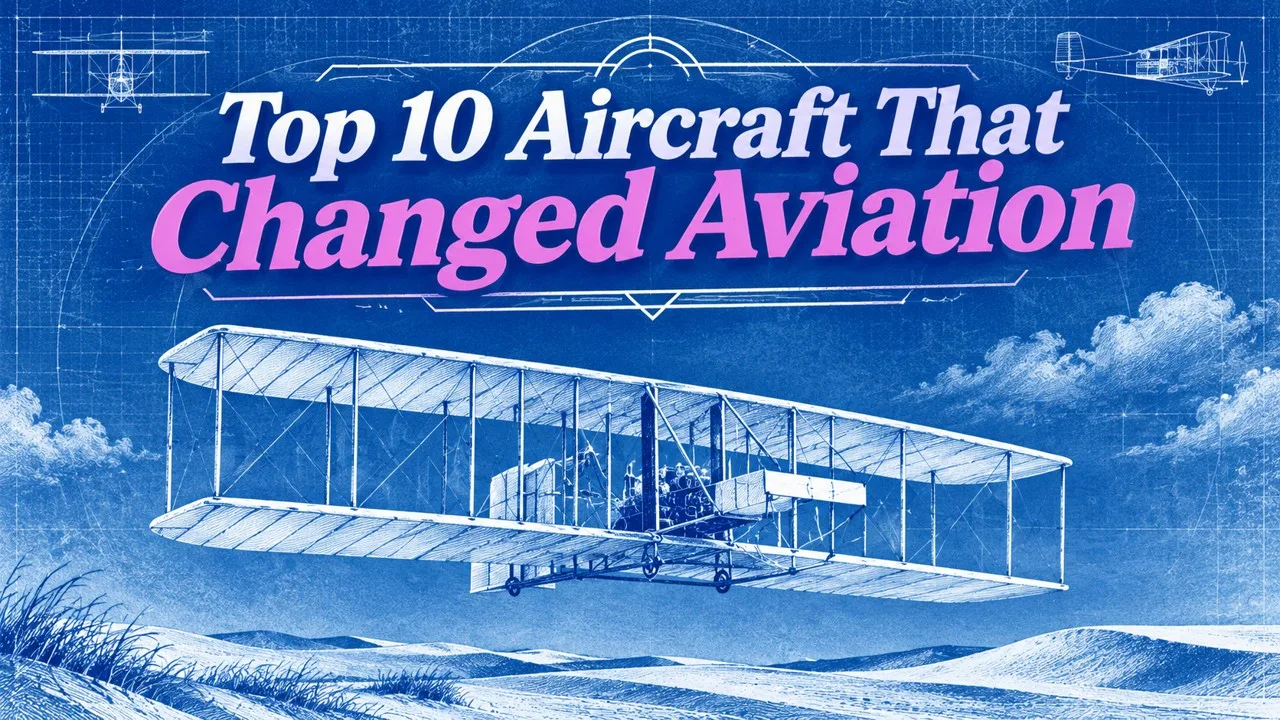
From the Wright Flyer's 12-second hop to supersonic Concorde, these ten aircraft that changed aviation pushed flight further, faster and higher than before. Powered flight is little more than a century old. In that time, aircraft have gone from fragile wooden machines that could barely leave the ground to jets that cross oceans in hours and planes that fly at more than three times the speed of sound.
This list highlights ten aircraft that marked turning points in that story. Some set records, some changed warfare and others made air travel possible for ordinary people. Airliners such as the Boeing 747 are covered in our list of the most produced commercial aircraft, so this list focuses on other milestones.
Key Facts
The ten aircraft below date from 1903 to the 1970s and come from the United States, France, Britain and Germany.
Aircraft That Changed Aviation at a Glance
| # | Aircraft | First flight or feat | Country | Why it mattered |
|---|---|---|---|---|
| 1 | Wright Flyer | 1903 | United States | First powered, controlled flight |
| 2 | Bleriot XI | 1909 | France | First flight across the English Channel |
| 3 | Spirit of St. Louis | 1927 | United States | First solo nonstop transatlantic flight |
| 4 | Douglas DC-3 | 1935 | United States | Made airlines profitable |
| 5 | Supermarine Spitfire | 1936 | Britain | Defender in the Battle of Britain |
| 6 | Messerschmitt Me 262 | 1944 | Germany | First operational jet fighter |
| 7 | Bell X-1 | 1947 | United States | First to break the sound barrier |
| 8 | de Havilland Comet | 1949 | Britain | First jet airliner |
| 9 | Concorde | 1969 | Britain and France | Supersonic passenger travel |
| 10 | Lockheed SR-71 Blackbird | 1964 | United States | Fastest jet-powered aircraft |
1. Wright Flyer
The Wright Flyer was built by the brothers Orville and Wilbur Wright, bicycle makers from Dayton, Ohio. On 17 December 1903, at Kill Devil Hills near Kitty Hawk, North Carolina, it made the first sustained, controlled flight of a powered heavier-than-air aircraft. [1]
The first flight, piloted by Orville, lasted 12 seconds and covered about 37 metres. Wilbur made the longest flight that day, lasting 59 seconds and covering about 260 metres. [1]
The brothers' key breakthrough was control. Their wing-warping system allowed the pilot to roll the aircraft, an idea that led to the ailerons used on modern planes.
The Wrights also built their own lightweight engine and propellers after finding nothing suitable on the market.
The original Wright Flyer is displayed at the Smithsonian's National Air and Space Museum in Washington, DC.
Key Figures
- Builders: Orville and Wilbur Wright
- Date: 17 December 1903
- First flight: 12 seconds, about 37 m
- Key idea: three-axis control
Why It Made the List
The Wright Flyer began the age of powered flight. Its control system is the basis of every aircraft since.
2. Bleriot XI
The Bleriot XI was a monoplane designed by the French aviator Louis Bleriot. On 25 July 1909 he flew it across the English Channel from near Calais to Dover in about 37 minutes. [2]
The flight won a prize of 1,000 pounds offered by the Daily Mail newspaper. It caused a sensation, showing that Britain was no longer cut off from the continent by water. [2]
The Bleriot XI became one of the most successful aircraft of its time, and hundreds were built for flying schools, races and early military use.
Its monoplane layout, with a single wing and a front-mounted engine, became the standard for later aircraft.
Bleriot's company later built many aircraft during the First World War.
Key Figures
- Designer: Louis Bleriot
- Channel crossing: 25 July 1909
- Flight time: about 37 minutes
- Prize: 1,000 pounds from the Daily Mail
Why It Made the List
The Bleriot XI proved that aircraft could cross seas. It made aviation an international story overnight.
Related: Top 10 Largest Airlines by Fleet or Passengers
3. Spirit of St. Louis
The Spirit of St. Louis was a single-engine monoplane built by Ryan Airlines in San Diego for the pilot Charles Lindbergh. On 20 and 21 May 1927 he flew it nonstop from New York to Paris. [3]
The flight took about 33 and a half hours, and Lindbergh flew alone, fighting fatigue and fog. The aircraft carried so much fuel that a large tank blocked his forward view, so he used a periscope or looked out of the side windows. [3]
Lindbergh won the Orteig Prize of 25,000 dollars and became one of the most famous people in the world.
His flight sparked a boom in public interest in aviation and investment in airlines.
The aircraft now hangs in the National Air and Space Museum.
Key Figures
- Pilot: Charles Lindbergh
- Flight: New York to Paris, May 1927
- Time: about 33.5 hours
- Prize: the Orteig Prize
Why It Made the List
The Spirit of St. Louis showed that long-distance flight was possible. It inspired the growth of commercial aviation.
4. Douglas DC-3
The Douglas DC-3 first flew on 17 December 1935, exactly 32 years after the Wright brothers' first flight. It was a fast, reliable airliner that could carry around 21 to 32 passengers. [4]
The DC-3 was the first airliner that could make a profit by carrying passengers alone, without relying on mail contracts. By the late 1930s it carried most of the world's airline passengers. [4]
During the Second World War, its military version, the C-47 Skytrain, also known as the Dakota, carried troops and supplies. More than 16,000 DC-3s and related versions were built.
Many DC-3s are still flying today, more than eighty years after the first.
Its toughness and simplicity made it popular in remote regions.
Key Figures
- First flight: 17 December 1935
- Military version: C-47 Skytrain or Dakota
- Total built: more than 16,000
- Breakthrough: profit from passengers alone
Why It Made the List
The DC-3 turned air travel into a real business. Its long service life is unmatched.
5. Supermarine Spitfire
The Supermarine Spitfire was designed by R. J. Mitchell and first flew on 5 March 1936. Its thin elliptical wings gave it excellent speed and agility. [5]
The Spitfire became famous during the Battle of Britain in 1940, when it fought alongside the Hawker Hurricane against the German Luftwaffe. [5]
The design was continually improved throughout the war, with more powerful engines and better weapons. More than 20,000 were built, more than any other British aircraft.
Related: Top 10 Most Dangerous Airports in the World
Mitchell died in 1937 and did not see his aircraft's wartime success.
The Spitfire remains a symbol of British resilience, and many still fly at air shows.
Its Rolls-Royce Merlin engine was later replaced in some versions by the more powerful Griffon.
Key Figures
- Designer: R. J. Mitchell
- First flight: 5 March 1936
- Famous battle: Battle of Britain, 1940
- Total built: more than 20,000
Why It Made the List
The Spitfire combined beauty and performance. It became the most famous fighter of the Second World War.
6. Messerschmitt Me 262
The Messerschmitt Me 262 was the world's first operational jet-powered fighter aircraft. It entered combat with the German air force in 1944. [6]
Powered by two jet engines, the Me 262 was much faster than the propeller-driven fighters of the Allies. It could reach speeds of about 870 kilometres per hour. [6]
However, it arrived too late and in too small numbers to change the course of the war. Its engines were unreliable, and shortages of fuel and trained pilots limited its use.
After the war, the Allies studied the Me 262 closely, and its swept wings and jet power influenced later fighter designs.
About 1,400 were built.
Allied pilots learned to attack it when it was slow, during take-off and landing.
Key Figures
- Entered combat: 1944
- Engines: two jet engines
- Top speed: about 870 km/h
- Built: about 1,400
Why It Made the List
The Me 262 marked the start of the jet age in air combat. It showed that propeller fighters would soon be obsolete.
7. Bell X-1
The Bell X-1 was a rocket-powered research aircraft built to explore flight near the speed of sound. On 14 October 1947, test pilot Chuck Yeager flew it faster than sound for the first time in level flight. [7]
The X-1 was carried aloft under a B-29 bomber and released before firing its rocket engine. Yeager reached about Mach 1.06. [7]
Its bullet-shaped fuselage was based on the shape of a rifle bullet, known to be stable at supersonic speeds. Yeager named the aircraft Glamorous Glennis after his wife.
Related: Top 10 Longest Nonstop Flights in the World
The flight was kept secret for months before it was announced.
The X-1's success paved the way for supersonic fighters and later research aircraft such as the X-15.
Yeager flew the record flight despite two broken ribs from a riding accident days earlier.
Key Figures
- Pilot: Chuck Yeager
- Date: 14 October 1947
- Speed reached: about Mach 1.06
- Nickname: Glamorous Glennis
Why It Made the List
The X-1 proved that the so-called sound barrier could be broken. It opened the era of supersonic flight.
8. de Havilland Comet
The de Havilland Comet was the world's first commercial jet airliner. It first flew on 27 July 1949 and entered service with BOAC on 2 May 1952. [8]
The Comet offered quiet, smooth flights at high altitude and nearly halved travel times on some routes. [8]
In 1954, two Comets broke up in flight. Investigators found that metal fatigue had caused cracks to spread from corners of openings in the fuselage. The Comet was grounded and redesigned.
The lessons learned from the Comet disasters changed aircraft design and testing worldwide.
Later versions, such as the Comet 4, flew successfully, but rivals such as the Boeing 707 had taken the lead.
Its engines were buried inside the wing roots, giving it a smooth, clean shape.
Key Figures
- First flight: 27 July 1949
- Entered service: 2 May 1952, BOAC
- Problem discovered: metal fatigue
- Legacy: safer aircraft design
Why It Made the List
The Comet launched the jet age for passengers. Its failures made every later airliner safer.
9. Concorde
Concorde was a supersonic airliner built jointly by Britain and France. It first flew on 2 March 1969 and entered passenger service on 21 January 1976 with British Airways and Air France. [9]
Concorde cruised at about twice the speed of sound, around Mach 2.04. It could cross the Atlantic from London to New York in about three and a half hours. [9]
Related: Top 10 Oldest Airlines Still Operating
Only 20 Concordes were built, including test aircraft. High costs, fuel use and limits on supersonic flights over land made the aircraft expensive to run.
After a fatal crash near Paris in 2000 and a fall in air travel, Concorde was retired in 2003.
Concorde remains the most famous passenger aircraft ever built.
Its distinctive drooping nose was lowered for take-off and landing so pilots could see the runway.
Key Figures
- First flight: 2 March 1969
- Entered service: 21 January 1976
- Cruising speed: about Mach 2.04
- Retired: 2003
Why It Made the List
Concorde made supersonic travel a reality for passengers. No passenger aircraft has matched it since.
10. Lockheed SR-71 Blackbird
The SR-71 Blackbird was a long-range reconnaissance aircraft built by Lockheed's Skunk Works under the designer Kelly Johnson. It first flew in 1964. [10]
The Blackbird flew at more than three times the speed of sound and at altitudes above 24,000 metres. In 1976 it set a speed record of about 3,530 kilometres per hour that still stands for jet-powered aircraft. [10]
The aircraft was built mostly from titanium to survive the intense heat created by friction at such speeds.
No SR-71 was ever shot down, as it could outrun missiles fired at it.
The US Air Force retired the Blackbird in 1998, and NASA flew it for research until 1999.
Its crews wore pressure suits similar to those of astronauts.
Key Figures
- Designer: Kelly Johnson, Skunk Works
- First flight: 1964
- Speed record: about 3,530 km/h, 1976
- Main material: titanium
Why It Made the List
The SR-71 remains the fastest jet-powered aircraft ever flown. Its engineering is still admired decades later.
Conclusion
These ten aircraft show how quickly aviation advanced, from wooden gliders with engines to supersonic jets in just a few decades.
Each solved a problem or broke a barrier, and together they made air travel and flight part of everyday life.
- ^ [1] "Wright Flyer". Wikipedia. Wikipedia: Wright Flyer Wikipedia: Wright brothers
- ^ [2] "Bleriot XI". Wikipedia. Wikipedia: Bleriot XI Wikipedia: Louis Bleriot
- ^ [3] "Spirit of St. Louis". Wikipedia. Wikipedia: Spirit of St. Louis Wikipedia: Orteig Prize
- ^ [4] "Douglas DC-3". Wikipedia. Wikipedia: Douglas DC-3 Wikipedia: Douglas C-47 Skytrain
- ^ [5] "Supermarine Spitfire". Wikipedia. Wikipedia: Supermarine Spitfire Wikipedia: Battle of Britain
- ^ [6] "Messerschmitt Me 262". Wikipedia. Wikipedia: Messerschmitt Me 262 Wikipedia: Jet engine
- ^ [7] "Bell X-1". Wikipedia. Wikipedia: Bell X-1 Wikipedia: Chuck Yeager
- ^ [8] "de Havilland Comet". Wikipedia. Wikipedia: de Havilland Comet Wikipedia: Fatigue (material)
- ^ [9] "Concorde". Wikipedia. Wikipedia: Concorde Wikipedia: Supersonic transport
- ^ [10] "Lockheed SR-71 Blackbird". Wikipedia. Wikipedia: Lockheed SR-71 Blackbird Wikipedia: Skunk Works























Discussion
Log in with