





 By
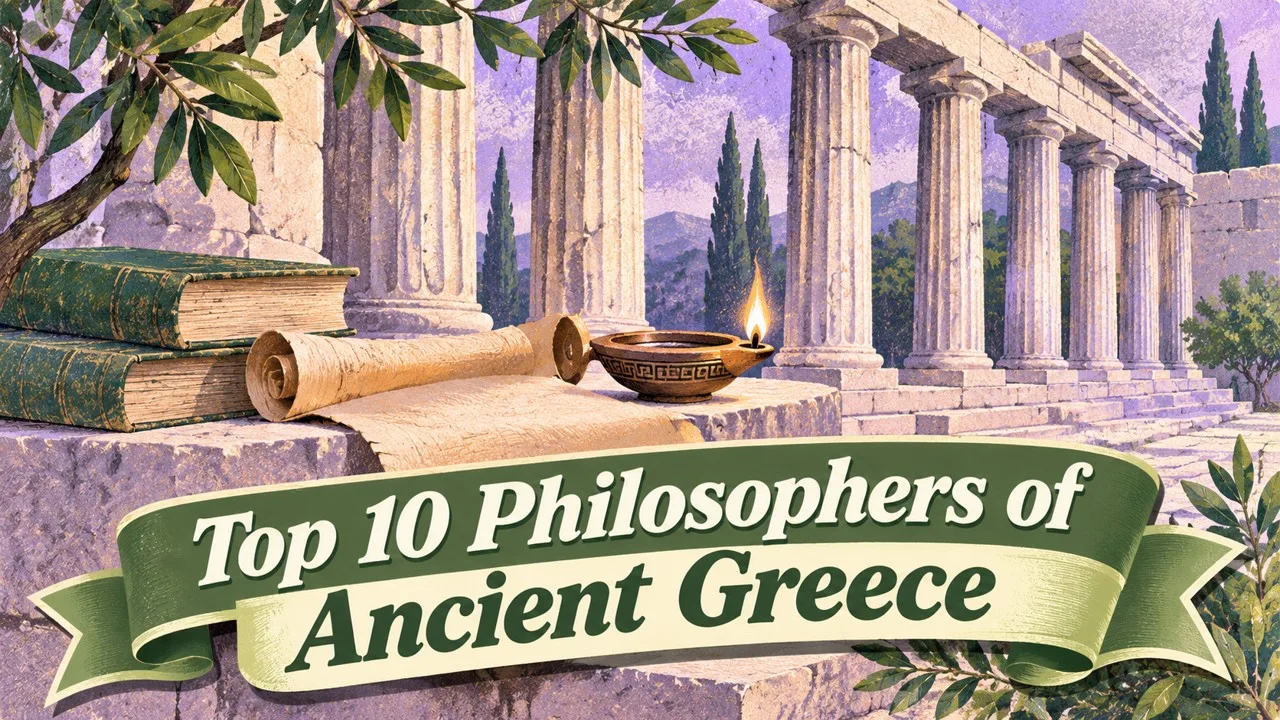
From Thales to Zeno of Citium, these ten philosophers of ancient Greece asked the questions about nature, knowledge and the good life that we still ask today. Philosophy in the Western tradition began in the Greek world in the sixth century BC. Thinkers in cities around the Aegean Sea began to explain nature through reason and observation instead of relying only on myths about the gods.
Over the following centuries, Greek philosophers developed ideas in science, mathematics, ethics, politics and logic that still shape education and thought. This list introduces ten of the most influential, in roughly chronological order.
Key Facts
The ten philosophers below lived between about 624 BC and 262 BC.
Greek Philosophers at a Glance
| # | Philosopher | Lived | Home city | Big idea |
|---|---|---|---|---|
| 1 | Thales of Miletus | c. 624 to 546 BC | Miletus | Water as the source of all things |
| 2 | Pythagoras | c. 570 to 495 BC | Samos and Croton | Numbers underlie the universe |
| 3 | Heraclitus | c. 535 to 475 BC | Ephesus | Everything is in constant change |
| 4 | Parmenides | c. 515 to 450 BC | Elea | Change is an illusion |
| 5 | Democritus | c. 460 to 370 BC | Abdera | Everything is made of atoms |
| 6 | Socrates | c. 470 to 399 BC | Athens | Question everything |
| 7 | Plato | c. 428 to 348 BC | Athens | The theory of Forms |
| 8 | Aristotle | 384 to 322 BC | Stagira and Athens | Logic, science and the golden mean |
| 9 | Epicurus | 341 to 270 BC | Samos and Athens | Happiness through simple pleasures |
| 10 | Zeno of Citium | c. 334 to 262 BC | Citium and Athens | Founder of Stoicism |
1. Thales of Miletus
Thales of Miletus is often called the first philosopher in the Greek tradition. He lived in Miletus, a wealthy Greek city on the coast of what is now Turkey. [1]
Thales tried to explain the world through natural causes rather than myths. He proposed that everything was ultimately made from water, an idea that showed a search for a single underlying principle. [1]
He was also famous for practical knowledge. According to the historian Herodotus, Thales predicted a solar eclipse, often dated to 585 BC, and a geometry theorem about triangles in semicircles carries his name.
Stories describe him as so absorbed in studying the sky that he fell into a well.
Aristotle later named Thales the founder of natural philosophy.
Key Figures
- Home: Miletus, Ionia
- Big idea: everything is made of water
- Famous prediction: a solar eclipse
- Legacy: Thales' theorem
Why It Made the List
Thales began the habit of explaining nature through reason. That habit is the root of both philosophy and science.
2. Pythagoras
Pythagoras was born on the island of Samos and later founded a school and religious community at Croton in southern Italy. His followers, the Pythagoreans, lived by strict rules. [2]
Pythagoras and his followers believed numbers were the key to understanding the universe. They studied the mathematical ratios behind musical harmony and believed the cosmos was ordered by number. [2]
The famous Pythagorean theorem about right-angled triangles carries his name, although the relationship was known earlier to Babylonian mathematicians.
Pythagoras also taught that souls are reborn in new bodies, and his followers avoided eating meat and beans.
He left no writings, so much of what is known about him comes from later sources mixed with legend.
His influence on music theory lasted into the Middle Ages.
Key Figures
- Born: Samos
- School: Croton, southern Italy
- Big idea: number orders the cosmos
- Belief: rebirth of the soul
Why It Made the List
Pythagoras linked mathematics with philosophy. His ideas influenced Plato and the long tradition of mathematical science.
3. Heraclitus
Heraclitus lived in Ephesus, another Greek city in Ionia. He wrote in short, puzzling sayings, which earned him the nickname the Obscure. [3]
Related: History of Human Civilization: From Ancient Times to the Modern Age
His most famous idea is that everything is constantly changing. A well-known saying attributed to him states that you cannot step into the same river twice, because the water is always flowing. [3]
Heraclitus believed that change was governed by an underlying order he called the logos. He also saw fire as a basic element and believed opposites, such as hot and cold, depend on each other.
Only fragments of his writings survive, quoted by later authors.
The later Stoics adopted many of his ideas, especially about fire and the logos.
He is said to have been a member of an aristocratic family in Ephesus and to have looked down on popular opinion.
Key Figures
- Home: Ephesus
- Nickname: the Obscure
- Big idea: everything flows
- Key term: logos
Why It Made the List
Heraclitus made change a central question of philosophy. His river image is still quoted today.
4. Parmenides
Parmenides lived in Elea, a Greek colony in southern Italy. He set out his ideas in a poem known as On Nature, of which only parts survive. [4]
Parmenides argued the opposite of Heraclitus. He claimed that true reality is single, unchanging and eternal, and that the change we see is an illusion of the senses. [4]
He insisted on following reason even when it contradicted experience. His student Zeno of Elea created famous paradoxes, such as Achilles and the tortoise, to support his ideas.
Plato admired Parmenides and named a dialogue after him.
His arguments about being and nothing were among the first in the branch of philosophy called metaphysics.
His school became known as the Eleatic school, after his home city.
Key Figures
- Home: Elea, southern Italy
- Work: the poem On Nature
- Big idea: reality is unchanging
- Famous student: Zeno of Elea
Why It Made the List
Parmenides showed the power of pure logical argument. He set the agenda for much of later Greek philosophy.
5. Democritus
Democritus came from Abdera in northern Greece. With his teacher Leucippus, he developed the theory that everything is made of tiny, indivisible particles called atoms. [5]
The word atom comes from the Greek for uncuttable. Democritus believed atoms move through empty space and combine in different ways to form all things. [5]
He wrote on many subjects, including ethics, mathematics and music, though almost all of his works are lost.
Related: Top 10 Most Bizarre Phobias: Strange Fears That Exist
Democritus was nicknamed the laughing philosopher because of his cheerful attitude to life.
Modern atomic theory is very different, but his idea has made him famous as a forerunner of science.
Democritus is also said to have travelled widely, possibly to Egypt and Persia, in search of knowledge. Later writers credited him with dozens of books.
Key Figures
- Home: Abdera
- Teacher: Leucippus
- Big idea: atoms and empty space
- Nickname: the laughing philosopher
Why It Made the List
Democritus imagined atoms more than two thousand years before they were proven to exist. His theory is one of the boldest ideas of ancient thought.
6. Socrates
Socrates lived in Athens and is often seen as the founder of Western moral philosophy. He wrote nothing, and he is known through the writings of his students, especially Plato and Xenophon. [6]
Socrates questioned people in the marketplace about justice, courage and virtue. His method of asking questions to test ideas and expose contradictions is known as the Socratic method. [6]
He claimed his wisdom lay in knowing that he knew nothing. In 399 BC he was tried for impiety and corrupting the youth of Athens, found guilty and sentenced to death by drinking hemlock.
Plato's dialogues portray his calm acceptance of death.
The phrase the unexamined life is not worth living is attributed to him.
He served as a soldier in the Peloponnesian War and was known for his toughness.
Key Figures
- Home: Athens
- Writings: none
- Method: the Socratic method
- Death: 399 BC, by hemlock
Why It Made the List
Socrates turned philosophy towards how people should live. His method of questioning is still used in education.
7. Plato
Plato was a student of Socrates and one of the most influential philosophers in history. Around 387 BC he founded the Academy in Athens, often described as one of the first institutions of higher learning in the Western world. [7]
Plato wrote dialogues, many featuring Socrates as the main speaker. They cover ethics, politics, knowledge, love and the nature of reality. [7]
Related: Top 10 Oldest Buildings in the World
His theory of Forms holds that the physical world is a shadow of a higher world of perfect, unchanging ideas. In the Republic, his allegory of the cave compares ordinary people to prisoners who mistake shadows for reality.
The Republic also describes an ideal state ruled by philosopher kings.
All of his known works are believed to have survived, which is rare for an ancient author.
Key Figures
- Teacher: Socrates
- School: the Academy, c. 387 BC
- Famous work: the Republic
- Big idea: the theory of Forms
Why It Made the List
Plato shaped Western philosophy so deeply that it has been called a series of footnotes to his work. His Academy set a model for later schools.
8. Aristotle
Aristotle was born in Stagira in northern Greece and studied at Plato's Academy for about twenty years. He later tutored the young Alexander the Great. [8]
In 335 BC Aristotle founded his own school in Athens, the Lyceum. His followers were called Peripatetics, perhaps because he taught while walking. [8]
Aristotle wrote on an enormous range of topics, including logic, biology, physics, ethics, politics and poetry. He created a formal system of logic and carried out detailed studies of animals.
In ethics he argued that virtue lies in a balance between extremes, an idea known as the golden mean.
His works dominated science and philosophy in Europe and the Islamic world for centuries.
After Alexander's death, Aristotle left Athens and died the following year in Chalcis.
Key Figures
- Born: Stagira, 384 BC
- Teacher: Plato
- Pupil: Alexander the Great
- School: the Lyceum, 335 BC
Why It Made the List
Aristotle organised knowledge into the subjects we still study. His influence lasted for nearly two thousand years.
9. Epicurus
Epicurus was born on Samos and founded a school in Athens around 306 BC, known as the Garden. Unusually, it welcomed women and enslaved people. [9]
Epicurus taught that the goal of life is happiness, which he defined as freedom from pain and peace of mind, called ataraxia. He believed this came from simple pleasures, friendship and moderation, not luxury. [9]
Related: 10 Sikh Gurus: The Pillars of Sikhism Who Shaped Faith, Equality, Courage, and Humanity
He followed Democritus in believing the universe is made of atoms. He argued that death is nothing to fear because when we die we no longer exist to experience it.
The Roman poet Lucretius later spread his ideas in the poem On the Nature of Things.
Today the word epicure suggests a lover of fine food, a meaning Epicurus himself would not have recognised.
Key Figures
- Born: Samos
- School: the Garden, c. 306 BC
- Goal: ataraxia, or peace of mind
- Roman follower: Lucretius
Why It Made the List
Epicurus offered a practical philosophy of happiness. His calm attitude to death still appeals to many readers.
10. Zeno of Citium
Zeno of Citium was born in Citium on the island of Cyprus and moved to Athens, where he studied with several philosophers. Around 300 BC he began teaching in the Stoa Poikile, or Painted Porch. [10]
His philosophy took the name Stoicism from this porch. Stoics taught that virtue is the only true good and that people should accept what they cannot control. [10]
Stoicism became one of the most influential philosophies of the ancient world. Later Stoics included the Roman statesman Seneca, the former slave Epictetus and the emperor Marcus Aurelius.
Stoics believed in living in harmony with nature and reason.
Stoicism has enjoyed a modern revival as a practical guide to coping with stress.
Key Figures
- Born: Citium, Cyprus
- Teaching place: the Painted Porch, Athens
- School founded: Stoicism, c. 300 BC
- Famous followers: Seneca, Epictetus, Marcus Aurelius
Why It Made the List
Zeno founded a philosophy that has guided people for more than two thousand years. Stoicism remains popular today.
Conclusion
In just a few centuries, Greek philosophers moved from asking what the world is made of to asking how people should live and govern themselves.
Their questions about reality, knowledge and happiness are still debated today. Reading them remains one of the best introductions to philosophy.
- ^ [1] "Thales of Miletus". Wikipedia. Wikipedia: Thales of Miletus Wikipedia: Thales's theorem
- ^ [2] "Pythagoras". Wikipedia. Wikipedia: Pythagoras Wikipedia: Pythagoreanism
- ^ [3] "Heraclitus". Wikipedia. Wikipedia: Heraclitus Wikipedia: Logos
- ^ [4] "Parmenides". Wikipedia. Wikipedia: Parmenides Wikipedia: Zeno's paradoxes
- ^ [5] "Democritus". Wikipedia. Wikipedia: Democritus Wikipedia: Atomism
- ^ [6] "Socrates". Wikipedia. Wikipedia: Socrates Wikipedia: Socratic method
- ^ [7] "Plato". Wikipedia. Wikipedia: Plato Wikipedia: Allegory of the cave
- ^ [8] "Aristotle". Wikipedia. Wikipedia: Aristotle Wikipedia: Lyceum (classical)
- ^ [9] "Epicurus". Wikipedia. Wikipedia: Epicurus Wikipedia: Epicureanism
- ^ [10] "Zeno of Citium". Wikipedia. Wikipedia: Zeno of Citium Wikipedia: Stoicism





















Discussion
Log in with