






 By
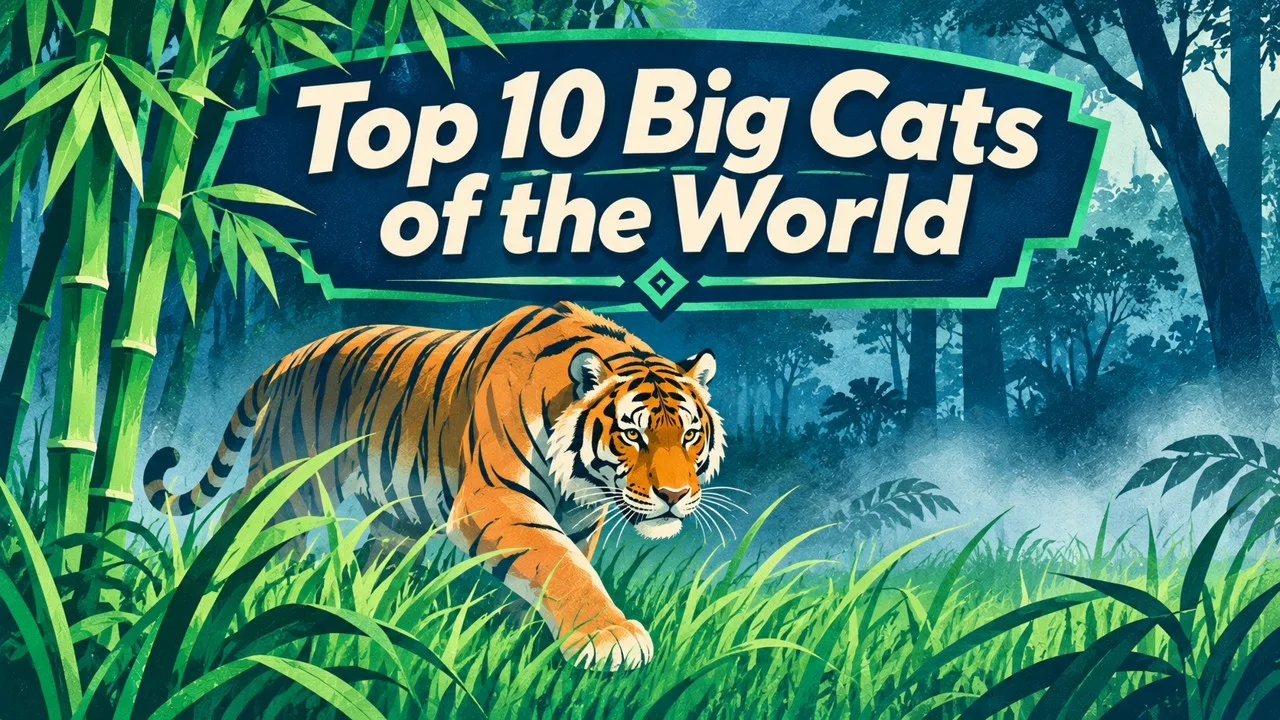
Tigers, lions, jaguars and snow leopards rule very different worlds. Meet ten big cats of the world, with facts on their size, range, hunting and survival. Big cats are the largest members of the cat family. In the strict scientific sense the term covers the roaring cats of the genus Panthera, but it is often used more widely to include the cheetah, cougar and other large wild cats.
This list follows the wider meaning and includes ten large wild cats found across Asia, Africa, Europe and the Americas. Weights are typical ranges for adult males, and conservation statuses follow the IUCN Red List at the time of writing.
Key Facts
The ten cats below range from the mighty tiger to the elusive clouded leopards of Southeast Asian forests.
Big Cats at a Glance
| # | Cat | Main range | Typical weight of adult males | Conservation status |
|---|---|---|---|---|
| 1 | Tiger | South and Southeast Asia, Russian Far East | About 180 to 300 kg | Endangered |
| 2 | Lion | Africa and Gir in India | About 150 to 250 kg | Vulnerable |
| 3 | Jaguar | Central and South America | About 55 to 120 kg | Near Threatened |
| 4 | Leopard | Africa and Asia | About 30 to 90 kg | Vulnerable |
| 5 | Snow Leopard | Mountains of Central and South Asia | About 27 to 55 kg | Vulnerable |
| 6 | Cougar | North and South America | About 50 to 100 kg | Least Concern |
| 7 | Cheetah | Africa and Iran | About 35 to 65 kg | Vulnerable |
| 8 | Clouded Leopard | Himalayan foothills to Southeast Asia | About 15 to 23 kg | Vulnerable |
| 9 | Eurasian Lynx | Europe and northern Asia | About 18 to 30 kg | Least Concern |
| 10 | Sunda Clouded Leopard | Borneo and Sumatra | About 12 to 25 kg | Vulnerable |
1. Tiger
The tiger is the largest living cat. Big males of the Bengal and Siberian populations can weigh well over 200 kilograms, and each tiger's stripes are unique, like a fingerprint. [1]
Tigers are solitary hunters that stalk deer, wild boar and other large prey, usually at night. Unlike many cats, they are strong swimmers and often cool off in rivers and lakes. [1]
Hunting and habitat loss reduced wild tiger numbers to only a few thousand by the early 2000s. India, which launched Project Tiger in 1973, now holds roughly three-quarters of the world's wild tigers, with its 2022 survey estimating about 3,682 animals.
Tigers once ranged from Turkey to the Pacific, but they now survive in a small fraction of that area.
Key Figures
- Weight of large males: over 200 kilograms
- India's 2022 estimate: about 3,682 tigers
- Project Tiger launched: 1973
- Status: Endangered
Why It Made the List
The tiger is the largest and most iconic big cat. Its recovery in India shows that determined conservation can work.
2. Lion
The lion is the only truly social cat. It lives in groups called prides, usually made up of related females, their cubs and one or more adult males. [2]
Lionesses do most of the hunting, often working together to bring down antelope, zebra and buffalo. A lion's roar can be heard several kilometres away and helps mark territory. [2]
Most wild lions live in sub-Saharan Africa. A small population of Asiatic lions survives only in and around Gir National Park in Gujarat, India, where careful protection has helped numbers rise from very low levels in the early twentieth century.
Lions have disappeared from most of their former range, which once included parts of southern Europe and the Middle East.
Key Figures
- Social group: the pride
- Main hunters: lionesses
- Asian population: Gir, Gujarat
- Status: Vulnerable
Why It Made the List
The lion is the most social and best-known big cat. Its history in Gir is one of Asia's conservation success stories.
Related: Top 25 Interesting Facts About the Universe
3. Jaguar
The jaguar is the largest cat in the Americas and the third-largest in the world. Its coat has rosettes with small spots inside, which helps tell it apart from the leopard. [3]
Jaguars have an exceptionally powerful bite for their size. Unlike many big cats that kill by suffocating prey, they often bite directly through the skull or shell of animals such as capybaras, caimans and turtles. [3]
Jaguars are excellent swimmers and live in rainforests, wetlands such as the Pantanal, and dry forests. Their range once reached the south-western United States, and a few individuals still wander across the border from Mexico.
The Amazon basin holds the largest remaining jaguar population.
The jaguar was a powerful symbol for the Maya, Aztec and other peoples of the Americas, appearing in art, religion and royal titles as an emblem of strength.
Key Figures
- Rank by size: third-largest cat
- Typical prey: capybaras, caimans, turtles
- Key habitat: Amazon and Pantanal
- Status: Near Threatened
Why It Made the List
The jaguar is the great predator of the American tropics. Its unusual skull-piercing bite makes it unique among big cats.
4. Leopard
The leopard has the widest range of any wild cat, living across much of sub-Saharan Africa and parts of Asia. It thrives in habitats from rainforest and savanna to mountains and the edges of cities. [4]
Leopards are strong climbers and often drag their prey up into trees to keep it safe from lions and hyenas. Their rosette-patterned coat provides excellent camouflage. [4]
Black leopards, often called black panthers, have a genetic variation that produces dark fur, though their rosettes can still be seen in good light. They are most common in humid forests in South and Southeast Asia.
Leopards live close to people in parts of India, including on the edge of Mumbai's Sanjay Gandhi National Park.
Key Figures
- Range: the widest of any wild cat
- Hunting habit: hoisting prey into trees
- Dark form: the black panther
- Status: Vulnerable
Why It Made the List
The leopard is the most adaptable big cat. Its ability to live near people makes it both resilient and vulnerable to conflict.
5. Snow Leopard
The snow leopard lives in the high mountains of Central and South Asia, including the Himalayas, Tibetan Plateau and Altai. It is often found at altitudes of 3,000 to 4,500 metres or higher. [5]
It has thick, smoky-grey fur, wide paws that act like snowshoes and a very long, bushy tail that helps with balance and wraps around its body for warmth. [5]
Related: Top 25 Interesting Facts About the Solar System
Snow leopards hunt wild sheep and goats such as blue sheep and ibex on steep slopes. Unlike most Panthera cats, they cannot roar.
The IUCN changed their status from Endangered to Vulnerable in 2017, but they still face poaching, retaliation by herders and climate change. Their total wild population is estimated at a few thousand.
Key Figures
- Typical altitude: about 3,000 to 4,500 metres
- Main prey: blue sheep and ibex
- Special feature: a very long, thick tail
- Status: Vulnerable, since 2017
Why It Made the List
The snow leopard is the most elusive big cat. Its survival depends on the health of some of the world's harshest mountains.
6. Cougar
The cougar, also called the puma or mountain lion, has the largest range of any wild land mammal in the Western Hemisphere, from Canada to the southern Andes. [6]
It is a powerful jumper and solitary hunter that feeds mainly on deer. Despite its size, the cougar cannot roar and instead purrs, hisses and makes high-pitched calls. [6]
The cougar holds a record for the animal with the most common names in English, according to some sources, reflecting how widely it is found.
In eastern North America it was largely wiped out, but a small population survives in Florida, where it is known as the Florida panther.
Young cougars can travel hundreds of kilometres to find their own territory, and individuals have turned up far from known populations, including one that walked from South Dakota to Connecticut.
Key Figures
- Range: from Canada to the southern Andes
- Main prey: deer
- Other names: puma, mountain lion, panther
- Status: Least Concern
Why It Made the List
The cougar is the most widespread large cat in the Americas. Its adaptability lets it live in mountains, deserts and forests alike.
7. Cheetah
The cheetah is the fastest land animal, able to reach speeds of around 100 kilometres per hour in short bursts. Its slender body, long legs and long tail are built for speed and balance. [7]
Cheetahs hunt in daylight, chasing gazelles and other antelope. Their claws are only partly retractable, giving extra grip like running spikes. [7]
Related: Top 10 Mythical Creatures in World Mythology - That Inspired Myths Across Civilizations (unchanged)
Only around 7,000 cheetahs are thought to remain in the wild, mostly in eastern and southern Africa. A tiny population of Asiatic cheetahs survives in Iran.
Cheetahs were declared extinct in India in 1952. In September 2022, cheetahs from Namibia were released into Kuno National Park in Madhya Pradesh in a reintroduction project.
Key Figures
- Top speed: around 100 kilometres per hour
- Wild population: about 7,000
- Reintroduced to India: Kuno National Park, 2022
- Status: Vulnerable
Why It Made the List
The cheetah is the sprinter of the cat world. Its fragile numbers make it one of the most closely watched big cats.
8. Clouded Leopard
The clouded leopard lives in forests from the Himalayan foothills to Southeast Asia. It is named for the large cloud-shaped blotches on its coat. [8]
It has the longest canine teeth relative to body size of any living cat. Its short legs, broad paws and long tail make it an expert climber. [8]
Clouded leopards can climb down trees head first and even hang upside down from branches using their hind feet. They hunt monkeys, birds and small deer.
They are rarely seen in the wild, and much of what is known comes from camera traps and studies of animals in zoos.
In Taiwan the native clouded leopard was declared extinct after years of camera-trap surveys found no trace of it, a warning for the remaining populations.
Key Figures
- Range: Himalayas to mainland Southeast Asia
- Special feature: very long canine teeth
- Climbing skill: descends trees head first
- Status: Vulnerable
Why It Made the List
The clouded leopard is the tree-climbing specialist among big cats. It links the small cats and the roaring cats in evolution.
9. Eurasian Lynx
The Eurasian lynx is the largest of the four lynx species. It lives in forests from western Europe across Russia to the Pacific. [9]
It has tufted ears, a short tail and large furry paws that help it move across snow. It hunts deer such as roe deer, as well as hares and birds. [9]
Related: Top 25 Weird Facts About Left-Handed People
The lynx was wiped out from much of western Europe by the twentieth century. Reintroductions since the 1970s in countries such as Switzerland and Germany have brought it back to parts of its range.
It is the third-largest predator in Europe, after the brown bear and the wolf.
In some areas the return of the lynx has caused tension with sheep farmers and hunters, so reintroduction programmes often include compensation schemes and monitoring of each animal.
Key Figures
- Rank among lynx: the largest species
- Main prey: roe deer and hares
- Reintroductions: from the 1970s
- Status: Least Concern
Why It Made the List
The Eurasian lynx shows how a large cat can return to modern Europe. Its comeback is a model for rewilding.
10. Sunda Clouded Leopard
The Sunda clouded leopard lives only on the islands of Borneo and Sumatra. It was recognised as a separate species from the mainland clouded leopard in 2006, based on genetic and coat differences. [10]
Its coat is darker, with smaller cloud markings, and it is the largest cat on Borneo. Like its mainland relative, it has very long canines and is an excellent climber. [10]
It is threatened by deforestation, especially for palm oil plantations and logging. Camera traps have been vital for studying this shy animal.
Scientists estimate there are only a few thousand adults left in the wild.
Because it lives deep in the forest and is mostly active at night, the cat was rarely filmed in the wild before camera traps became common. Protecting large connected areas of forest is seen as the key to its survival.
Key Figures
- Islands: Borneo and Sumatra
- Recognised as a species: 2006
- Rank on Borneo: the largest cat
- Status: Vulnerable
Why It Made the List
The Sunda clouded leopard shows that new big cat species are still being recognised. Its future depends on Southeast Asia's forests.
Conclusion
These ten big cats live in very different places, from snowy mountains to tropical forests and open grasslands. They share sharp senses, powerful bodies and an important role as top predators in their ecosystems.
Most of them are threatened by habitat loss, poaching and conflict with people. Protecting them also protects the forests, grasslands and mountains they need, along with countless other species.
- ^ [1] "Tiger". Wikipedia. Wikipedia: Tiger Wikipedia: Project Tiger
- ^ [2] "Lion". Wikipedia. Wikipedia: Lion Wikipedia: Asiatic lion
- ^ [3] "Jaguar". Wikipedia. Wikipedia: Jaguar Wikipedia: Pantanal
- ^ [4] "Leopard". Wikipedia. Wikipedia: Leopard Wikipedia: Black panther
- ^ [5] "Snow Leopard". Wikipedia. Wikipedia: Snow leopard
- ^ [6] "Cougar". Wikipedia. Wikipedia: Cougar Wikipedia: Florida panther
- ^ [7] "Cheetah". Wikipedia. Wikipedia: Cheetah Wikipedia: Kuno National Park
- ^ [8] "Clouded Leopard". Wikipedia. Wikipedia: Clouded leopard
- ^ [9] "Eurasian Lynx". Wikipedia. Wikipedia: Eurasian lynx
- ^ [10] "Sunda Clouded Leopard". Wikipedia. Wikipedia: Sunda clouded leopard
























Discussion
Log in with