






 By
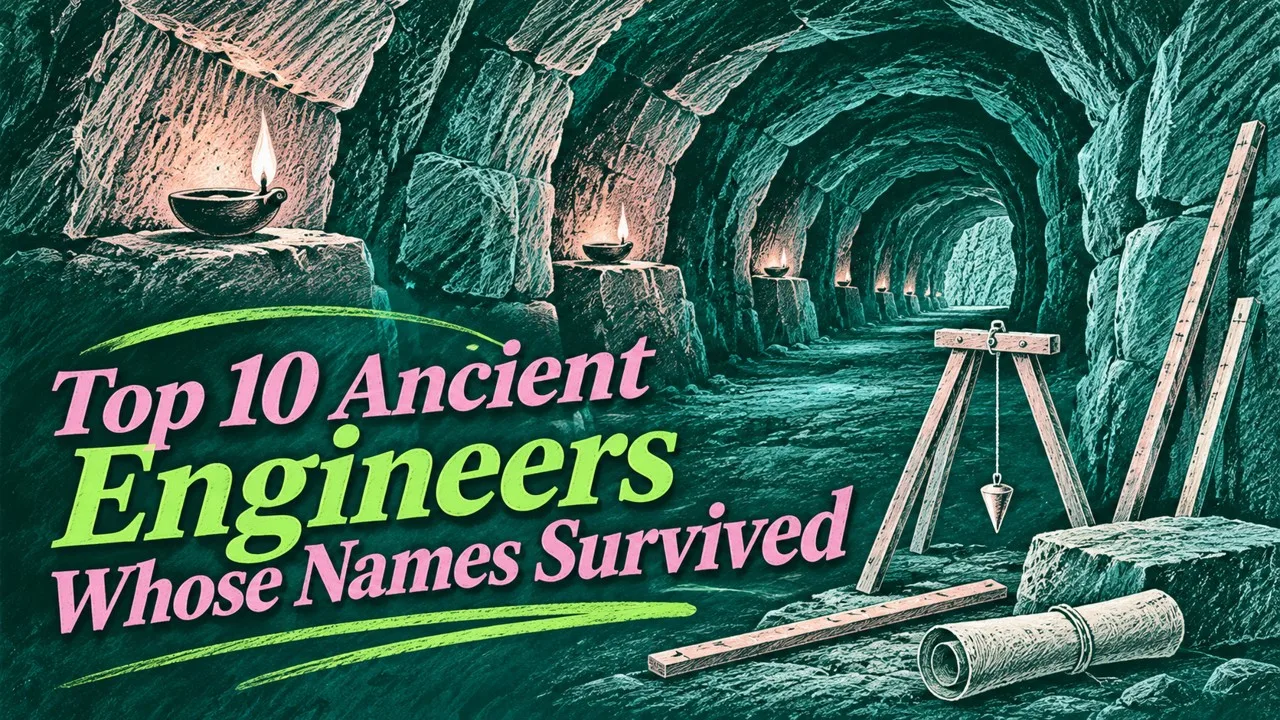
From Imhotep's step pyramid to Li Bing's river works, these ten ancient engineers whose names survived built wonders that still impress experts today. Most of the people who built the ancient world are anonymous. Thousands of workers, masons and overseers shaped pyramids, canals and temples without leaving their names behind. A few engineers, however, became famous enough that their names were recorded in inscriptions, histories and their own books.
This list introduces ten of them, from Egypt, Greece, China and the Roman and Byzantine worlds. Their work ranged from giant tombs and tunnels to water machines, siege defences and domes, and several of their creations still stand or still work today.
Key Facts
The ten engineers below lived between about 2650 BC and the sixth century AD.
Ancient Engineers at a Glance
| # | Engineer | Era | Place | Known for |
|---|---|---|---|---|
| 1 | Imhotep | c. 2650 BC | Saqqara, Egypt | The first great stone pyramid |
| 2 | Hemiunu | c. 2560 BC | Giza, Egypt | The Great Pyramid of Khufu |
| 3 | Eupalinos of Megara | 6th century BC | Samos, Greece | A tunnel dug from both ends |
| 4 | Li Bing | c. 256 BC | Sichuan, China | The Dujiangyan irrigation system |
| 5 | Archimedes | 287 to 212 BC | Syracuse, Sicily | Levers, pulleys and war machines |
| 6 | Ctesibius | 3rd century BC | Alexandria, Egypt | The father of pneumatics |
| 7 | Hero of Alexandria | 1st century AD | Alexandria, Egypt | Steam toys and automatic machines |
| 8 | Vitruvius | 1st century BC | Rome | The oldest surviving book on architecture |
| 9 | Apollodorus of Damascus | 2nd century AD | Rome and the Danube | Trajan's great bridge |
| 10 | Anthemius of Tralles and Isidore of Miletus | 6th century AD | Constantinople | The great dome of Hagia Sophia |
1. Imhotep
Imhotep served the pharaoh Djoser of Egypt's Third Dynasty, around 2650 BC. Inscriptions describe him as chancellor of the king and high priest at Heliopolis, and later tradition credits him as the architect of Djoser's Step Pyramid at Saqqara. [1]
The Step Pyramid was built as six stacked layers, or steps, of stone rising about 62 metres. It is often described as the earliest large building made entirely of cut stone, replacing the mud brick used for earlier royal tombs. [1]
Around the pyramid, Imhotep's builders created a large walled complex of courtyards, shrines and imitation buildings carved in stone. They copied in stone the shapes of reeds, wood and matting used in ordinary buildings.
Imhotep's reputation grew enormously after his death. More than two thousand years later, Egyptians worshipped him as a god of wisdom and medicine, and the Greeks linked him with their healing god Asclepius.
His name is one of the very few of an architect to survive from the Old Kingdom, and it appears on the base of a statue of Djoser found at Saqqara.
Key Figures
- Ruler served: Djoser, Third Dynasty
- Main work: Step Pyramid of Saqqara
- Height: about 62 metres
- Later status: worshipped as a god of medicine
Why It Made the List
Imhotep is the first engineer in history known by name. His stone pyramid opened the age of monumental building in Egypt.
2. Hemiunu
Hemiunu was a vizier of Egypt and a relative of the pharaoh Khufu of the Fourth Dynasty. As overseer of the king's works, he is widely credited with organising the building of the Great Pyramid of Giza, completed around 2560 BC. [2]
The Great Pyramid originally rose about 146 metres and remained the tallest human-made structure in the world for more than three thousand years. It contains an estimated 2.3 million blocks of stone. [2]
Building it required careful surveying, levelling and planning of labour and supplies. The sides of the base are aligned very closely with the four cardinal directions, showing remarkable precision for the time.
Hemiunu was buried in a large mastaba tomb near the pyramid. A life-size seated statue of him, found in his tomb, is now held in the Roemer- und Pelizaeus-Museum in Hildesheim, Germany.
Records found at Wadi al-Jarf, including papyri from the time of Khufu, show how crews moved limestone by boat to Giza, helping historians understand the scale of the project Hemiunu managed.
Key Figures
- Office: vizier and overseer of royal works
- Ruler served: Khufu, Fourth Dynasty
- Original pyramid height: about 146 metres
- Statue: Hildesheim, Germany
Why It Made the List
Hemiunu's project was the largest building feat of the ancient world. Its precision still draws engineers and scientists to study it.
3. Eupalinos of Megara
Eupalinos was a Greek engineer from Megara who built an aqueduct tunnel on the island of Samos in the sixth century BC, during the rule of the tyrant Polycrates. [3]
Related: Top 10 Architectural Wonders of the Ancient World
The Tunnel of Eupalinos runs for about 1,036 metres through a mountain to bring water to the ancient city. Remarkably, two teams dug from opposite sides of the mountain and met in the middle with only a small error. [3]
To achieve this, Eupalinos must have used careful geometry and surveying. Near the meeting point, the tunnel bends, which suggests the teams changed direction to make sure they would find each other.
The Greek historian Herodotus described the tunnel as one of the greatest works in the Greek world and named Eupalinos as its builder.
The tunnel was rediscovered in modern times and has been partly opened to visitors. It is part of a UNESCO World Heritage Site on Samos.
Key Figures
- Home city: Megara
- Tunnel length: about 1,036 metres
- Method: dug from both ends at once
- Recorded by: Herodotus
Why It Made the List
Eupalinos built the first known tunnel dug from two ends using geometry. It shows the mathematical skill of early Greek engineers.
4. Li Bing
Li Bing was a governor of Shu, in what is now Sichuan, under the state of Qin in the third century BC. Around 256 BC he began building the Dujiangyan irrigation system on the Min River. [4]
Instead of building a dam, Li Bing divided the river with an artificial levee called the Fish Mouth. One channel carried floodwater away, while the other carried water through a channel cut through a mountain, known as the Bottle Neck, to the fields of the Chengdu Plain. [4]
Workers cut through the rock by heating it with fire and then cooling it with water to crack it. A spillway allowed excess water and sediment to return to the main river.
The system ended frequent flooding and turned the Chengdu Plain into one of China's richest farming regions. It still irrigates more than 5,000 square kilometres of land.
Dujiangyan is part of a UNESCO World Heritage Site, and Li Bing is honoured in temples near the works.
Key Figures
- Office: governor of Shu under Qin
- Begun: about 256 BC
- River: the Min
- Area irrigated today: over 5,000 square km
Why It Made the List
Li Bing built one of the oldest irrigation systems still in use. His design worked with the river rather than blocking it.
5. Archimedes
Archimedes of Syracuse is best known as a mathematician, but he was also a brilliant engineer. He studied levers and is said to have declared that, given a place to stand, he could move the Earth. [5]
The water-raising device known as the Archimedes screw carries his name. It uses a rotating spiral inside a tube to lift water and is still used today in pumps and water treatment. [5]
Related: Top 10 Construction Projects That Took Centuries
According to ancient writers, he designed systems of compound pulleys that allowed a single person to move a fully loaded ship.
During the Roman siege of Syracuse in the Second Punic War, Archimedes designed defensive machines. These included the claw of Archimedes, a crane-like device said to lift attacking ships out of the water.
When the Romans finally captured the city in 212 BC, Archimedes was killed by a Roman soldier, despite orders that he be spared.
Key Figures
- Home: Syracuse, Sicily
- Device: the Archimedes screw
- War machine: the claw of Archimedes
- Death: 212 BC, during the fall of Syracuse
Why It Made the List
Archimedes combined theory and practical engineering. His screw and principles of the lever are still used.
6. Ctesibius
Ctesibius was a Greek inventor who worked in Alexandria in the third century BC. He is often called the father of pneumatics, the study of air and its pressure. [6]
He invented the hydraulis, a water organ that used water pressure to push air through pipes. It is considered the ancestor of the pipe organ. [6]
Ctesibius also improved the water clock, or clepsydra, adding a float and gears to make it more accurate. His design remained one of the most accurate clocks for centuries.
He is credited with inventing a force pump for raising water, which later developed into devices used for fighting fires.
None of his writings survive, so his work is known from later authors such as Vitruvius, Philo of Byzantium and Hero of Alexandria.
Key Figures
- City: Alexandria
- Invention: the hydraulis, a water organ
- Improvement: a more accurate water clock
- Also credited: a force pump
Why It Made the List
Ctesibius was one of the first engineers to harness air and water pressure. His inventions inspired later machines for centuries.
7. Hero of Alexandria
Hero of Alexandria was a mathematician and engineer who worked in Alexandria in the first century AD. His books describe a remarkable range of machines. [7]
His most famous invention is the aeolipile, a hollow sphere that spun when steam escaped from bent nozzles. It is often described as the first recorded steam engine, though it was treated as a curiosity. [7]
Hero also described a coin-operated machine that dispensed holy water, an early vending machine, and automatic theatres that moved figures using ropes, weights and wheels.
Related: Top 10 Greatest Engineering Achievements
In mathematics, a formula for the area of a triangle from the lengths of its sides is known as Heron's formula.
His works, including Pneumatica and Automata, were copied and studied in the Islamic world and Renaissance Europe.
Key Figures
- City: Alexandria
- Famous device: the aeolipile
- Other inventions: vending machine and automata
- Books: Pneumatica and Automata
Why It Made the List
Hero showed that steam and mechanics could create motion. His books preserved Greek engineering for later inventors.
8. Vitruvius
Marcus Vitruvius Pollio was a Roman architect and military engineer who served under Julius Caesar and later Augustus. [8]
He wrote De architectura, or Ten Books on Architecture, dedicated to Augustus. It is the only major work on architecture to survive from the classical world. [8]
The books cover building materials, temple design, town planning, water supply, machines, sundials and siege engines. Vitruvius argued that good buildings need strength, usefulness and beauty.
His description of the ideal proportions of the human body inspired Leonardo da Vinci's famous drawing known as the Vitruvian Man.
After his text was rediscovered and studied in the fifteenth century, it shaped Renaissance architecture and the design of countless classical-style buildings.
He also described Roman cranes powered by people walking inside large treadwheels.
Key Figures
- Served: Julius Caesar and Augustus
- Book: De architectura, in ten books
- Principles: strength, usefulness and beauty
- Inspired: Leonardo's Vitruvian Man
Why It Made the List
Vitruvius preserved Roman engineering knowledge in writing. His principles still appear in architecture courses.
9. Apollodorus of Damascus
Apollodorus of Damascus was the leading architect and engineer of the Roman emperor Trajan in the early second century AD. [9]
Around AD 105 he built Trajan's Bridge over the Danube River, in what is now the border region of Serbia and Romania. It was more than a kilometre long and remained the longest arch bridge in the world for about a thousand years. [9]
Related: Top 10 Oldest Surviving Buildings on Earth
The bridge allowed Roman armies to cross into Dacia during Trajan's wars there. Its ruined piers can still be seen on the riverbanks.
In Rome, Apollodorus designed Trajan's Forum and is closely associated with Trajan's Markets, a multi-level complex of shops and offices.
According to the historian Cassius Dio, he later fell out with the emperor Hadrian and was banished and possibly executed.
Key Figures
- Patron: Emperor Trajan
- Bridge: over the Danube, about AD 105
- Bridge length: more than 1 km
- Rome projects: Trajan's Forum
Why It Made the List
Apollodorus pushed Roman engineering to its limits. His bridge was a record-breaking structure.
10. Anthemius of Tralles and Isidore of Miletus
Anthemius of Tralles and Isidore of Miletus were Greek mathematicians chosen by the Byzantine emperor Justinian to design the new church of Hagia Sophia in Constantinople. [10]
The building was completed in just under six years, between 532 and 537. Its huge central dome seemed to float above a ring of windows, creating a sense of light and space. [10]
Anthemius wrote on geometry and burning mirrors, while Isidore taught geometry and edited works of Archimedes. Their mathematical skill helped them plan the structure's curves and supports.
The original dome collapsed after earthquakes in 558. Isidore's nephew, Isidore the Younger, rebuilt it with a higher profile.
Hagia Sophia was the largest cathedral in the world for nearly a thousand years and influenced mosques and churches across the region.
Key Figures
- Patron: Emperor Justinian
- Built: 532 to 537
- Dome collapse: 558, later rebuilt
- Background: mathematicians
Why It Made the List
Anthemius and Isidore created one of the greatest domes ever built. Their work shows how mathematics guided ancient design.
Conclusion
These ten engineers show that ancient people solved huge practical problems with surveying, mathematics and clever use of materials. Many of their solutions lasted for centuries.
Their names survived through inscriptions, histories and books, while most of their fellow builders were forgotten. Remembering them reminds us that every great structure begins with a person who planned it.
- ^ [1] "Imhotep". Wikipedia. Wikipedia: Imhotep Wikipedia: Pyramid of Djoser
- ^ [2] "Hemiunu". Wikipedia. Wikipedia: Hemiunu Wikipedia: Great Pyramid of Giza
- ^ [3] "Eupalinos of Megara". Wikipedia. Wikipedia: Tunnel of Eupalinos Wikipedia: Polycrates
- ^ [4] "Li Bing". Wikipedia. Wikipedia: Dujiangyan Wikipedia: Li Bing (Qin)
- ^ [5] "Archimedes". Wikipedia. Wikipedia: Archimedes Wikipedia: Archimedes' screw
- ^ [6] "Ctesibius". Wikipedia. Wikipedia: Ctesibius Wikipedia: Water clock
- ^ [7] "Hero of Alexandria". Wikipedia. Wikipedia: Hero of Alexandria Wikipedia: Aeolipile
- ^ [8] "Vitruvius". Wikipedia. Wikipedia: Vitruvius Wikipedia: De architectura
- ^ [9] "Apollodorus of Damascus". Wikipedia. Wikipedia: Apollodorus of Damascus Wikipedia: Trajan's Bridge
- ^ [10] "Anthemius of Tralles and Isidore of Miletus". Wikipedia. Wikipedia: Anthemius of Tralles Wikipedia: Isidore of Miletus





















Discussion
Log in with