






 By
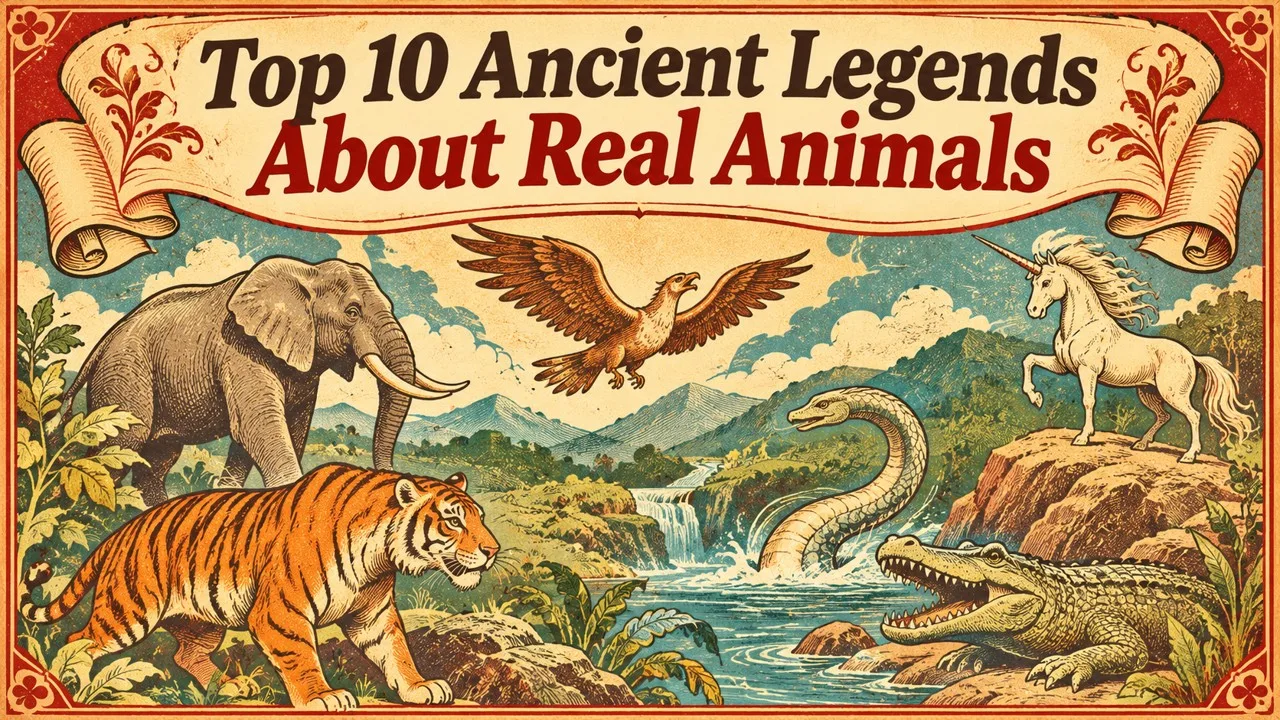
Unicorns, griffins, cyclopes and gold-digging ants may all have grown from real animals. Ten ancient legends and the creatures that may lie behind them. Ancient writers were fascinated by the animal world. Greek and Roman authors collected reports of creatures from distant lands, mixing careful observation with travellers' tales, rumours and myths.
Many of their descriptions seem fantastical today. They wrote of one-horned beasts, man-eating monsters with human faces, giant gold-digging ants and lizards that could survive fire.
Yet some of these legends appear to have been inspired by real animals. Ancient authors often relied on second-hand reports from traders and travellers, and details could become distorted as stories passed from person to person.
Other legends arose from genuine observations that were misunderstood. Unusual anatomy, surprising behaviour or the discovery of strange bones could lead people to imaginative conclusions.
Modern scholars have proposed real-world explanations for many ancient animal legends. Some of these explanations are widely accepted, while others remain speculative and debated.
The legends in this list come mainly from ancient Greek and Roman sources, including the historian Herodotus, the physician Ctesias, the philosopher Aristotle and the naturalist Pliny the Elder, as well as early Christian animal symbolism.
This list avoids common modern myths about animals, which are covered in a separate article, and focuses on legends from the ancient world.
Each entry names the legend, the ancient source in which it appears and the real animal that may lie behind it, followed by an account of the story and the possible explanation.
The entries are not ranked.
Together, they show how ancient people tried to make sense of the animal world, and how much truth can lie hidden inside a legend.
Key Facts
| # | Legend | Ancient source | Possible real animal |
|---|---|---|---|
| 1 | The unicorn | Ctesias of Cnidus | The Indian rhinoceros |
| 2 | The manticore | Ctesias of Cnidus | The tiger |
| 3 | The griffin | Greek accounts of Central Asia | Possibly dinosaur fossils |
| 4 | The cyclopes | Homer and other Greek writers | Possibly dwarf elephant skulls |
| 5 | Gold-digging ants | Herodotus | Possibly marmots |
| 6 | The fire salamander | Aristotle and Pliny the Elder | Salamanders hiding in logs |
| 7 | The swan song | Plato and other Greek writers | Swans |
| 8 | The hyena | Greek and Roman writers | The spotted hyena |
| 9 | The pelican | The Physiologus | Pelicans |
| 10 | Shapeless bear cubs | Pliny the Elder | Newborn bears |
1. The One-Horned Beast of India
The earliest detailed description of a unicorn-like animal in Greek literature comes from Ctesias, a Greek physician who lived at the Persian court around 400 BC. He wrote about wild asses in India that had a single horn on their foreheads, which he claimed could protect against poison [1].
Ctesias never visited India himself. He relied on reports that reached the Persian court, and his descriptions mixed real information with exaggeration [1].
Related: Top 10 Mythical Creatures in World Mythology - That Inspired Myths Across Civilizations (unchanged)
Many scholars believe that his account was partly inspired by the Indian rhinoceros, which has a single horn and was known to traders in the region. Over the following centuries, the unicorn developed into the graceful horse-like creature of medieval legend, far removed from its possible origins.
2. The Man-Eater With a Human Face
Ctesias also described a terrifying creature from India called the manticore. According to his account, it had the body of a lion, a human face with several rows of teeth and a tail that could shoot stings [2].
The name is thought to come from an old Persian word meaning man-eater. This has led many scholars to suggest that the legend was based, at least in part, on reports of the tiger, a dangerous predator known to kill people in parts of Asia [2].
As stories about the tiger passed through translators and storytellers, details may have been exaggerated and mixed with other ideas. The manticore later became a popular monster in medieval bestiaries and modern fantasy.
3. Guardians of Gold
The griffin, a creature with the body of a lion and the head and wings of an eagle, was said to guard gold in the deserts of Central Asia. Greek writers reported that nomadic peoples encountered griffins while searching for gold [3].
The historian Adrienne Mayor has suggested that the legend may have been inspired by fossils of dinosaurs such as Protoceratops, which are found in the Gobi Desert. These animals had beaks and bony frills, and their skeletons could have been seen by ancient prospectors [3].
This idea has attracted much interest, but it remains debated. Some palaeontologists and historians argue that the griffin's appearance can be explained by earlier traditions of artistic creatures from the Near East, without any need for fossils.
4. One-Eyed Giants
In Greek mythology, the cyclopes were giants with a single eye in the middle of their foreheads. In Homer's Odyssey, the hero Odysseus encounters the cyclops Polyphemus on an island [4].
In the early twentieth century, the palaeontologist Othenio Abel suggested that the legend might have been inspired by the skulls of extinct dwarf elephants found on Mediterranean islands such as Sicily, Malta and Crete. These skulls have a large central opening for the trunk, which could be mistaken for a single eye socket [4].
The idea is popular and plausible, but there is no direct ancient evidence that people who found such skulls linked them to the cyclopes. It remains an intriguing hypothesis rather than a proven explanation.
Related: Top 10 Mythical Creatures of Indian and Asian Mythology
5. Ants That Dug for Gold
The Greek historian Herodotus, writing in the fifth century BC, reported a remarkable story about ants in a desert region near India. These ants, he wrote, were smaller than dogs but larger than foxes, and they dug up sand containing gold, which people then collected [5].
For centuries, the story was regarded as fantasy. In the 1990s, the French explorer Michel Peissel reported that on a plateau in the Himalayan region, marmots dug burrows in soil containing gold dust, and that local people had traditionally collected the gold from the excavated soil [5].
Peissel suggested that a confusion between the Persian words for marmot and ant might explain the story. His explanation has been widely reported, though it has not been universally accepted.
6. The Lizard That Survived Fire
Ancient writers, including Aristotle and Pliny the Elder, described the salamander as an animal that could survive fire or even extinguish it. This belief continued into the medieval period, when the salamander became a symbol of endurance and faith [6].
A common explanation is that real salamanders often hide in damp, rotting logs. When such logs were thrown onto a fire, the salamanders would crawl out, appearing to emerge from the flames [6].
Some salamanders also produce a moist, toxic secretion from their skin, which might have reinforced the idea that they were cool to the touch. The legend influenced alchemy, heraldry and the naming of a mineral fibre once thought to come from salamanders.
7. The Final Song of the Swan
The idea that swans sing a beautiful song just before they die appears in ancient Greek literature. In Plato's dialogue Phaedo, the philosopher Socrates mentions the belief, interpreting the swans' song as one of joy rather than sorrow [7].
Even in ancient times, some writers doubted the story. Pliny the Elder said that observation showed it to be false [7].
The mute swan, common in Europe, is relatively quiet, though not entirely silent. However, other swan species, such as the whooper swan, make loud calls. Some writers have suggested that the sounds of these species may have contributed to the legend. Today, the phrase swan song refers to a final performance or achievement.
Related: Top 10 Animals People Commonly Get Wrong
8. The Animal Said to Change Sex
Some ancient writers believed that hyenas could change sex, switching between male and female. Aristotle rejected this idea, explaining that it arose from a misunderstanding of the animal's anatomy [8].
The belief was likely inspired by the spotted hyena, in which females have external genitals that closely resemble those of males. This makes it very difficult to tell the sexes apart by sight [8].
Despite Aristotle's correction, the legend persisted into medieval bestiaries, where the hyena was often used as a symbol of deceit. Modern biologists continue to study the unusual anatomy and social life of spotted hyenas, in which females are typically dominant.
9. The Bird That Fed Its Young With Blood
An early Christian text called the Physiologus, probably written in the first centuries AD, described the pelican as a bird that revived or fed its young with its own blood. The image became a powerful symbol of sacrifice in Christian art [9].
The legend may have been inspired by pelicans pressing their bills against their chests to empty their pouches when feeding their young. Some species also show reddish colouring on their bills or plumage during the breeding season, which could have been mistaken for blood [9].
The pelican feeding its young became a common image in medieval churches, manuscripts and heraldry. It remains a familiar symbol in Christian tradition and appears on some coats of arms and emblems today.
10. Cubs Licked Into Shape
Pliny the Elder and other ancient writers claimed that bears gave birth to shapeless lumps of flesh, which the mother then licked into the shape of a cub. This idea survives in the English expression to lick something into shape [10].
The legend has a real basis. Bears give birth in dens during winter, and their newborn cubs are very small compared to their mothers. They are born with their eyes closed and with little fur, and they look very different from adult bears [10].
Since few people could observe bears in their dens, the tiny, undeveloped newborns and the mother's constant grooming may have given rise to the story. Modern research has shown how bear cubs develop rapidly in the den before emerging in spring.
Related: Top 10 'Ancient Alien' Artifacts with Ordinary Explanations
Conclusion
These legends show how ancient people tried to understand animals they could rarely observe directly. Travellers' tales, rare sightings and strange bones all fed the imagination.
Many legends contained a kernel of truth, such as the single horn of the rhinoceros or the unusual anatomy of the spotted hyena.
Some explanations, such as the link between dwarf elephant skulls and the cyclopes, are intriguing but remain unproven. Scholars continue to debate them.
The legends also show how stories changed over time, as they passed through translations, retellings and religious symbolism.
Ancient writers such as Aristotle sometimes corrected popular beliefs, showing that scepticism and careful observation existed alongside legend.
The study of ancient animal legends brings together history, biology, palaeontology and linguistics, offering fresh insights into the past.
For anyone curious about animals and myths, these stories are a reminder that the natural world can be as astonishing as any legend.
Museums of natural history, with their collections of skulls, skins and fossils, now allow anyone to see the real animals behind these ancient stories, from rhinoceros horns to dwarf elephant skulls.
- ^ [1] Accounts of Ctesias and the unicorn. Wikipedia: Ctesias Wikipedia: Indian rhinoceros
- ^ [2] Accounts of the manticore. Wikipedia: Manticore Wikipedia: Tiger
- ^ [3] Accounts of the griffin. Wikipedia: Griffin Wikipedia: Adrienne Mayor
- ^ [4] Accounts of the cyclopes. Wikipedia: Cyclopes Wikipedia: Dwarf elephant
- ^ [5] Accounts of the gold-digging ants. Wikipedia: Gold-digging ant Wikipedia: Himalayan marmot
- ^ [6] Accounts of the salamander legend. Wikipedia: Salamander (legendary creature) Wikipedia: Natural History (Pliny)
- ^ [7] Accounts of the swan song. Wikipedia: Swan song Wikipedia: Phaedo
- ^ [8] Accounts of the hyena legend. Wikipedia: Spotted hyena Wikipedia: History of Animals
- ^ [9] Accounts of the pelican legend. Wikipedia: Physiologus Wikipedia: Pelican
- ^ [10] Accounts of bear cubs. Wikipedia: Brown bear Wikipedia: Pliny the Elder





















Discussion
Log in with