






 By
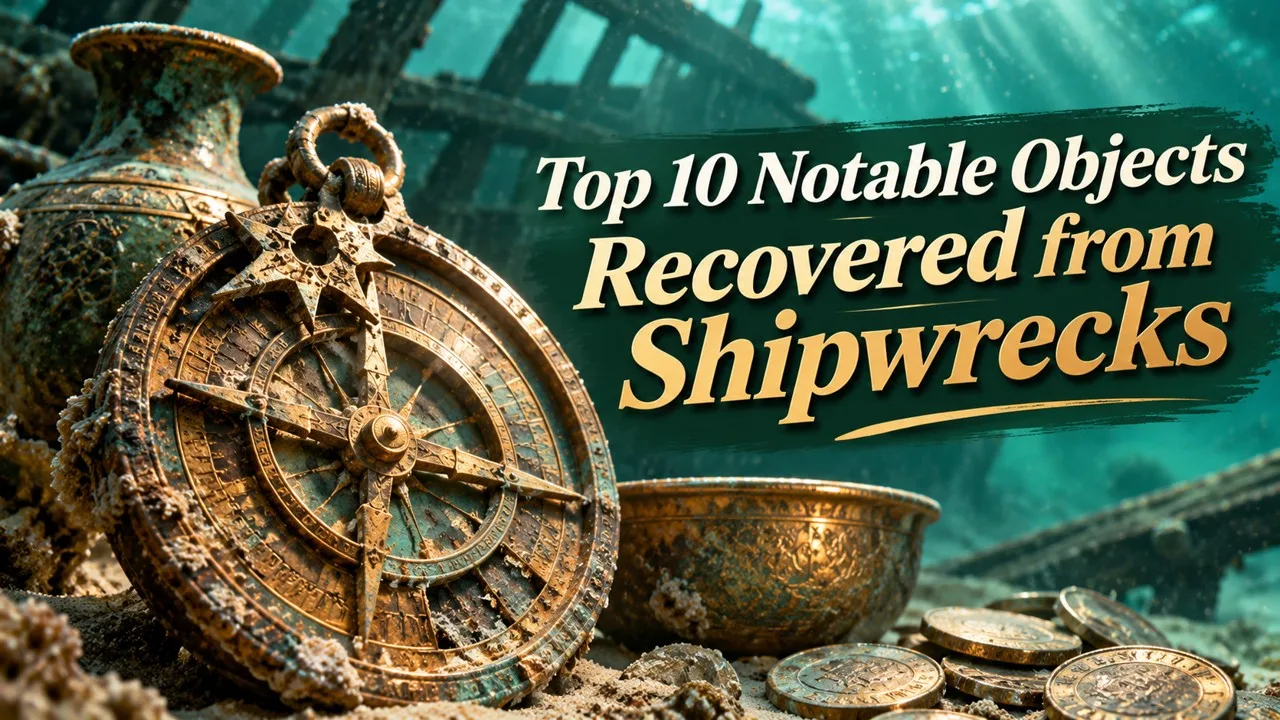
Some shipwrecks have given back cargo more telling than gold, including bottles, cloth, stone, sauce, medicine, and a perfume case.
The ten recoveries below are champagne from a Baltic schooner, silk dresses from the Palmwood wreck, the Antikythera mechanism, medieval grave slabs from the Mortar Wreck, Roman fish sauce off Mallorca, a packed sturgeon from the Danish ship Gribshunden, ivory from the Portuguese ship Bom Jesus, a dairy remnant from the Swedish warship Kronan, eye tablets from a wreck off Tuscany, and perfume samples from Titanic. This article is a record of documented archaeological finds. It is not a treasure-hunting guide, and it will not describe human remains.
Key Facts
| Find | What was recovered | A limit on the story |
|---|---|---|
| 1 | Nineteenth-century champagne bottles from the Foglio wreck in the Baltic | A scientific tasting is not an invitation to salvage bottles |
| 2 | Seventeenth-century silk garments from the Palmwood wreck off Texel | Textile survival depended on sediment, not on a secret method |
| 3 | The Antikythera mechanism, a Greek geared astronomical device | Only a fraction of the original survives, and some functions remain debated |
| 4 | Purbeck stone cargo, including grave slabs, from the Mortar Wreck off Poole | The site was investigated under permission, not as a souvenir hunt |
| 5 | Fourth-century amphorae of fish sauce from Ses Fontanelles, Mallorca | The jars are evidence of a known product, not a lost secret recipe |
| 6 | A barrelled Atlantic sturgeon from the 1495 wreck of Gribshunden | The fish is a royal-provision find, not a hunting trophy |
| 7 | More than a hundred elephant tusks from the 1533 wreck of Bom Jesus | The scientific value now is historical and genetic, not a market in ivory |
| 8 | A poorly identified dairy mass from the 1676 wreck of Kronan | A smell is not a complete menu |
| 9 | Sealed tablets, probably eye medicine, from a wreck off Populonia | This is not a formula to copy |
| 10 | Perfume sample vials linked to Adolphe Saalfeld, recovered from Titanic | The story is of a surviving passenger's lost luggage, not of the sinking as a spectacle |
1. Champagne That Waited in the Baltic
In 2010, divers documented a large group of champagne bottles, commonly counted at 168, on a nineteenth-century wreck in the Baltic known as the Foglio wreck, or the Champagne Schooner [1]. Cork marks identified more than one historic house, including Veuve Clicquot Ponsardin. Chemical work found a much higher sugar level than in many modern dry champagnes, which is a period fact about taste, not a sales claim. A few bottles were later tasted under study, and a few were auctioned [1].
The unexpected fact is how much a cold, low-oxygen basin can do for a sealed cork [1]. This article will not give a position that could be used as a salvage brief, and it will not treat an auction hammer as the main point. The careful fact is a documented Baltic cargo, laboratory comparison with later wine, and a reminder that "recovered alcohol" is still an archaeological object. The ship's full identity is not certain. The bottles are.
A wreck can be famous for what was meant to be drunk. In this case, the drink outlasted the voyage by about two centuries.
2. Silk That Survived Because Sand Closed Over It
Natural cloth usually disappears on an old wreck. The Palmwood wreck, off the Dutch island of Texel, was buried in sediment soon enough that seventeenth-century garments, including elaborate silk dresses, survived in extraordinary condition [2]. One almost complete silk satin dress points to expensive cloth and careful tailoring; another garment, decorated with metal thread, has been discussed as possible wedding wear. The colors have shifted with time, and the textiles now need tightly controlled cases to remain stable in air [2].
The unexpected fact is not that rich people packed good clothes. It is that the clothes are still here to be studied as objects, not only as entries in a wardrobe account [2]. This article will not treat the wreck as a closet to be picked, and it will not invent a passenger's biography from a hem. The careful fact is a documented burial in sediment, rare almost-complete garments, and a conservation problem that begins the moment the cloth leaves the seabed. Fashion history rarely gets this kind of primary fabric. When it does, the fabric is fragile.
A dress can outlast a ship and still be, in a museum case, only barely holding together. That is the real afterlife of the Palmwood textiles.
3. A Bronze Device That Was More Than a Lump
In 1901, sponge divers off the island of Antikythera brought up corroded fragments that later proved to contain a Greek geared mechanism, now called the Antikythera mechanism [3]. Imaging and reconstruction work have shown a system of bronze wheels that could model astronomical cycles, including motions of the Sun and Moon and, in likely restorations, the planets then known, as well as eclipse cycles. Only about a third of the original device survives, in dozens of fragments. Some details of the missing parts remain argued [3].
Related: Top 10 Famous Shipwrecks That Rewrote History
The unexpected fact is not a myth of "impossible technology." It is how much calculation a small, hand-turned device could already do in the Hellenistic world [3]. This article will not present a complete working replica as if it were the recovered object, and it will not treat the wreck as a treasure map. The careful fact is a documented early-twentieth-century recovery, a long scientific reading of the fragments, and a machine that is best called an astronomical calculator, not a modern computer by metaphor alone. Gear trains have a history. This is one of the earliest complicated examples we have in metal.
A lump in a crate can turn out to be a sky in bronze. It took decades of patient study, not a single gasp, to read it.
4. Stone Cargo, Including Unfinished Graves
The Mortar Wreck, in Poole Bay on the south coast of England, was investigated with permission in 2020 after a local skipper, Trevor Small, had argued that a ignored seabed scatter was more than junk [4]. The vessel, dated to around the mid-thirteenth century, carried Purbeck stone, including large mortars for grinding and at least two carved grave slabs that had not been fully finished. It has been described as England's oldest known wreck with substantial surviving hull remains. The half-finished slabs suggest that some skilled carving was done near the quarries, with finishing intended later [4].
The unexpected fact is that a medieval tomb, or the stone for one, can be interrupted by a voyage and then wait on the seabed as cargo, not as a burial [4]. This article will not give a dive route, and it will not treat the slabs as portable souvenirs. The careful fact is an authorized investigation, a dated stone cargo, and a hull that matters because so few English medieval ships survive in this way. Mortars named the wreck. The grave slabs are the quieter, heavier story.
A quarry product can fail to reach the church it was meant for. In Poole Bay, the failure became an archaeological site.
5. Fish Sauce in Jars That Still Hold Evidence
In 2019 a storm exposed a fourth-century wreck in shallow water off Mallorca, now called Ses Fontanelles, close to a popular beach [5]. Sand had buried the small ship and its cargo of amphorae. Some jars held wine or oil; others held liquamen, a fermented fish sauce related to the better-known name garum. Fish bones in the vessels point to small fish such as anchovies and sardines. Painted inscriptions on many amphorae still record information about contents and people connected with the shipment [5].
The unexpected fact is how close to a swimming beach a well-preserved Roman cargo could lie, unseen until weather moved the sand [5]. This article will not treat the site as a place to pick up pottery, and it will not claim a secret recipe. Ancient writers already described fish sauces. The jars give physical evidence of a commercial product, which is rarer than a paragraph in a text. The careful fact is a dated wreck, a shallow sandy burial, and inscriptions that make the cargo a document as well as a food.
Related: Top 20 Archaeological Hoaxes That Fooled the Public
A condiment can be ordinary in its century and extraordinary in ours. The Mallorca jars are ordinary Roman trade, recovered intact enough to study.
6. A Royal Sturgeon Packed for a Voyage
The Danish warship Gribshunden, flagship of King Hans of Denmark, caught fire and sank in 1495 off the coast of what is now Sweden, while the king was ashore on a political journey [6]. Much later, archaeologists recovered a wooden barrel containing the remains of a large Atlantic sturgeon, cut and packed as provisions. Sturgeon was a prestige food, and the fish has been read as part of the ship's display of royal supply, perhaps intended for elite hospitality. The find also records a Baltic sturgeon population that later disappeared from the region [6].
The unexpected fact is that a diplomatic voyage can be documented in a barrel of fish as clearly as in a letter [6]. This article will not treat the animal as a trophy, and it will not describe the wreck as a hunting ground. The careful fact is a dated 1495 loss, a scientific recovery of packed provisions, and a species history that now has a late-medieval data point. Kings provisioned ships to impress as well as to eat. This barrel shows both motives at once.
A prestige fish can become, after five centuries, a zoological specimen. That second life is the reason the barrel was worth opening in a lab.
7. Ivory That Is Now a Scientific Archive
The Portuguese ship Bom Jesus, bound for the Indian Ocean trade, sank in 1533 and was found in 2008 in the diamond-mining region of the Namibian coast [7]. Among the cargo were gold, copper, and more than a hundred elephant tusks. Later genetic work on the ivory reported African forest-elephant ancestry and a wider set of maternal lineages than researchers could easily match in some living West African populations, with chemical clues that some of those elephants had lived in mixed or more open habitats, not only deep forest [7].
The unexpected fact is that a sixteenth-century trade cargo can become a biological record of animals and landscapes that later hunting and land change have altered [7]. This article will not treat the wreck as a source of ivory for sale, and it will not offer a method for finding ships in a mining zone. The careful fact is a documented 2008 identification, a dated Portuguese wreck, and a scientific rereading of the tusks as historical evidence. The ivory trade was a real, extractive business. The ethical use of these objects now is study and custody, not a new market.
Related: Top 10 Overlooked Ancient Mysteries
A cargo can change its meaning completely and still be the same tusks. In Namibia, the change is from merchandise to data.
8. A Warship's Uncertain Dairy
The Swedish warship Kronan exploded and sank in battle in the Baltic in 1676, a disaster that killed a large part of the crew and scattered the ship's contents [8]. Among thousands of later archaeological finds was a sealed mass of yellowish material, protected by clay and sediment, that researchers have described as a dairy product: possibly cheese, possibly butter, possibly another milk food that cannot be neatly named from a modern menu. The smell, once the container was opened, was famously strong. The find is rare evidence of perishable rations on a warship [8].
The unexpected fact is that a battle wreck, known for guns and coins, can still surprise a laboratory with lunch [8]. This article will not describe the dead, and it will not pretend that a smell is a complete identification. The careful fact is a documented 1676 loss, a recovered organic mass under study, and the ordinary truth that crews had to eat. Metals survive more willingly than food. When food survives, it is usually because mud sealed it.
A mystery can be as humble as a dairy tub. Kronan's tub is humble, and it is still a primary source.
9. Tablets from a Physician's Kit, Not a Recipe Book
A Roman trading vessel that sank off Tuscany, near ancient Populonia, around 140 to 130 BC, yielded what appears to have been part of a physician's kit, including a sealed tin holding small gray tablets [9]. Chemical study found zinc compounds along with fats, starch, resin, and other ingredients consistent with a medicinal, rather than purely cosmetic, preparation. The shape and the materials have led researchers to discuss the tablets as likely eye medicines, in the broad ancient category of collyria. Nearby containers and an instrument have been read as supporting a medical context [9].
The unexpected fact is that a written medical tradition can be checked, cautiously, against a sealed object from a wreck [9]. This article will not treat the analysis as a formula to copy, and it will not offer medical advice. The careful fact is a documented wreck assemblage, a laboratory reading of the tablets, and a probable ophthalmological use that remains an interpretation. Ancient medicine is a historical subject. It is not a kit to reopen for use.
Related: Cleopatra's Tomb: History, Theories and the Search at Taposiris Magna
A tin can outlast the doctor. The tablets inside are evidence, and they should stay in that role.
10. A Perfumer's Samples That Came Up Without Him
When Titanic left Southampton in April 1912, Adolphe Saalfeld, a German-born chemist and perfumer living in Britain, was traveling with sample vials of fragrance he hoped to show in America [10]. He survived the sinking. His case did not. Decades later, a leather case associated with him was recovered from the wreck, with dozens of small glass ampoules, many still sealed; accounts of the recovery commonly count sixty-five intact vials. Some scent was noticed when a few containers broke during the work. The samples are ordinary commercial luggage that became, by accident, an unusually well-sealed time capsule [10].
The unexpected fact is how personal a famous wreck's cargo can be when it is not a jewel, only a sales kit [10]. This article will not narrate the night of the sinking as a spectacle, and it will not describe a method for visiting the site. The careful fact is a documented surviving passenger, a later recovery of his samples, and a set of vials whose value is historical, not a treasure map. Saalfeld never got the case back. The archive did.
A perfume sample is a small object with a large afterlife. On this wreck, the afterlife is a line in a conservation inventory.
Conclusion
The ten recoveries above are Baltic champagne, Texel silk, a Greek geared calculator, medieval grave slabs, Roman fish sauce, a packed royal sturgeon, scientifically restudied ivory, a warship's uncertain dairy, possible eye tablets from Tuscany, and a perfumer's vials from Titanic. None of them needs a hunt, and none of them is improved by a story about bones.
An archaeological object is already found when it is published, conserved, and kept in custody. That is the only ending this list will give it.
- ^ [1] Archaeological and scientific accounts of champagne bottles recovered from the nineteenth-century Foglio wreck, or Champagne Schooner, in the Baltic, including cork identifications and later chemical comparison. Britannica: champagne Wikipedia: Foglio wreck
- ^ [2] Museum and archaeological accounts of seventeenth-century garments from the Palmwood wreck off Texel, including conservation display of the silk dresses. Museum Kaap Skil Britannica: Texel
- ^ [3] Museum and scientific accounts of the Antikythera mechanism, including the 1901 recovery, the surviving fraction of the device, and its interpretation as a geared astronomical calculator. Britannica: Antikythera mechanism National Archaeological Museum, Athens
- ^ [4] Licensed archaeological accounts of the Mortar Wreck in Poole Bay, including the mid-thirteenth-century Purbeck stone cargo and carved grave slabs. Bournemouth University, maritime archaeology Britannica: underwater archaeology
- ^ [5] Archaeological reports on the Ses Fontanelles wreck off Mallorca, including fourth-century amphorae of liquamen, fish-bone evidence, and painted inscriptions. Britannica: garum Britannica: Majorca
- ^ [6] Archaeological and scientific accounts of the 1495 wreck of Gribshunden and of the barrelled Atlantic sturgeon recovered from the site. Britannica: Sweden Wikipedia: Gribshunden
- ^ [7] Archaeological and genetic accounts of the 1533 Portuguese wreck Bom Jesus, found in 2008 on the Namibian coast, including study of the elephant ivory as historical and biological evidence, not as a commodity. Britannica: Namibia Wikipedia: Bom Jesus (ship)
- ^ [8] Archaeological accounts of organic finds from the 1676 wreck of the Swedish warship Kronan, including a sealed dairy mass whose exact product remains uncertain. Kronan collection, Kalmar County Museum Britannica: Baltic Sea
- ^ [9] Archaeological and laboratory studies of tablets from the so-called Pozzino wreck off Populonia, treated as historical evidence of a probable eye preparation and not as a recipe for use. Britannica: Populonia Wikipedia: Pozzino shipwreck
- ^ [10] Recovery and collection accounts of perfume sample vials associated with Adolphe Saalfeld from the wreck of Titanic, kept distinct from any retelling of the sinking as spectacle. Britannica: Titanic Royal Museums Greenwich



















Discussion
Log in with