





 By
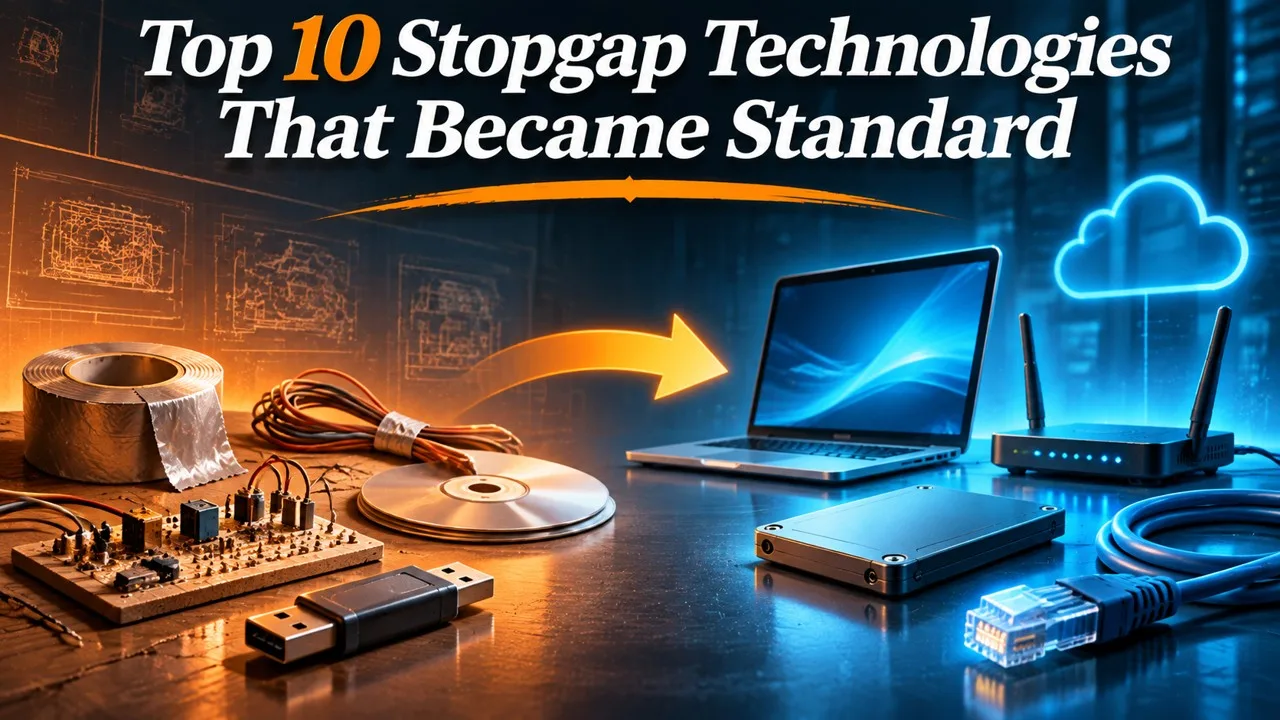
Several tools that now feel inevitable began as limited fixes, from 160-character phone messages to a parts-tracking barcode. A stopgap, in this sense, is a design that solved a narrow, immediate problem with the tools at hand. Some of the examples below were officially temporary. Others were simply modest: a lab markup language, a factory label, a compressed music file for disks that were too small [1][5][6].
What they share is a second life. Once a format or a protocol is widely implemented, it becomes easier to keep using it than to start over, even if later systems are more elegant. SMS still sits inside smartphones that can also send richer messages. HTML still sits under pages that look nothing like a 1991 physics memo. USB still carries power and data decades after it was sold as a way to tidy the back of a personal computer [3][5][7].
This list is a curated set of ten well-documented cases, not a ranking by market share, and it does not claim that no rival ever existed. It only claims that each of these technologies began with a smaller job than the one it ended up doing.
Key Facts
"Stopgap" here means a limited or narrowly targeted design that later became infrastructure. Dates below refer to first public or commercial introduction, not to the last revision of the standard.
Ten Interim Tools That Stuck at a Glance
| Rank | Technology | Original job | First widely cited date | Later role |
|---|---|---|---|---|
| 1 | SMS | Short text on a mobile signalling channel | GSM era, early 1990s | Default phone messaging |
| 2 | HTML | Simple markup for sharing documents on the early Web | 1991 | The language of web pages |
| 3 | Ethernet | A wired local-area network among several rivals | 1980 commercial introduction | Dominant wired LAN |
| 4 | USB | One plug for many PC peripherals | 1996 | Default cable for data and power |
| 5 | Documents that look the same on every machine | 1993; later ISO 32000 | Standard portable documents | |
| 6 | QR code | Fast-to-scan labels for car parts | 1994 | General-purpose matrix barcode |
| 7 | MP3 | Heavily compressed audio for limited storage | 1990s, Fraunhofer | Mass digital music format |
| 8 | Spreadsheet software | An electronic ledger and calculator | VisiCalc, 1979 | Standard business modelling tool |
| 9 | Wi-Fi | Wireless local networking from IEEE 802.11 | Late 1990s | Default indoor wireless access |
| 10 | CAPTCHA | A test to tell a person from a program | Early 2000s | Common gate on web forms |
1. SMS Text Messaging
Short Message Service was built as a tight, almost incidental feature of digital mobile networks, especially GSM. It uses standardized protocols to carry a short text, famously limited to 160 seven-bit characters in the original design, over control channels that already existed to run the network [1]. In other words, the message service was squeezed into space that was there for signalling, not invented as a full stand-in for mail or conversation.
That limitation is the reason SMS felt like a stopgap. It could not carry long documents, rich formatting, or, at first, a reliable sense that a message had been read. It could, however, reach a phone that was already on the network, and it could be stored and forwarded if the handset was off [1]. Those narrow virtues were enough. By the 2000s, SMS had become an everyday messaging layer, a vehicle for alerts and authentication codes, and a habit that later chat apps had to accommodate rather than simply erase.
The format is no longer the only way a phone sends text, but it is still a baseline that works across carriers and devices. A temporary-looking 160-character service became part of the world's communications plumbing [1].
2. HTML
Hypertext Markup Language was created so that documents on the early World Wide Web could be written, linked, and displayed in a browser. Tim Berners-Lee and colleagues at CERN needed a simple way to share research documents, not a finished typographic system for the entire public internet [5]. The first public descriptions, around 1991, presented a small set of tags for headings, paragraphs, lists, and links.
That simplicity was the point, and it was also why HTML looked provisional. Designers and engineers spent years adding layout, style sheets, scripting, and multimedia around it. The original language did not even try to be a complete graphical design tool [5]. Yet the web did not migrate to an entirely different document language. It kept HTML at the centre and piled other standards on top.
Related: Top 10 Most Bizarre Phobias: Strange Fears That Exist
A page today may be generated by frameworks that Berners-Lee never saw, but the browser still parses markup in the HTML family. A lab format for linked documents became the default way the web is structured, which is as complete a promotion from stopgap to standard as any item on this list [5].
3. Ethernet
Ethernet is a family of wired networking standards for local, access, and metropolitan networks. It was developed at Xerox PARC, with Robert Metcalfe among its principal figures, and was introduced commercially in 1980 [3]. At the time it was not obvious that this particular design would win. Other LAN technologies, including token-passing systems, were serious alternatives in offices and factories.
Ethernet's early forms were also physically awkward by later standards: coaxial cables, strict topologies, and collision-detection rules that had to be explained to people who only wanted printers to work. Later revisions moved to twisted-pair cabling, switches, and much higher speeds, but they kept the Ethernet name and a compatible idea of the frame [3]. The "temporary" competing-LAN period ended with Ethernet as the default wired network in buildings and, in its broader family, as a building block for larger networks.
The lesson is not that the first Ethernet cable was perfect. It is that a workable local network, revised often enough, can outlast more specialized rivals and become the thing everything else plugs into.
4. USB
Universal Serial Bus was developed in the mid-1990s as an industry standard for connecting peripherals to a personal computer, with the first specification appearing in 1996 under the USB Implementers Forum [4]. The immediate problem was a mess of serial, parallel, keyboard, and other ports, each with its own cable and often no simple way to add a device while the machine was running. USB offered one family of plugs, power on the cable, and a promise of easier installation.
It was a cleanup job, not a claim to be the last connector anyone would ever need. Later versions added speed, new connector shapes, and a much more ambitious role as a power standard for phones and laptops [4]. Those later roles were not all visible in 1996. They grew because the connector was already on millions of machines.
USB is still revised, and it still frustrates people when the plug or the speed rating is wrong. That irritation is a sign of success: a stopgap for the back of a desktop PC became the default way a huge class of devices talk to one another and take power.
5. PDF
Portable Document Format was developed by Adobe in 1993 so that a file could carry its text, fonts, and images and look substantially the same on different computers and printers [7]. Before PDF, exchanging a designed document often meant sending a paper original, a page-layout file that the recipient might not be able to open, or a brittle export that reflowed into a mess. PDF was "digital paper": a way to freeze a layout for distribution.
Related: Top 10 Oldest Buildings in the World
That was a practical fix for offices, governments, and printers, and it might have remained a vendor format. Instead it became a widely implemented standard and was later published as ISO 32000 [7]. Forms, accessibility features, and interactive elements were added over time, but the core job — a page that remains a page — did not change.
PDF is a stopgap in the kindest sense. It did not try to replace every editable file format. It tried to solve the last mile of document exchange, and that last mile became part of the standard route.
6. QR Codes
The QR, or quick-response, code is a two-dimensional matrix barcode invented in 1994 by Masahiro Hara at Denso Wave in Japan, so that automotive parts could be labelled and scanned quickly on a production line [6]. A QR symbol can hold much more information than a conventional one-dimensional barcode and can be read from more angles, which mattered in a factory where speed and reliability counted.
Nothing in that brief required the code to appear on museum tickets, restaurant menus, or payment posters. Denso Wave allowed the specification to be used widely, and cameras in phones turned a parts-tracking tool into a general public interface [6]. The symbol that was designed to be read by industrial scanners became something a consumer could point a phone at.
The factory origin is worth keeping in view. A QR code looks like a modern marketing device, but it began as an engineering label, a better barcode for a plant that needed to move inventory without mistakes.
7. MP3 Audio Compression
MP3 is an audio coding format developed largely at the Fraunhofer Society in Germany, under the lead of Karlheinz Brandenburg, to make a sound recording much smaller while remaining acceptable to a listener [2]. The problem was practical: digital audio in uncompressed form took too much disk space and too much bandwidth for the personal computers and early internet connections of the 1990s.
Related: 10 Sikh Gurus: The Pillars of Sikhism Who Shaped Faith, Equality, Courage, and Humanity
The format discarded information that psychoacoustic research suggested people would be less likely to notice. That bargain was a stopgap in the eyes of anyone who wanted bit-perfect sound, and later formats and higher bit rates improved on it. Even so, MP3 became the everyday wrapper for recorded music for a generation, the file that moved collections off compact discs and onto players and computers [2].
Streaming and newer codecs have since taken much of the public attention, but they did not un-invent the idea. A compressed, "good enough" audio file, built because storage was scarce, is still a standard object in digital sound.
8. Spreadsheet Software
A spreadsheet program is an electronic version of the paper ledgers that offices already knew: a grid of cells that can hold numbers, labels, and formulas, and that recalculates when an input changes [8]. VisiCalc, released in 1979 for the Apple II, is the usual starting point for the personal-computer spreadsheet. It gave managers a visible, immediate calculator for budgets and projections that had previously meant erasers and adding machines.
The first programs were limited by memory, screen size, and the kinds of functions they offered. They were a practical substitute for paper, not a complete model of a firm. Lotus 1-2-3, Microsoft Excel, and later tools expanded the idea until the spreadsheet became, for better and worse, the default place in which a huge amount of business analysis still happens [8].
If a stopgap is a tool you adopt because it is already at hand, the spreadsheet is the classic case. It mapped onto a paper habit, ran on machines people were already buying, and then became hard to displace because so many other workflows were built inside it.
9. Wi-Fi
Wi-Fi is the everyday name for wireless local-area networking based on the IEEE 802.11 family of standards. The point of those standards, as they were commercialized in the late 1990s, was to let devices talk to a local network and to the internet without a cable, at ranges and speeds useful inside a building [9]. Wired Ethernet was already becoming the office default; wireless was, at first, the convenient extension for laptops and for rooms that were expensive to rewire.
Those early networks were slow, fussy about radio conditions, and less secure than later revisions. Successive 802.11 generations raised throughput, improved authentication, and made the access point a household appliance [9]. The "temporary" wireless LAN, used when a cable was inconvenient, became the way most phones, laptops, and televisions join a home or office network.
Related: Top 10 Tallest Buildings in the World
Wi-Fi did not abolish wired Ethernet, and it did not have to. It became the standard last hop for people, which is the hop that most users actually see.
10. CAPTCHA
A CAPTCHA is a challenge-response test meant to tell whether a user is a person or a program, usually in order to slow automated account creation, ticket-buying, or comment spam [10]. Early versions asked a person to read distorted letters or digits that were hard for the software of the time to recognize. The test was a patch: web forms had no built-in way to know who was on the other side, so designers added a small obstacle.
The obstacle became familiar enough to earn a name and a research literature, including work associated with Luis von Ahn and colleagues, and it spread across large websites in the 2000s [10]. As machine vision improved, the old letter puzzles grew less reliable, and later systems turned to image selection, risk analysis, or quieter background checks. That evolution shows the original puzzle for what it was: a temporary defence, repeatedly rebuilt.
Even so, the idea of a gate that tries to filter bots from people is now a standard part of web security. The first distorted words were a stopgap. The category they founded is still in the way of the form.
Conclusion
A technology does not have to be designed as eternal infrastructure in order to become infrastructure. SMS, HTML, Ethernet, USB, PDF, the QR code, MP3, the electronic spreadsheet, Wi-Fi, and CAPTCHA all began by solving a smaller problem: a short signal, a linked memo, a local cable, a tidy port, a portable page, a factory scan, a smaller music file, a digital ledger, a wireless hop, a test for a bot. Once enough other systems depended on them, replacement became harder than revision.
The useful question, looking at a modest tool today, is not only whether it is elegant. It is whether it is already sitting in the path of everything else. If it is, there is a decent chance that the stopgap is on its way to becoming the standard.
- ^ [1] "SMS." Wikipedia. Wikipedia: SMS
- ^ [2] "MP3." Wikipedia. Wikipedia: MP3
- ^ [3] "Ethernet." Wikipedia. Wikipedia: Ethernet
- ^ [4] "USB." Wikipedia. Wikipedia: USB
- ^ [5] "HTML." Wikipedia. Wikipedia: HTML
- ^ [6] "QR code." Wikipedia. Invention in 1994 by Masahiro Hara at Denso Wave. Wikipedia: QR code
- ^ [7] "PDF." Wikipedia. Adobe, 1993, later standardized as ISO 32000. Wikipedia: PDF
- ^ [8] "Spreadsheet." Wikipedia. Wikipedia: Spreadsheet
- ^ [9] "Wi-Fi." Wikipedia. Wikipedia: Wi-Fi
- ^ [10] "CAPTCHA." Wikipedia. Wikipedia: CAPTCHA






















Discussion
Log in with