






 By
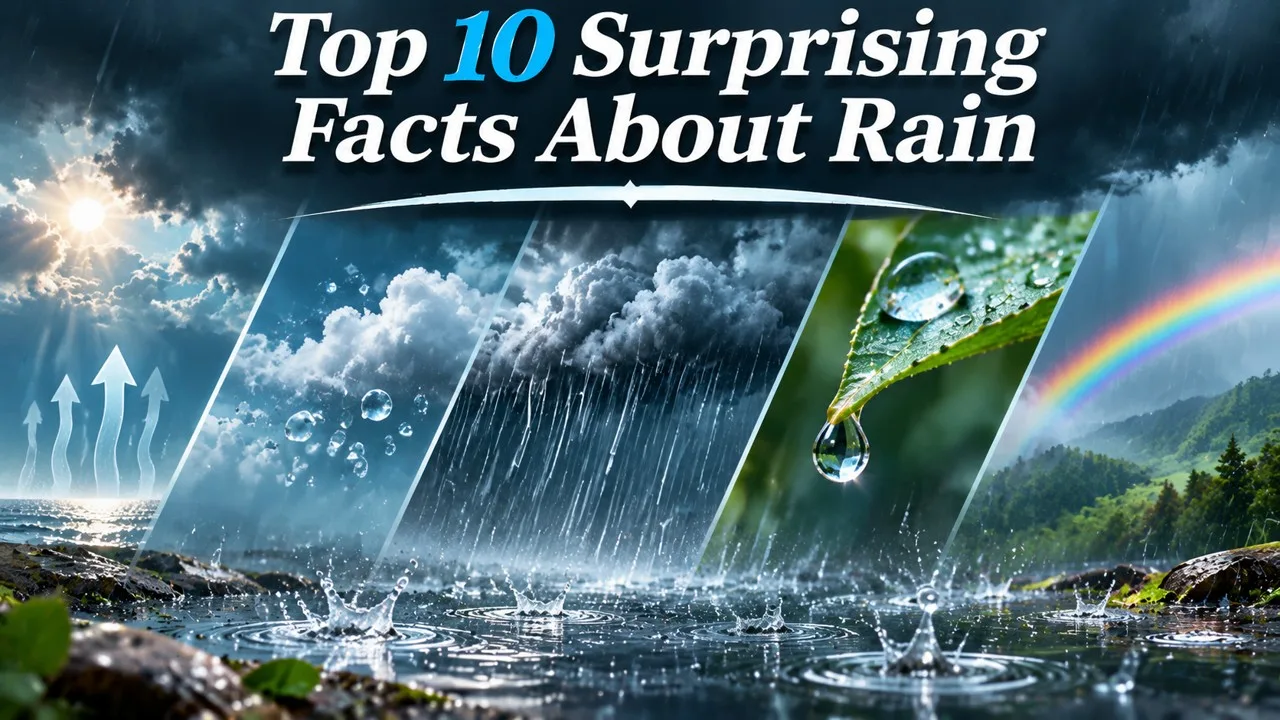
Rain is stranger than a weather forecast suggests: drops are not teardrop-shaped, some rain never reaches the ground, and wet air can have a nameable smell. A rain event is a chain of physics, chemistry, and geography, from the shape of a falling drop to the place that claims a world rainfall record [1][3][6]. This list is a curated set of ten documented facts, not a ranking, and not a complete hydrology lesson.
A few popular claims need a tighter wording. Acid rain was a real, measured problem, and it has declined in many industrial countries after sulfur and nitrogen emissions were cut, which is a success story as well as a warning [4]. Whether you stay drier by running or walking is a real physics question with a less dramatic answer than folklore suggests [5]. The entries below stay with those tighter wordings.
Key Facts
Rain starts as cloud droplets or ice particles. Most cloud water does not reach the ground in a given moment. Records of "wettest places" depend on the period and the gauge.
Ten Rain Facts at a Glance
| Rank | Fact | Why it surprises people | A main source of the evidence |
|---|---|---|---|
| 1 | Raindrops are not teardrops | Small drops are nearly spheres; larger ones flatten | Atmospheric physics, NASA explanations |
| 2 | Some rain evaporates before it lands | Virga can leave a visible streak and a dry ground | Meteorology |
| 3 | The smell after rain has a chemistry | Petrichor and geosmin are identifiable compounds | Bear and Thomas; later chemistry |
| 4 | Acid rain declined where emissions were cut | The problem was real and, in many regions, reduced | EPA and related monitoring |
| 5 | A few places are extraordinarily wet | Mawsynram, Cherrapunji, and Hawaiian mountains compete in the records | Climatology |
| 6 | Running in rain is only a modest tactic | You trade time in the rain against more drops hit per second | Physics papers |
| 7 | Clouds can hold water without pouring | Cloud droplets must grow a lot before they fall as rain | Cloud physics |
| 8 | Much rain is recycled moisture | Evaporation from land can feed later rainfall | Hydrology |
| 9 | Extreme bursts are not the same as annual totals | Intensity records and annual records are different lists | Official weather records |
| 10 | Ice in clouds is often part of the story | Mid-latitude rain commonly involves the ice-crystal process | Bergeron–Findeisen process |
1. Raindrops Are Not Teardrop-Shaped
The teardrop is a graphic convention, not a good picture of a falling raindrop. Small drops are nearly spherical because surface tension dominates. As a drop grows, aerodynamic pressure flattens the bottom, so the shape becomes more like a bun or a hamburger than like a drip on a drawing [1]. If the drop grows larger still, it becomes unstable and breaks into smaller drops rather than stretching into a pointed tail [1].
That is why photographs taken with high-speed techniques, and textbook diagrams in cloud physics, do not look like the icon on a weather app. The app is using a symbol. The drop is solving a mechanics problem in air.
2. Some Rain Never Reaches the Ground
Virga is precipitation that falls from a cloud and evaporates or sublimates before it reaches the surface [2]. From a distance it can look like a curtain of rain hanging in mid-air, which is exactly what it is: a visible shaft of drops or ice crystals that are shrinking as they fall through drier air. The ground under virga can stay dry even though a cloud is clearly "raining" [2].
The phenomenon is common in dry and high-base cloud conditions, including many continental interiors and some mountain interiors. It is one reason a radar or a distant glance can overstate how much rain a place is actually receiving. "Lots of rain, no rainfall" is not a riddle once the falling stuff is allowed to disappear on the way down.
Related: Top 10 Rare Cloud Formations and How They Form
3. The Smell of Rain Has a Name and a Chemistry
The pleasant, earthy smell that often follows the first rain after a dry spell is not an illusion, and it is not only "clean air." In 1964, I. J. Bear and R. G. Thomas described oils released from dry earth and rock by moisture and named the resulting odor petrichor [3]. A related, strongly earthy compound, geosmin, is produced by soil bacteria such as Streptomyces and is detectable by people at very low concentrations [3].
Ozone from lightning, and other volatile compounds from plants and soil, can join the mix, so the "smell of rain" is a small family of smells rather than a single molecule. The useful fact is that a everyday sensation has a published chemistry. Wet dust is doing something specific, and the nose is reporting it.
4. Acid Rain Was Real, and It Receded Where Emissions Fell
Acid rain, more precisely acid deposition, occurs when sulfur dioxide and nitrogen oxides form acids in the atmosphere and return to earth in rain, snow, or dry particles [4]. In the late twentieth century it was linked to damaged lakes, forests, and buildings in parts of Europe and North America. The chemistry was measured, not merely alleged [4].
In the United States and in much of Europe, later controls on power-plant and industrial emissions reduced those pollutants, and monitoring networks recorded a decline in acidity [4]. The problem has not vanished worldwide, and ecosystems can recover slowly, but the record is a genuine case of an environmental harm that responded to regulation. "The truth about acid rain" is not that it was a hoax, and not that nothing changed. It is that a documented pollution problem was, in several regions, reduced on purpose.
5. A Few Mountains and Hills Are Almost Unreasonably Wet
Annual rainfall records cluster in a handful of places where moist air is forced up steep slopes. The towns of Mawsynram and Cherrapunji in Meghalaya, India, often appear at or near the top of lists of the world's wettest inhabited places, with totals of many metres a year in strong monsoon seasons [5]. In the Hawaiian Islands, Mount Waialeale on Kauai and the Big Bog area on Maui are also famous for extraordinary annual totals, again because trade winds and steep terrain wring water from the air [5][6].
Related: Top 10 Surprising Microclimates Around the World
Which site "wins" depends on the years chosen and on how a gauge is sited. That is a good reason to treat any single champion with care, and a bad reason to doubt that these places are, by ordinary standards, astonishingly wet. A mere 100 miles away, a leeward slope can be comparatively dry. Rainfall is not a gentle average; it is a map.
6. Running in the Rain Helps, but Only Up to a Point
A familiar argument asks whether you get wetter if you run or if you walk in the rain. The physics is a trade: running shortens the time you are out in the falling drops, but it also increases the number of drops you meet on your front as you move into them [7]. Calculations and later discussions in the physics-teaching literature have generally found that running keeps you somewhat drier, especially in a short dash to shelter, though the advantage is not magical and depends on wind, rain rate, and how you lean [7].
The question is a good example of a folk puzzle that can be made precise. It is not a survival secret, and it does not mean a long run in a storm is a dry experience. It only means that, for a given distance to a doorway, speed usually beats strolling.
7. Clouds Can Be Full of Water and Still Not Rain
A typical cloud is made of tiny droplets or ice crystals that are light enough to stay aloft. For rain to form, those particles have to grow by collision or by ice-crystal processes until they are heavy enough to fall and to survive the descent [8]. Most of the liquid water in a cloud, at any one moment, is not on its way to the ground as rain. That is why a grey sky can threaten all day and deliver little, and why a smaller, deeper cloud can produce a brief, heavy shower.
The fact is simple and easy to forget when the whole sky looks wet. "Lots of water, no rainfall" can describe a cloud as well as it describes virga. The water is there. It is just still too small to be rain.
Related: Top 10 Extremes and Records on Planet Earth
8. Some Rain Is Moisture That Already Fell Once
Not all rain is moisture that has just arrived from a distant ocean. In many continental interiors, a substantial fraction of precipitation comes from water that evaporated from local or upwind land — from soils, plants, and inland waters — and then fell again [9]. Hydrologists call this precipitation recycling. The exact fraction varies with season, region, and the size of the area being studied, but the existence of the process is not in doubt [9].
The idea matters for drought and for land-use change. If a region depends partly on its own evapotranspiration to make later rain, then drying soils or a loss of vegetation can feed back on rainfall. "Rain, rain, coming back" is, in that sense, a hydrological fact, not only a nursery rhyme.
9. The Wettest Hour Is Not the Same as the Wettest Year
Climate records keep more than one kind of rainfall extreme. A place can hold a record for annual total, like the monsoon hills of Meghalaya, and a quite different place can hold a record for the most rain in an hour or a day, often in a thunderstorm, a cyclone, or a sudden orographic burst [5][10]. Official weather services maintain these records separately because they describe different physics.
That is why "rain at the extremes" should be stated with a time unit attached. A map of the wettest year is not a map of the most violent downpour. Both maps are useful, and mixing them up is one of the common ways a remarkable rain fact gets mis-told.
Related: Top 10 Largest Islands in the World
10. Much Mid-Latitude Rain Begins as Ice
In a large class of rain events in mid-latitudes, the drops that land were not grown only by the collision of liquid droplets. They grew in the presence of ice crystals, through the Bergeron–Findeisen process: ice particles grow at the expense of nearby supercooled droplets and then may melt on the way down, arriving as rain [8][11]. That is one reason a summer shower can be connected, aloft, to ice, even when no snow is seen at the ground.
The fact does not make every tropical warm-rain shower into a snow story. It does mean that "rain" is often the last stage of a colder process. The cloud has a vertical life, and the drop at the umbrella is only the ending.
Conclusion
Rain looks simple because it is familiar. The drop is not the shape we draw, the shaft of rain is not always a gift to the ground, the smell has a published chemistry, and the wettest places on earth are wet for reasons a map can show. Acid rain, running in a shower, recycled moisture, and ice in rain clouds are all cases where a little physics or a little monitoring changes the proverb.
The forecast still matters. These facts only add what the forecast, in a single number, cannot say: how the rain is made, where it can fail to arrive, and why some hills almost never dry out.
- ^ [1] "Shape of a Raindrop." NASA, and "Raindrop." Wikipedia. NASA: Shape of a raindrop
- ^ [2] "Virga." Wikipedia. Wikipedia: Virga
- ^ [3] Bear, I.J. and Thomas, R.G., 1964, "Nature of argillaceous odour," Nature, and "Petrichor," "Geosmin." Wikipedia. Wikipedia: Petrichor
- ^ [4] "Acid Rain." U.S. Environmental Protection Agency. EPA: Acid rain
- ^ [5] "Mawsynram" and "Cherrapunji." Wikipedia. Wikipedia: Mawsynram
- ^ [6] "Mount Waialeale" and Hawaiian rainfall records. Wikipedia. Wikipedia: Mount Waialeale
- ^ [7] "Running vs. walking in the rain" discussions in the physics-education literature; see also popular summaries of the problem. Wikipedia "Rain" and physics references therein. Wikipedia: Rain
- ^ [8] "Cloud physics." Wikipedia. Wikipedia: Cloud physics
- ^ [9] "Precipitation recycling" in the hydrological literature; overview at "Water cycle." Wikipedia. Wikipedia: Water cycle
- ^ [10] World Meteorological Organization and national weather-service rainfall extremes, summarized in "List of weather records." Wikipedia. Wikipedia: Weather records
- ^ [11] "Wegener–Bergeron–Findeisen process." Wikipedia. Wikipedia: Bergeron–Findeisen process



















Discussion
Log in with