






 By
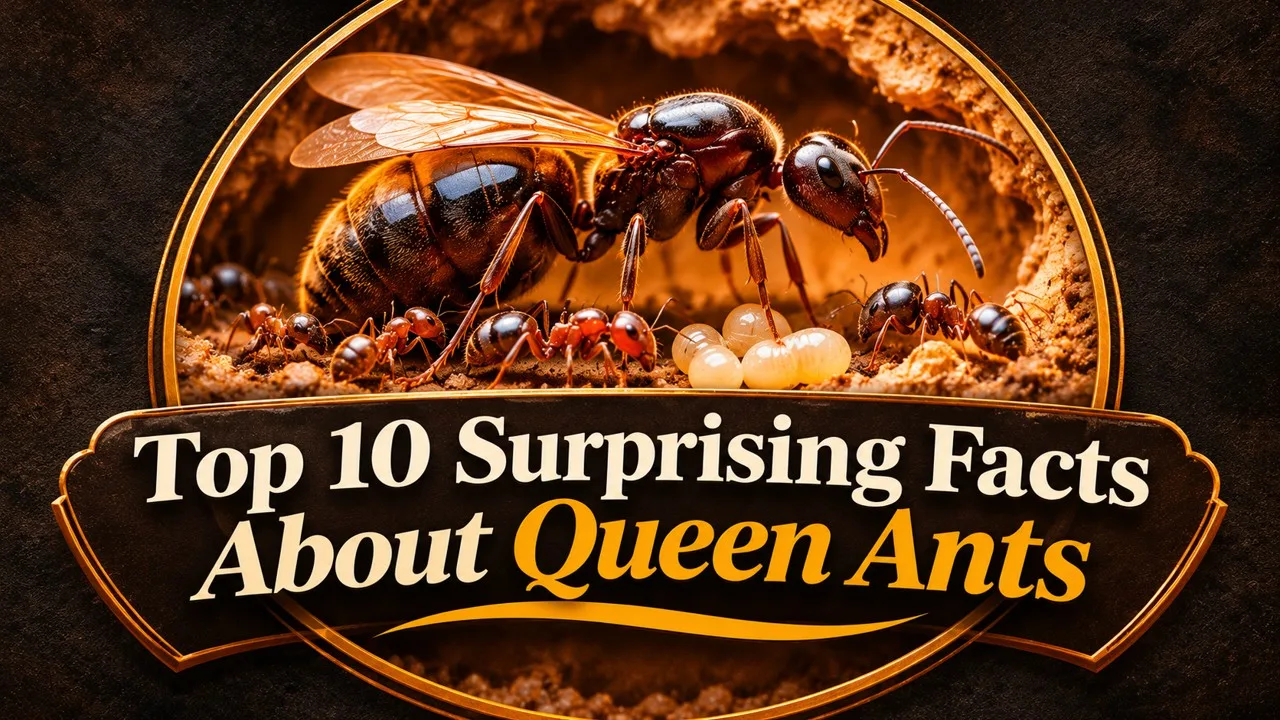
Most young ant queens never found a colony, and some species let workers reproduce; a radar echo of rain can be a nuptial flight, and this list is biology. A queen ant is a reproductive female, not a monarch, and the ten notes below are about how colonies actually start, fail, get taken over, or get invaded by a parasite or a caterpillar [1][6][9]. Some of the facts are harsh in outline, including the consumption of doomed brood during founding and the replacement of a host queen, and they will be stated as life history, without a court scene and without a hunt [4][7][8]. Radar that looks like rain can be a swarm of winged ants [3]. A recently described harvester-ant system, in which queens maintain hybrid workers and can produce males whose nuclear genes match another species, will be qualified as a new and still-discussed result [10].
Social insects reward precise language. This article will use "host workers," "brood raiding" and "gamergates," and it will leave thrones, princesses and slaveries in the metaphor bin.
Key Facts
These are documented ant life histories, told as biology.
Ten Facts at a Glance
| Rank | Claim | Careful version |
|---|---|---|
| 1 | Most founding attempts fail | After a nuptial flight, a young queen must found alone; long-term studies of red harvester ants show how rare a lasting colony is, even if a successful queen can live for decades |
| 2 | Reproductive workers | In Harpegnathos saltator, some workers can become gamergates after the queen is gone, following ritualized antennal contests, not a court coup |
| 3 | Radar "rain" | A dry-weather radar echo over southern England in July 2019 was a mass nuptial flight, not precipitation |
| 4 | Founding and doomed brood | Claustral queens, such as Lasius niger, live on reserves; a laboratory study found that they may consume fungus-infected larvae and later lay more eggs, a founding-economy fact, not a horror scene |
| 5 | Brood-raiding parasites | Temnothorax americanus colonies often contain host workers of T. longispinosus, reared from raided brood |
| 6 | A workerless parasite | Temnothorax kinomurai consists of parthenogenetic queens that take over colonies of a related host; there are no workers of their own species |
| 7 | Induced queen replacement | Some parasitic Lasius queens use chemical camouflage and a secretion that can lead host workers to attack their own queen; the mechanism is described, not staged |
| 8 | A tapeworm in the nest | Anomotaenia brevis can push infected Temnothorax workers toward a more queen-like, longer-lived physiology; this is parasite manipulation, not a caste spell |
| 9 | A cuckoo butterfly | Phengaris rebeli caterpillars enter Myrmica nests by chemical, and later acoustic, mimicry and are fed as if they belonged |
| 10 | A two-species reproductive system | In Messor ibericus, workers are hybrids, and recent work argues that queens can also produce males whose nuclear genomes match Messor structor; the system is newly described and still under discussion |
1. A Flight, and a Rare Lasting Nest
A newly mated ant queen has to find a nest site, survive, and raise a first generation of workers with no help, and most such attempts fail [1]. A long-running study of red harvester ants in Arizona, combining decades of colony maps with genetic sampling, has made that unevenness visible: many starts disappear, while a successful queen may store sperm from an early mating period and live, and keep a colony going, for decades [1]. The unexpected fact is the combination of ordinary failure and extraordinary persistence. This article will not turn a census into a royal saga. The careful fact is the low success rate of founding, and the long reproductive life of the queens that do succeed.
A colony on a hillside can be older than a graduate career. The career, in the data, is the exception, not the rule.
2. Workers That Can Reproduce
In many species, the loss of the queen begins a decline, because workers cannot replace themselves indefinitely. Indian jumping ants, Harpegnathos saltator, are different: when the queen is gone, some workers enter ritualized antennal contests, and a few become gamergates, reproductive workers whose ovaries and behavior change and whose lives can lengthen [2]. Studies have also reported changes in brain volume associated with that shift, a physiological cost or reallocation, not a coronation [2]. The unexpected fact is the flexibility of caste. This article will not describe a fight for a throne. The careful fact is a documented succession by reproductive workers, reversible in some accounts, in one well-studied species.
A worker can, in this genus, become a reproductive. The becoming is biology; the throne is a headline.
3. A Swarm That Looked Like Rain
On a dry morning in July 2019, weather radar over parts of southern England showed echoes that resembled showers, in counties including Hampshire, West Sussex and Dorset, when the surface weather was not raining [3]. The echoes were masses of winged ants on a nuptial flight, a seasonal event sometimes nicknamed, too neatly, "flying ant day," although such flights can occur on more than one suitable warm, still, humid day in summer [3]. The unexpected fact is the instrument. A meteorological tool can record biology. This article will not treat a single date as the only flight of the year. The careful fact is the misread radar, and the synchronized mating flights that produced it.
Related: Top 10 Most Bizarre Phobias: Strange Fears That Exist
A rain image can be a million insects. The insects were looking for mates, not for a forecast.
4. A Founding Economy, Stated Plainly
A black garden ant queen, Lasius niger, typically seals herself in a small chamber and raises her first brood from stored reserves and from her own tissues, without foraging [4]. In that closed economy, a laboratory study found that queens given fungus-infected larvae consumed most of them, survived, and later laid more eggs than queens in a comparison group, a result read as both hygiene and recycling of doomed brood [4]. The unexpected fact is the accounting, not a taste for drama. This article will not stage the feeding, and it will not treat a lab percentage as a field law for every nest. The careful fact is claustral founding, and a documented response to diseased larvae in that experiment.
A first brood is a scarce resource. The resource can be protected, or reused, and both sentences can be written without a horror caption.
5. A Colony Built with Another Species' Workers
Temnothorax americanus often keeps only a few workers of its own species, and many more workers of Temnothorax longispinosus, reared from brood carried out of neighboring nests on raids conducted by the parasite's own workers [5]. The host-born ants then do the ordinary work of the mixed nest [5]. The unexpected fact is the arithmetic: a tiny parasite workforce, a larger borrowed one. This article will not use the old "slave" vocabulary of the field, and it will not become a raid manual. The careful fact is dulosis, or brood raiding, as a documented social parasitism, including research on how cuticular chemistry affects whether raiders are recognized.
A nest can be a mixed species for reasons that have nothing to do with a treaty. The mixture, here, is an abduction of brood, and it should be named as that.
Related: Top 10 Oldest Buildings in the World
6. Queens without Workers of Their Own
Temnothorax kinomurai, a Japanese species, has been described as having no workers, and no known males, of its own kind; the queens reproduce by parthenogenesis, and a young queen must take over a colony of a related host, Temnothorax makora, if she is to have a workforce [6]. The unexpected fact is the completeness of the dependency. A species can be all queens and still be unable, alone, to feed itself. This article will not reconstruct a takeover as a battle scene. The careful fact is a workerless, clonally produced parasite that relies on a host colony, as reported in the myrmecological literature.
A queen without workers is not a complete society. The completeness, in this case, is borrowed, and the borrowing is the life history.
7. A Chemical Route to Replacement
Some parasitic Lasius queens, including L. orientalis and L. umbratus, have been reported to acquire a host colony's odor, enter a nest of a related species, and apply a secretion that can lead host workers to attack their own queen, after which the parasite can occupy the reproductive role [7]. The fluid has been discussed as including formic acid and as disrupting the familiar odor of the resident queen; those chemical details should be treated as a current account, not as a finished recipe [7]. The unexpected fact is the use of the host's own defense. This article will not stage the attack, and it will not offer a method. The careful fact is a documented form of social parasitism that induces the host workers, rather than a simple duel of queens.
A colony can be taken over by turning its recognition system against the queen it already has. The turning is the biological fact; the scene is unnecessary.
Related: 10 Sikh Gurus: The Pillars of Sikhism Who Shaped Faith, Equality, Courage, and Humanity
8. A Parasite That Shifts a Worker's Life
The tapeworm Anomotaenia brevis has a life cycle that includes Temnothorax nylanderi ants and woodpeckers; ants can bring eggs into the nest, and infected workers may be paler, less active outside, longer-lived, and more heavily tended [8]. A 2026 gene-expression study reported that some pathways in the fat body of infected workers partly resembled queen-like patterns, a physiological shift, not a literal change of caste [8]. The unexpected fact is the remodeling of a life history for the parasite's benefit, because a longer-lived, nest-bound ant is a longer-lived host. This article will not become a parasitology manual. The careful fact is the manipulation, described at a high level, and the bird that later completes the cycle.
A worker can be made to live more like a queen and still be, from the parasite's point of view, a vehicle. The vehicle is the ant; the point of view is the worm's.
9. A Caterpillar That Is Fed Like Family
The mountain Alcon blue, Phengaris rebeli, is a butterfly whose caterpillar, after feeding on a plant, uses chemical signals that resemble those of Myrmica larvae, so that a worker may carry it into the nest and feed it [9]. Acoustic signals later in development have been reported to resemble queen-like vibrations more than worker ones, which is the limited sense in which the caterpillar can be said to "sing" its way up the nest's preference order [9]. The unexpected fact is the double impersonation, smell and sound. This article will not treat the butterfly as a courtier, and it will not linger on brood that other Phengaris species may eat; this one is mainly a cuckoo, fed by the ants. The careful fact is the mimicry, and the host genus.
A caterpillar can be a nest mate by fraud. The fraud is chemical and acoustic, and it is already strange enough without a royal metaphor.
Related: Top 10 Tallest Buildings in the World
10. A Colony That Keeps Two Species in Play
In the Iberian harvester ant Messor ibericus, workers have been shown to carry mixed DNA from M. ibericus and Messor structor, even in places where no wild M. structor colony is nearby, a hybrid workforce maintained by the queen's mating system [10]. Recent work has gone further, arguing that some males in those nests have nuclear genomes that match M. structor, and that certain eggs develop by androgenesis, with the mother's nuclear genome excluded, so that stored sperm of the other species can produce those males [10]. The unexpected fact is a reproductive system that looks, at first, impossible. The careful fact is that the account is new, technical, and still under discussion; this article will not treat it as a magic trick or as a method to copy. Queens are not "inventing" a second species from nothing; they are using stored sperm and an unusual egg-development path.
A nest can contain males that, genetically, belong to a partner species. The partner species, in this system, is part of the household account, and the account should be allowed to be checked and refined.
Conclusion
The ten facts above are a hard founding, a gamergate succession, a radar swarm, a founding queen's treatment of diseased brood, a brood-raiding parasite, a workerless parasite, a chemically induced queen replacement, a tapeworm that shifts a worker's life, a cuckoo butterfly, and a harvester-ant system that keeps two species in its genetics. They are life histories. They are not a palace chronicle.
An ant colony is a family of females, a stored sperm supply, and sometimes a parasite. The decent way to list its stranger habits is to keep the species names, retire the court, and describe harm only as far as the life history requires.
- ^ [1] Long-term studies of red harvester ants in Arizona, including colony survival, founding failure, and long-lived queens. Britannica: harvester ant Britannica: ant
- ^ [2] Research on Harpegnathos saltator gamergates, including reproductive workers and ritualized antennal contests after the queen is lost. Britannica: ant
- ^ [3] Meteorological and entomological accounts of nuptial flights appearing as rain-like echoes on weather radar, including the July 2019 event in southern England. Britannica: weather radar Britannica: nuptial flight
- ^ [4] Laboratory studies of Lasius niger founding queens and of the consumption of fungus-infected larvae during claustral founding, described as life history, not as a scene. Britannica: Lasius
- ^ [5] Accounts of brood raiding by Temnothorax americanus on T. longispinosus, using host-worker language rather than older "slave" terms. Britannica: ant
- ^ [6] Descriptions of the workerless, parthenogenetic parasite Temnothorax kinomurai and of its use of T. makora host colonies. Britannica: social parasite Britannica: parthenogenesis
- ^ [7] Reports of parasitic Lasius queens that induce host workers to attack the resident queen, including chemical camouflage, with mechanisms qualified and not offered as a method. Britannica: Lasius
- ^ [8] Studies of Anomotaenia brevis in Temnothorax nylanderi, including later work on queen-like gene-expression patterns in infected workers. Britannica: tapeworm Britannica: ant
- ^ [9] Research on Phengaris rebeli and on chemical and acoustic mimicry inside Myrmica nests. Britannica: blue butterfly Britannica: Myrmica
- ^ [10] Recent genetic studies of Messor ibericus, including hybrid workers and reports of males with M. structor nuclear genomes via an unusual egg-development path, treated as a newly described and still-discussed system. Britannica: harvester ant Britannica: hybrid






















Discussion
Log in with