






 By
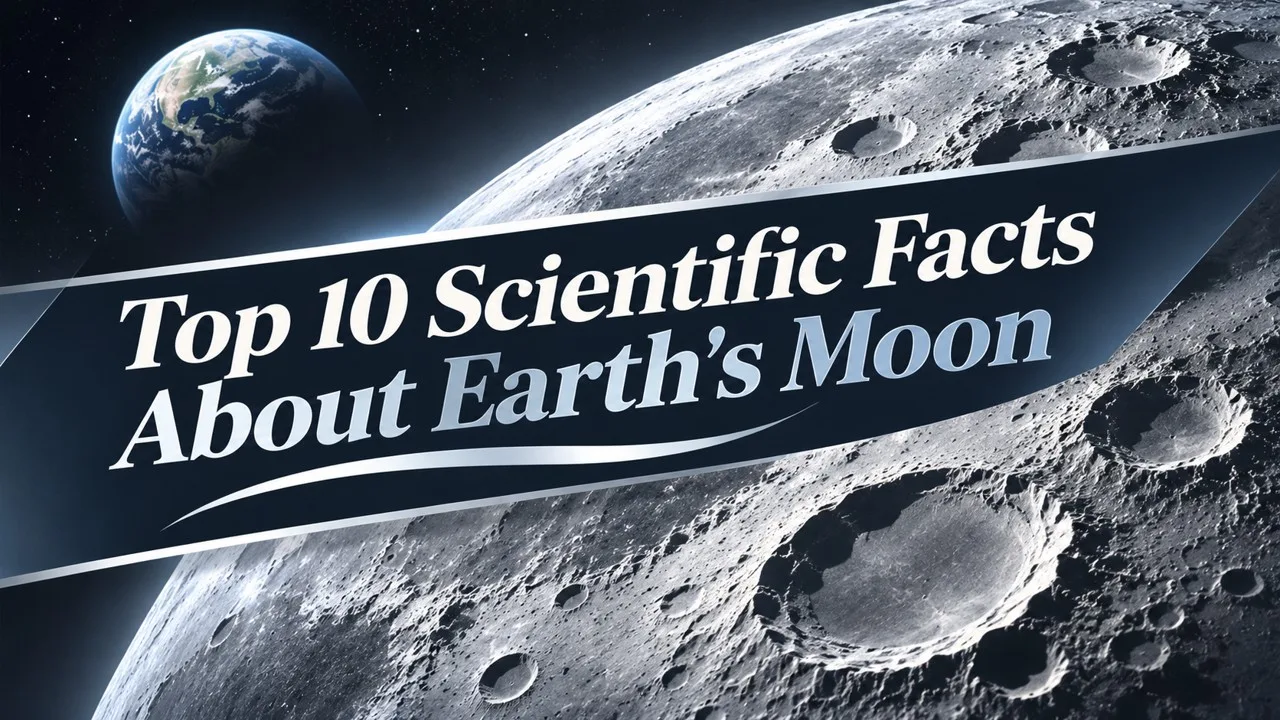
The Moon is not hollow and is not the solar system's largest satellite; it is receding by centimeters a year, and a 1950s nuclear-test study was never flown. A list inspired by a headline about "Earth's biggest moon" has to begin with a correction: Earth's Moon is large for a satellite of a terrestrial planet, and it is not the largest moon in the solar system [2]. Ganymede, around Jupiter, holds that title [2]. The ten notes below are documented facts and retired misconceptions about Earth's Moon: a seismic "ring" that does not imply a hollow body, a pre-landing fear of bottomless dust, a tidal recession measured with lasers, and a cancelled military study that should not be misfiled as a NASA flight plan [1][3][7]. This article will not use an astronaut's likeness or an agency logo, will not offer a weapons description, and will not treat dust as medical advice [6][7][9]. Transient lights, already mentioned in an earlier lunar inventory, are kept here only as qualified reports [8].
The Moon is a rocky, well-studied object. The useful work is to keep the measurements, and to retire the captions that outran them.
Key Facts
These are documented facts about Earth's Moon, with popular errors marked.
Ten Facts at a Glance
| Rank | Claim | Careful version |
|---|---|---|
| 1 | A hollow Moon | Apollo impact experiments showed a dry, poorly attenuating crust that can "ring" for a long time; they do not show a hollow interior |
| 2 | The biggest moon? | Ganymede is the solar system's largest moon; Earth's is the largest relative to its planet, and its apparent size nearly matches the Sun's, which is why total eclipses occur |
| 3 | Bottomless dust | A pre-Apollo worry that a lander would sink out of sight was not borne out by Surveyor or Apollo; a thin-dust argument for a young Moon is not accepted science |
| 4 | Recession | Laser ranging to retroreflectors shows the Moon receding at about 3.8 centimeters a year, a tidal effect, not a sudden departure |
| 5 | Stars and "fireflies" | Stars are hard to see from a sunlit surface or a bright cabin; particles around a spacecraft can glitter in sunlight; neither fact is a mystery of missing stars |
| 6 | A slightly deformed body | The Moon is not a perfect sphere; it retains a modest tidal or fossil bulge. The leading formation account is a giant impact, not an even contest among four equal theories |
| 7 | Transient lunar phenomena | Lights and hazes have been reported for centuries; they remain a file of observations, not a settled mechanism |
| 8 | Project A119 | A late-1950s U.S. Air Force study examined a nuclear demonstration on the Moon; it was a paper project, cancelled, and not a flown NASA mission. No design is discussed here |
| 9 | Regolith | Lunar dust is fine, sharp and easily kicked up, a materials and operations problem, described generally, not as medical advice |
| 10 | Other "moons" | Kordylewski clouds are hypothesized or reported dust concentrations near the Earth-Moon Lagrange points, not solid moons; Earth also sometimes hosts temporary mini-moons |
1. A Long Ring, and a Solid Interior
After Apollo 12, the discarded lunar module was crashed into the Moon as a known seismic source, and the surface rang, in the popular phrase, for a long time [1]. Later artificial and natural moonquakes gave the same impression of a dry, fractured crust that attenuates seismic waves poorly [1]. The unexpected fact, for a headline, is how easily that ring was misread. A hollow Moon is not the conclusion of those experiments. Gravity, samples, and later seismic modeling point to a differentiated body with a dense interior and a small core. This article will not treat a long vibration as a cavern. The careful fact is the low damping, and the solid Moon that still produces it.
A bell can be a metaphor and still be a bad model. The model that survives is a rocky interior, poorly damped at the surface.
2. Large for a Planet Like Ours, not the Largest
Ganymede, a moon of Jupiter, is the largest satellite in the solar system; Titan, Callisto and Io are also larger than Earth's Moon [2]. What Earth's Moon can claim is a high mass relative to its planet, and an apparent size in our sky that is, on average, close to the Sun's, which is why total solar eclipses happen here and not, in the same convenient way, at most other worlds [2]. The match is not perfect, which is why some eclipses are annular. The unexpected fact is the correction to a common boast. This article will not say that a mile of diameter is all that stands between us and a world without eclipses. The careful fact is the ranking, and the apparent-size coincidence.
A moon can be first in one list and fourth or fifth in another. The list that says "largest in the solar system" is Ganymede's, not ours.
3. A Fear That Did not Survive the Landing
Before the first soft landings, some researchers worried that meteoritic dust might have built a layer deep enough to swallow a spacecraft, a concern associated especially with a deep-dust idea that was already disputed in the 1960s [3]. Surveyor and then Apollo landed on a firm, dusty surface with a regolith meters thick in many places, not a bottomless powder [3]. A related popular claim, that a supposedly thin dust layer proves a young Moon, is not accepted science; the solar system is about 4.5 billion years old, and the regolith is the product of long bombardment and gardening [3]. The unexpected fact is how short a life the swallow-the-lander fear had once a footpad actually touched. This article will not give that fear equal standing with the landings.
Related: Top 10 Interesting Facts About the Moon
A dust layer can be real and still be shallow enough to walk on. The walk, in 1969, was the end of that particular argument.
4. A Few Centimeters a Year
Retroreflectors left on the surface have allowed laser ranging for more than half a century, and the measurements show the Moon receding from Earth at about 3.8 centimeters a year [4]. The cause is tidal friction: Earth rotates faster than the Moon orbits, the tidal bulge pulls the Moon forward, and the Moon's orbit enlarges [4]. The unexpected fact is the calmness of the number. A receding Moon is not a departure in any human sense; it is a slow, predicted drift. This article will not treat the experiment as a single observatory's secret, and it will not invent a date when the Moon will be "gone." The careful fact is the rate, and the tidal mechanism.
A laser can time a reflection and find a century's worth of drift. The drift is centimeters, stacked over years, and that is already a precise enough wonder.
5. A Bright Scene, and Lit Particles
Crews on the sunlit Moon, and in sunlit cabins, reported that stars were hard or impossible to see, which is what contrast and a bright foreground do, as on a sunlit snowfield or a lit street [5]. Particles near a spacecraft, catching sunlight, were sometimes compared to fireflies; the ordinary accounts treat them as ice, debris or other small, sunlit flakes, not as a zoology of space [5]. The unexpected fact is how little mystery remains once the lighting is in the sentence. This article will not use a likeness, and it will not follow rumors of secret experiments. The careful fact is glare, and particles, both of which are documented.
A sky can be full of stars and still look empty from a bright workplace. The workplace, in this case, was a sunlit gray plain, or a cabin window in the Sun.
Related: Top 10 Objects Found or Left on the Moon
6. A Bulge, and a Leading Story of Origin
The Moon is not a perfect sphere. Earth's gravity, and the Moon's early history when it was closer and more easily deformed, have left a modest bulge, sometimes compared, a little loosely, to a lemon [6]. The leading account of the Moon's origin is a giant impact early in the solar system, in which debris from a collision re-accreted into the Moon; older alternatives, capture, fission and co-formation, are historical competitors, not an even field of four equally supported theories today [6]. The unexpected fact is how much of the "lemon" is a fossil of a closer, more plastic past. This article will not treat a popular analogy as a precise geoid. The careful fact is a small departure from sphericity, and a formation model that is leading, not unanimous.
A shape can remember a closer orbit. The memory is a bulge; the origin story is a collision, told as the best current account.
7. Lights, still a File of Reports
For centuries, observers have reported brief glows, colors or obscurations on the lunar disk, now grouped as transient lunar phenomena [7]. The file is long and uneven, and it includes a 1178 chronicle that later writers have sometimes, speculatively, tied to a crater; that link is not established [7]. Possible explanations, from outgassing to observational error to Earth's atmosphere, have not been reduced to a single law. This article will not treat the file as a proof of a hollow or a haunted Moon, and it will not repeat, at length, an earlier inventory entry on the same reports. The careful fact is the existence of the reports, and the unsettled status of the mechanisms.
A light on the Moon can be a real, still-undiagnosed event, or a trick of seeing. Either way, it is a report until a cause is tied to a date and a place.
Related: Top 10 Most Bizarre Phobias: Strange Fears That Exist
8. A Study, on Paper, never a Launch
In the late 1950s, after Sputnik, the U.S. Air Force sponsored a study, sometimes listed as Project A119, of a nuclear demonstration on the lunar surface, framed in the paperwork as a research-flight study [8]. It was a study, with a small scientific staff, and it was not carried out; it was not a NASA landing plan, and this article will not describe a device, a yield, or a method [8]. The unexpected fact is the existence of the paperwork, not a secret detonation. The careful fact is a cancelled military idea, filed under history, and left without a manual.
A Cold War office can examine a demonstration and then not fly it. The examination is the historical fact; the flight, in this case, did not happen.
9. A Fine, Sharp Dust
Almost the entire lunar surface is covered by regolith, a fine, sharp-grained powder produced by micrometeorite bombardment in the absence of water and wind as we know them [9]. It clings, scratches, and fouls joints and seals; it was a practical nuisance for suits and equipment, and it is a general concern for later habitats, stated here as a materials fact, not as medical advice [9]. The unexpected fact is the texture, which photographs as a soft gray soil and behaves, in some ways, more like an industrial powder. This article will not invent a thickness for every site. The careful fact is the origin of the dust, and the operational problem it poses.
A landscape can look dusty and still be a welding-shop problem. The problem is the sharpness and the cling, both of which follow from a vacuum and a long rain of tiny impacts.
Related: Top 10 Oldest Buildings in the World
10. Dust at the Balance Points, not a Second Moon
Kazimierz Kordylewski reported, in 1961, faint dust concentrations near the Earth-Moon Lagrange points, later called Kordylewski clouds; later polarization studies have claimed to support them, and the detections have also been debated [10]. They are, if confirmed, clouds of dust, not solid moons. Earth also sometimes captures a small asteroid for a time as a temporary mini-moon, a documented class of objects, not a second permanent satellite [10]. The unexpected fact is how elastic the word "moon" becomes in a headline. This article will not promote dust to a companion world. The careful fact is Lagrange-point dust as a research claim, and temporary captures as a separate, real phenomenon.
A planet can have one large moon and still have a messy neighborhood. The neighborhood includes dust and occasional visitors, and it does not rewrite the count of true moons.
Conclusion
The ten facts above are a solid Moon that can ring, a ranking that belongs to Ganymede, a dust fear that landings retired, a recession of centimeters a year, a bright-sky explanation for missing stars, a modest bulge and a leading impact origin, a file of transient reports, a cancelled paper study, a sharp regolith, and dust or temporary objects that are not a second moon. A headline about "Earth's biggest moon" is the reason this list exists, and it is also the first caption that had to be rewritten.
The Moon is measured in samples, ranges and seismograms. The decent way to list it is to keep those measurements, correct the boast, and leave faces, logos and weapon designs off the page.
- ^ [1] Seismological accounts of Apollo artificial impacts and moonquakes, including long reverberation in a dry crust, and of models of a solid, differentiated interior. Britannica: Moon Britannica: moonquake
- ^ [2] Comparisons of satellite sizes, including Ganymede as the solar system's largest moon, and of the apparent-size coincidence that allows total solar eclipses at Earth. Britannica: Ganymede Britannica: solar eclipse
- ^ [3] Histories of pre-landing dust concerns, the Surveyor and Apollo landings, and the rejection of a thin-dust argument for a young Moon. Britannica: Surveyor Britannica: solar system
- ^ [4] Lunar laser-ranging results, including a recession rate of about 3.8 centimeters a year, and the tidal mechanism. Britannica: tide Britannica: Project Apollo
- ^ [5] Crew reports on the difficulty of seeing stars in sunlit conditions and on sunlit particles near spacecraft, discussed without likenesses or rumor. Britannica: Apollo 11
- ^ [6] Accounts of the Moon's departure from a perfect sphere and of the giant-impact hypothesis as the leading formation model. Britannica: giant-impact hypothesis Britannica: Moon
- ^ [7] Reviews of transient lunar phenomena as a historical file of reports, with particular crater links left speculative. Britannica: Moon
- ^ [8] Historical accounts of the late-1950s U.S. Air Force study sometimes called Project A119, treated as a cancelled paper project, without any design or method. Britannica: U.S. Air Force Britannica: nuclear weapon
- ^ [9] Descriptions of lunar regolith as a fine, sharp, electrostatically mobile powder, as a materials and operations issue, not as medical advice. Britannica: regolith
- ^ [10] Accounts of the Kordylewski dust clouds near the Earth-Moon Lagrange points, and of temporarily captured mini-moons, distinguished from a second permanent satellite. Britannica: Lagrange point Britannica: asteroid





















Discussion
Log in with