






Top 10 Times Animals Triggered Human Disasters by Accident
 By Dhiraj Sharma · Published
Share Post
Loading…
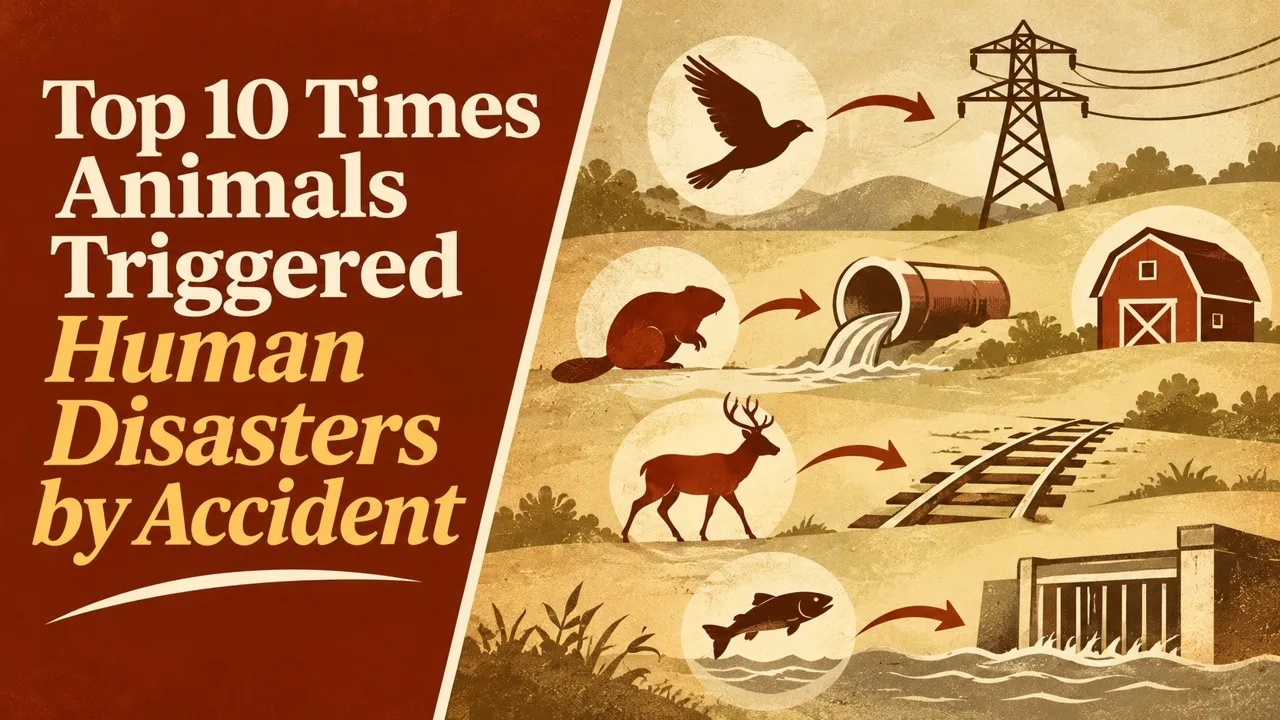
Documented cases show that animals have sometimes set off human disasters without intending the damage that followed.
A collision, a nest in a tube, or a bloom at a water intake is not a verdict on a species. The ten cases below are drawn from accident investigations, official briefings, historical inquiries, and well-reported humanitarian or ecological records. This article does not reconstruct injuries, and it does not treat a later story as a proven cause. Where an animal is only one step in a longer chain, the chain is the point: a flight path, a maintenance lapse, a trade route, a corridor cut by a railway, or a grid that can fail in cascade after a local trip.
Key Facts
| Item | What is established | What this article will not do |
|---|---|---|
| 1 | United Air Lines Flight 297, 23 November 1962, struck whistling swans and crashed in Maryland | Reconstruct the wreckage or treat a swan as a culprit with a motive |
| 2 | Birgenair Flight 301, 6 February 1996, lost reliable airspeed after a blocked pitot tube; a wasp nest is the leading explanation for the blockage | Give operating or maintenance instructions, or retell the cockpit minute by minute |
| 3 | The Great Chicago Fire began on 8 October 1871 near the O'Leary property; the cow-and-lantern story is later folklore, not a proven cause | Repeat a convenient barn story as a finding |
| 4 | The Black Death was caused by the bacterium Yersinia pestis; rats and fleas are part of a debated transmission story, not a complete European script | Offer a laboratory or infection how-to, or a simple blame-the-rat moral |
| 5 | The 2019 to 2021 desert locust upsurge damaged crops across East Africa and neighboring regions | Describe a swarm as a cartoon army, or turn a food-security emergency into spectacle |
| 6 | In June 2011 both reactors at Torness were shut as a precaution after jellyfish clogged seawater intake screens | Treat a clogged filter as a nuclear accident |
| 7 | European rabbits released in Australia in 1859 helped set off a continental ecological and agricultural crisis | Describe later control campaigns as a method, or treat introduction as a joke |
| 8 | On 22 September 2010 a goods train in Jalpaiguri district, West Bengal, struck a herd and killed seven elephants, one of many corridor collisions | Depict the collision, or treat the herd as an obstacle with no right of way |
| 9 | On 7 June 2016 KenGen attributed a nationwide outage to a monkey that tripped a transformer at Gitaru | Blame a species, or treat a grid cascade as a cartoon |
| 10 | US Airways Flight 1549 struck Canada geese on 15 January 2009, lost thrust in both engines, and ditched on the Hudson River; everyone on board survived | Use a portrait, a logo, or a retelling of injuries |
1. A Swan and a 1962 Airliner
On 23 November 1962, United Air Lines Flight 297, a Vickers Viscount flying from Newark to Washington, was at about 6,000 feet when it struck at least two whistling swans, a species now more often called the tundra swan [1]. The Civil Aeronautics Board found that one bird damaged the right horizontal stabilizer only slightly, while the other penetrated the left stabilizer, weakened it, and led to its separation. The crew lost control, and the aircraft crashed near Ellicott City, Maryland. Everyone on board, thirteen passengers and four crew members, was killed [1].
The unexpected fact, for a list of this kind, is how ordinary the flight had been until the strike, and how specific the damage had to be. Investigators later noted that a slightly different point of impact might have left the structure intact [1]. This article will not describe the wreckage, the remains of the birds, or the last minute of the descent. The careful fact is a documented bird strike at altitude, a failed stabilizer, and an official probable cause. A migratory bird on a well-used flyway is not a plot. It is a mass and a path that happened to meet an airframe.
A swan did not choose a disaster. The disaster was a collision in a place where large birds and a busy air corridor already overlapped.
2. A Blocked Tube, and a Wasp Nest
On 6 February 1996, Birgenair Flight 301, a Boeing 757, took off from Puerto Plata, in the Dominican Republic, bound for Germany [2]. Soon after departure the airspeed indications went wrong. The aircraft later crashed in the Atlantic, and no one on board survived. The investigation concluded that a pitot tube, the small opening that helps a system measure airspeed, had been blocked. Among the explanations consistent with the evidence is a mud-dauber wasp nest in a tube that had been left uncovered during a layover [2].
The unexpected fact is that the animal, if it was there, did not bring the jet down at 35,000 feet in the sense of a mid-air collision. The failure began on the ground, in a blocked instrument, and then unfolded in the air when the crew could no longer trust a basic number [2]. This article will not walk through cockpit warnings, recovery techniques, or a maintenance checklist. Those belong in official reports, not in a popular list. The careful fact is a blocked pitot, a leading biological explanation, and a human chain that includes covers, inspections, and the limits of instruments.
A wasp is not a saboteur. A covered tube is a procedure, and a blocked one is a hazard that accident reports have described in plain language for decades.
3. A Fire That Was Real, and a Cow That Was a Story
The Great Chicago Fire began on the evening of 8 October 1871 in or near a barn on DeKoven Street, on the property of Catherine and Patrick O'Leary, and then ran through a city of wooden buildings, dry weather, and a strong wind [3]. Hundreds of people died, and a large part of the city was destroyed. The same night, a still deadlier fire burned at Peshtigo, in Wisconsin, a reminder that the Midwest was already in a dangerous drought [3].
Related: Top 10 Surprising Animal Partnerships in Nature
The unexpected fact is how weakly the most famous animal in the story is attached to the fire. A later tale said that a cow belonging to Catherine O'Leary kicked over a lantern during milking. The official inquiry did not establish that cause, Mrs O'Leary denied it, and a reporter, Michael Ahern, later said he had invented the colorful version [3]. This article will not treat a barn animal as the founder of a city's disaster, and it will not repeat the story as if it were a finding. The careful fact is a fire with a starting place near a barn, a city built to burn, and a legend that was easier to remember than an unknown spark.
A convenient cow is a story. The fire is history, and history, in this case, does not need a scapegoat in a stall.
4. Rats, Fleas, and a Bacterium
The pandemic later called the Black Death killed a large share of the population in much of Europe, western Asia, and North Africa in the mid-fourteenth century [4]. Ancient DNA from burials has shown that the agent was Yersinia pestis, the bacterium of plague. The classic schoolbook chain is a commensal rat, a rat flea, and a human host. That chain is real in some settings, and it is not a complete account of every outbreak [4].
The unexpected fact, for a list that might want a single villain, is how much of the European story remains under debate. Some historians and epidemiologists have argued that human fleas and lice may have mattered more in medieval towns than a permanent reservoir of black rats, and that climate and rodent pulses farther east may have shaped the waves that reached the Mediterranean [4]. This article will not describe symptoms in detail, estimate a single death toll as if the figure were settled, or explain how the bacterium is handled. The careful fact is a documented pathogen, a set of animal and human hosts, and a transmission problem that is larger than a cartoon of ships and rats.
A rat can be part of a pandemic's ecology. It is not a moral, and it is not a laboratory lesson.
5. A Swarm, and a Food-Security Emergency
From late 2019 into 2021, unusually large populations of the desert locust spread from the Arabian Peninsula into the Horn of Africa and, in related pulses, toward parts of the Middle East and South Asia [5]. The Food and Agriculture Organization and national authorities treated the upsurge as a serious threat to crops and pasture. Households already under other stresses faced a further risk to harvests, and governments and aid agencies organized survey and control campaigns across a wide region [5].
The unexpected fact is how much of the crisis was meteorological and logistical rather than mysterious. Cyclones and unusual rains had created breeding conditions, and locusts, which are a phase of a familiar grasshopper, can concentrate and move when those conditions last [5]. This article will not treat a swarm as a horror-film army, list control chemicals as a recipe, or claim a single global famine from one insect. The careful fact is a documented upsurge, measured damage to crops in several countries, and a humanitarian risk that official agencies described in those terms.
Related: Top 10 Facts About Cats
A locust does not intend a crisis. A wet year, a breeding ground, and a farm already close to the margin can turn a pulse of insects into an emergency.
6. A Bloom That Stopped a Plant, Not a Reactor Accident
In late June 2011, both reactors at the Torness nuclear power station, on the coast of East Lothian in Scotland, were shut down after large numbers of jellyfish were found on the screens that filter seawater used for cooling [6]. The operator, EDF Energy, and reports from the period described the shutdown as a precaution. Officials said there was no danger to the public and no radiological release. One reactor was restarted within a few days, the other shortly after, once the screens and the nearby water had been cleared [6].
The unexpected fact is how ordinary the mechanism is, and how easily a headline can inflate it. Coastal plants draw water through filters; a dense bloom can clog those filters; procedures then call for a stop. Similar intake problems have been reported at other power stations, nuclear and otherwise, when jellyfish, fish, or seaweed arrive in unusual numbers [6]. This article will not treat a clogged screen as a meltdown, and it will not offer a plant diagram. The careful fact is a precautionary shutdown, a documented bloom at an intake, and a system that did what it was designed to do when the filter was overwhelmed.
A jellyfish has no interest in a turbine hall. A cooling intake has a finite screen, and that is enough to explain a week of headlines.
7. A Release That Became a Continental Problem
In 1859, Thomas Austin released European rabbits at Barwon Park, in Victoria, for sport, adding to a smaller set of earlier introductions [7]. Within a few decades the animals had spread across a huge area of the continent. They stripped vegetation, worsened erosion, competed with livestock, and put further pressure on native plants and animals already stressed by other colonial changes [7]. Later governments built fences, including the famous rabbit-proof fence, and tried a long series of control measures.
The unexpected fact is the speed of the expansion, and how poorly a nineteenth-century introduction was imagined as a continental event. A few dozen animals, in a landscape without the predators and diseases of their original range, were enough to start a population that would be counted in the hundreds of millions [7]. This article will not describe later biological-control campaigns as a method or a recipe, and it will not linger on culling. The careful fact is a documented introduction, a well-studied invasion, and an agricultural and ecological cost that Australian official histories still treat as one of the country's defining environmental mistakes.
Related: Top 10 Animals That Can Live Without Food for Months
A rabbit is not a villain in a fable. A release into a new continent is a human decision, and the disaster that followed was ecological, not personal.
8. A Railway Through a Corridor
On the night of 22 September 2010, a goods train on the New Jalpaiguri–Assam line struck a herd of Asian elephants near Banarhat and Moraghat, in Jalpaiguri district, West Bengal [8]. Seven elephants were killed. Forest officials said the track crossed ground that elephants use, that trains had hit animals in the region before, and that speed limits requested for such stretches had not been kept. Railway officials disputed whether that exact spot was on a formally listed corridor. The line was blocked for hours [8].
The unexpected fact is how often this kind of collision has been recorded in eastern and northeastern India, especially in Assam and West Bengal, where railways cut known movement routes [8]. This article will not describe the impact, and it will not treat the herd as an obstruction with no claim to the ground. The careful fact is a dated, well-reported case, a wider pattern of collisions, and a policy argument about speed, warning systems, and the routing of lines through habitat. Later years have brought further incidents and further mitigation trials; the 2010 collision is one documented night, not a unique freak event.
An elephant on a track is not a stunt. It is a crossing problem, and the disaster is what happens when a corridor and a timetable share the same ground.
9. A Transformer, a Monkey, and a Cascade
On 7 June 2016, Kenya lost power across much of the country for about three to four hours [9]. The Kenya Electricity Generating Company said that a monkey had climbed onto the roof of the Gitaru hydroelectric power station, on the Tana River, and had dropped onto a transformer, tripping it. Other machines at the plant then tripped on overload, more than 180 megawatts left the grid, and the loss cascaded into a national outage. Power was later restored, and KenGen said the animal survived and was taken in by the Kenya Wildlife Service [9].
The unexpected fact is not that a wild animal can reach equipment. It is that a local trip, in a tightly coupled grid, can become a countrywide interruption if the system cannot isolate the fault [9]. This article will not treat the episode as a cartoon, and it will not use a photograph of the animal as a punch line. KenGen's account is the official one that was reported at the time; a large outage is not in doubt, and a single animal is the cause the operator gave. The careful fact is a transformer trip, a cascade, and an infrastructure lesson about fencing, redundancy, and how little it can take to start a failure.
Related: Top 10 Most Dangerous Wild Animals in Canada
A monkey did not plot a blackout. A grid can turn one contact into a national afternoon without any intention on the animal's part.
10. A Flock, Two Engines, and a River
On 15 January 2009, US Airways Flight 1549 left LaGuardia Airport in New York, bound for Charlotte, and shortly afterward struck a flock of Canada geese [10]. The National Transportation Safety Board found that both engines ingested birds and lost thrust. The crew, Captain Chesley Sullenberger and First Officer Jeffrey Skiles, ditched the Airbus A320 on the Hudson River. Everyone on board, 155 people, survived, and boats from the river traffic helped with the evacuation [10].
The unexpected fact, now half-buried under a famous nickname for the day, is how ordinary the wildlife hazard was, and how complete the loss of thrust became at low altitude over a dense city [10]. This article will not restage the cabin, describe injuries, or turn the crew into portraits. It will not use an airline logo. The careful fact is a documented dual-engine bird strike, an official investigation, and a ditching that did not become a second disaster. Airport bird-hazard programs exist because this kind of encounter is a known risk, not because one flock chose a particular flight.
A goose is not a character in a film. A flock and a departure path can meet, and the rest of the story, in this case, is a crew, a river, and a report.
Conclusion
The ten cases above are a 1962 swan strike, a blocked pitot with a wasp nest as the leading explanation, a Chicago fire whose famous cow is a story, a plague whose rat-and-flea script is incomplete, a desert-locust upsurge, a jellyfish bloom at a cooling intake, rabbits introduced to Australia, a train through an elephant corridor, a 2016 outage that KenGen tied to a monkey at Gitaru, and a 2009 dual-engine strike over the Hudson. In each case the animal is part of a chain, not a defendant.
A fair list of accidental disasters keeps the chain, drops the gore, and leaves the moral about species off the page.
- ^ [1] Civil Aeronautics Board investigation of United Air Lines Flight 297, 23 November 1962, including the probable cause of a loss of control after a whistling-swan strike damaged the left horizontal stabilizer, as summarized in official aviation safety records. FAA Lessons Learned: United Air Lines Flight 297 Wikipedia: United Air Lines Flight 297
- ^ [2] Accident investigation summaries of Birgenair Flight 301, 6 February 1996, including the finding of unreliable airspeed after a blocked pitot tube and the leading explanation of a wasp nest in an uncovered tube. Wikipedia: Birgenair Flight 301 Britannica: pitot tube
- ^ [3] Historical accounts of the Great Chicago Fire of 8–10 October 1871, its origin near the O'Leary property, the unproven cow-and-lantern story, and the same-night Peshtigo fire. Britannica: Chicago fire of 1871 Wikipedia: Great Chicago Fire
- ^ [4] Overviews of the Black Death and of Yersinia pestis, with the classic rat-and-flea model and later debate about human ectoparasites and rodent reservoirs. Britannica: Black Death Britannica: plague
- ^ [5] Food and Agriculture Organization and related reporting on the 2019–2021 desert locust upsurge in East Africa and neighboring regions, including breeding conditions and crop-threat assessments. FAO: locust watch Britannica: locust
- ^ [6] Contemporary official and news accounts of the June 2011 precautionary shutdown of both reactors at Torness after jellyfish clogged seawater intake screens, with no radiological release reported. BBC: jellyfish force Torness shutdown The Guardian: jellyfish shut down nuclear reactors
- ^ [7] Historical and official accounts of the introduction of European rabbits to Australia, including the 1859 Barwon Park release and the later ecological and agricultural effects. Britannica: Australia Wikipedia: rabbits in Australia
- ^ [8] Contemporary reporting on the 22 September 2010 goods-train collision with a herd of elephants in Jalpaiguri district, West Bengal, and on the wider pattern of railway collisions in elephant habitat. BBC: seven elephants killed by goods train The Hindu: seven elephants die after train hits herd
- ^ [9] Official and news accounts of the 7 June 2016 Kenyan power outage, including KenGen's statement that a monkey tripped a transformer at Gitaru and that the animal survived. BBC: Kenya nationwide blackout Reuters: monkey tripping transformer
- ^ [10] National Transportation Safety Board findings on US Airways Flight 1549, 15 January 2009, including the Canada-goose strike, the loss of thrust in both engines, the Hudson River ditching, and the survival of everyone on board. NTSB Aircraft Accident Report AAR-10/03 Wikipedia: US Airways Flight 1549





















Discussion
Log in with