





Top 10 Valuable Things Their Owners Walked Away From
 By Dhiraj Sharma · Published
Share Post
Loading…
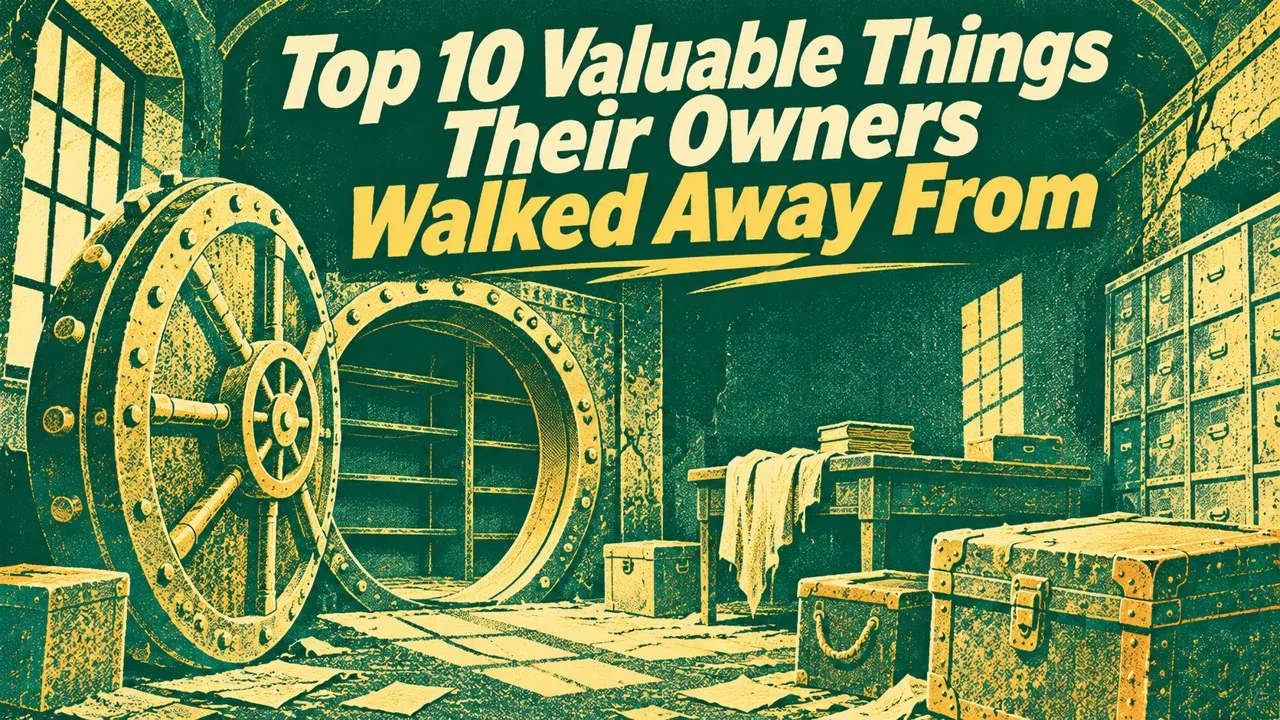
A claim to Manhattan, a share of Apple, a diamond town and a fortune in bitcoin: ten valuable things that their owners walked away from or left behind. People and organisations sometimes walk away from things that later turn out to be enormously valuable. Others abandon valuable assets because keeping them no longer makes sense at the time.
Hindsight makes many of these decisions look foolish. But at the moment they were made, they often seemed reasonable, or even wise, given what people knew and the choices they faced.
Some of the things in this list were traded away in negotiations. Others were sold cheaply, abandoned when circumstances changed, or simply thrown away by mistake.
The stories cover more than three centuries. They range from colonial diplomacy and gold rush harbours to Cold War spacecraft and digital currency.
Some of the abandoned assets were later reclaimed and restored. Others remain lost, decaying or out of reach.
This list focuses on physical assets, places and stakes in things that later became valuable. Famous corporate blunders, such as companies passing on early chances to buy rivals or develop new products, are a separate subject.
Where figures are uncertain or based on later estimates, they are presented as such. Values of things such as cryptocurrency can change dramatically from year to year.
Each entry names what was left, the owner who walked away from it and the year, followed by an account of what happened.
The entries are arranged in chronological order.
Together, they show how value depends on timing, circumstance and luck, and how difficult it can be to know what will matter in the future.
Key Facts
| # | What was left | Owner | Year |
|---|---|---|---|
| 1 | The claim to New Netherland, including Manhattan | The Dutch Republic | 1667 |
| 2 | Hundreds of ships in San Francisco | Ship owners and crews | 1849 |
| 3 | Kolmanskop | Diamond miners and residents | 1950s |
| 4 | A ten percent stake in Apple | Ronald Wayne | 1976 |
| 5 | Hashima Island | Mitsubishi and its residents | 1974 |
| 6 | Michigan Central Station | Railway operators | 1988 |
| 7 | The Nintendo PlayStation | Nintendo | 1991 |
| 8 | The Buran orbiters | The Soviet and then Russian space programme | 1993 |
| 9 | The MV Lyubov Orlova | Owners and creditors | 2013 |
| 10 | A hard drive containing bitcoin | James Howells | 2013 |
1. A Trade for Nutmeg
In the seventeenth century, nutmeg was one of the most valuable spices in the world, and it grew in only a few small islands in what is now Indonesia. One of these, the tiny island of Run, was contested between the English and the Dutch [1].
Meanwhile, in North America, the English had seized the Dutch colony of New Netherland, including the settlement of New Amsterdam on Manhattan, in 1664. Under the Treaty of Breda in 1667, which ended a war between the two countries, each side kept what it held. The Dutch kept Run, while the English kept New Netherland [1].
Related: Top 10 Most Bizarre Phobias: Strange Fears That Exist
The arrangement is often described as a trade of Manhattan for a nutmeg island, although historians note that this simplifies a broader peace settlement. At the time, the spice trade seemed far more valuable. Today, Manhattan is one of the most valuable places on Earth.
2. Ships Left to Rot in the Harbour
When news of the California Gold Rush spread, thousands of people sailed to San Francisco. Once they arrived, many sailors deserted their ships to search for gold, sometimes accompanied by their captains [2].
Hundreds of ships were left abandoned in the harbour. Some were converted into warehouses, stores, hotels and even a jail. Others were broken up or simply left to rot [2].
As the city grew, parts of the shoreline were filled in, and some abandoned ships were buried beneath new land. The remains of several of these ships have been discovered during construction projects in downtown San Francisco, revealing a hidden layer of gold rush history.
3. A Town Given Back to the Sand
In 1908, a worker found a diamond near the town of Luderitz in what was then German South West Africa, now Namibia. A diamond rush followed, and the town of Kolmanskop was built in the desert to house miners and their families [3].
At its height, Kolmanskop had substantial houses, a hospital, a school, a ballroom and other amenities. It was one of the wealthiest small towns in the region [3].
After richer diamond deposits were found farther south, the town declined. It was finally abandoned in the 1950s, and sand from the desert has gradually filled its buildings. It is now a well-known attraction for tourists and photographers.
4. A Share of Apple for a Few Hundred Dollars
In April 1976, Steve Jobs, Steve Wozniak and Ronald Wayne founded Apple Computer. Wayne, who was older and more experienced in business, received a ten percent stake in the company [4].
Just days later, Wayne decided to withdraw from the partnership. He was reportedly worried about the financial risk, because the partners could be personally liable for the company's debts. He sold his share back for 800 dollars and later received a further payment to give up any claims [4].
Apple went on to become one of the most valuable companies in the world. Wayne has said in interviews that he did not regret his decision given the circumstances at the time, though the value of his lost stake has become a famous example of what might have been.
Related: Top 10 Oldest Buildings in the World
5. An Island Left Empty
Hashima Island lies off the coast of Nagasaki in Japan. From the late nineteenth century, it was the site of a coal mine operated by Mitsubishi. The island was built up with sea walls and concrete apartment blocks to house workers and their families [5].
At its peak, Hashima was one of the most densely populated places on Earth. Its history also includes the use of forced labour during the Second World War, a subject that remains sensitive in the region [5].
When the coal mine closed in 1974, the residents left. The island's concrete buildings were left to decay. In 2015, Hashima was included in a group of Japanese industrial heritage sites listed by UNESCO.
6. A Grand Station Left Derelict
Michigan Central Station opened in Detroit in 1913. It was a grand building with a large waiting room and an office tower, built for a city that was booming as the centre of the American car industry [6].
As rail travel declined and Detroit's economy struggled, the station's use dwindled. The last train left in 1988, and the building was abandoned. For decades, it stood as a symbol of the city's decline [6].
In 2018, the Ford Motor Company bought the station. After an extensive restoration, it reopened in 2024 as part of a technology campus. Its revival became a symbol of Detroit's recovery.
7. A Partnership That Created a Rival
In the late 1980s, Nintendo and Sony worked together on a CD-based add-on for Nintendo's home console. The project was known as the Nintendo PlayStation [7].
At a trade show in 1991, Nintendo surprised Sony by announcing a partnership with another company instead. The deal with Sony collapsed [7].
Sony went on to develop its own console, the PlayStation, which was released in Japan in 1994 and became a huge success. A surviving prototype of the original Nintendo PlayStation was later sold at auction for a large sum.
Related: 10 Sikh Gurus: The Pillars of Sikhism Who Shaped Faith, Equality, Courage, and Humanity
8. A Space Shuttle in a Hangar
The Soviet Union built the Buran space shuttle as a response to the American Space Shuttle. In 1988, Buran made a single uncrewed orbital flight, landing automatically [8].
After the collapse of the Soviet Union, funding dried up, and the programme was cancelled in 1993. The orbiters and equipment were left at the Baikonur Cosmodrome in Kazakhstan [8].
In 2002, the roof of a hangar housing the Buran orbiter collapsed, destroying the spacecraft and killing several workers. Other orbiters remained in storage, abandoned, and became a destination for urban explorers.
9. A Cruise Ship Adrift
The Lyubov Orlova was a cruise ship built in Yugoslavia for the Soviet Union in 1976. It later carried tourists on polar cruises [9].
In 2010, the ship was seized in St John's, Newfoundland, because of unpaid debts. Its crew was left stranded until they were eventually sent home [9].
In 2013, the ship was being towed away to be scrapped when the tow line broke. The empty ship drifted in the North Atlantic and was never recovered. It is presumed to have sunk, though its fate has not been confirmed.
10. A Fortune in the Rubbish
In 2013, James Howells, a computer engineer in Wales, threw away a hard drive. He has said that it contained the private keys to around 8,000 bitcoins that he had mined years earlier [10].
The drive is believed to have been taken to a landfill site in Newport. As the value of bitcoin rose, the potential value of the lost coins grew to hundreds of millions of dollars [10].
Howells sought permission to search the landfill, but the local council refused. In 2025, a court in the United Kingdom rejected his legal claim. The drive, if it still exists, remains buried.
Related: Top 10 Tallest Buildings in the World
Conclusion
These stories show how value can change dramatically over time. Things that seemed worthless or burdensome at one moment became precious later.
In many cases, the people who walked away made reasonable decisions given what they knew. Hindsight makes their choices look worse than they were.
Some abandoned assets, such as Michigan Central Station, were later reclaimed and restored. Others, like the Buran orbiters and the lost bitcoin, remain out of reach.
The stories also show the importance of timing. The same asset can be a liability in one era and a treasure in another.
Abandoned places such as Kolmanskop and Hashima Island have found new value as tourist attractions and heritage sites, attracting visitors from around the world.
Business schools and historians often use such examples to discuss risk, uncertainty and decision-making.
For anyone facing a difficult decision about what to keep and what to let go, these stories offer both a warning and a reminder that no one can predict the future perfectly.
Economists sometimes describe the pull of past investments as the sunk cost fallacy, the tendency to keep pouring money into something because so much has already been spent. Walking away can therefore be a rational choice, even when the asset still has some value. The difficulty is that nobody knows in advance which abandoned assets will later be revived, which will be forgotten and which will become legendary examples of missed fortune. Many of the decisions in this list were judgements about risk, and the people who made them could not see how the world would change around them.
- ^ [1] Accounts of Run and the Treaty of Breda. Wikipedia: Run (island) Wikipedia: New Netherland
- ^ [2] Accounts of the gold rush ships. Wikipedia: California Gold Rush Wikipedia: History of San Francisco
- ^ [3] Accounts of Kolmanskop. Wikipedia: Kolmanskop Wikipedia: Luderitz
- ^ [4] Accounts of Ronald Wayne. Wikipedia: Ronald Wayne Wikipedia: Apple Inc.
- ^ [5] Accounts of Hashima Island. Wikipedia: Hashima Island Wikipedia: Nagasaki
- ^ [6] Accounts of Michigan Central Station. Wikipedia: Michigan Central Station Wikipedia: Detroit
- ^ [7] Accounts of the Nintendo PlayStation. Wikipedia: Nintendo PlayStation Wikipedia: PlayStation (console)
- ^ [8] Accounts of the Buran programme. Wikipedia: Buran programme Wikipedia: Baikonur Cosmodrome
- ^ [9] Accounts of the Lyubov Orlova. Wikipedia: MV Lyubov Orlova Wikipedia: Ghost ship
- ^ [10] Accounts of the lost bitcoin. Wikipedia: Bitcoin in landfill Wikipedia: Bitcoin





















Discussion
Log in with