





Top 10 Cities That Tried to Reinvent Themselves and Struggled
 By Dhiraj Sharma · Published
Share Post
Loading…
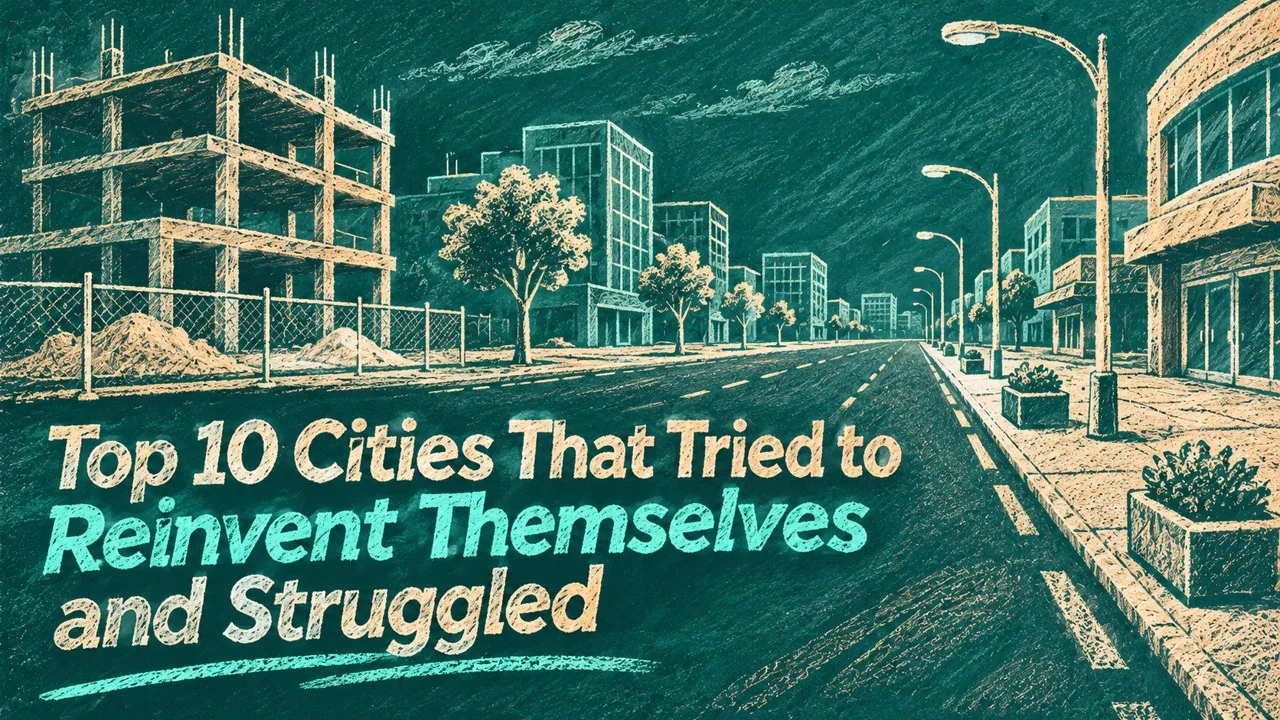
Some cities bet on bold plans to reinvent themselves and struggled, from Detroit and Flint to casino Atlantic City, Olympic hosts and planned smart cities. Cities rise and fall with the fortunes of the industries and ideas that built them. When a major employer closes, a population shrinks or the world economy shifts, city leaders often look for a bold new strategy: a casino strip, an Olympic Games, a downtown megaproject or a futuristic planned district.
Some of these strategies succeed spectacularly. Others struggle, leaving behind debts, empty buildings or problems worse than the ones they were meant to solve. The difference often depends on timing, funding, wider economic trends and whether the plan meets the real needs of residents.
The ten cities below are Detroit, Flint, Atlantic City, Youngstown, Gary, Montreal, Athens, Sheffield, Masdar City and Songdo. They include declining industrial cities, hosts of major sporting events and newly built districts that promised to be cities of the future.
This list is not meant to mock these places. Many of them have made real progress, and several are now growing or improving after difficult years. The aim is to show how hard reinvention is, and what lessons other cities have drawn from their experiences.
The details come from news reports, government documents and urban studies. Figures for costs and populations are approximate, and the situation in each city continues to change.
Behind every one of these stories are residents who lived through hard times, and in many cases community groups, local businesses and ordinary people have done as much to rebuild their cities as any grand plan.
Key Facts
| # | City | Reinvention attempt | Main problem |
|---|---|---|---|
| 1 | Detroit | Downtown megaprojects and later bankruptcy restructuring | Population loss and debt |
| 2 | Flint, Michigan | Switching water sources to save money | A public health crisis |
| 3 | Atlantic City | Legalized casino gambling | Competition and closures |
| 4 | Youngstown, Ohio | A plan to accept a smaller population | Decades of job losses |
| 5 | Gary, Indiana | Casinos, events and an airport | Population loss |
| 6 | Montreal | Hosting the 1976 Summer Olympics | Decades of debt |
| 7 | Athens | Hosting the 2004 Summer Olympics | Expensive venues left unused |
| 8 | Sheffield | Hosting the 1991 World Student Games | Long-term debt |
| 9 | Masdar City | A planned sustainable city in Abu Dhabi | Delays and scaling back |
| 10 | Songdo | A planned smart city near Seoul | Slower growth than expected |
1. The Motor City's Long Fall
Detroit was once one of the richest cities in the United States, the center of the American car industry. Its population peaked at about 1.85 million in 1950. As factories moved and residents left for the suburbs, the city lost more than half its population over the following decades [1].
Detroit tried many strategies to revive itself, including the Renaissance Center, a huge office and hotel complex opened in the late 1970s, and an elevated People Mover rail line in the 1980s, which carried fewer riders than hoped. These projects did not stop the city's decline [1].
In July 2013, Detroit filed for bankruptcy with debts estimated at about 18 billion dollars, the largest municipal bankruptcy in American history. It emerged in late 2014, and its downtown has since seen significant investment and renewal, though many neighborhoods still face challenges.
2. A Cost-Saving Decision Gone Wrong
Flint, Michigan, was a major center of car manufacturing, but it suffered heavy job losses as General Motors cut back. By the 2010s, the city faced severe financial problems and was placed under state-appointed emergency management [2].
Related: Top 10 Planned Cities That Were Never Built
In April 2014, to save money while a new pipeline was built, the city switched its water supply to the Flint River. The water was not treated to prevent corrosion, and lead leached from old pipes into homes. An outbreak of Legionnaires' disease also occurred in the area [2].
The city switched back to its previous water source in October 2015, but the damage was done. The crisis led to criminal charges against officials, many of which were later dropped, and a settlement of more than 600 million dollars from the State of Michigan. It became a national symbol of failed governance.
3. Casinos by the Sea
Atlantic City, New Jersey, was a popular seaside resort in the early twentieth century, but it declined after the Second World War. In 1976, New Jersey voters approved casino gambling in the city, hoping it would bring jobs and visitors [3].
The first casino opened in 1978, and for years Atlantic City was the gambling capital of the eastern United States. But as neighboring states legalized casinos, competition grew. In 2014, four casinos closed, including the newly built Revel, which had cost billions of dollars [3].
The city's finances deteriorated, and in 2016 the State of New Jersey took control of many of its affairs. Some casinos have since reopened under new owners, and the city continues to look for ways to diversify its economy.
4. Planning to Shrink
Youngstown was a major steel city in northeastern Ohio. On September 19, 1977, a day remembered locally as Black Monday, the Youngstown Sheet and Tube Company announced it was closing a major plant, eliminating about five thousand jobs. More closures followed [4].
The city's population fell from about 170,000 at its peak to around 60,000. In 2005, it adopted a plan called Youngstown 2010, which accepted that the city would not regain its former size and proposed demolishing abandoned buildings and turning vacant land into green space [4].
The plan attracted international attention as a rare example of a city planning to shrink. Results were mixed, as the city continued to struggle with poverty and vacant properties, though some neighborhoods were stabilized.
Related: Top 10 Most Bizarre Phobias: Strange Fears That Exist
5. A Steel Town's Search for a Future
Gary, Indiana, was founded in 1906 by the United States Steel Corporation as a company town. It grew rapidly, reaching a population of about 178,000 in 1960. As steel employment declined, the population fell sharply, to less than half its peak [5].
The city tried several strategies to revive its economy, including riverboat casinos in the 1990s, hosting the Miss USA pageant in the early 2000s and expanding its airport to serve the Chicago region [5].
These efforts brought some investment, but they did not reverse the city's decline. Gary remains one of the most dramatic examples of an American industrial city's struggle to find a new identity.
6. An Olympic Debt
Montreal hosted the Summer Olympic Games in 1976, hoping to showcase the city to the world. The centerpiece was the Olympic Stadium, an ambitious design with a tower meant to support a retractable roof [6].
Costs soared far beyond the original budget, due to construction problems, labor disputes and inflation. The stadium was not completed in time for the Games, and its roof was not finished until years later, then caused repeated problems [6].
The province of Quebec took about thirty years to pay off the Olympic debt, finally finishing in 2006, partly through a tobacco tax. The stadium earned the nickname the Big Owe, and the Games became a warning for other host cities.
7. Abandoned Olympic Venues
Athens hosted the Summer Olympics in 2004, returning the Games to the country where they began. The city invested heavily in new venues, roads, a tram line and an expanded metro, and the Games themselves were widely considered a success [7].
After the Games, however, many venues were left unused, and some fell into disrepair. Photographs of abandoned stadiums and pools became symbols of wasteful spending, especially after Greece entered a severe debt crisis a few years later [7].
Related: Top 10 Oldest Buildings in the World
Economists debate how much the Olympics contributed to Greece's financial problems, which had many causes. But the experience of Athens has made cities more cautious about building expensive venues without plans for their future use.
8. Student Games and Long Debts
Sheffield, in northern England, was a world-famous center of steel production. As the steel industry declined in the 1980s, the city sought new ways to attract investment and visitors [8].
In 1991, Sheffield hosted the World Student Games, building new sports facilities, including the Don Valley Stadium, Ponds Forge swimming complex and an arena. The event was meant to help reinvent the city as a center of sport and leisure [8].
The Games left the city with substantial debts, which took decades to repay. The Don Valley Stadium was demolished in 2013. However, some facilities, including the arena and Ponds Forge, remained in use, and the city's sporting reputation did grow.
9. A Zero-Carbon Dream
In 2006, Abu Dhabi announced plans to build Masdar City, intended to be one of the world's most sustainable urban developments. Designed by the architecture firm Foster and Partners, it was meant to run on renewable energy and produce little or no carbon emissions [9].
The original plan called for a city of tens of thousands of residents, with driverless electric pods replacing cars. After the 2008 financial crisis, the project was slowed, its targets were scaled back and its completion date was pushed back by many years [9].
Masdar City has nonetheless attracted businesses and research institutions, including the headquarters of the International Renewable Energy Agency. It is often cited as both an inspiring experiment and a lesson in the difficulty of building new cities from scratch.
Related: The Science Behind Auroras: How Solar Winds Create Colorful Skies
10. A Smart City by the Sea
Songdo International Business District was built on land reclaimed from the sea near Incheon, South Korea, starting in the early 2000s. It was promoted as a smart city, with sensors, high-speed networks and automated waste collection [10].
Developers hoped Songdo would become a major international business hub. But for years, its growth was slower than planned, and parts of the district seemed empty. Critics argued that it had been designed around technology rather than people [10].
Over time, Songdo has grown into a substantial community, home to international organizations such as the Green Climate Fund. Its experience shows that building a successful city takes far longer than building its infrastructure.
Conclusion
These cities show how difficult reinvention can be. Large projects can bring jobs and attention, but they can also bring debt and disappointment if they do not match the city's needs or the wider economic situation.
They also show the importance of good governance and long-term planning. Some of the most serious problems on this list, such as the Flint water crisis, came from decisions made to save money in the short term.
Many of these cities are still working to rebuild. Their experiences offer valuable lessons for other cities facing similar challenges.
Successful reinventions, such as those of Pittsburgh and Bilbao, often combine new industries, investment in education and attention to the quality of life for residents. There is rarely a single quick fix, and the best plans tend to build on a city's existing strengths.
- ^ [1] Accounts of Detroit's decline and bankruptcy. Wikipedia: Detroit bankruptcy Wikipedia: Renaissance Center
- ^ [2] Accounts of the Flint water crisis. Wikipedia: Flint water crisis Wikipedia: Flint, Michigan
- ^ [3] Accounts of Atlantic City. Wikipedia: Atlantic City Wikipedia: Ocean Casino Resort
- ^ [4] Accounts of Youngstown. Wikipedia: Youngstown, Ohio Wikipedia: shrinking cities
- ^ [5] Accounts of Gary, Indiana. Wikipedia: Gary, Indiana Wikipedia: U.S. Steel
- ^ [6] Accounts of the Montreal Olympics. Wikipedia: 1976 Summer Olympics Wikipedia: Olympic Stadium
- ^ [7] Accounts of the Athens Olympics. Wikipedia: 2004 Summer Olympics Wikipedia: Greek government-debt crisis
- ^ [8] Accounts of Sheffield's World Student Games. Wikipedia: 1991 Summer Universiade Wikipedia: Don Valley Stadium
- ^ [9] Accounts of Masdar City. Wikipedia: Masdar City Wikipedia: International Renewable Energy Agency
- ^ [10] Accounts of Songdo. Wikipedia: Songdo Wikipedia: smart city





















Discussion
Log in with