






 By
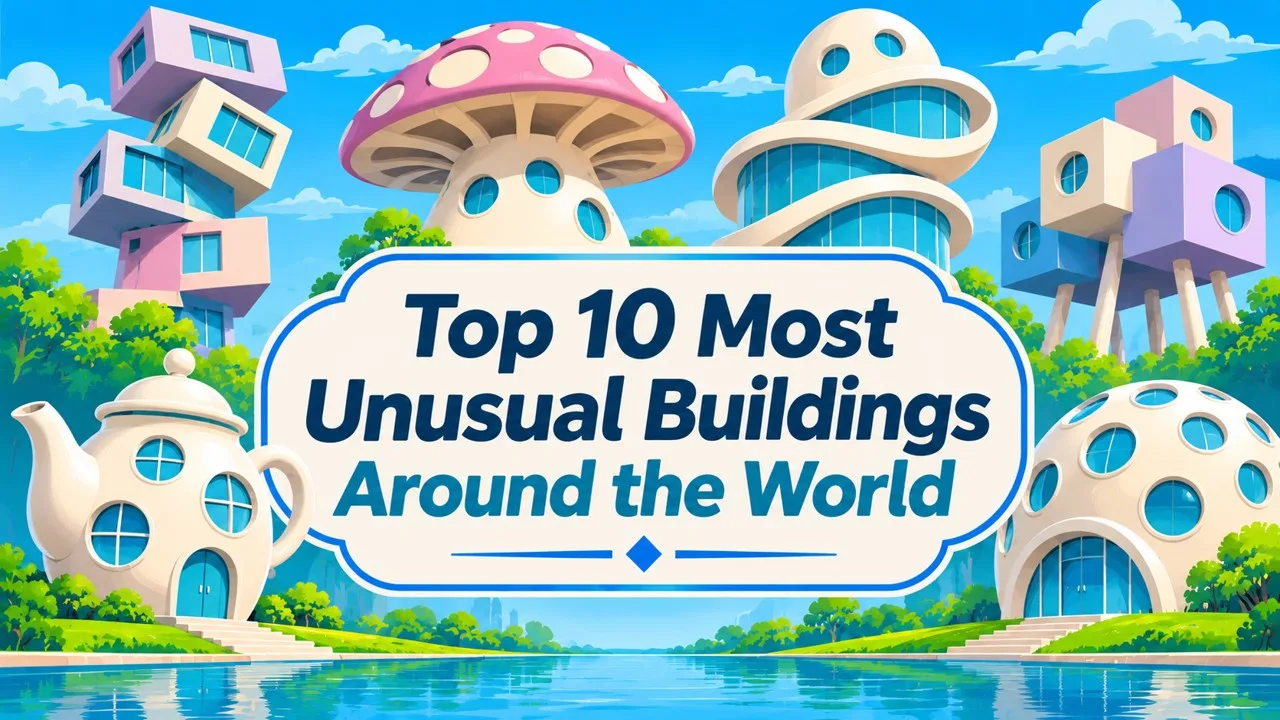
A dancing office block, a giant picnic basket, an elephant you can walk inside and a house built between boulders: ten of the world's most unusual buildings. Most buildings are designed to be practical, with straight walls, flat floors and familiar shapes. But some architects and builders have deliberately broken the rules, creating structures that surprise, amuse and sometimes baffle everyone who sees them.
Unusual buildings have many origins. Some were designed as artistic statements, challenging ideas about what architecture should look like. Others were built as advertisements, intended to attract attention to a business or a property development.
Some unusual designs were experiments in new ways of living. Architects in the twentieth century explored ideas such as prefabricated housing, modular apartments and buildings that could change and grow over time.
Others were simply the product of individual imagination and determination, built by people who wanted something unlike anything else in their neighborhood.
The buildings below come from Europe, North America and Asia. They include homes, offices, a shopping center, a hotel and a roadside attraction. Some are celebrated as architectural landmarks, while others are better known as quirky curiosities.
Several have faced uncertain futures. Unusual buildings can be expensive to maintain, and some have been threatened with demolition or left unfinished for decades.
Each entry names the building, its location and the year it was completed, followed by an account of its design and the story behind it.
The buildings are arranged roughly in chronological order of completion, from a Victorian-era elephant in New Jersey to a crooked shopping center built in the twenty-first century.
Together, they show the remarkable range of human creativity in architecture, and the ways in which buildings can express humor, ambition and new ideas about how people should live.
They also remind us that even the most practical art form can be a source of wonder and delight.
Architects use a number of terms to describe such buildings. Novelty architecture refers to structures designed to attract attention through unusual shapes, often resembling animals or everyday objects. Deconstructivism describes buildings that appear fragmented or distorted, challenging traditional ideas of harmony and order. Organic architecture seeks to harmonize buildings with nature, sometimes using curving forms and natural materials. Several of the buildings below fit into one or more of these categories, while others defy easy classification altogether.
Key Facts
| # | Building | Location | Completed |
|---|---|---|---|
| 1 | Lucy the Elephant | Margate City, New Jersey, United States | 1881 |
| 2 | Casa do Penedo | Fafe, Portugal | 1974 |
| 3 | Habitat 67 | Montreal, Canada | 1967 |
| 4 | Nakagin Capsule Tower | Tokyo, Japan | 1972 |
| 5 | The Cube Houses | Rotterdam, Netherlands | 1984 |
| 6 | Hundertwasserhaus | Vienna, Austria | 1985 |
| 7 | Ryugyong Hotel | Pyongyang, North Korea | Construction began in 1987 |
| 8 | The Dancing House | Prague, Czech Republic | 1996 |
| 9 | The Longaberger basket building | Newark, Ohio, United States | 1997 |
| 10 | The Crooked House | Sopot, Poland | 2004 |
1. An Elephant You Can Walk Inside
Lucy the Elephant is a six-story building shaped like an elephant, standing near the beach in Margate City, New Jersey. It was built in 1881 by James V. Lafferty, a real estate developer who wanted to attract potential buyers to land he was selling in the area [1].
Related: Top 10 Architectural Wonders of the Modern World
Visitors can climb stairs inside the elephant's legs and explore rooms within its body, and there is a viewing platform on its back offering views of the coast. Over the years, the building has served as a business office, a tavern and a summer home [1].
Lucy fell into disrepair in the twentieth century and was threatened with demolition, but local residents raised money to save and restore her. She was designated a National Historic Landmark in 1976 and is often described as the oldest surviving roadside tourist attraction in the United States.
2. A House Squeezed Between Boulders
Casa do Penedo is a small stone house built in the mountains of northern Portugal. It was constructed in 1974 between four enormous boulders, which form its walls, foundation and roof [2].
The house was reportedly built as a country retreat and originally had no electricity. Its builders made use of the natural rock formations, filling the gaps between the boulders with doors, windows and stonework [2].
Photographs of the house spread widely online, and it became a popular tourist curiosity. Its popularity reportedly caused problems for its owners, who had to deal with large numbers of visitors.
3. An Experiment in Modular Living
Habitat 67 is a housing complex built for the 1967 World's Fair in Montreal. It was designed by the architect Moshe Safdie, based on ideas he had developed while studying at McGill University [3].
The complex is made from hundreds of identical prefabricated concrete modules stacked in seemingly random arrangements. This design gave each residence privacy, gardens on neighboring roofs and views in several directions [3].
Safdie hoped Habitat 67 would provide a model for affordable urban housing, but construction costs were high. Today, it remains a sought-after residential complex and a celebrated example of modern architecture.
4. Capsules That Were Never Replaced
The Nakagin Capsule Tower in Tokyo was designed by the architect Kisho Kurokawa as part of the Japanese movement known as Metabolism. The building consisted of two concrete towers to which more than a hundred small, prefabricated capsules were attached [4].
Each capsule was a tiny apartment or office with a round window, built-in furniture and appliances. The capsules were designed to be replaced over time, allowing the building to adapt and grow like a living organism [4].
Related: Top 10 Iconic Parliament Buildings of the World
In practice, the capsules were never replaced, and the building gradually deteriorated. Despite campaigns to save it, the tower was demolished in 2022. Some capsules were preserved and restored for museums and other uses.
5. Houses Tilted on Their Corners
The Cube Houses in Rotterdam were designed by the Dutch architect Piet Blom. Each house is a cube tilted at forty-five degrees, resting on one corner atop a hexagonal pillar [5].
Blom reportedly imagined the houses as trees, with the cubes together forming a kind of forest above the street. The design allowed space for pedestrians and shops beneath the houses [5].
Living in the houses can be challenging, since many walls are sloping, and furniture must be chosen carefully. One house has been turned into a museum so that visitors can see the interior.
6. A Colorful Housing Block
The Hundertwasserhaus is an apartment building in Vienna designed by the Austrian artist Friedensreich Hundertwasser, with the architect Joseph Krawina. It was built as public housing by the city of Vienna [6].
The building features brightly colored walls, irregular windows, uneven floors and onion-shaped domes. Trees grow from inside the apartments and on the roof, which Hundertwasser described as tree tenants [6].
Hundertwasser disliked straight lines and wanted buildings to be in harmony with nature. The building has become one of Vienna's most popular tourist attractions, though it remains a residential building.
7. A Hotel That Never Opened
The Ryugyong Hotel is a pyramid-shaped skyscraper in Pyongyang, North Korea, with more than a hundred floors. Construction began in 1987, but work stopped in the early 1990s during North Korea's economic crisis [7].
For years, the unfinished concrete structure stood empty, and some foreign media nicknamed it one of the worst buildings in the world. Work resumed in the 2000s, and the exterior was covered in glass panels [7].
Related: Top 10 Famous Domes of the World
Despite this, the hotel has not officially opened as of the mid-2020s. It remains one of the tallest unoccupied buildings in the world and a striking feature of the Pyongyang skyline.
8. A Building That Seems to Dance
The Dancing House in Prague was designed by the Croatian-Czech architect Vlado Milunić and the Canadian-American architect Frank Gehry. Its curving glass tower appears to lean against a solid concrete tower, like two dancers [8].
The building is nicknamed Fred and Ginger, after the dancers Fred Astaire and Ginger Rogers. It stands on a site where a building had been destroyed during the Second World War [8].
When it was built, the design was controversial in a city famous for its historic architecture. Over time, it has become a well-known landmark and an example of modern architecture in Prague.
9. A Giant Picnic Basket
The Longaberger Company, which made handcrafted baskets, built its headquarters in the shape of one of its products. The seven-story building in Newark, Ohio, resembles a giant picnic basket, complete with handles on top [9].
The building is many times larger than the basket it was modeled on. It became a famous example of novelty architecture, sometimes called programmatic architecture, in which a building resembles the product it sells [9].
The company moved out of the building in 2016, and it was later sold. Its future use has been the subject of various proposals, including conversion into a hotel.
10. A House That Looks Melted
The Crooked House, known in Polish as Krzywy Domek, is part of a shopping center in the seaside town of Sopot. Its walls, windows and roof appear to bend and sway as if the building were melting or reflected in a funhouse mirror [10].
The design was inspired by the fairy tale illustrations of the Polish artist Jan Marcin Szancer and the Swedish artist Per Dahlberg. It was created by the architects Szotyńscy and Zaleski [10].
Related: Top 10 Tallest Buildings in the World
The building contains shops, restaurants and other businesses. It has become one of the most photographed buildings in Poland.
Conclusion
These buildings show the remarkable creativity of architects, artists and builders. They challenge the idea that buildings must be plain or predictable, offering instead a sense of fun, wonder and imagination.
Some were designed as artistic statements, while others served practical purposes, such as advertising or experimental housing.
Not all of them have been successful. Some proved expensive or impractical, and one has been demolished. Yet each has left a mark on the history of architecture.
Unusual buildings often become beloved landmarks, attracting visitors from around the world and helping define the identity of their communities.
They also inspire new generations of architects to think differently about how buildings can look and function.
Many cities now actively encourage bold designs, recognizing that striking buildings can attract tourists, businesses and residents, and help give a place a distinctive character.
The next time you see an ordinary building, it may be worth imagining what it might look like if its designer had chosen to break the rules.
Preserving unusual buildings can be a challenge. Their unconventional designs often make repairs complicated and costly, and changing tastes can leave them unloved for years before a new generation comes to appreciate them. Campaigns by residents, historians and architecture enthusiasts have saved several of the buildings in this list, while others have survived through new uses, such as museums, offices or tourist attractions.
- ^ [1] Accounts of Lucy the Elephant. Wikipedia: Lucy the Elephant Wikipedia: Novelty architecture
- ^ [2] Accounts of Casa do Penedo. Wikipedia: Casa do Penedo Wikipedia: Fafe
- ^ [3] Accounts of Habitat 67. Wikipedia: Habitat 67 Wikipedia: Moshe Safdie
- ^ [4] Accounts of the Nakagin Capsule Tower. Wikipedia: Nakagin Capsule Tower Wikipedia: Metabolism (architecture)
- ^ [5] Accounts of the Cube Houses. Wikipedia: Cube house Wikipedia: Piet Blom
- ^ [6] Accounts of the Hundertwasserhaus. Wikipedia: Hundertwasserhaus Wikipedia: Friedensreich Hundertwasser
- ^ [7] Accounts of the Ryugyong Hotel. Wikipedia: Ryugyong Hotel Wikipedia: Pyongyang
- ^ [8] Accounts of the Dancing House. Wikipedia: Dancing House Wikipedia: Frank Gehry
- ^ [9] Accounts of the Longaberger building. Wikipedia: Longaberger Wikipedia: Novelty architecture
- ^ [10] Accounts of the Crooked House. Wikipedia: Krzywy Domek Wikipedia: Sopot



















Discussion
Log in with