


 By
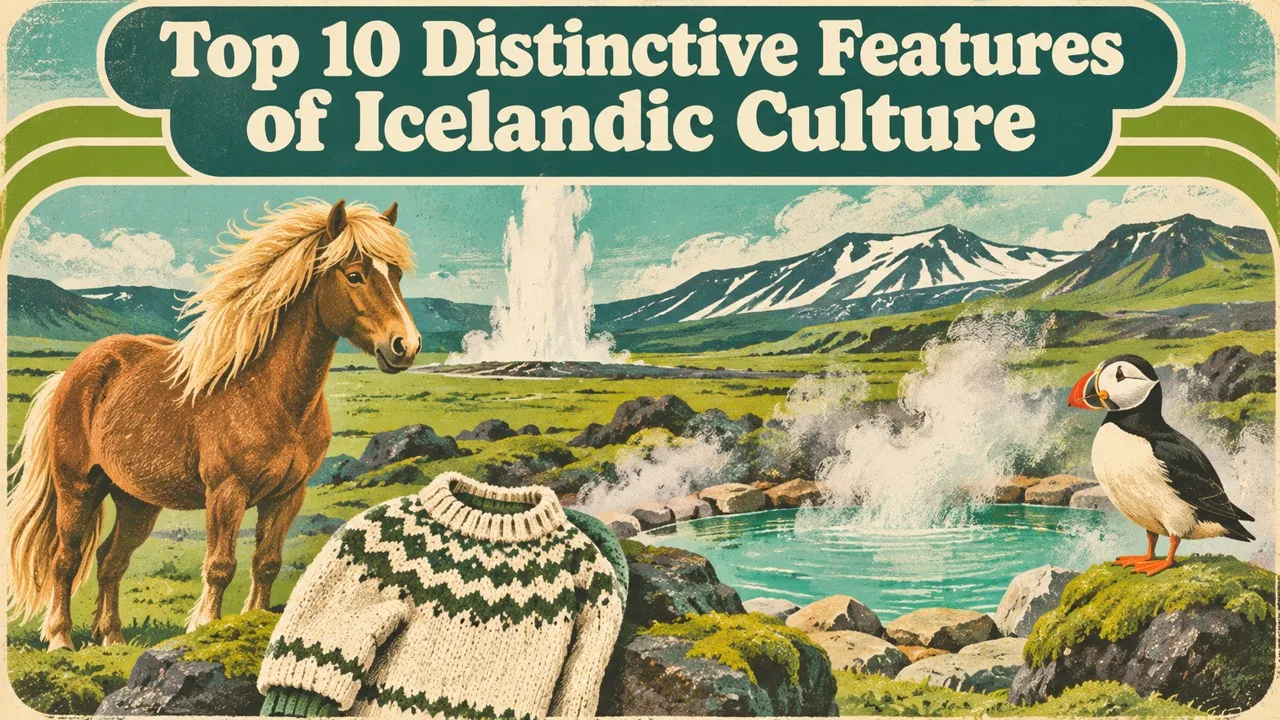
Names without surnames, a genealogy app that warns cousins, a Christmas book flood, thirteen Yule Lads and a long beer ban: ten features of Icelandic culture. Iceland, a volcanic island in the North Atlantic with fewer than 400,000 people, has a culture shaped by isolation, harsh weather and a strong literary tradition. Settled mainly by Norse and Gaelic people in the ninth and tenth centuries, it established one of the world's earliest parliaments, the Althing, in 930.
For centuries, Icelanders lived mostly on scattered farms, depending on fishing, sheep and long winter evenings spent reading and telling stories. Many customs from that era survive, adapted to modern life.
Today, Iceland is a wealthy, highly connected society, yet it keeps traditions that surprise visitors, from the way people are named to the foods eaten at midwinter.
The ten features below reflect Iceland's history, language, folklore and social life.
Key Facts
| # | Feature | What it involves | Origins |
|---|---|---|---|
| 1 | Patronymic names | Children named after a parent | Medieval Norse custom |
| 2 | Icelandic Naming Committee | Approves new first names | Founded 1991 |
| 3 | Islendingabok | Genealogical database | Launched in the late 1990s |
| 4 | Jolabokaflod | Giving books on Christmas Eve | Mid-twentieth century |
| 5 | Yule Lads | Christmas folklore | Folk tradition |
| 6 | Huldufolk | Folklore about elves | Centuries-old tradition |
| 7 | Icelandic language | New native words for new things | Language policy |
| 8 | Geothermal swimming pools | Social life in hot water | Twentieth century onward |
| 9 | Thorrablot | Traditional winter festival | Revived in the nineteenth and twentieth centuries |
| 10 | Beer Day | The end of a long ban | March 1, 1989 |
1. Names Without Surnames
Most Icelanders do not have family surnames. Instead, their last names are formed from a parent's first name, usually the father's, with the ending son for sons or dottir for daughters. A man named Jon Einarsson and his sister Gudrun Einarsdottir are both children of Einar [1].
Because of this system, Icelanders generally address each other by first name, including the prime minister and the president. The telephone directory has traditionally been arranged by first name [1].
Since 2019, people registered as nonbinary may use the neutral ending bur. A small number of Icelanders have family names, but new family names are generally not allowed. The system can produce confusion abroad, for example when a mother and her children share no common surname on travel documents. Some Icelanders use a matronymic, formed from the mother's name, either alone or alongside a patronymic, as did the footballer Heidar Helguson.
2. A Committee for Names
Parents in Iceland who want to give their child a name not already on an official list must apply to the Icelandic Naming Committee. The committee checks whether the name fits Icelandic grammar and spelling [2].
Names that cannot be declined according to Icelandic grammar or that use letters not in the Icelandic alphabet may be rejected. Each year, the committee approves many names and rejects others [2].
Some decisions have attracted international attention, such as the case of a girl named Harriet, whose passport application was refused in 2014 because her name was not approved. Critics have argued that the system restricts personal freedom. The committee was set up in 1991, and its decisions are based on the Personal Names Act. Proposals to abolish or reform it have been debated in the Althing several times, and the rules have been relaxed somewhat over the years.
Related: Top 10 Best Attractions in Iceland
3. A Database of the Whole Nation
Because Iceland's population is small and its records are detailed, much of its genealogy can be traced back over a thousand years. A database called Islendingabok, created by a genetics company and a software entrepreneur, contains information about most Icelanders who have ever lived [3].
Icelanders can log in and see how they are related to one another. In 2013, students developed an app with a feature that allowed two people to bump their phones together to check whether they were closely related [3].
The app was promoted with a joking slogan about avoiding an embarrassing family surprise at a family gathering. The database has also been used in genetic research. The project was a collaboration between the genetics firm deCODE and the software developer Fridrik Skulason. Iceland's population history, with relatively little immigration for centuries and detailed church records, makes it valuable for studies of inherited diseases.
4. A Flood of Books at Christmas
Iceland has a tradition known as the Christmas book flood. Many Icelanders give books as gifts on Christmas Eve and spend the night reading [4].
Each autumn, a catalogue of new books is sent to households across the country, and many publishers release their books in time for the holiday season. The tradition is often traced to World War II, when imports were restricted but paper was relatively available [4].
Iceland is often said to publish more books per person than almost any other country, and a large share of Icelanders report reading regularly. The country has a proud literary heritage dating back to the medieval sagas. The catalogue, called Bokatidindi, has been distributed since 1944, the year Iceland became an independent republic. Book sales in Iceland are concentrated heavily in the last months of the year, and many authors time their releases for the Christmas season.
5. Thirteen Mischievous Visitors
Instead of a single Santa Claus, Iceland has the Yule Lads, thirteen mischievous figures who visit one by one during the thirteen nights before Christmas. Children leave shoes on windowsills and receive small gifts or, if naughty, a rotten potato [5].
Each Yule Lad has a name describing his habits, such as Spoon-Licker, Door-Slammer, Sausage-Swiper and Window-Peeper. They are the sons of Gryla, a troll said to eat naughty children [5].
Related: Top 10 Most Bizarre Phobias: Strange Fears That Exist
The family also includes the Yule Cat, which in folklore eats people who have not received new clothes before Christmas. In 1746, an official decree reportedly forbade parents from using the Yule Lads to frighten children. Each Yule Lad departs in the same order after Christmas, the last leaving on January 6, the thirteenth day of Christmas. The Yule Cat legend is often linked to an old custom of rewarding farm workers who finished processing the autumn wool with new clothing.
6. Respect for Hidden People
Icelandic folklore tells of the huldufolk, or hidden people, who live in rocks, hills and cliffs. They are described as resembling humans and living parallel lives [6].
Surveys have suggested that many Icelanders are unwilling to completely rule out the existence of elves, though most do not claim to believe in them firmly [6].
Road and building projects have occasionally been altered or delayed after protests citing elf rocks. In one widely reported case, a large rock believed to be an elf church was moved carefully to a new location during construction of a road near Reykjavik. The move in question took place in 2014 on the Alftanes peninsula, after a dispute in which environmental activists and elf advocates opposed a new road through a lava field. Iceland even has an Elf School in Reykjavik, which teaches visitors about the folklore.
7. Inventing Words Instead of Borrowing
Icelandic has changed relatively little since the Middle Ages, and modern Icelanders can read medieval sagas with some effort. The language is a source of national pride [7].
Rather than borrowing foreign words, Icelanders often create new words from old roots. The word for computer, tolva, combines the word for number with the word for prophetess. The word for telephone, simi, comes from an old word for thread [7].
The Icelandic Language Day is celebrated each year on November 16, the birthday of the nineteenth-century poet Jonas Hallgrimsson. Hallgrimsson was also a naturalist, and he coined several new Icelandic words himself, including terms used in astronomy. The country has invested in digital tools to make sure that Icelandic is supported by computers and voice assistants.
Related: Top 10 Oldest Buildings in the World
8. The Pool as Meeting Place
Iceland's abundant geothermal energy heats outdoor swimming pools and hot tubs across the country. Almost every town has a public pool, open even in winter [8].
Pools are important social spaces, where people meet friends, discuss news and relax in hot tubs. Swimming lessons are part of the school curriculum [8].
Visitors are expected to follow strict hygiene rules, including showering without a swimsuit before entering the pool. Attendants may remind those who do not. Reykjavik alone has more than a dozen public pools, and the largest, Laugardalslaug, attracts many residents every day. Iceland's geothermal water also heats most homes, which are connected to district heating systems fed by hot springs and boreholes.
9. A Midwinter Feast of Old Foods
Thorrablot is a midwinter festival held during the old Icelandic month of Thorri, from late January to late February. People gather to eat traditional foods and drink, sing and celebrate [9].
The foods reflect older methods of preserving food through the winter. They include hakarl, fermented shark; svid, singed sheep's head; and sour ram's testicles, preserved in whey [9].
Hakarl is made from Greenland shark, whose flesh is toxic when fresh and must be fermented and dried for months. It is often accompanied by a strong spirit called brennivin. Thorrablot gatherings are held by workplaces, towns and organizations as well as families. The modern popularity of the festival owes much to a Reykjavik restaurant that began serving traditional Thorri food in the late 1950s.
10. Beer Banned for Decades
Iceland introduced prohibition in 1915. Wine and spirits were later legalized, but strong beer remained banned until March 1, 1989 [10].
Related: The Science Behind Auroras: How Solar Winds Create Colorful Skies
During the ban, some bars mixed legal low-alcohol beer with spirits to create a beer-like drink, until that was also prohibited [10].
When the ban ended, Icelanders celebrated in bars and restaurants, and March 1 is now known as Beer Day. Craft breweries have since flourished across the country. Prohibition had been approved in a national referendum in 1908 and took effect in 1915. Spanish pressure to buy its wine led Iceland to legalize wine in the early 1920s, as Spain was a major buyer of Icelandic salted fish.
Conclusion
These features show how Iceland's culture blends ancient traditions with modern life. Its language, names and folklore connect present-day Icelanders with their medieval ancestors.
At the same time, Iceland is a modern, technologically advanced society, using apps, geothermal energy and international trade. It is also known for its record on gender equality. On October 24, 1975, around 90 percent of Icelandic women stopped work for a day to demonstrate their importance, and in 1980 Vigdis Finnbogadottir became the world's first democratically elected female president.
Visitors often find Icelandic culture both welcoming and unique, shaped by a small population and a dramatic landscape.
Its traditions continue to evolve, as each generation adapts them to new circumstances.
- ^ [1] Accounts of Icelandic names. Wikipedia: Icelandic name Wikipedia: patronymic
- ^ [2] Accounts of the Naming Committee. Wikipedia: Icelandic Naming Committee Wikipedia: Icelandic alphabet
- ^ [3] Accounts of Islendingabok. Wikipedia: Islendingabok (database) Wikipedia: deCODE genetics
- ^ [4] Accounts of the book flood. Wikipedia: Jolabokaflod Wikipedia: Icelandic literature
- ^ [5] Accounts of the Yule Lads. Wikipedia: Icelandic Christmas folklore Wikipedia: Yule cat
- ^ [6] Accounts of huldufolk. Wikipedia: Huldufolk Wikipedia: elf
- ^ [7] Accounts of Icelandic. Wikipedia: Icelandic language Wikipedia: Icelandic Language Day
- ^ [8] Accounts of geothermal pools. Wikipedia: Geothermal power in Iceland Wikipedia: Blue Lagoon
- ^ [9] Accounts of Thorrablot. Wikipedia: Thorrablot Wikipedia: Hakarl
- ^ [10] Accounts of Beer Day. Wikipedia: Beer Day Wikipedia: prohibition




















Discussion
Log in with