

 By
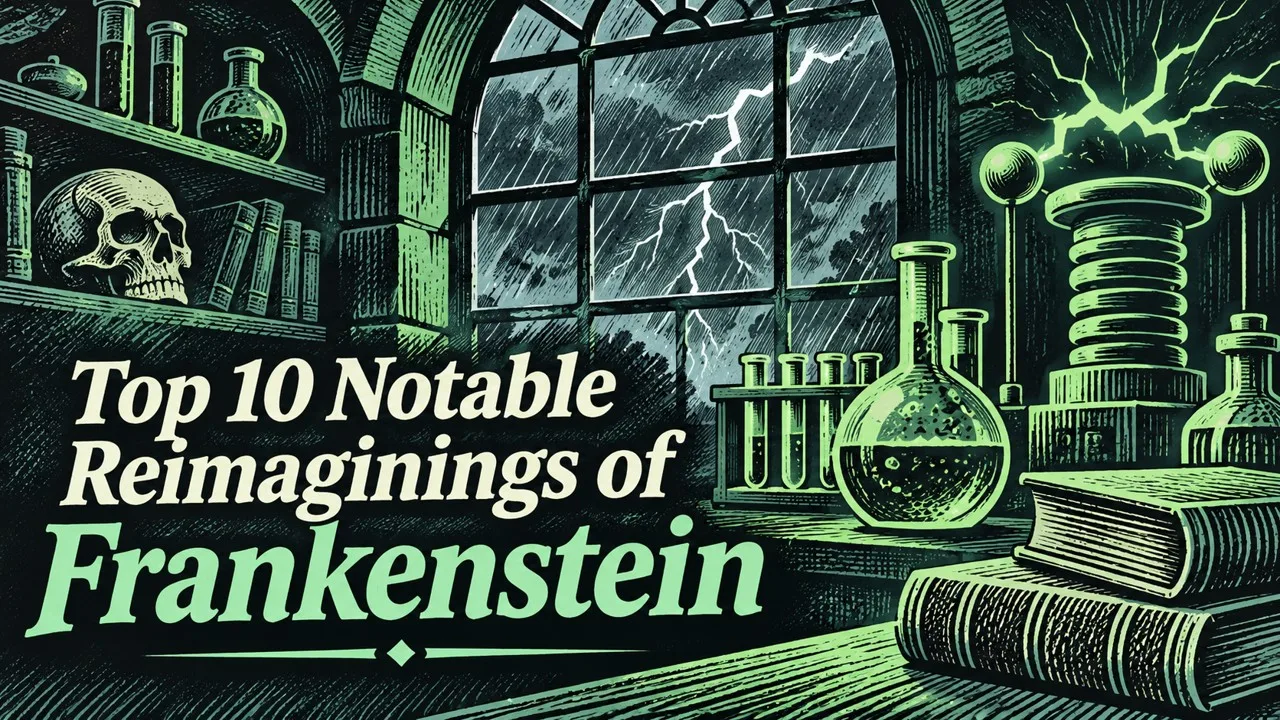
From an 1823 stage play to Iraq and Victorian Glasgow, ten notable reimaginings of Mary Shelley's Frankenstein across stage, film and fiction. Mary Shelley's novel Frankenstein; or, The Modern Prometheus was first published in 1818. It tells the story of Victor Frankenstein, a young scientist who creates a living being and then abandons it, with tragic consequences for both creator and creature.
The novel grew out of a famous ghost story contest held in 1816 at the Villa Diodati near Lake Geneva, where Shelley was staying with Percy Bysshe Shelley, Lord Byron and John Polidori. She was still a teenager when she began writing it.
Since then, the story has been retold countless times. It has been adapted for the stage, cinema, television, comics and new novels, and its central ideas about creation, responsibility and isolation continue to resonate.
Each retelling reflects the concerns of its own time. Some versions emphasize horror, others comedy, tragedy or social commentary. Many change the story dramatically, sometimes turning the articulate creature of the novel into a silent monster.
Many popular images associated with Frankenstein, such as the flat-headed monster with bolts in his neck, do not come from the novel at all. They were created by later adaptations, particularly Hollywood films of the 1930s.
The adaptations below were chosen because they changed how audiences understood the story, introduced new ideas or reached new audiences. They include plays, films and novels from three centuries.
They are arranged in chronological order, beginning with a stage play that Mary Shelley herself saw and ending with novels and productions from recent decades.
Each entry names the work, its medium and the year it was first presented or published, followed by an account of how it reimagined the original story.
Together, these works show how a single novel written by a young woman more than two centuries ago became one of the most influential stories in modern culture.
They also show how each generation finds new meaning in the tale of a creator and the being he brought to life.
The novel itself has a layered structure. It is told through the letters of an Arctic explorer, Robert Walton, who meets Victor Frankenstein near the North Pole and records his story. Within Victor's account, the creature tells his own story in his own words, describing how he learned to speak and read by secretly observing a family, and how rejection turned him toward violence. This shifting point of view encourages readers to sympathize with both creator and creature, a balance that adaptations have often struggled to keep.
Key Facts
| # | Work | Medium | Year |
|---|---|---|---|
| 1 | Presumption; or the Fate of Frankenstein | Stage play | 1823 |
| 2 | Frankenstein produced by Edison Studios | Silent film | 1910 |
| 3 | Frankenstein starring Boris Karloff | Film | 1931 |
| 4 | Bride of Frankenstein | Film | 1935 |
| 5 | The Curse of Frankenstein | Film | 1957 |
| 6 | Young Frankenstein | Film | 1974 |
| 7 | Frankenweenie | Short film and animated feature | 1984 and 2012 |
| 8 | Frankenstein at the National Theatre | Stage play | 2011 |
| 9 | Poor Things | Novel and film | 1992 and 2023 |
| 10 | Frankenstein in Baghdad | Novel | 2013 |
1. The First Stage Version
Just five years after the novel appeared, the playwright Richard Brinsley Peake adapted it for the London stage as Presumption; or the Fate of Frankenstein. The play was a success and helped make the story widely known, reaching audiences who had never read the book [1].
Related: Top 25 Interesting Facts About the Solar System
The play introduced several elements that became standard in later versions. It added a comic assistant for Victor Frankenstein, and the creature did not speak, a sharp departure from the eloquent being of the novel [1].
Mary Shelley attended a performance and reportedly enjoyed it, noting with interest how the creature was listed in the program simply with a blank. The success of the play also encouraged a new edition of the novel.
2. The First Film
In 1910, the Edison film company produced a short silent version of Frankenstein, running only a little over ten minutes. It is generally considered the first film adaptation of the story [2].
In this version, the creature is created not by stitching together body parts but in a vat of chemicals, a sequence shown with striking special effects for the time. The film ends with the creature disappearing into a mirror, suggesting it represents the dark side of Frankenstein's mind [2].
For many years, the film was believed to be lost. A print was eventually found in the hands of a private collector, and it has since been restored and made widely available.
3. The Monster Most People Picture
Universal Pictures released its film version of Frankenstein in 1931, directed by James Whale. Boris Karloff played the creature, with makeup designed by Jack Pierce [3].
The film created the image of the monster that most people recognize today, with a flat head, heavy eyelids and bolts in the neck. It also added the famous scene in which Frankenstein cries out that his creation is alive [3].
The film was a major success and helped establish Universal as the leading studio for horror films. Karloff's performance gave the creature a sense of pathos despite his limited speech.
4. A Sequel With Depth
In 1935, James Whale directed a sequel, Bride of Frankenstein, which many critics consider even better than the original. Boris Karloff returned as the creature, and Elsa Lanchester played both Mary Shelley in a prologue and the bride [4].
The film drew on episodes from the novel that the first film had left out, including the creature learning to speak and seeking companionship. It also added dark humor and memorable visual style [4].
Related: Top 25 Interesting Facts About the Universe
The bride's appearance, with her tall hair streaked with white, became one of the most famous images in horror cinema. The film is now regarded as a classic and has been preserved in the United States National Film Registry.
5. Horror in Color
In 1957, the British studio Hammer Film Productions released The Curse of Frankenstein. Peter Cushing played Baron Frankenstein, and Christopher Lee played the creature [5].
The film was one of the first horror films shot in color, and it was much more graphic than earlier versions. It focused on Frankenstein himself as a ruthless and arrogant scientist [5].
The film's success launched a long series of Hammer horror films. It also helped establish Cushing and Lee as stars of the genre, and it influenced horror films for years to come.
6. Comedy Takes Over
In 1974, Mel Brooks directed Young Frankenstein, a comedy that affectionately parodied the Universal horror films of the 1930s. Gene Wilder, who co-wrote the script, played the grandson of Victor Frankenstein [6].
The film was shot in black and white and even used some of the original laboratory equipment from the 1931 film. Its memorable cast included Marty Feldman, Teri Garr, Madeline Kahn and Peter Boyle as the creature [6].
Young Frankenstein became one of the most celebrated comedies of its era. It was later adapted into a stage musical, showing that the Frankenstein story could work as comedy as well as horror.
7. A Boy and His Dog
Tim Burton first told the story of Frankenweenie in a live-action short film in 1984. In it, a young boy named Victor uses science to bring his beloved dog, Sparky, back to life after it is killed by a car [7].
The story turned Frankenstein into a gentle tale about love and loss. It also playfully referenced the classic Universal films, including the famous windmill scene [7].
Related: Top 10 Mythical Creatures in World Mythology - That Inspired Myths Across Civilizations (unchanged)
In 2012, Burton expanded the story into a full-length stop-motion animated film in black and white. It was nominated for an Academy Award, introducing the Frankenstein story to a new generation of young viewers.
8. Two Actors Swapping Roles
In 2011, Danny Boyle directed a stage adaptation of Frankenstein at the National Theatre in London, with a script by Nick Dear. Benedict Cumberbatch and Jonny Lee Miller alternated the roles of Victor Frankenstein and the creature from one performance to the next [8].
The production told the story largely from the creature's point of view, beginning with his birth and showing his attempts to learn and find a place in the world. This brought it closer to the spirit of the novel [8].
The production was broadcast to cinemas around the world and received widespread acclaim. Cumberbatch and Miller shared a major theater award for their performances.
9. A Creature Made in Victorian Glasgow
The Scottish writer Alasdair Gray published Poor Things in 1992. The novel tells the story of Bella Baxter, a woman brought back to life by a Glasgow surgeon who implants a new brain, in a clear reworking of the Frankenstein theme [9].
The novel explored themes of freedom, gender and social reform in the Victorian era, and it uses a playful structure with multiple narrators who contradict one another [9].
In 2023, the novel was adapted into a film directed by Yorgos Lanthimos, starring Emma Stone as Bella. The film won several Academy Awards, including Best Actress for Stone.
10. A Creature Made From the Victims of War
The Iraqi writer Ahmed Saadawi published Frankenstein in Baghdad in 2013. The novel is set in the city during the violence that followed the American-led invasion of Iraq in 2003 [10].
In the story, a junk dealer collects body parts from victims of bombings and stitches them together into a single body, which comes to life and seeks revenge for those who died [10].
Related: Top 25 Weird Facts About Left-Handed People
The novel won the International Prize for Arabic Fiction in 2014 and was later translated into English, earning international acclaim. It shows how the Frankenstein story can be used to explore modern conflict and its human costs.
Conclusion
Mary Shelley's Frankenstein has proven to be one of the most adaptable stories ever written. Its central ideas about creation, responsibility and isolation have been reinterpreted in horror, comedy, tragedy and social commentary.
Each version reflects the concerns of its own time, from fears about science to the effects of war and questions about gender and freedom.
Many of the most famous images associated with the story come from adaptations rather than the novel, showing how retellings can reshape a story in the popular imagination.
New adaptations continue to appear, including a major film by the director Guillermo del Toro released in 2025, proving that the story still has much to offer.
Reading the original novel alongside these adaptations can be rewarding, revealing how much was changed and what remained constant.
Many readers are surprised to discover that the creature of the novel is intelligent and articulate, quoting from great works of literature and questioning his creator about justice and responsibility.
More than two centuries after its publication, Frankenstein remains a powerful reminder of the responsibilities that come with creation.
- ^ [1] Accounts of Presumption. Wikipedia: Presumption Wikipedia: Frankenstein
- ^ [2] Accounts of the 1910 film. Wikipedia: Frankenstein (1910 film) Wikipedia: Edison Studios
- ^ [3] Accounts of the 1931 film. Wikipedia: Frankenstein (1931 film) Wikipedia: Boris Karloff
- ^ [4] Accounts of Bride of Frankenstein. Wikipedia: Bride of Frankenstein Wikipedia: James Whale
- ^ [5] Accounts of The Curse of Frankenstein. Wikipedia: The Curse of Frankenstein Wikipedia: Hammer Film Productions
- ^ [6] Accounts of Young Frankenstein. Wikipedia: Young Frankenstein Wikipedia: Mel Brooks
- ^ [7] Accounts of Frankenweenie. Wikipedia: Frankenweenie (2012 film) Wikipedia: Tim Burton
- ^ [8] Accounts of the National Theatre production. Wikipedia: Frankenstein (play) Wikipedia: Danny Boyle
- ^ [9] Accounts of Poor Things. Wikipedia: Emma Stone Wikipedia: Alasdair Gray
- ^ [10] Accounts of Frankenstein in Baghdad. Wikipedia: Frankenstein in Baghdad Wikipedia: Ahmed Saadawi




















Discussion
Log in with