






 By
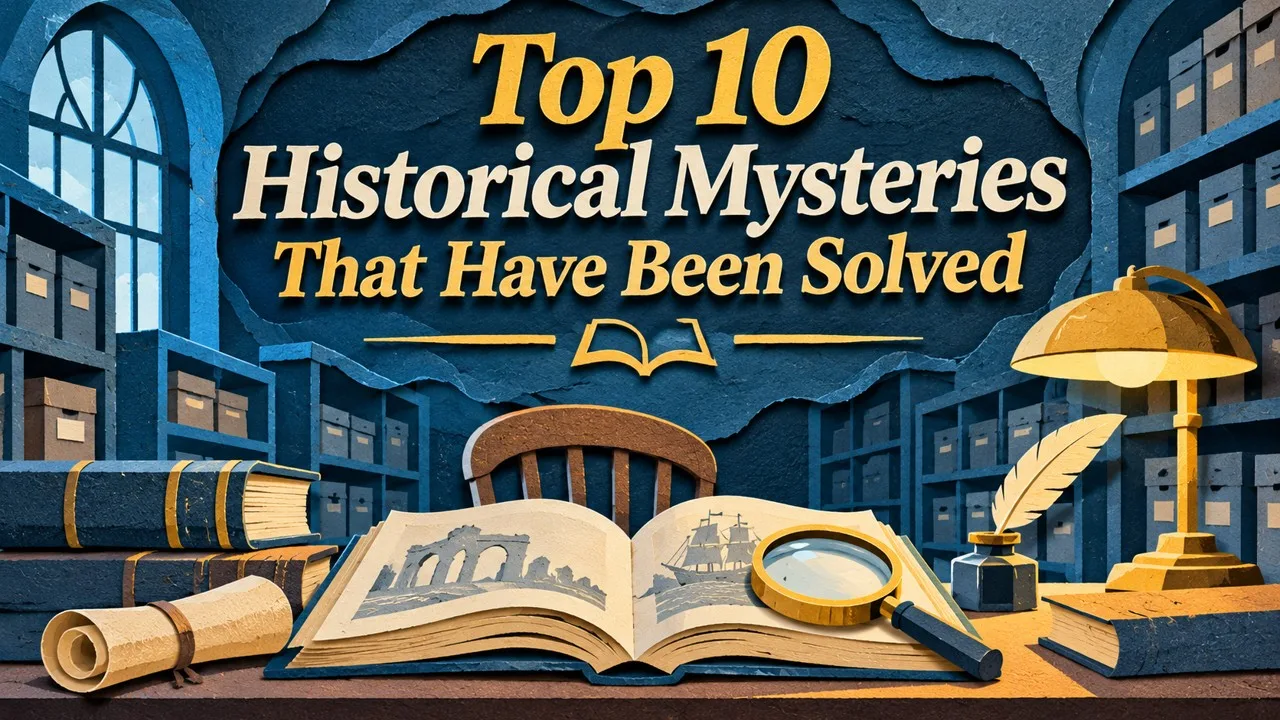
A king under a car park, lost polar ships, a cipher cracked after 51 years and moving desert stones: ten historical mysteries that have been solved. History is full of unanswered questions. Lost ships, missing remains, unreadable messages and strange natural phenomena have puzzled people for generations.
Some mysteries seem destined to remain unsolved forever. But in recent decades, new technologies and dedicated research have cracked a remarkable number of long-standing puzzles.
DNA analysis, underwater robots, satellite navigation, time-lapse cameras and powerful computers have all played a part. So have patient archival research, local knowledge and sheer persistence.
The solutions have sometimes confirmed what people suspected. In other cases, they overturned long-held assumptions or revealed surprising new details.
Not every solution is accepted by everyone. In a few cases, researchers have proposed convincing explanations that some people still dispute, and this is noted where relevant.
The mysteries in this list come from many fields, including archaeology, polar exploration, geology, cryptography, music history and criminal investigation.
This list avoids mysteries about the identities of unknown people, such as famous unidentified bodies, which are covered in a separate article.
Each entry names the mystery, how it was solved and the year of the breakthrough, followed by an account of the puzzle and its solution.
The entries are arranged in chronological order of their solutions.
Together, they show how science and persistence can uncover answers to questions that once seemed impossible to resolve.
Solving a historical mystery usually requires several kinds of evidence working together. In the search for Richard III, historical documents narrowed down the location, archaeology uncovered the skeleton, and scientific tests on bones and DNA confirmed the identity. In the Arctic, Victorian records, Inuit testimony and modern sonar each played a part. Researchers increasingly work in teams that combine historians, scientists, engineers and local experts, because few puzzles can be solved from a single direction.
Key Facts
| # | Mystery | How it was solved | Year solved |
|---|---|---|---|
| 1 | The lost city of Thonis-Heracleion | Underwater archaeology | 2000 |
| 2 | The grave of Richard III | Archaeology and DNA analysis | 2012 to 2013 |
| 3 | The wrecks of Erebus and Terror | Searches guided by Inuit knowledge | 2014 and 2016 |
| 4 | The sailing stones of Death Valley | Time-lapse photography and GPS | 2014 |
| 5 | The Golden State Killer | Investigative genetic genealogy | 2018 |
| 6 | The Zodiac Killer's 340-character cipher | Amateur codebreakers and computer software | 2020 |
| 7 | The Dyatlov Pass incident | Avalanche modelling | 2021 |
| 8 | The Endurance | An underwater search expedition | 2022 |
| 9 | Beethoven's health | Genome analysis of hair | 2023 |
| 10 | Stonehenge's Altar Stone | Mineral dating | 2024 |
1. A Sunken City Rediscovered
Ancient Greek writers mentioned a city called Heracleion near the mouth of the Nile in Egypt, and Egyptian texts referred to a port called Thonis. Over time, the city disappeared, and its location was forgotten [1].
In 2000, a team of underwater archaeologists led by Franck Goddio discovered the remains of the city beneath the waters of Abu Qir Bay, near Alexandria. They found statues, temples, ships and inscriptions [1].
Related: Top 10 Biggest Historical Mysteries
The discoveries showed that Thonis and Heracleion were in fact the same city, known by an Egyptian name and a Greek name. The city appears to have sunk gradually, likely because of soil instability and rising waters, though research continues.
2. A King Under a Car Park
King Richard III of England was killed at the Battle of Bosworth in 1485. He was buried in a friary in Leicester, but the friary was later demolished, and the exact location of his grave was lost [2].
In 2012, archaeologists from the University of Leicester, working with a society dedicated to Richard III, excavated a car park on the site of the former friary. They found a skeleton with a curved spine and battle wounds [2].
In 2013, researchers announced that DNA evidence, including comparisons with living relatives of the king's family, together with other evidence, confirmed that the remains were Richard's. He was reburied in Leicester Cathedral in 2015.
3. Lost Ships of the Arctic
In 1845, the British explorer Sir John Franklin set out with two ships, HMS Erebus and HMS Terror, to find the Northwest Passage through the Arctic. The ships never returned, and all 129 men died [3].
Many search expeditions over the following decades found relics and graves, but the ships themselves remained lost. Inuit oral histories described ships in the area, but they were not always taken seriously by early searchers [3].
In 2014, a Canadian-led search found the wreck of Erebus. In 2016, Terror was found in a bay off King William Island, after a tip from an Inuk man. Inuit testimony had helped guide the searches, and both wrecks are now protected.
4. Rocks That Moved Themselves
On a dry lake bed in Death Valley National Park in California, called Racetrack Playa, large rocks leave long trails across the ground, as if they had moved by themselves. No one had ever seen them move [4].
Theories included strong winds, ice and even pranksters. In 2014, researchers published the results of a study using time-lapse cameras and GPS-equipped rocks [4].
They found that the stones moved when thin sheets of ice formed on shallow water on the playa. On sunny days, the ice broke into panels that were pushed by light winds, carrying the rocks slowly across the mud.
Related: Cleopatra's Tomb: History, Theories and the Search at Taposiris Magna
5. A Serial Offender Identified
In the 1970s and 1980s, a serial offender committed numerous murders, rapes and burglaries in California. The case remained unsolved for decades, and the offender became known as the Golden State Killer [5].
In 2018, investigators used DNA from crime scenes and a public genealogy database to identify relatives of the offender, gradually narrowing the search. They arrested Joseph James DeAngelo, a former police officer [5].
In 2020, DeAngelo pleaded guilty to multiple murders and other crimes and was sentenced to life in prison. The case demonstrated the power of genetic genealogy for solving cold cases, while also raising debates about privacy.
6. A Cipher Cracked After 51 Years
In the late 1960s and early 1970s, a serial killer known as the Zodiac terrorised northern California. He sent letters and ciphers to newspapers, taunting the police. One of these, sent in 1969 and known as the 340 cipher, resisted decoding for decades [6].
In December 2020, a team of three amateur codebreakers, David Oranchak, Sam Blake and Jarl Van Eycke, announced that they had solved it. They used computer software and careful analysis to work out the cipher's complex method [6].
The decoded message did not reveal the killer's identity, and the Zodiac case itself remains officially unsolved. But the breakthrough, which the FBI acknowledged, solved one of the most famous cipher puzzles in history.
7. A Tragedy in the Ural Mountains
In 1959, nine experienced hikers died in the northern Ural Mountains of the Soviet Union. Their tent was found cut open from the inside, and some of the bodies were found far from the tent in light clothing, with unusual injuries [7].
The mystery inspired many theories, including military tests, animal attacks and even more exotic explanations. Russian investigators reopened the case and in 2020 concluded that an avalanche was the likely cause [7].
In 2021, scientists published a study using computer modelling to show how a small slab avalanche could have struck the tent and caused the injuries observed. This explanation is now widely regarded as the most likely, though not everyone accepts it.
Related: Top 10 Ancient Sites That Keep Yielding New Finds
8. The Wreck at the Bottom of the Weddell Sea
In 1915, Ernest Shackleton's ship Endurance was trapped and crushed by sea ice in the Weddell Sea off Antarctica. The ship sank, and its crew survived an epic journey to safety [8].
The ship's captain, Frank Worsley, recorded its position when it sank, but the area is covered by thick sea ice that made searching extremely difficult [8].
In March 2022, an expedition using underwater drones found the wreck at a depth of about 3,000 metres, close to the position Worsley recorded. The ship was remarkably well preserved, with its name still clearly visible on the stern.
9. The Composer's DNA
Ludwig van Beethoven suffered from deafness, stomach problems and liver disease. Scholars have long debated the causes, and locks of his hair have been studied for clues [9].
In 2023, researchers published an analysis of DNA from several locks of hair that they had authenticated as Beethoven's. They found genetic risk factors for liver disease and evidence of a hepatitis B infection [9].
The study also found that one famous lock, previously used to support a theory of lead poisoning, did not come from Beethoven at all. The cause of his deafness, however, remains uncertain.
10. A Stone From the Other End of Britain
The Altar Stone is a large slab of sandstone at the centre of Stonehenge in southern England. For decades, it was thought to have come from Wales, like some of the monument's other stones [10].
In 2024, researchers published a study analysing tiny mineral grains in the stone. Their ages matched rocks from northeast Scotland, more than 700 kilometres away [10].
The discovery raised new questions about how prehistoric people transported a stone weighing several tonnes such a great distance. It showed that even well-studied monuments can still hold surprises.
Related: Top 10 Historical Facts That Sound Fake but Are True
Conclusion
These solved mysteries show the power of modern science and patient research. DNA analysis, underwater technology and computer modelling have answered questions that puzzled people for generations.
Several solutions relied on knowledge that had been overlooked, such as Inuit oral histories of the Franklin expedition. Listening to local communities can be as important as new technology.
Some solutions raised new questions. The Altar Stone's Scottish origin, for example, opened a new mystery about how it was moved.
Not every solution is universally accepted, and researchers continue to test and refine their conclusions as new evidence emerges.
New techniques, such as ancient DNA analysis and genetic genealogy, are likely to solve many more mysteries in the coming years.
At the same time, they raise important ethical questions about privacy, the treatment of human remains and the interests of descendants.
For anyone who loves a good mystery, these stories show that the answers to some of history's puzzles may still be waiting to be found.
Many of these breakthroughs also depended on funding, public interest and sometimes good fortune. Searches for lost ships and graves can take years and cost large sums, and some succeed only after many earlier attempts have failed. The persistence of researchers, enthusiasts and communities who refused to give up is a common thread running through these stories.
Museums and archives play an important part in this work. Collections of hair, bones, letters, maps and logbooks gathered long ago have become valuable evidence, as scientists apply new methods that earlier collectors could never have imagined.
- ^ [1] Accounts of Thonis-Heracleion. Wikipedia: Thonis-Heracleion Wikipedia: Franck Goddio
- ^ [2] Accounts of Richard III's remains. Wikipedia: Exhumation of Richard III Wikipedia: Richard III of England
- ^ [3] Accounts of the Franklin expedition. Wikipedia: Franklin's lost expedition Wikipedia: HMS Erebus (1826)
- ^ [4] Accounts of the sailing stones. Wikipedia: Sailing stones Wikipedia: Racetrack Playa
- ^ [5] Accounts of the Golden State Killer case. Wikipedia: Joseph James DeAngelo Wikipedia: Genetic genealogy
- ^ [6] Accounts of the Zodiac cipher. Wikipedia: Zodiac Killer Wikipedia: Cryptanalysis
- ^ [7] Accounts of the Dyatlov Pass incident. Wikipedia: Dyatlov Pass incident Wikipedia: Avalanche
- ^ [8] Accounts of the Endurance. Wikipedia: Endurance (1912 ship) Wikipedia: Imperial Trans-Antarctic Expedition
- ^ [9] Accounts of Beethoven's health. Wikipedia: Ludwig van Beethoven Wikipedia: Hepatitis B
- ^ [10] Accounts of the Altar Stone. Wikipedia: Altar Stone (Stonehenge) Wikipedia: Stonehenge




















Discussion
Log in with