






Top 10 Ancient Jobs and Chores That Were Truly Unpleasant
 By Dhiraj Sharma · Published
Share Post
Loading…
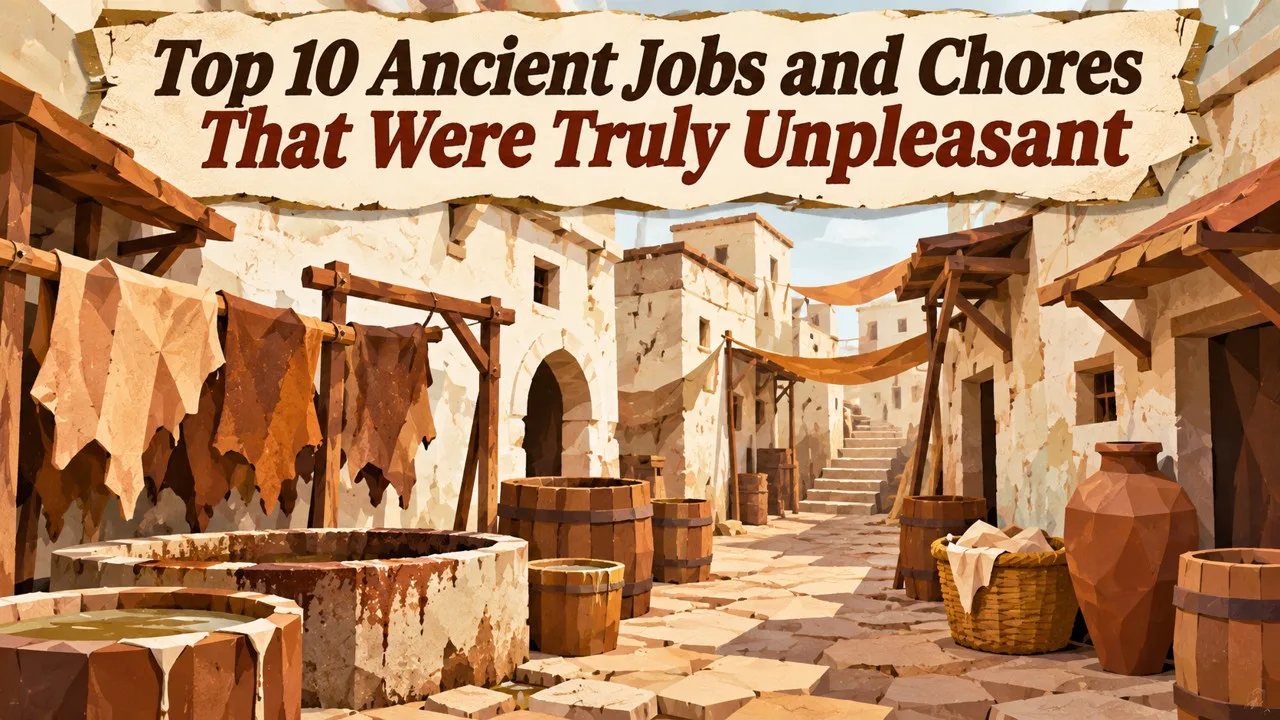
Washing cloth in urine, scraping hides, emptying cesspits and fermenting fish in the sun: ten historical jobs and chores that were truly unpleasant. Modern workers often complain about their jobs, but few face the conditions that many people endured in the past. Before machines, plumbing and modern chemistry, a great deal of necessary work was smelly, dirty, exhausting or dangerous.
Ancient and early modern societies depended on people who were willing, or forced, to do this work. Cloth had to be cleaned, leather had to be made, waste had to be removed and metals had to be dug from the ground.
Many of these tasks relied on materials that seem shocking today. Urine, dung and rotting fish were valuable resources in some industries, because they supplied chemicals that people could not yet manufacture.
The people who did these jobs were often poor, enslaved or convicted of crimes. Others were free workers who earned a living from tasks that most people preferred not to think about.
Some unpleasant jobs were surprisingly well paid or even prestigious, because few people wanted to do them or because they brought workers close to powerful people.
This list covers jobs and chores from ancient Egypt and Rome through to Tudor England. It avoids dangerous industrial jobs of the nineteenth and twentieth centuries, which are a separate subject.
Historical sources about ordinary workers are often limited. Where the evidence is uncertain or debated, that is noted.
Each entry names the job or chore, where it was done and when, followed by an account of what it involved.
The entries are arranged in roughly chronological order.
Together, they offer a vivid reminder of how much modern technology has changed working life, and how much earlier societies relied on people doing unpleasant tasks.
Key Facts
| # | Job or chore | Where | When |
|---|---|---|---|
| 1 | The trades described in the Satire of the Trades | Ancient Egypt | Middle Kingdom period |
| 2 | Tanning | Many ancient societies | Ancient times onwards |
| 3 | Galley rowing | The Mediterranean | Ancient to early modern times |
| 4 | Mining as punishment | Roman Empire | Roman period |
| 5 | Fulling | Roman Empire | Roman period |
| 6 | Making garum | Roman Empire | Roman period |
| 7 | Sewer cleaning | Ancient Rome | Roman period |
| 8 | Roman latrine sponges | Roman Empire | Roman period |
| 9 | Gong farmer | Tudor England | Sixteenth century |
| 10 | Groom of the Stool | Tudor England | Sixteenth century |
1. An Ancient Warning Against Manual Work
One of the earliest descriptions of unpleasant jobs comes from an ancient Egyptian text known as the Satire of the Trades. It is presented as advice from a father to his son as they travel to a school for scribes. The father describes many other occupations in deliberately grim terms [1].
According to translations of the text, metalworkers are described as having fingers like crocodile skin and smelling worse than fish eggs. Washermen work on the riverbank near crocodiles, and other labourers suffer from exhaustion, insects and dirt [1].
Related: Top 10 Historic Jobs Transformed by Technology
The text was meant to persuade students that the life of a scribe was far better than manual work. Although it exaggerates for effect, historians value it as a window into how ancient Egyptians viewed different kinds of labour.
2. Making Leather From Raw Hides
Turning animal skins into leather was one of the smelliest jobs in the ancient world. Tanners had to remove flesh and hair from raw hides and then treat them to prevent rotting [2].
Traditional methods used substances such as urine, animal dung and plant materials containing tannins. Hides were soaked for long periods in pits or vats, producing a powerful stench [2].
Because of the smell and waste, tanneries were often located on the edges of towns or downstream on rivers. Tanners in many societies were looked down upon, even though leather was essential for shoes, armour, harnesses and countless other items.
3. Rowing Heavy Galleys
Galleys, ships powered mainly by oars, were used in the Mediterranean for thousands of years. Rowing them was gruelling work, requiring crews to pull heavy oars for hours in cramped and hot conditions [3].
Contrary to a popular image, the rowers of ancient Greek and Roman warships were mostly free men, often paid for their service. In ancient Athens, poorer citizens frequently served as rowers [3].
In later centuries, however, Mediterranean powers increasingly used convicts, prisoners of war and enslaved people as galley rowers. Galley slaves lived in harsh conditions, chained to their benches, until the use of galleys declined in the eighteenth century.
4. Sent to the Mines
The Roman Empire mined gold, silver, copper, lead and other metals across its territory, including large operations in Spain. Mining was extremely hard and dangerous work, involving dark tunnels, heavy loads and toxic dust [4].
Many miners were enslaved people or convicts. Roman law included a punishment known as damnatio ad metalla, which sentenced criminals to work in the mines. It was regarded as one of the harshest penalties short of death [4].
At sites such as Las Medulas in Spain, Romans used huge amounts of water to break down entire hillsides in search of gold. The scarred landscape that remains shows the enormous scale of the labour involved.
Related: Top 10 Jobs That No Longer Exist
5. Washing Clothes With Urine
In ancient Rome, fullers cleaned and finished woollen cloth in workshops known as fullonicae. Their work involved trampling cloth in tubs filled with water and cleaning agents [5].
One of the most important cleaning agents was stale urine, which contains ammonia. Urine was collected, including from public containers, and used to remove grease and dirt from fabric. Several well-preserved fulleries have been found at Pompeii [5].
The trade in urine was valuable enough that the emperor Vespasian is said to have taxed its collection. According to the Roman historian Suetonius, when his son objected, Vespasian replied with words often rendered as money does not stink.
6. Fermenting Fish in the Sun
Garum was a fermented fish sauce that was widely used in Roman cooking. It was made by mixing fish, often including the guts, with salt and leaving the mixture to ferment for weeks or months [6].
The fermentation produced a strong-smelling liquid that was strained and sold in many grades, from cheap varieties to expensive luxury sauces. Large production sites existed around the Mediterranean, including in Spain and North Africa [6].
Workers had to handle large quantities of fish and tend the fermenting vats. Ancient writers commented on the smell of garum production, and some towns are thought to have restricted it for that reason, though details vary by place.
7. Cleaning the Sewers of Rome
Ancient Rome had an impressive system of drains and sewers, including the Cloaca Maxima, one of the oldest sewers in the world. These channels carried away waste and rainwater, but they also needed regular cleaning [7].
Clearing blockages and removing waste from sewers was filthy and unhealthy work. In a letter to the emperor Trajan, the Roman official Pliny the Younger mentioned convicts being used for public tasks such as cleaning baths and sewers [7].
The work exposed people to disease and foul air. Although Roman sanitation was advanced for its time, its maintenance depended on people doing some of the most unpleasant work imaginable.
Related: Top 25 Interesting Facts About the Universe
8. The Shared Sponge
Roman public latrines were often communal, with rows of seats side by side. Archaeologists and historians have long discussed how Romans cleaned themselves without toilet paper [8].
One commonly cited answer is the xylospongium, a sponge attached to a stick. It is often described as having been rinsed in water or vinegar and possibly shared, though some scholars argue that it may have been used mainly for cleaning the latrines themselves [8].
Whatever the exact use, someone had to clean the latrines, the sponges and the channels beneath them. Such tasks were usually done by enslaved people or low-status workers.
9. Emptying the Cesspits
In Tudor England, many homes relied on cesspits and privies, which needed to be emptied periodically. The workers who did this job were known as gong farmers, from gong, an old word for a privy [9].
Gong farmers dug out human waste by hand, often standing in it, and carried it away in barrels or carts. They were usually allowed to work only at night, and the waste had to be taken out of town [9].
The job was dangerous as well as disgusting, because of the fumes and the risk of falling into pits. Because few people wanted to do it, gong farmers were reportedly paid relatively well for manual workers.
10. The King's Most Intimate Servant
At the court of King Henry VIII, the Groom of the Stool was an official responsible for attending the king when he used the close stool, a portable toilet. The duties could include helping with personal hygiene [10].
Despite the nature of the work, the position was highly prestigious. The groom spent private time with the king and became one of his closest confidants, often gaining considerable influence and wealth [10].
The office changed over time and later became largely ceremonial. It shows that in royal courts, even the most personal and unpleasant tasks could bring power and status.
Related: Top 25 Interesting Facts About the Solar System
Conclusion
These jobs and chores show how much ancient and early modern societies depended on unpleasant labour. Many essential products and services relied on people willing, or forced, to work with filth, smells and danger.
The use of urine, dung and fermentation in industry reflects the limits of chemistry before modern times. People made clever use of available materials, even when the results were unpleasant.
Many of the workers involved were enslaved, convicted or poor, and their stories were rarely recorded in their own words. Historians often rely on legal texts, letters and archaeology to understand their lives.
Some unpleasant jobs, like that of the Groom of the Stool, could bring wealth and influence. Others, like mining as a punishment, were among the worst fates imaginable.
Modern sanitation, chemistry and machinery have eliminated many of these tasks, though some unpleasant jobs still exist in different forms today.
Archaeological sites such as Pompeii continue to reveal new details about everyday working life in the ancient world.
For modern readers, these jobs offer perspective on how much easier daily life has become, and a reason to appreciate the workers who keep modern sanitation running.
It is worth remembering that the people who did these jobs were not simply victims of their circumstances. Fullers formed associations in Roman towns, tanners and other tradespeople organised guilds in later centuries, and many workers took pride in their skills. Inscriptions, wall paintings and tools found by archaeologists show that ordinary workers left traces of their lives, even if the written histories of their time focused mainly on rulers, soldiers and wealthy citizens. Their labour quite literally kept ancient cities clean, clothed and fed.
- ^ [1] Accounts of the Satire of the Trades. Wikipedia: Satire of the Trades Wikipedia: Scribe
- ^ [2] Accounts of tanning. Wikipedia: Tanning (leather) Wikipedia: Tannery
- ^ [3] Accounts of galley rowing. Wikipedia: Galley slave Wikipedia: Galley
- ^ [4] Accounts of Roman mining. Wikipedia: Mining in ancient Rome Wikipedia: Las Medulas
- ^ [5] Accounts of Roman fulling. Wikipedia: Fulling Wikipedia: Vespasian
- ^ [6] Accounts of garum. Wikipedia: Garum Wikipedia: Ancient Roman cuisine
- ^ [7] Accounts of Roman sewers. Wikipedia: Cloaca Maxima Wikipedia: Pliny the Younger
- ^ [8] Accounts of Roman latrines. Wikipedia: Xylospongium Wikipedia: Sanitation in ancient Rome
- ^ [9] Accounts of gong farmers. Wikipedia: Gong farmer Wikipedia: Night soil
- ^ [10] Accounts of the Groom of the Stool. Wikipedia: Groom of the Stool Wikipedia: Henry VIII






















Discussion
Log in with