






 By
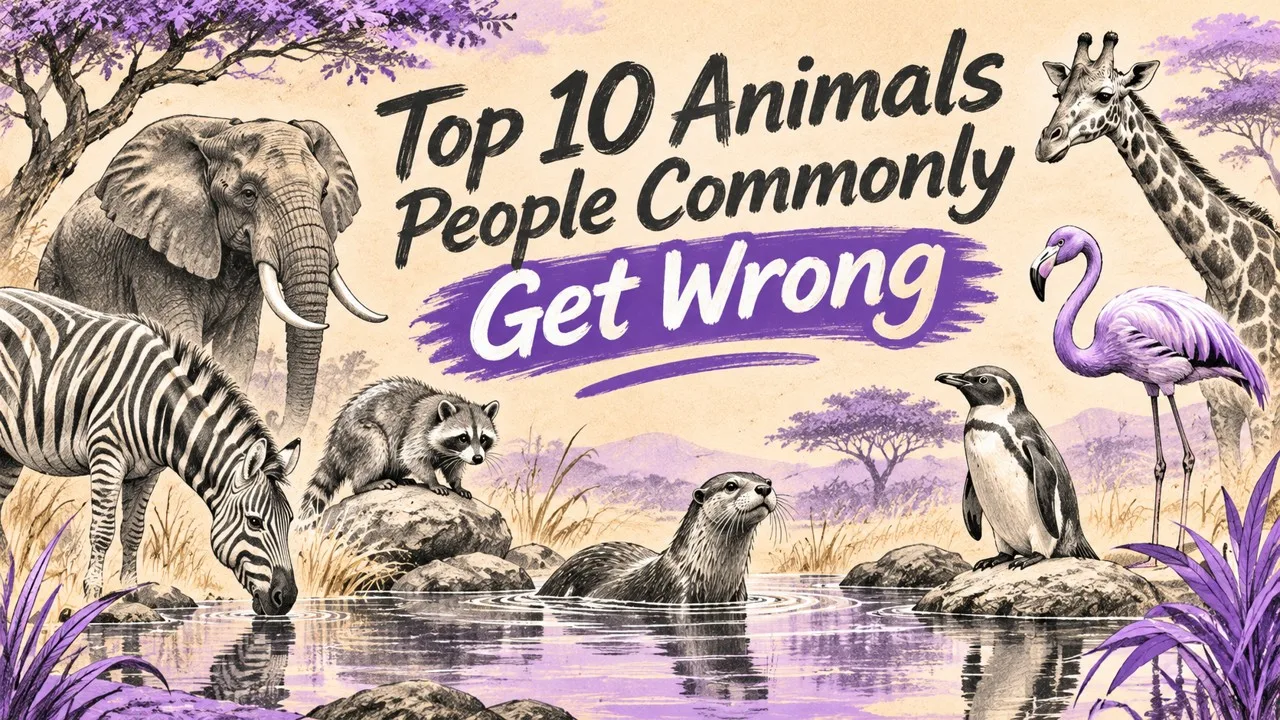
Ostriches do not bury their heads, bats are not blind and lemmings do not leap off cliffs: ten animals people commonly get wrong, and the truth about them. Many of the things people believe about animals are simply not true. Myths about animal behavior are passed down through stories, cartoons, films and casual conversation, until they become so familiar that few people stop to question them.
Some of these myths began with genuine observations that were misunderstood. An animal's behavior may look like one thing to a casual observer but turn out to mean something entirely different when studied closely.
Others grew from ancient writings, folk tales or deliberate exaggerations. In at least one famous case, a myth was reinforced by staged scenes in a nature documentary watched by millions of viewers.
Correcting these myths matters. Misunderstandings about animals can lead people to fear harmless creatures, mistreat wildlife or make poor decisions when they encounter animals in the wild.
The truth is often more interesting than the myth. Animals have evolved remarkable abilities and behaviors that are far more impressive than the simple stories told about them.
The animals below include birds, mammals, insects and arachnids from around the world. Some are familiar household visitors, while others live in deserts, forests and the Arctic tundra.
The explanations are based on the findings of biologists and other researchers who have studied these animals in detail. Where scientists are still investigating a question, that is noted.
Each entry names the animal, the common myth about it and the reality, followed by a fuller explanation.
The entries are arranged in no particular order. Several of these myths are so widespread that they appear in everyday expressions, such as burying one's head in the sand or being blind as a bat.
Together, they show the value of looking closely at the natural world and checking popular beliefs against careful observation.
Ancient naturalists played a large role in spreading some animal myths. Writers such as Pliny the Elder in Roman times collected stories from travelers and earlier authors, often without checking them. Medieval bestiaries, illustrated books about animals, combined real observations with fables and moral lessons. Some of the myths they recorded survived for centuries, passed from book to book long after anyone had tested them against the behavior of real animals.
Key Facts
| # | Animal | Common myth | Reality |
|---|---|---|---|
| 1 | The ostrich | Ostriches bury their heads in the sand when frightened | Ostriches do not bury their heads; they lie low or run |
| 2 | The bull | Bulls are enraged by the color red | Bulls react to movement, not color |
| 3 | Bats | Bats are blind | Bats can see, and many see well |
| 4 | Lemmings | Lemmings commit mass suicide by jumping off cliffs | Lemmings migrate but do not deliberately kill themselves |
| 5 | Camels | Camels store water in their humps | Camel humps store fat, not water |
| 6 | Porcupines | Porcupines can shoot their quills at attackers | Porcupines cannot throw their quills |
| 7 | Daddy longlegs | Daddy longlegs are the most venomous spiders but cannot bite humans | The claim is false |
| 8 | Bumblebees | Science says bumblebees should not be able to fly | Bumblebee flight is well understood |
| 9 | Songbirds | Parent birds will abandon chicks touched by humans | Most birds have a poor sense of smell and do not abandon chicks for this reason |
| 10 | Owls | Owls can turn their heads all the way around | Owls can rotate their heads about 270 degrees |
1. Heads in the Sand
The idea that ostriches bury their heads in the sand to hide from danger dates back at least to ancient Roman writers. It has become a common expression for ignoring a problem, and it appears in countless cartoons and jokes [1].
Related: Top 10 New Facts About Everyday Animals
In reality, ostriches do not bury their heads. When threatened, they usually run away, reaching high speeds, or kick powerfully with their long legs. A frightened ostrich may also lie flat on the ground with its neck stretched out, which from a distance can make its head seem to disappear [1].
The myth may also come from the way ostriches tend their eggs. They lay eggs in shallow holes in the ground and regularly turn them with their beaks, which can look as if their heads are buried. An animal that truly buried its head would not survive long in the wild.
2. Seeing Red
In bullfighting, the matador waves a red cloth called a muleta, and many people believe the color itself makes the bull angry. The idea has entered everyday language, as in the phrase like a red rag to a bull [2].
Cattle, however, are dichromatic, meaning they cannot distinguish red in the way humans do. Experiments have shown that bulls charge at moving cloths regardless of their color [2].
What provokes the bull is the movement of the cloth and the stressful situation of the bullring. The red color is traditional, and it may also help disguise bloodstains during the event.
3. Blind as a Bat
The expression blind as a bat suggests that bats cannot see. In fact, no bat species is blind. All bats have eyes and can see, though their vision varies between species [3].
Many small insect-eating bats rely heavily on echolocation, producing high-pitched sounds and listening to the echoes to navigate and find prey in the dark. This remarkable ability may have contributed to the myth [3].
Larger fruit bats, sometimes called flying foxes, often have excellent vision and do not echolocate in the same way. Some bats can even see ultraviolet light.
4. Cliffs and Lemmings
Lemmings are small rodents that live in the Arctic. A popular myth claims that they periodically follow one another off cliffs in a mass suicide [4].
The myth was strongly reinforced by the 1958 Disney documentary White Wilderness, which showed lemmings appearing to leap into the sea. Later investigations revealed that the filmmakers had staged the scene, bringing lemmings to the location and pushing them off a ledge [4].
Related: Top 10 Most Intelligent Animals
In reality, lemming populations rise and fall dramatically. When populations are high, lemmings may disperse in search of food, and some may drown while crossing water, but they do not deliberately kill themselves.
5. Water in the Hump
Camels are famous for surviving long periods without drinking water, and many people believe they store water in their humps. This is not the case [5].
A camel's hump contains fat, which serves as an energy reserve when food is scarce. When the fat is used up, the hump can shrink and droop [5].
Camels survive in deserts because of other adaptations. They can lose a large proportion of their body water without harm, drink enormous amounts quickly when water is available and conserve water through their kidneys and breathing.
6. Flying Quills
A popular belief holds that porcupines can shoot their quills like arrows when threatened. In reality, porcupines cannot launch their quills [6].
The quills are modified hairs that detach easily when touched. When threatened, a porcupine raises its quills and may back into an attacker or swing its tail, embedding quills in the predator's skin [6].
Many quills have tiny barbs that make them difficult and painful to remove. This defense is effective enough that most predators learn to avoid porcupines.
7. The Venomous Spider Myth
A widely repeated myth claims that the daddy longlegs is the most venomous spider in the world, but its fangs are too small to bite humans. This claim is false [7].
The name daddy longlegs is used for several different creatures, including harvestmen, which are not spiders at all and have no venom glands, and cellar spiders, which are true spiders [7].
Related: Top 10 Unexpected Abilities Found in Animals
Cellar spiders do have venom, but there is no evidence that it is especially dangerous to humans. Researchers who tested the claim found that their venom has only a mild effect.
8. The Bumblebee That Science Said Could Not Fly
A popular story claims that scientists once calculated that bumblebees should not be able to fly, because their wings are too small for their bodies. The story is often used to suggest that science does not know everything [8].
The myth appears to come from early twentieth-century calculations that treated bee wings like airplane wings, which do not flap. Bees fly very differently [8].
Bumblebees beat their wings rapidly in a sweeping motion that creates swirling air currents, producing lift. Scientists using high-speed cameras and models have explained how this works.
9. Touching Baby Birds
Many people believe that if a human touches a baby bird, its parents will smell the human scent and abandon it. This myth has discouraged people from helping chicks that have fallen from nests [9].
Most songbirds have a relatively poor sense of smell and do not reject chicks because of human scent. Parents are usually strongly attached to their young [9].
Experts advise that a featherless nestling found on the ground can often be gently returned to its nest. However, many young birds found on the ground are fledglings learning to fly, and their parents are usually nearby, so they are best left alone.
10. Spinning Heads
Owls are famous for their ability to turn their heads, and a common myth claims they can rotate them in a full circle. In fact, many owls can turn their heads about 270 degrees [10].
Owls need this flexibility because their eyes are fixed in their sockets and cannot move like human eyes. To look around, they must turn their whole head [10].
Related: Top 10 Animals That Make Music in the Wild
Researchers have found that owls have special adaptations, including extra neck vertebrae and blood vessels designed to keep blood flowing to the brain while the head is turned.
Conclusion
Many popular beliefs about animals turn out to be myths. Ostriches do not bury their heads, bats are not blind and camels do not store water in their humps.
These myths spread through stories, films and everyday expressions, and some were reinforced by misleading documentaries.
The truth is often more fascinating than the myth. Animals have evolved remarkable adaptations that allow them to survive in challenging environments.
Correcting these myths can help people better understand and respect wildlife, and make better decisions when they encounter animals.
Wildlife organizations and museums work to share accurate information, and many encourage people to report observations that can help scientists learn more.
New research continues to overturn assumptions, showing that even familiar animals can surprise the scientists who study them most closely.
The next time you hear a surprising claim about an animal, it may be worth checking whether it is true. The real story is often even better.
Even experts are sometimes surprised. Scientists regularly discover that familiar animals are smarter, more social or more adaptable than previously believed.
- ^ [1] Accounts of ostriches. Wikipedia: Common ostrich Wikipedia: Ostrich effect
- ^ [2] Accounts of bulls and color. Wikipedia: Bullfighting Wikipedia: Color vision
- ^ [3] Accounts of bat vision. Wikipedia: Bat Wikipedia: Animal echolocation
- ^ [4] Accounts of lemmings. Wikipedia: Lemming Wikipedia: White Wilderness
- ^ [5] Accounts of camels. Wikipedia: Camel Wikipedia: Dromedary
- ^ [6] Accounts of porcupines. Wikipedia: Porcupine Wikipedia: North American porcupine
- ^ [7] Accounts of daddy longlegs. Wikipedia: Opiliones Wikipedia: Pholcidae
- ^ [8] Accounts of bumblebee flight. Wikipedia: Bumblebee Wikipedia: Insect flight
- ^ [9] Accounts of baby birds. Wikipedia: Fledge Wikipedia: Bird
- ^ [10] Accounts of owls. Wikipedia: Owl Wikipedia: Bird anatomy




















Discussion
Log in with