






 By
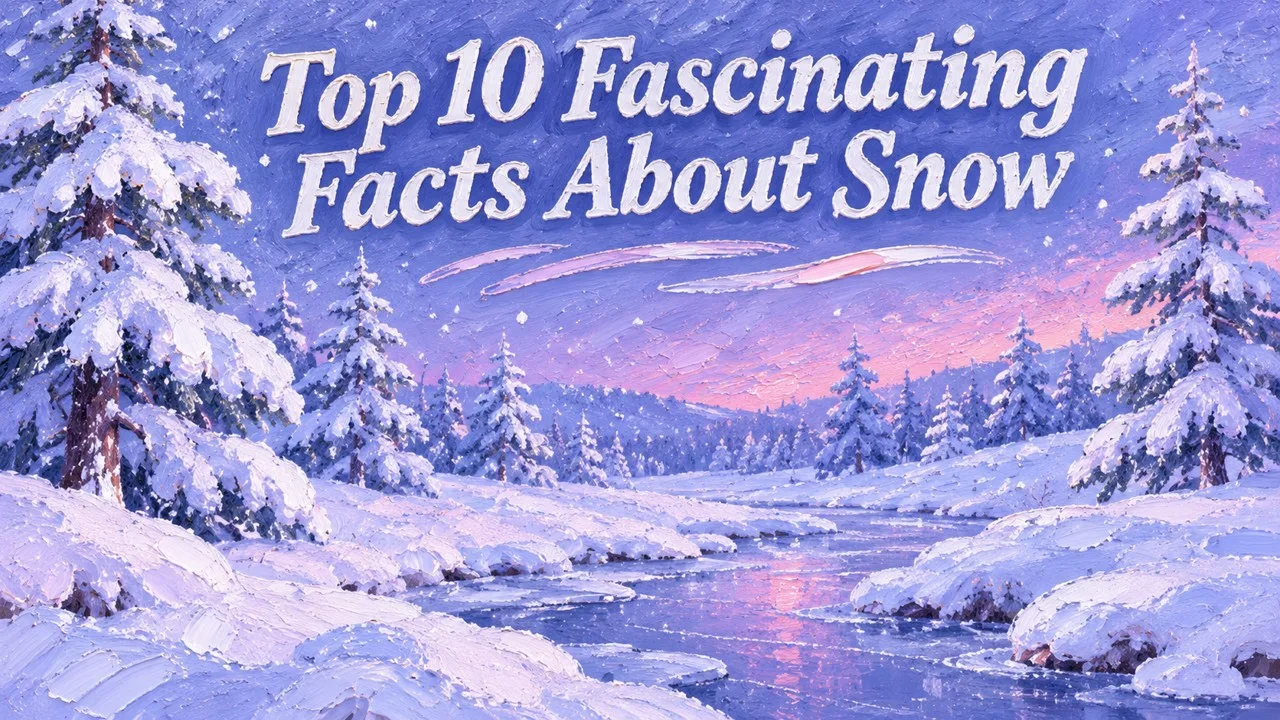
Six-sided crystals, pink snow, record snowfalls and flakes falling on Mars: ten fascinating facts about the science and history of snow. Snow is one of the most familiar forms of weather for millions of people, yet it is also one of the most remarkable. Each flake is a tiny ice crystal shaped by the conditions it encounters as it falls, and together those crystals can blanket entire landscapes.
Scientists have studied snow for centuries. Early naturalists sketched its shapes by hand, photographers captured its patterns on glass plates and physicists grew artificial crystals in laboratories to understand how they form.
Snow matters for far more than winter sports and holiday scenery. It stores water that later feeds rivers, reflects sunlight back into space and provides shelter for animals that live beneath it.
It also has a surprising cultural history, including a popular claim about the number of words certain languages have for it, a claim that linguists have spent decades debating.
The facts below range from the physics of ice to record snowfalls on mountains in the United States and snow observed falling on another planet.
Some of them correct common misunderstandings, such as the idea that snow is naturally white or that it is always cold and lifeless underneath.
Others introduce lesser-known phenomena, such as pink snow colored by algae and thunderstorms that produce snow instead of rain.
Taken together, they show that this everyday substance is far more complex and interesting than it first appears, and that there is still much for scientists to learn.
Key Facts
| # | Fact | Key term | Example |
|---|---|---|---|
| 1 | Snow crystals are hexagonal | Ice Ih | Classic six-armed flakes |
| 2 | Wilson Bentley's micrographs | Photomicrography | More than 5,000 images |
| 3 | Ukichiro Nakaya's artificial crystals | Nakaya diagram | Hokkaido University, 1936 |
| 4 | Light scattering in ice | Albedo | Fresh snow reflects most sunlight |
| 5 | Snow as insulation | Subnivean zone | Igloos and burrowing animals |
| 6 | Algae color the snowpack | Watermelon snow | Mountains and polar regions |
| 7 | The heaviest recorded seasonal snowfall | Mount Baker | Winter of 1998 to 1999 |
| 8 | Snow from a thunderstorm | Thundersnow | Lake-effect and winter storms |
| 9 | Inuit and Yupik vocabulary | Eskimo words for snow | Linguistic debate |
| 10 | Snow observed falling on Mars | Phoenix lander | Mars, 2008 |
1. Why Snowflakes Have Six Sides
Most snow crystals have a six-fold symmetry. This comes from the way water molecules bond together when they freeze into ordinary ice, which scientists call ice Ih. The molecules link through hydrogen bonds into a hexagonal lattice, and that arrangement is reflected in the shape of the crystal [1].
As a crystal falls through clouds, it grows by collecting water vapor. Because all six arms experience nearly the same temperature and humidity at the same moment, they tend to grow in similar ways, producing the familiar symmetrical star shapes. Real snowflakes are often less perfect, with broken arms or irregular growth [1].
Snow crystals also take other forms, including plates, columns, needles and hollow prisms. These shapes depend largely on the temperature and humidity in which the crystals grow. Many falling snowflakes are actually clumps of several crystals stuck together.
Related: Top 10 Most Bizarre Phobias: Strange Fears That Exist
2. The Farmer Who Photographed Snow
Wilson Bentley, a farmer from Jericho, Vermont, became famous for photographing snowflakes. In 1885, he succeeded in capturing an image of a single snow crystal by attaching a camera to a microscope, which is believed to be the first photograph of its kind [2].
Over the rest of his life, Bentley photographed more than five thousand snow crystals. He worked in the cold, handling each crystal carefully with a feather or a small tool so that it would not melt before he could photograph it [2].
His work helped popularize the idea that no two snowflakes are alike. In 1931, many of his images were published in a book called Snow Crystals, which remains a valued resource. He became known as the Snowflake Man.
3. Snow Made in a Laboratory
The Japanese physicist Ukichiro Nakaya was the first to grow artificial snow crystals in a laboratory. Working at Hokkaido University in the 1930s, he created crystals on a rabbit hair in a cold chamber, carefully controlling the temperature and humidity [3].
By varying these conditions, Nakaya showed how they determined the shape of the crystals. He organized his results into a chart, often called the Nakaya diagram, which links crystal types to the temperature and moisture in which they form [3].
Nakaya is often quoted as saying that snow crystals are letters sent from heaven, because their shapes reveal information about the conditions in the upper atmosphere. His research laid the foundation for the modern science of snow crystals.
4. Snow Is Not Really White
Individual ice crystals are translucent, not white. Snow appears white because light is scattered many times as it passes through the countless crystals and air pockets in a snowpack. Because the scattering affects all visible colors similarly, the light that reaches our eyes appears white [4].
Fresh snow reflects a large share of the sunlight that falls on it, giving it a very high albedo. This helps keep snowy regions cool and plays an important role in Earth's climate, since melting snow exposes darker ground that absorbs more heat [4].
Deep snow or glacial ice can sometimes look blue. This happens because ice absorbs slightly more red light than blue light, so when light travels a long distance through it, the blue tones become more visible.
Related: Top 10 Oldest Buildings in the World
5. A Warm Blanket of Snow
Snow contains a large amount of trapped air, which makes it a good insulator. This is why a snow shelter can be much warmer inside than the air outside. The igloo, a traditional shelter built by Inuit people, uses blocks of compacted snow to hold in warmth [5].
Beneath a deep snowpack, a space called the subnivean zone can form near the ground. Temperatures there stay relatively stable, often close to freezing, even when the air above is far colder. Small animals such as voles, mice and shrews live and travel in this zone during winter [5].
The insulating effect of snow also protects plants and soil. A covering of snow can prevent the ground from freezing as deeply as it would otherwise, helping roots and hibernating insects survive the winter.
6. Pink and Red Snow
In some mountain and polar regions, snow can turn pink or red during the warmer months. This phenomenon, often called watermelon snow, is caused by microscopic algae such as Chlamydomonas nivalis that live in the snow. The algae contain red pigments that protect them from strong sunlight [6].
The colored snow is sometimes said to smell faintly of watermelon, though this description varies. Hikers are generally advised not to eat it, since the algae may cause digestive upset [6].
Watermelon snow has an important effect on melting. Because the colored snow is darker than clean snow, it absorbs more sunlight and melts faster. Scientists study this process to understand how algae may influence the melting of snow and ice.
7. A Mountain of Record Snowfall
Mount Baker in Washington State is known for its extremely heavy snowfall. During the winter of 1998 to 1999, the Mount Baker Ski Area recorded about 1,140 inches, or roughly 29 meters, of snow, which is widely cited as a world record for snowfall in a single season [7].
The record beat a previous mark set at Mount Rainier's Paradise area in the early 1970s. Such enormous totals result from moist air moving in from the Pacific Ocean and rising over the Cascade Range, where it cools and drops much of its moisture as snow [7].
Related: 10 Sikh Gurus: The Pillars of Sikhism Who Shaped Faith, Equality, Courage, and Humanity
Measurements like these depend on where and how snow is recorded, so different sources sometimes cite slightly different figures. Even so, the Cascade Mountains are among the snowiest places on Earth.
8. Thunder and Lightning in a Snowstorm
Thundersnow occurs when a thunderstorm produces snow instead of rain. It is relatively rare, because the conditions that create thunderstorms, such as strong rising air, are more common in warm weather [8].
It can happen in intense winter storms and in lake-effect snow, which forms when cold air passes over warmer lake water and picks up moisture. The Great Lakes region of North America is one place where this can occur [8].
Thunder is often harder to hear during thundersnow, because falling snow muffles sound. Thundersnow is often associated with very heavy snowfall rates, so meteorologists pay close attention when it is reported.
9. The Debate Over Words for Snow
A popular claim says that Inuit and Yupik languages have dozens or even hundreds of words for snow. The idea has been repeated widely, but linguists have debated it for decades [9].
Part of the debate involves how words are counted. These languages build long words by adding endings to roots, so many combinations are possible, much as English can describe snow with phrases like powder or slush. Some researchers argue the claim is exaggerated, while others say these languages do have a rich vocabulary for snow and ice [9].
The discussion has become a well-known example in linguistics of how claims about language can spread and change over time. It also raises questions about how vocabulary reflects the environment in which people live.
10. Snow on Another Planet
In 2008, NASA's Phoenix lander, which touched down near the north pole of Mars, detected snow falling from Martian clouds. Its laser instrument observed precipitation descending from clouds several kilometers above the surface [10].
Related: Top 10 Tallest Buildings in the World
The snow observed by Phoenix appeared to vaporize before reaching the ground. Scientists also believe that carbon dioxide snow, made of frozen carbon dioxide rather than water, falls in the polar regions of Mars during winter [10].
Discoveries like these help scientists understand weather on other worlds. They also show that the processes that make snow on Earth can happen in very different environments.
Conclusion
Snow is far more than frozen rain. Its six-sided crystals reveal the structure of water molecules, its whiteness comes from the scattering of light and its shapes record the conditions of the clouds where it formed.
Pioneers like Wilson Bentley and Ukichiro Nakaya helped turn snow into a subject of serious scientific study, while modern researchers continue to explore its role in climate and ecosystems.
From pink snow on mountains to snow observed on Mars, the subject still offers surprises. Even familiar claims, like those about words for snow, turn out to be more complex than they first appear.
Understanding snow also matters for practical reasons, from forecasting winter storms to managing water supplies that depend on melting snowpacks.
The next time snow begins to fall, it is worth taking a closer look at the flakes landing on a coat sleeve, each one a tiny record of its journey through the sky.
Snow research continues today with satellites that measure snow cover from space and field scientists who dig snow pits to study the layers within a snowpack, work that helps predict avalanches and water supplies alike.
- ^ [1] Accounts of snowflake structure. Wikipedia: Snowflake Wikipedia: Ice Ih
- ^ [2] Accounts of Wilson Bentley. Wikipedia: Wilson Bentley Wikipedia: Snowflake
- ^ [3] Accounts of Ukichiro Nakaya. Wikipedia: Ukichiro Nakaya Wikipedia: Snowflake
- ^ [4] Accounts of snow color and albedo. Wikipedia: Snow Wikipedia: Albedo
- ^ [5] Accounts of snow as insulation. Wikipedia: Subnivean climate Wikipedia: Igloo
- ^ [6] Accounts of watermelon snow. Wikipedia: Watermelon snow Wikipedia: Snow
- ^ [7] Accounts of record snowfall. Wikipedia: Mount Baker Wikipedia: Mount Rainier
- ^ [8] Accounts of thundersnow. Wikipedia: Thundersnow Wikipedia: Lake-effect snow
- ^ [9] Accounts of words for snow. Wikipedia: Eskimo words for snow Wikipedia: Inuit languages
- ^ [10] Accounts of snow on Mars. Wikipedia: Phoenix (spacecraft) Wikipedia: Climate of Mars





















Discussion
Log in with