





 By
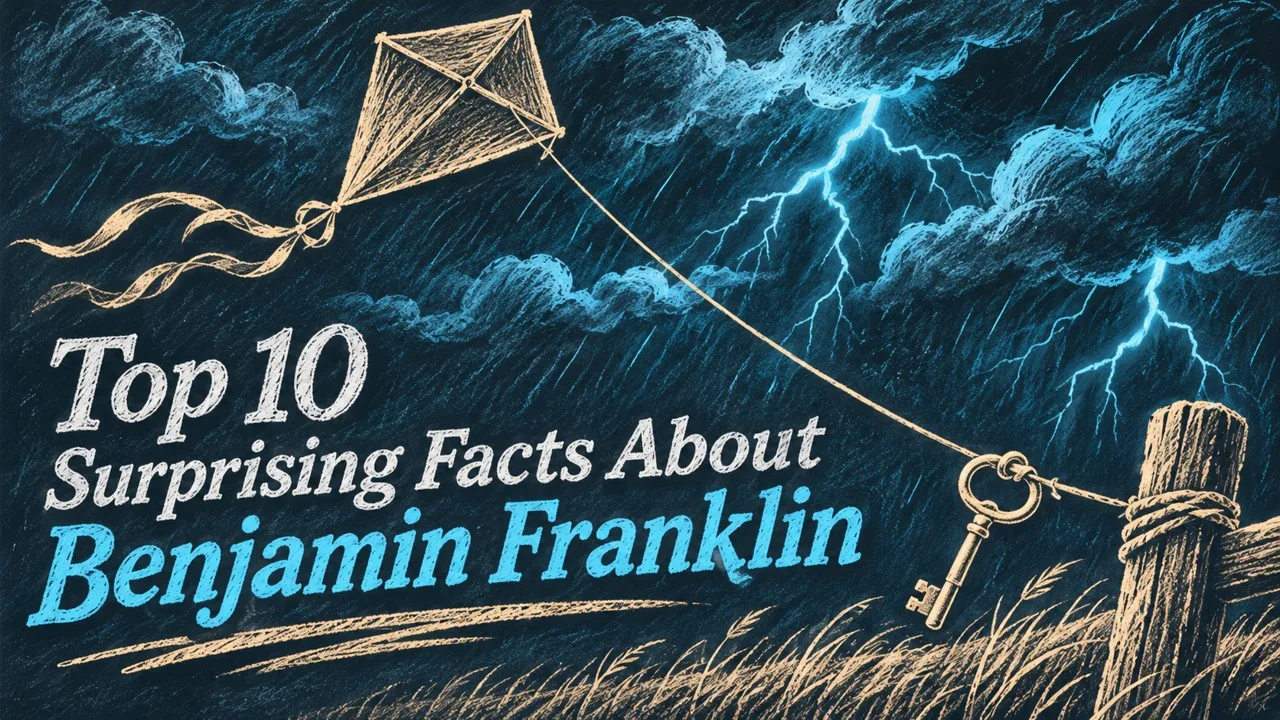
He wrote as a fictional widow, swam for fun, refused patents and left money to grow for 200 years: ten surprising facts about Benjamin Franklin. Benjamin Franklin is one of the most famous figures in American history. He is remembered as a Founding Father, a scientist, an inventor, a writer and a diplomat.
Born in Boston in 1706, Franklin was the fifteenth child of a candle and soap maker. He had little formal schooling, yet he became one of the most celebrated thinkers of the eighteenth century.
Most people know of his experiments with electricity, his role in the American Revolution and his face on the hundred-dollar bill. But his long life, which ended in 1790, was full of lesser-known episodes.
Some of these facts reveal a playful sense of humour. Others show his practical inventiveness, his scientific curiosity or his long-term thinking.
Franklin was also a complex figure whose views changed over time. His life included actions that seem troubling today as well as achievements that are widely admired.
This list avoids his best-known work on lightning, which is covered extensively elsewhere, and focuses on less familiar aspects of his life.
Several popular stories about Franklin are exaggerated or untrue. Where a common belief about him is a myth, that is explained.
Each entry names the fact, the area of his life it concerns and when it happened, followed by an explanation.
The entries are arranged in roughly chronological order.
Together, they offer a fuller picture of a man who was curious about almost everything.
Franklin's public career was remarkably long. He served as a colonial postal official, represented Pennsylvania and other colonies in London, helped draft the Declaration of Independence, negotiated the alliance with France during the Revolutionary War and helped negotiate the peace treaty with Britain in 1783. In his eighties, he was a delegate to the Constitutional Convention in Philadelphia. Along the way he helped found a lending library, a hospital and the academy that became the University of Pennsylvania.
Key Facts
| # | Fact | Area of life | When |
|---|---|---|---|
| 1 | Letters from Silence Dogood | Writing | 1722 |
| 2 | Swimming | Sport and leisure | 1710s onwards |
| 3 | Poor Richard's Almanack | Publishing | 1732 to 1758 |
| 4 | The Franklin stove | Invention | 1740s |
| 5 | Mapping an ocean current | Science | Around 1770 |
| 6 | The glass armonica | Music | 1761 |
| 7 | Slavery and abolition | Politics and society | 1730s to 1790 |
| 8 | The national bird | Popular myths | 1784 |
| 9 | An economical project | Humour and science | 1784 |
| 10 | A long-term bequest | Philanthropy | 1790 to 1990 |
1. The Teenager Who Wrote as a Widow
As a teenager, Franklin worked as an apprentice in the Boston printing shop of his older brother James, who published a newspaper called the New-England Courant. Franklin wanted to write for the paper, but he suspected his brother would not publish his work [1].
In 1722, at the age of 16, he began submitting letters under the name Silence Dogood, a fictional middle-aged widow. He slipped them under the door of the print shop at night [1].
Related: Top 10 Inventions That Changed the World
The letters, which gently mocked aspects of Boston life, were popular with readers. Franklin later revealed that he was the author, which reportedly did not please his brother. Soon afterwards, he left his apprenticeship and moved to Philadelphia.
2. An Early Swimming Enthusiast
Franklin loved swimming at a time when few people in the American colonies swam for pleasure. As a boy, he experimented with wooden paddles strapped to his hands to help him swim faster [2].
He later wrote about swimming techniques and recommended that more people learn to swim. During a stay in London as a young man, he impressed onlookers by swimming a long distance in the River Thames, and he was reportedly encouraged to open a swimming school [2].
Franklin's enthusiasm for the sport has been recognised in modern times. In 1968, he was inducted as an honorary member of the International Swimming Hall of Fame.
3. The Voice of Poor Richard
In 1732, Franklin began publishing an annual almanac under the pen name Richard Saunders. Almanacs were popular in colonial America, providing calendars, weather predictions, astronomical information and entertainment [3].
Poor Richard's Almanack became famous for its witty sayings about thrift, hard work and common sense. Many of these were adaptations of older proverbs, which Franklin reworded in a memorable way [3].
The almanac was a commercial success and helped make Franklin wealthy. He published it for about 25 years, and many of its sayings are still quoted today.
4. An Inventor Who Refused Patents
In the early 1740s, Franklin designed an improved wood-burning stove that was intended to heat rooms more efficiently than an open fireplace. It became known as the Franklin stove [4].
The governor of Pennsylvania reportedly offered him a patent for the design, but Franklin declined. In his autobiography, he explained that because people benefit from the inventions of others, they should be glad to share their own inventions freely [4].
Franklin followed this principle with other inventions as well. Others made money from versions of his stove, but he did not seek to profit from it.
Related: Top 10 Accidental Inventions That Changed Everyday Life
5. Charting the Gulf Stream
While serving as a colonial postal official, Franklin wondered why mail ships sailing from Britain to America often took longer than merchant ships. He consulted his cousin Timothy Folger, a whaling captain from Nantucket [5].
Folger explained that whalers knew about a strong current flowing across the Atlantic and avoided sailing against it. Franklin worked with him to produce a chart of this current, which Franklin named the Gulf Stream [5].
The chart was printed around 1770, but British sea captains were slow to use it. It is now regarded as an important early contribution to the scientific study of ocean currents.
6. An Instrument That Mozart Composed For
Franklin was fascinated by the music produced by rubbing wet fingers around the rims of glasses. In 1761, he invented a more practical instrument based on this effect, which he called the armonica [6].
The glass armonica used a set of nested glass bowls mounted on a rotating rod, operated by a foot pedal. The player touched the spinning glass with wet fingers to produce ethereal tones [6].
The instrument became popular in Europe, and composers including Wolfgang Amadeus Mozart and Ludwig van Beethoven wrote music for it. Its popularity later declined, partly because of rumours that its sound harmed listeners' health, though there is no good evidence for this.
7. A Slaveholder Who Turned to Abolition
For much of his life, Franklin owned enslaved people, and his newspaper printed advertisements for the sale of enslaved people. This part of his history is often left out of popular accounts [7].
Over time, his views changed. In his later years, he became an opponent of slavery, and in 1787 he became president of the Pennsylvania Society for Promoting the Abolition of Slavery [7].
In 1790, shortly before his death, Franklin signed a petition from the society asking the United States Congress to end slavery. Historians continue to discuss how his views developed and how to assess his record.
Related: Top 10 Surprising Facts About Paul Revere
8. The Truth About the Turkey
A popular story claims that Franklin wanted the turkey, rather than the bald eagle, to be the national bird of the United States. This is a myth, at least in its common form [8].
The story comes from a private letter that Franklin wrote to his daughter Sarah in 1784. Commenting on the design of a badge for a veterans' society, he joked that the eagle looked like a turkey and said the bald eagle was a bird of bad moral character, while the turkey was a more respectable bird [8].
Franklin never formally proposed the turkey as a national symbol. His letter was a humorous aside rather than a political campaign.
9. The Joke Behind Daylight Saving
Franklin is often credited with inventing daylight saving time. The claim is based on a letter he published in a Paris newspaper in 1784 while serving as a diplomat in France [9].
In the letter, he humorously observed that Parisians slept through the morning sunlight and burned candles late into the night. He suggested, satirically, that they could save money by getting up earlier, and proposed measures such as taxing window shutters and firing cannons to wake people at dawn [9].
The letter was a joke and did not propose changing clocks. Modern daylight saving time was proposed in the late nineteenth and early twentieth centuries by others.
10. A Gift Designed to Grow for 200 Years
In his will, Franklin left 1,000 pounds each to the cities of Boston and Philadelphia. The money was to be lent to young tradesmen at interest, and the funds were to grow over two centuries [10].
Franklin specified that part of the money could be spent after 100 years, with the rest continuing to grow for another century. He calculated that the funds would grow substantially through compound interest [10].
When the trusts reached their 200-year mark in 1990, they had grown to millions of dollars, though less than Franklin had projected. The money had supported institutions including a technical school in Boston, and the remaining funds were used for local purposes in both cities.
Related: Top 10 Facts About America's First Ladies
Conclusion
These facts show that Benjamin Franklin was far more than a man with a kite. He was a writer, swimmer, publisher, inventor, scientist, musician and philanthropist.
His sense of humour comes through in his letters, from the Silence Dogood essays to his joking comments on turkeys and early rising. Some of these jokes have been mistaken for serious proposals.
His refusal to patent his inventions and his long-term bequest reflect a belief in public benefit and practical improvement.
His record on slavery is a reminder that admired historical figures often had complex and troubling histories, and that people's views can change over time.
Franklin's scientific work, from electricity to ocean currents, earned him international recognition and helped him represent America abroad.
Historians continue to study his writings, which fill many volumes, revealing new details about his life and thought.
For anyone interested in American history, Franklin remains one of its most fascinating and many-sided figures.
Franklin's own autobiography, written in several stages late in his life and never finished, is one of the best-known American memoirs. It describes his early struggles, his self-improvement schemes and his business career, but it stops before the Revolution. Readers should remember that it presents Franklin as he wished to be seen, and historians compare it carefully with letters, newspapers and other records to build a more complete and balanced portrait.
Franklin died in Philadelphia in April 1790 at the age of 84. Large crowds attended his funeral, and tributes came from both sides of the Atlantic, including from the French National Assembly, which observed a period of mourning in his honour.
- ^ [1] Accounts of the Silence Dogood letters. Wikipedia: Silence Dogood Wikipedia: The New-England Courant
- ^ [2] Accounts of Franklin's swimming. Wikipedia: Benjamin Franklin Wikipedia: International Swimming Hall of Fame
- ^ [3] Accounts of the almanac. Wikipedia: Poor Richard's Almanack Wikipedia: Almanac
- ^ [4] Accounts of the Franklin stove. Wikipedia: Franklin stove Wikipedia: The Autobiography of Benjamin Franklin
- ^ [5] Accounts of the Gulf Stream chart. Wikipedia: Gulf Stream Wikipedia: Nantucket
- ^ [6] Accounts of the glass armonica. Wikipedia: Glass harmonica Wikipedia: Wolfgang Amadeus Mozart
- ^ [7] Accounts of Franklin and slavery. Wikipedia: Pennsylvania Abolition Society Wikipedia: Slavery in the United States
- ^ [8] Accounts of the turkey letter. Wikipedia: Bald eagle Wikipedia: Society of the Cincinnati
- ^ [9] Accounts of daylight saving time. Wikipedia: Daylight saving time Wikipedia: Journal de Paris
- ^ [10] Accounts of Franklin's bequest. Wikipedia: Benjamin Franklin Cummings Institute of Technology Wikipedia: Compound interest






















Discussion
Log in with