






 By
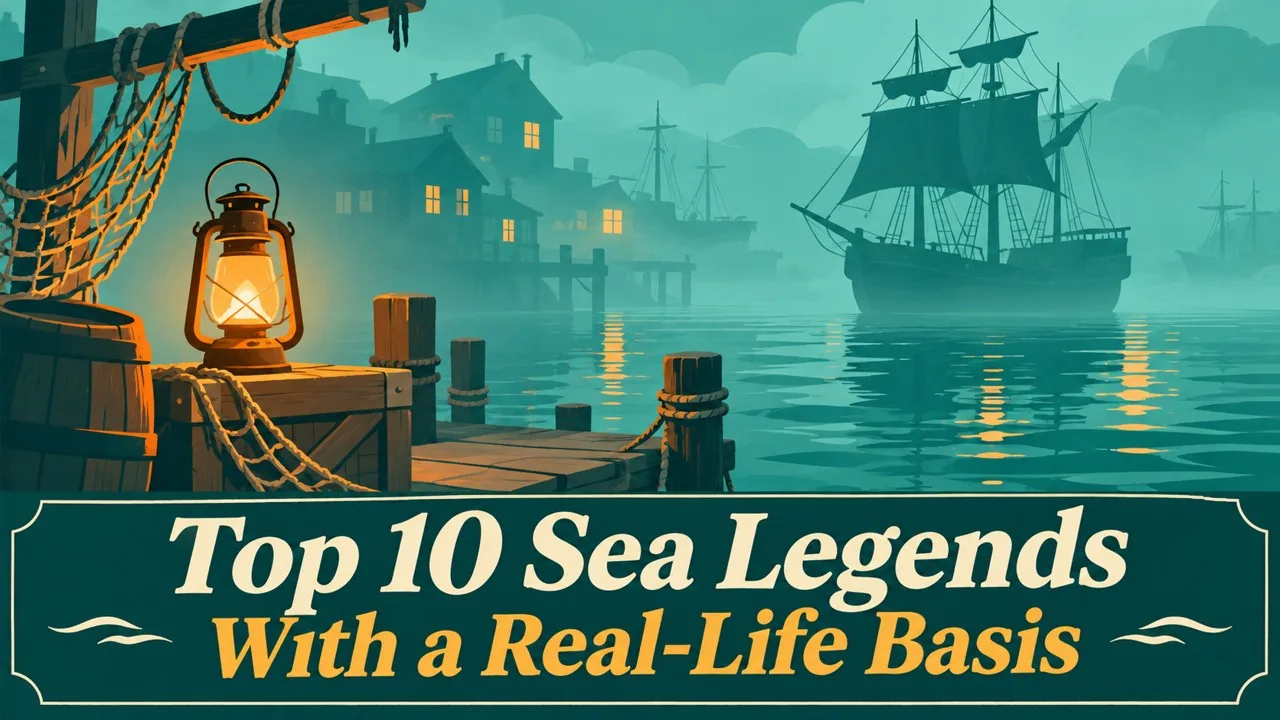
Krakens, mermaids, sea serpents and monster waves once sounded like sailors' tall tales. Ten sea legends that turned out to have a real basis. For thousands of years, sailors have returned from the sea with extraordinary stories. They told of giant tentacled monsters, beautiful half-human creatures, ghostly ships and waves as tall as buildings.
Many of these stories were dismissed as exaggerations, superstitions or the products of long voyages, loneliness and imagination. Life at sea was dangerous and mysterious, and the ocean seemed to hide endless secrets.
Yet modern science has shown that some of these legends had a real basis. Strange animals, unusual natural phenomena and optical illusions can explain many of the tales that sailors told.
In some cases, scientists confirmed the existence of phenomena that had long been doubted. In others, they found natural explanations for sightings that once seemed supernatural.
This does not mean that every sea legend is true. Many stories grew in the retelling, and some were deliberate hoaxes. But the kernel of truth behind several famous legends is remarkable.
The legends in this list come from many seafaring traditions. They include monsters, ghostly visions, deadly natural hazards and places that appeared on maps but did not exist.
Where the link between a legend and its proposed explanation is uncertain, that is noted.
Each entry names the legend, its real-life basis and how it was confirmed or explained, followed by an account of the story and the science.
The entries are not ranked.
Together, they show how the ocean continues to surprise us, and why sailors' stories deserved more attention than they sometimes received.
Key Facts
| # | Legend | Real-life basis | Confirmed or explained |
|---|---|---|---|
| 1 | The kraken | The giant squid | Live images captured in 2004 |
| 2 | Mermaids | Manatees and dugongs | Long suspected |
| 3 | Sea serpents | The oarfish and other animals | Known from specimens |
| 4 | The Flying Dutchman | Optical illusions such as the Fata Morgana | Proposed explanation |
| 5 | Monster waves | Rogue waves | Measured in 1995 |
| 6 | The Maelstrom | The Moskstraumen tidal currents | Studied and documented |
| 7 | Milky seas | Bioluminescent bacteria | Satellite images in 2005 |
| 8 | Saint Elmo's fire | An electrical discharge | Explained by physics |
| 9 | Unicorn horns | Narwhal tusks | Recognised in the seventeenth century |
| 10 | Phantom islands | Mapping errors and illusions | Disproved by survey in 2012 |
1. The Tentacled Giant
The kraken was a legendary sea monster said to lurk off the coasts of Norway and Greenland. In the eighteenth century, the Danish-Norwegian bishop Erik Pontoppidan described it as an enormous creature that could be mistaken for an island [1].
The legend is widely thought to have been inspired, at least in part, by sightings of the giant squid. This animal can grow to well over 10 metres long, including its long feeding tentacles, and it has the largest eyes of any known animal [1].
Related: Top 10 Phantom Islands That Fooled Mapmakers
For centuries, giant squid were known mainly from dead specimens washed ashore or found in the stomachs of sperm whales. In 2004, Japanese researchers captured the first photographs of a live giant squid in its natural habitat, and the first video footage in the deep sea followed in 2012.
2. Women of the Sea
Stories of mermaids, creatures with the upper body of a woman and the tail of a fish, appear in the folklore of many seafaring cultures. Sailors told of seeing them sitting on rocks or swimming near ships [2].
In January 1493, Christopher Columbus recorded in his journal that he had seen three mermaids near the island of Hispaniola. He noted that they were not as beautiful as they were usually depicted. Historians generally believe that he saw manatees [2].
Manatees and dugongs belong to a group of marine mammals called Sirenia, named after the sirens of Greek mythology. From a distance, their rounded heads, flippers and habit of floating upright could perhaps be mistaken for human figures, though how much they inspired mermaid legends is debated.
3. Serpents of the Deep
Sea serpents, long snake-like monsters, have been reported by sailors for centuries. Some reports described creatures many metres long, with crests or manes along their backs [3].
One animal often suggested as a source of these stories is the giant oarfish, the longest known bony fish. It can grow to around 8 metres, and it has a long, ribbon-like silver body with a bright red crest. It lives in deep water and is rarely seen alive [3].
Oarfish sometimes wash ashore or appear near the surface when sick or dying, which may have fuelled sightings of serpents. Other sea serpent reports may be explained by lines of swimming animals, floating seaweed or large eels.
4. The Ghost Ship
The Flying Dutchman is a legendary ghost ship said to be doomed to sail the oceans forever, never able to reach port. Sightings of the ship were considered an omen of doom. The legend appears in print from the late eighteenth century and later inspired an opera by Richard Wagner [4].
Sailors over the years reported seeing ghostly ships floating above the horizon or appearing in strange places. One possible explanation is the Fata Morgana, a complex mirage that can make distant ships appear to float in the air or appear distorted [4].
This type of mirage occurs when layers of air at different temperatures bend light. It is particularly common over cold water. While it cannot explain every ghost ship story, it may account for some sightings that inspired the legend.
Related: Top 10 Phantom Islands That Never Existed
5. Walls of Water
For centuries, sailors told of enormous waves that appeared suddenly out of relatively normal seas. Scientists and engineers were often sceptical, as such waves seemed inconsistent with standard models of ocean waves [5].
On 1 January 1995, instruments on the Draupner gas platform in the North Sea recorded a single wave about 25.6 metres high, far taller than the surrounding waves. It was one of the first rogue waves to be measured reliably [5].
Further research, including satellite observations, has shown that rogue waves are more common than once believed. They are now recognised as a serious hazard to ships and offshore structures, and scientists continue to study how they form.
6. The Great Whirlpool
The word maelstrom, meaning a powerful whirlpool, comes from a real place: a system of strong tidal currents and eddies off the Lofoten Islands in Norway, known as the Moskstraumen. Legends described a giant whirlpool that could swallow ships [6].
The Moskstraumen became famous through literature, including a story by Edgar Allan Poe published in 1841. These accounts exaggerated it into a vast vortex [6].
In reality, the Moskstraumen is created by strong tides moving through a narrow passage. It can produce powerful currents and whirlpools that are dangerous to small boats, but it does not swallow large ships as legends claimed.
7. The Sea That Glows
Sailors have long reported nights when the sea glowed with a steady white light, stretching to the horizon. These milky seas were described in ships' logs and literature, but scientists struggled to study them [7].
In 1995, the crew of a merchant ship in the Arabian Sea reported sailing through a glowing sea for hours. Researchers later examined satellite images from that night and, in a study published in 2005, identified a glowing area of ocean covering thousands of square kilometres [7].
Milky seas are thought to be caused by vast numbers of bioluminescent bacteria. They remain rare and poorly understood, but they are now recognised as a real phenomenon.
Related: Top 10 Historical Myths and the Texts That Started Them
8. Fire on the Masts
During storms, sailors sometimes saw a glowing blue or violet light on the tops of masts and rigging. They called it Saint Elmo's fire, after Saint Erasmus of Formia, a patron saint of sailors, and often saw it as a sign of divine protection [8].
The phenomenon was recorded by many sailors over the centuries, including members of Ferdinand Magellan's expedition in the sixteenth century [8].
Scientists now know that Saint Elmo's fire is a weather phenomenon caused by electrical discharge. In a strong electric field, such as during a thunderstorm, the air around pointed objects becomes ionised and glows.
9. The Sea Unicorn
In medieval and Renaissance Europe, unicorn horns were among the most valuable objects that a person could own. They were believed to have the power to neutralise poisons and were sold for enormous sums [9].
Many of these horns were actually the tusks of narwhals, Arctic whales whose males typically grow a long, spiralled tusk. The tusk is an elongated tooth. Traders from the far north supplied the tusks to Europe, sometimes without revealing their true source [9].
In the seventeenth century, naturalists including the Danish scholar Ole Worm helped show that so-called unicorn horns came from narwhals. Narwhal tusks were also used in royal objects, including a throne of the Danish kings.
10. Islands That Were Never There
For centuries, maps showed islands that did not exist. These phantom islands appeared because of navigational errors, mirages, floating pumice or simple mistakes copied from one map to another [10].
One of the most recent examples was Sandy Island, which appeared on many maps and in digital mapping services in the Coral Sea between Australia and New Caledonia. In 2012, an Australian research ship sailed to its supposed location and found only deep open ocean [10].
The disappearance of Sandy Island made headlines around the world. It showed that even modern maps could contain errors inherited from much older charts, and that sailors' reports of land were not always reliable.
Related: Top 10 Bioluminescent Sea Animals That Use Light to Survive
Conclusion
These legends show that sailors' stories often contained a kernel of truth. Strange creatures, natural phenomena and illusions lay behind many tales once dismissed as fantasy.
Science has explained some of these legends and confirmed others, such as rogue waves and milky seas, that experts once doubted.
At the same time, the legends grew in the retelling. Giant squid do not sink ships, and the Maelstrom does not swallow them whole.
The ocean remains one of the least explored parts of our planet. Scientists continue to discover new species and phenomena in the deep sea.
New technologies, from satellites to deep-sea cameras, are allowing researchers to investigate ocean mysteries that were once beyond reach.
The history of these legends also reminds scientists to take eyewitness reports seriously, even when they seem unlikely.
For anyone who loves the sea, these stories show that reality can be just as extraordinary as legend.
Ships' logs, kept by officers on countless voyages, have become a valuable resource for modern researchers. Historians and climate scientists have used old logbooks to reconstruct past weather, sea ice and ocean conditions, and the same records sometimes contain detailed descriptions of glowing seas, strange lights and unusual animals. Read carefully, these entries can help separate genuine observations from later embellishment.
- ^ [1] Accounts of the kraken and giant squid. Wikipedia: Kraken Wikipedia: Giant squid
- ^ [2] Accounts of mermaids and manatees. Wikipedia: Mermaid Wikipedia: Sirenia
- ^ [3] Accounts of the oarfish. Wikipedia: Oarfish Wikipedia: Sea serpent
- ^ [4] Accounts of the Flying Dutchman. Wikipedia: Flying Dutchman Wikipedia: Fata Morgana (mirage)
- ^ [5] Accounts of rogue waves. Wikipedia: Draupner wave Wikipedia: Rogue wave
- ^ [6] Accounts of the Moskstraumen. Wikipedia: Moskstraumen Wikipedia: Lofoten
- ^ [7] Accounts of milky seas. Wikipedia: Milky seas effect Wikipedia: Bioluminescence
- ^ [8] Accounts of Saint Elmo's fire. Wikipedia: St. Elmo's fire Wikipedia: Erasmus of Formia
- ^ [9] Accounts of narwhal tusks. Wikipedia: Narwhal Wikipedia: Ole Worm
- ^ [10] Accounts of phantom islands. Wikipedia: Sandy Island, New Caledonia Wikipedia: Phantom island


















Discussion
Log in with