





 By
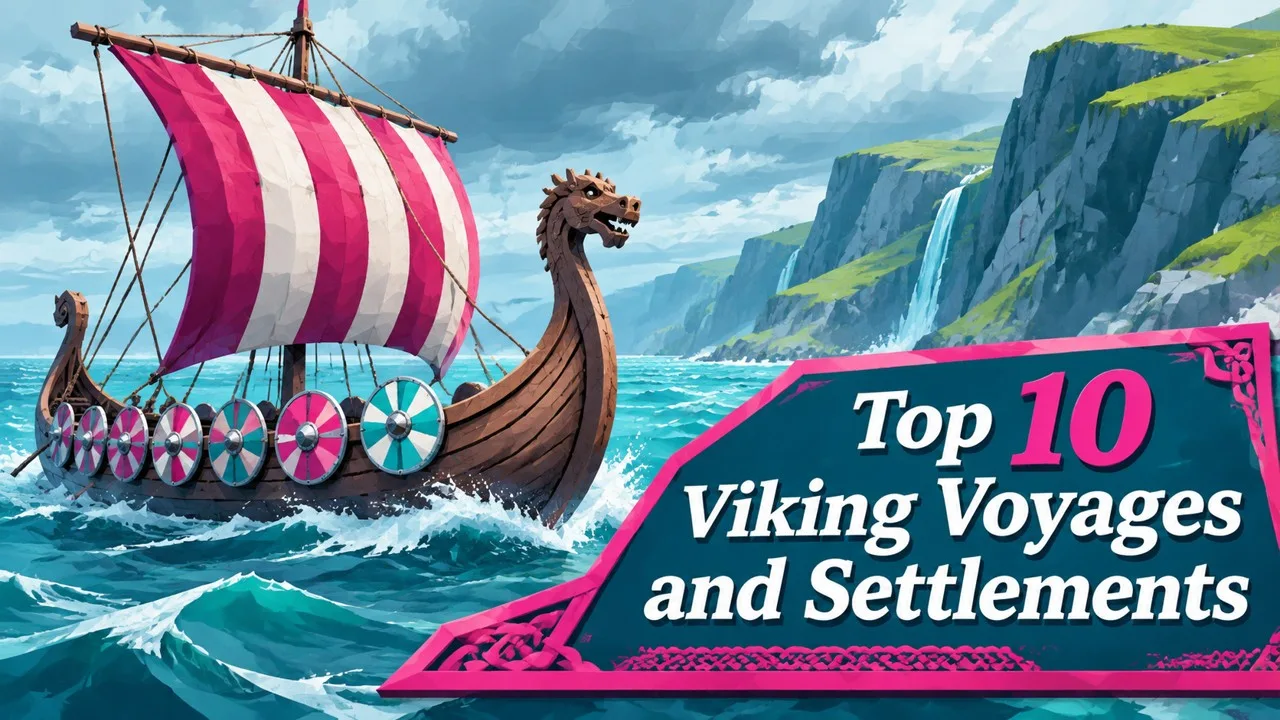
From the raid on Lindisfarne to a Norse camp in Newfoundland, these ten Viking voyages and settlements show how far Scandinavian seafarers really travelled. The Viking Age lasted from the late eighth century to the mid-eleventh century. During this time, seafarers from Denmark, Norway and Sweden sailed far from home in fast, shallow-draught longships. Some came to raid monasteries and towns, while many others came to trade, settle and farm.
Their voyages took them west across the North Atlantic to Iceland, Greenland and North America, south to France, Spain and the Mediterranean, and east along the rivers of Eastern Europe to Constantinople and Baghdad's trading world. This list follows ten of their most important voyages and settlements.
Key Facts
The ten voyages and settlements below span the years from 793 to about 1021.
Viking Voyages and Settlements at a Glance
| # | Voyage or settlement | Date | Region | Significance |
|---|---|---|---|---|
| 1 | Raid on Lindisfarne | 793 | Northumbria, England | The start of the Viking Age |
| 2 | Orkney Settlement | 9th century | Orkney, Scotland | A Norse earldom in the north |
| 3 | Founding of Dublin | 841 | Ireland | A Viking trading town |
| 4 | Raid on Seville | 844 | Al-Andalus, Spain | Vikings meet the Emirate of Cordoba |
| 5 | Rus' in Novgorod and Kyiv | 862 | Eastern Europe | River routes to Byzantium |
| 6 | Jorvik and the Danelaw | 866 | Northern England | A Viking kingdom in England |
| 7 | Settlement of Iceland | c. 874 | Iceland | A new society in the North Atlantic |
| 8 | Normandy | 911 | Northern France | Vikings become Normans |
| 9 | Greenland Settlement | c. 985 | Greenland | The westernmost Norse colony |
| 10 | Vinland and L'Anse aux Meadows | c. 1000 to 1021 | Newfoundland, Canada | The first Europeans in the Americas |
1. Raid on Lindisfarne
On 8 June 793, Viking raiders attacked the monastery on Lindisfarne, a tidal island off the coast of Northumbria in north-east England. The monks were killed or taken captive, and the church's treasures were seized. [1]
Lindisfarne was one of the most important religious centres in England, and the attack shocked Christian Europe. The scholar Alcuin, writing from the court of Charlemagne, described it as an unheard-of terror. [1]
Monasteries were attractive targets because they held valuable objects and were often located on undefended coasts and islands. Raids on other monasteries, such as Iona in Scotland, soon followed.
Historians often use the Lindisfarne raid to mark the start of the Viking Age, though Scandinavians had contacts with Britain before this.
The famous Lindisfarne Gospels, an illuminated manuscript made on the island decades earlier, survived and are now held in the British Library.
Key Figures
- Date: 8 June 793
- Target: monastery on Lindisfarne
- Reaction: letter of Alcuin
- Survived: the Lindisfarne Gospels
Why It Made the List
The Lindisfarne raid announced the arrival of the Vikings in Western Europe. It became the symbol of the age of raids.
2. Orkney Settlement
During the ninth century, Norse settlers from Norway arrived in the Orkney and Shetland islands, north of mainland Scotland. They farmed, fished and used the islands as a base for voyages further west and south. [2]
The Earldom of Orkney became a powerful Norse lordship ruled by earls under the Norwegian crown. Its history is told in the Orkneyinga saga, written in Iceland around 1200. [2]
In 1137, Earl Rognvald began building St Magnus Cathedral in Kirkwall, in honour of his murdered uncle, Earl Magnus.
Norse visitors also carved runic graffiti inside the ancient burial mound of Maeshowe in the twelfth century, one of the largest collections of runic inscriptions outside Scandinavia.
Orkney remained under Scandinavian rule until 1468, when it was pledged to Scotland as part of a royal marriage agreement, and a Norse language called Norn was spoken there for centuries.
Key Figures
- Settled: 9th century
- Saga: the Orkneyinga saga
- Cathedral begun: 1137, Kirkwall
- Passed to Scotland: 1468
Why It Made the List
Orkney was one of the longest-lasting Viking settlements. Its Norse heritage is still visible in place names and culture.
3. Founding of Dublin
In 841, Vikings built a fortified camp, called a longphort, beside the River Liffey in Ireland. It grew into the town of Dublin, known to the Norse as Dyflin. [3]
Related: Exploring the Epic Saga of Vikings: A Historical Drama
Viking Dublin became a major trading centre, linking Ireland with Britain, Scandinavia and beyond. It was also an important market for captives taken in raids. [3]
Excavations at Wood Quay and other sites in the 1970s and 1980s uncovered houses, streets, workshops and thousands of everyday objects from the Viking town.
The Norse rulers of Dublin often fought and allied with Irish kings. In 1014, at the Battle of Clontarf, the Irish high king Brian Boru defeated an alliance that included Dublin's Norse forces, although Brian himself was killed.
Norse Dublin continued as a town of mixed Irish and Scandinavian culture until the English arrived in the twelfth century.
Key Figures
- Founded: 841
- Norse name: Dyflin
- Excavations: Wood Quay
- Famous battle: Clontarf, 1014
Why It Made the List
Dublin grew from a Viking camp into Ireland's capital. It shows how Vikings built towns as well as raiding them.
4. Raid on Seville
In 844 a Viking fleet sailed south along the coasts of France and Spain. It entered the Guadalquivir River and attacked Seville, a city of the Muslim Emirate of Cordoba. [4]
The raiders sacked much of the city and occupied the area for several weeks, causing great destruction and loss of life. [4]
The emir, Abd al-Rahman II, sent an army that defeated the Vikings in battle at Tablada, near Seville, in November 844. Many raiders were killed or captured, and some ships were destroyed.
After the attack, the emirate built a navy and strengthened the walls of Seville to defend against future raids.
Arabic writers described the raiders as al-Majus, and the raid became a well-known episode in the history of al-Andalus.
Key Figures
- Date: 844
- River: the Guadalquivir
- Ruler: Emir Abd al-Rahman II
- Result: Viking defeat at Tablada
Why It Made the List
The Seville raid shows how far south the Vikings sailed. It brought them into contact with the Islamic world in the west.
5. Rus' in Novgorod and Kyiv
Swedish Vikings, known in the east as the Rus' or Varangians, travelled along the rivers of Eastern Europe. According to the Primary Chronicle, a leader named Rurik began ruling in Novgorod in 862. [5]
His successor, Oleg, captured Kyiv around 882 and made it the centre of a state now called Kievan Rus', which gave its name to Russia. [5]
Related: Ragnarok: A Modern Take on Norse Mythology in Edda
The Rus' traded furs, honey and captives along the Dnieper and Volga rivers, reaching Constantinople and the markets of the Abbasid Caliphate. Large hoards of Arab silver coins have been found in Scandinavia.
In 921 and 922 the Arab traveller Ibn Fadlan met Rus' traders on the Volga and described a chieftain's funeral, including a ship that was burned.
Some Varangians served the Byzantine emperors in the elite Varangian Guard, formed in 988.
Key Figures
- Rurik at Novgorod: 862
- Oleg took Kyiv: about 882
- Witness: Ibn Fadlan, 921 to 922
- Elite unit: the Varangian Guard
Why It Made the List
The Rus' linked Scandinavia with Byzantium and the Islamic world. They helped found one of Europe's largest medieval states.
6. Jorvik and the Danelaw
In 865 a large Viking army, called the Great Heathen Army by English writers, landed in East Anglia. On 1 November 866 it captured York, which the Vikings called Jorvik. [6]
Over the next decades, the Vikings conquered much of northern and eastern England. After wars with King Alfred the Great of Wessex, a treaty divided England, and the Viking-controlled area became known as the Danelaw. [6]
Jorvik became a busy trading town. Excavations at Coppergate in York between 1976 and 1981 uncovered houses, workshops, textiles and even preserved footprints from the Viking town.
Thousands of English words, such as sky, egg, knife and window, come from Old Norse, reflecting the influence of Viking settlers.
The last Viking king of York, Eric Bloodaxe, was expelled in 954.
Key Figures
- Great Heathen Army landed: 865
- York captured: 1 November 866
- Excavations: Coppergate, 1976 to 1981
- Last Viking king: Eric Bloodaxe, 954
Why It Made the List
The Danelaw brought Scandinavian settlers into the heart of England. Their language and place names still shape English.
7. Settlement of Iceland
According to Icelandic tradition, Ingolfur Arnarson became the first permanent Norse settler of Iceland around 874, making his home at Reykjavik. [7]
Over the next sixty years, thousands of settlers arrived, mostly from Norway, but also from Norse communities in Britain and Ireland. Genetic studies show that many of the women had Gaelic ancestry. [7]
The Book of Settlements, or Landnamabok, records the names of about four hundred early settlers and the land they claimed.
Related: Top 10 Most Bizarre Phobias: Strange Fears That Exist
In 930 the Icelanders established the Althing, an assembly at Thingvellir, often described as one of the oldest parliaments in the world.
Iceland's writers later produced the famous Icelandic sagas, which preserve much of what we know about the Viking Age.
Key Figures
- First settler: Ingolfur Arnarson, about 874
- Record: the Book of Settlements
- Assembly: the Althing, 930
- Literature: the Icelandic sagas
Why It Made the List
Iceland is the most successful Viking settlement in a previously empty land. Its parliament and sagas are lasting legacies.
8. Normandy
Vikings raided the Frankish kingdom for decades, sailing up rivers such as the Seine and even besieging Paris in 845 and between 885 and 886. [8]
In 911, the Frankish king Charles the Simple made an agreement with the Viking leader Rollo, known as the Treaty of Saint-Clair-sur-Epte. Rollo received land around Rouen in return for defending it against other raiders. [8]
The region became known as Normandy, the land of the Northmen. Rollo's followers adopted the French language and Christianity.
Rollo's descendant, William the Conqueror, invaded England in 1066 and won the Battle of Hastings, becoming king of England.
Normans also founded kingdoms in southern Italy and Sicily, spreading their influence across Europe.
Within a few generations, the Normans were famous for their castles, cavalry and church building.
Key Figures
- Treaty: Saint-Clair-sur-Epte, 911
- Leader: Rollo
- Capital: Rouen
- Descendant: William the Conqueror
Why It Made the List
Normandy turned Viking raiders into a powerful European dynasty. Their conquest of England changed its history forever.
9. Greenland Settlement
Erik the Red was exiled from Iceland for a series of killings. He explored the coast of Greenland for three years and returned to persuade others to settle there. [9]
According to the sagas, he named the land Greenland to make it sound attractive. Around 985, about 25 ships set out from Iceland, but only 14 arrived. [9]
Related: Top 10 Oldest Buildings in the World
The settlers founded two main settlements, known as the Eastern and Western Settlements, on the south-west coast. They farmed sheep, goats and cattle and hunted seals and walrus.
Walrus ivory was a valuable export that Greenland traded to Europe.
The Norse settlements were abandoned during the fifteenth century, possibly because of colder climate, declining trade and isolation. The last written record is a wedding at Hvalsey church in 1408.
Key Figures
- Founder: Erik the Red
- Settlement fleet: about 25 ships, 14 arrived
- Export: walrus ivory
- Last written record: 1408
Why It Made the List
Greenland was the furthest Norse colony from home. Its rise and fall is one of history's great survival stories.
10. Vinland and L'Anse aux Meadows
Around the year 1000, Leif Erikson, son of Erik the Red, sailed west from Greenland. According to the Icelandic sagas, he reached lands he named Helluland, Markland and Vinland. [10]
For centuries, historians debated whether these voyages really happened. In 1960, the explorers Helge Ingstad and Anne Stine Ingstad found the remains of a Norse settlement at L'Anse aux Meadows, at the northern tip of Newfoundland. [10]
The site included the remains of eight buildings and evidence of iron working and boat repair.
A study published in 2021 used a known spike of radiation in tree rings to show that wood at the site was cut in the year 1021.
The settlement was occupied only briefly, but it is the earliest known European presence in the Americas, almost five centuries before Columbus.
Key Figures
- Explorer: Leif Erikson
- Site found: 1960
- Buildings found: eight
- Wood cut in: 1021
Why It Made the List
L'Anse aux Meadows proves that Vikings reached North America. It is a UNESCO World Heritage Site.
Conclusion
The Vikings were raiders, but they were also traders, settlers, farmers and explorers. Their voyages reached four continents and created towns, kingdoms and new societies.
Their legacy survives in place names, languages, laws and the sagas. These ten voyages show just how widely the Norse travelled.
- ^ [1] "Raid on Lindisfarne". Wikipedia. Wikipedia: Lindisfarne Wikipedia: Viking Age
- ^ [2] "Orkney Settlement". Wikipedia. Wikipedia: Earldom of Orkney Wikipedia: Maeshowe
- ^ [3] "Founding of Dublin". Wikipedia. Wikipedia: History of Dublin to 795 Wikipedia: Battle of Clontarf
- ^ [4] "Raid on Seville". Wikipedia. Wikipedia: Viking raid on Seville Wikipedia: Abd al-Rahman II
- ^ [5] "Rus' in Novgorod and Kyiv". Wikipedia. Wikipedia: Rus' people Wikipedia: Varangian Guard
- ^ [6] "Jorvik and the Danelaw". Wikipedia. Wikipedia: Great Heathen Army Wikipedia: Danelaw
- ^ [7] "Settlement of Iceland". Wikipedia. Wikipedia: Settlement of Iceland Wikipedia: Althing
- ^ [8] "Normandy". Wikipedia. Wikipedia: Rollo Wikipedia: Normandy
- ^ [9] "Greenland Settlement". Wikipedia. Wikipedia: Norse colonization of North America Wikipedia: Erik the Red
- ^ [10] "Vinland and L'Anse aux Meadows". Wikipedia. Wikipedia: L'Anse aux Meadows Wikipedia: Leif Erikson




















Discussion
Log in with