





Top 10 Scientific Advances of the Islamic Golden Age
 By Dhiraj Sharma · Published
Share Post
Loading…
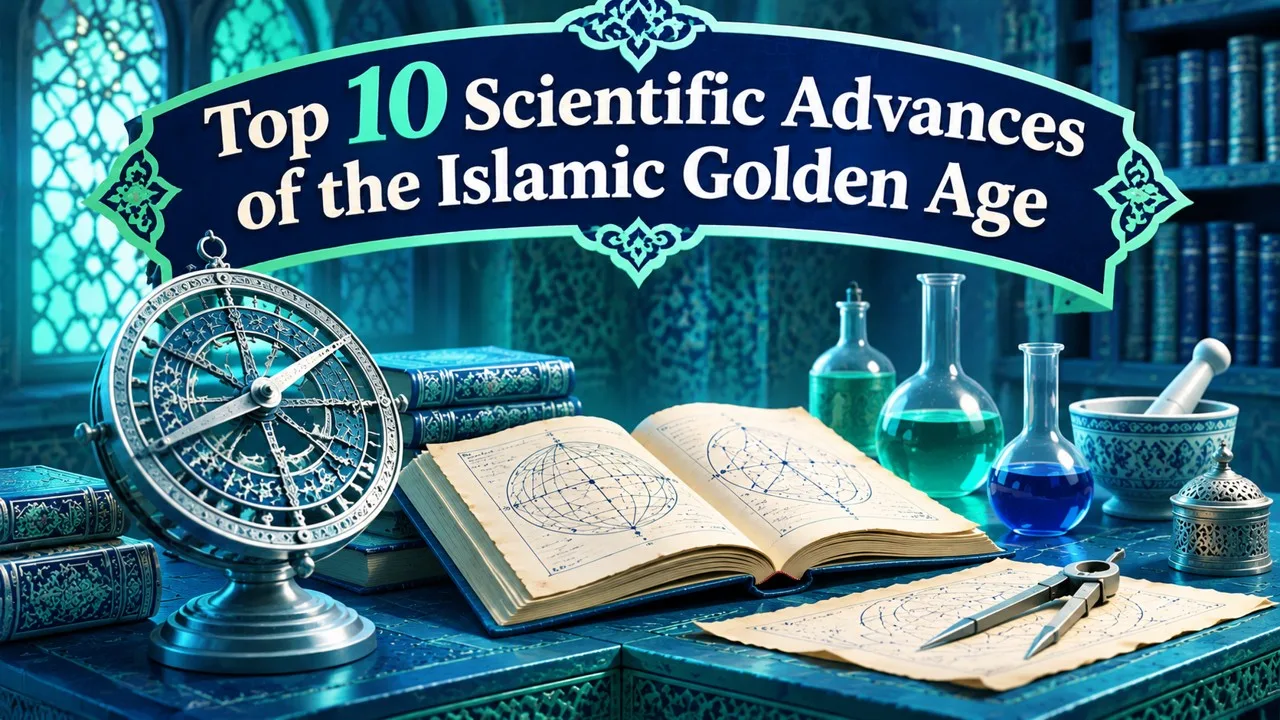
From algebra and optics to surgery and the lungs' blood flow, these ten scientific advances of the Islamic Golden Age shaped later science in Europe. Between roughly the eighth and thirteenth centuries, scholars in the Islamic world made major advances in mathematics, astronomy, medicine, optics and engineering. Cities such as Baghdad, Cairo, Cordoba and Damascus became centres of learning.
These scholars translated and studied Greek, Persian and Indian works, then tested, corrected and expanded them. Many of their books were later translated into Latin and taught in European universities. This list introduces ten scholars and the advances they are best known for.
Key Facts
The ten scholars below lived between the eighth and thirteenth centuries, from Spain to Central Asia.
Islamic Golden Age Science at a Glance
| # | Scholar | Lived | Field | Key advance |
|---|---|---|---|---|
| 1 | Al-Khwarizmi | c. 780 to 850 | Mathematics | Gave us algebra and the algorithm |
| 2 | Banu Musa Brothers | 9th century | Engineering | The Book of Ingenious Devices |
| 3 | Al-Razi | c. 865 to 925 | Medicine | Distinguished smallpox from measles |
| 4 | Al-Battani | c. 858 to 929 | Astronomy | Measured the solar year precisely |
| 5 | Al-Zahrawi | 936 to 1013 | Surgery | Illustrated surgical instruments |
| 6 | Ibn al-Haytham | c. 965 to 1040 | Optics | Explained how we see |
| 7 | Al-Biruni | 973 to 1048 | Geodesy and astronomy | Measured the size of the Earth |
| 8 | Ibn Sina | 980 to 1037 | Medicine and philosophy | The Canon of Medicine |
| 9 | Al-Jazari | 1136 to 1206 | Mechanical engineering | Machines with cranks and gears |
| 10 | Ibn al-Nafis | 1213 to 1288 | Medicine | Described blood flow through the lungs |
1. Al-Khwarizmi
Muhammad ibn Musa al-Khwarizmi was a Persian mathematician and astronomer who worked at the House of Wisdom in Baghdad during the rule of the caliph al-Ma'mun. [1]
Around 820 he wrote a book on calculation by completion and balancing, which explained systematic methods for solving linear and quadratic equations. The word algebra comes from al-jabr, a term in its title. [1]
Another of his books explained the Hindu decimal place-value number system. Its Latin translations helped introduce these numerals, now called Hindu-Arabic numerals, to Europe.
The Latin form of his name, Algoritmi, gave rise to the word algorithm, now central to computing.
Al-Khwarizmi also produced astronomical tables and a geography listing the coordinates of places around the known world.
Key Figures
- Worked at: the House of Wisdom, Baghdad
- Famous book: on al-jabr, around 820
- Words from his work: algebra and algorithm
- Spread: Hindu-Arabic numerals
Why It Made the List
Al-Khwarizmi founded algebra as a discipline. His name and work live on in mathematics and computing.
2. Banu Musa Brothers
The Banu Musa were three brothers, Muhammad, Ahmad and al-Hasan, who worked in Baghdad in the ninth century. They were wealthy patrons of science and skilled scholars themselves. [2]
Around 850 they wrote the Book of Ingenious Devices, describing about a hundred machines. Many were trick vessels and automatic devices driven by water and air pressure. [2]
Their designs used valves, siphons and feedback controls, some of which are among the earliest of their kind.
One of their inventions was an automatic flute player that could be set to play different tunes, sometimes described as an early programmable machine.
The brothers also wrote on geometry and astronomy and helped fund translations of Greek scientific texts.
Some of their devices refilled themselves automatically or released different liquids from the same container.
Related: Top 10 Inventions That Changed the World
Key Figures
- Brothers: Muhammad, Ahmad and al-Hasan
- City: Baghdad
- Book: Book of Ingenious Devices, around 850
- Famous device: an automatic flute player
Why It Made the List
The Banu Musa pioneered automatic machines. Their ideas foreshadowed later control systems.
3. Al-Razi
Abu Bakr al-Razi, known in Europe as Rhazes, was a Persian physician, chemist and philosopher. He directed hospitals in his home city of Rayy and in Baghdad. [3]
In a famous treatise, he gave the first clear description distinguishing smallpox from measles, describing their symptoms in careful detail. [3]
Al-Razi compiled a huge medical encyclopedia known as al-Hawi, or the Comprehensive Book, which collected knowledge from Greek, Indian and Persian sources along with his own observations.
He emphasised careful observation of patients and questioned the authority of earlier writers such as Galen when his experience differed.
His works were translated into Latin and studied in Europe for centuries.
A well-known story says that when choosing a site for a new hospital in Baghdad, he hung pieces of meat in different parts of the city and picked the place where they rotted most slowly. He also wrote books on medicine for the poor and on the ethics of being a doctor.
Key Figures
- Known in Europe as: Rhazes
- Hospitals: Rayy and Baghdad
- Key description: smallpox and measles
- Encyclopedia: al-Hawi
Why It Made the List
Al-Razi was one of the greatest physicians of the medieval world. His clinical observations set a model for medical practice.
4. Al-Battani
Al-Battani was an astronomer who worked in Raqqa, in present-day Syria. He made careful observations of the Sun, Moon and planets over many years. [4]
He measured the length of the solar year as 365 days, 5 hours, 46 minutes and 24 seconds, remarkably close to modern values. [4]
Al-Battani used trigonometry, including sines rather than the chords of Greek astronomy, making calculations simpler and more accurate.
His astronomical tables were translated into Latin and widely used in Europe.
The astronomer Nicolaus Copernicus cited al-Battani many times in his great work on the motion of the planets.
He also found that the point where the Earth's orbit comes closest to the Sun slowly shifts over time, correcting earlier tables made by Ptolemy. A crater on the Moon, Albategnius, is named after him.
Key Figures
- City: Raqqa
- Solar year: 365 days, 5 hours, 46 minutes, 24 seconds
- Method: trigonometry with sines
- Cited by: Copernicus
Why It Made the List
Al-Battani improved the accuracy of astronomy. His work influenced the scientific revolution in Europe.
5. Al-Zahrawi
Abu al-Qasim al-Zahrawi, known in Europe as Albucasis, was a physician who lived near Cordoba in al-Andalus, Islamic Spain. [5]
Related: Top 10 Overlooked Mathematicians Who Shaped the Modern World
He wrote a medical encyclopedia called Kitab al-Tasrif in 30 volumes. Its final volume, on surgery, became his most famous work. [5]
The surgical volume included illustrations of about 200 instruments, many designed by him. It described procedures such as removing stones, setting bones and treating wounds.
He is credited with uses of catgut for internal stitches and with designing new forceps and other tools.
Translated into Latin in the twelfth century, his book was used by European surgeons for centuries.
He also wrote about dentistry, eye surgery and the care of women in childbirth. His advice on choosing and training surgeons stressed careful study of anatomy before operating.
Key Figures
- Known in Europe as: Albucasis
- Home: near Cordoba, al-Andalus
- Work: Kitab al-Tasrif, 30 volumes
- Illustrated instruments: about 200
Why It Made the List
Al-Zahrawi is often called a father of modern surgery. His illustrated instruments guided surgeons for generations.
6. Ibn al-Haytham
Ibn al-Haytham, known in Europe as Alhazen, was a scientist born in Basra who later worked in Cairo. [6]
His Book of Optics, written between about 1011 and 1021, explained that we see because light enters the eye from objects, rather than rays coming out of the eye, as some Greek thinkers had believed. [6]
He studied reflection and refraction, and investigated the camera obscura, a dark room in which light through a small hole forms an image.
Ibn al-Haytham stressed testing ideas through careful experiments, an approach that has led many to see him as an early pioneer of the scientific method.
His work was translated into Latin and influenced European scientists such as Roger Bacon and Johannes Kepler.
Key Figures
- Known in Europe as: Alhazen
- Work: Book of Optics, about 1011 to 1021
- Key idea: light enters the eye
- Influenced: Roger Bacon and Kepler
Why It Made the List
Ibn al-Haytham transformed the science of light. His experimental approach shaped later science.
7. Al-Biruni
Abu Rayhan al-Biruni was a scholar from Khwarazm in Central Asia who wrote on astronomy, mathematics, geography, history and many other subjects. [7]
Related: Top 10 Inventions of Ancient China
He developed a clever method to measure the Earth's radius. From a mountain near Nandana, in present-day Pakistan, he measured the angle down to the horizon and used trigonometry to calculate the Earth's size. [7]
His result was close to the modern value, an impressive achievement for the time.
Al-Biruni also measured the densities of many metals and minerals and discussed whether the Earth rotates on its axis.
He travelled to India and wrote a detailed study of Indian culture, science and religion, considered one of the earliest works of its kind.
Key Figures
- Home region: Khwarazm, Central Asia
- Earth measured from: near Nandana
- Method: angle to the horizon
- Other work: a study of India
Why It Made the List
Al-Biruni combined careful measurement with wide learning. His Earth measurement was one of the best of the medieval world.
8. Ibn Sina
Ibn Sina, known in Europe as Avicenna, was a Persian physician and philosopher. He is said to have become a skilled doctor while still a teenager. [8]
His Canon of Medicine, completed around 1025, organised medical knowledge into five books covering anatomy, diseases, drugs and treatments. [8]
The Canon discussed contagious diseases and quarantine, and set out rules for testing new medicines.
Translated into Latin in the twelfth century, it became a standard textbook in European universities and was used for about five hundred years.
Ibn Sina also wrote the Book of Healing, a huge work of philosophy and science.
He also served as a physician and minister to several rulers in Persia.
Key Figures
- Known in Europe as: Avicenna
- Famous work: Canon of Medicine, about 1025
- Books in the Canon: five
- Used in Europe: for about 500 years
Why It Made the List
Ibn Sina's Canon was one of the most influential medical books ever written. It shaped medicine in Europe and Asia for centuries.
9. Al-Jazari
Ismail al-Jazari was an engineer who served the Artuqid rulers in Diyarbakir, in present-day Turkey. [9]
In 1206 he completed the Book of Knowledge of Ingenious Mechanical Devices, describing about fifty machines with detailed drawings and building instructions. [9]
His machines included water-raising pumps, clocks and automata. One water pump used a crank and connecting rod system to convert rotary motion into back-and-forth motion.
Related: Top 10 Greatest Engineering Achievements
His famous elephant clock combined Indian, Greek, Persian and Chinese elements in its design.
Al-Jazari's book is valued because it explains how to build each machine, not just what it does.
A full-size working reconstruction of the elephant clock can be seen in Dubai. His book also describes hand-washing devices, musical automata and a castle clock that showed the movement of the zodiac. Copies of his illustrated manuscript are held in museums and libraries around the world.
Key Figures
- Patrons: the Artuqid rulers
- Book completed: 1206
- Machines described: about fifty
- Famous design: the elephant clock
Why It Made the List
Al-Jazari was one of the greatest engineers of the medieval world. His mechanisms anticipated later machines.
10. Ibn al-Nafis
Ibn al-Nafis was an Arab physician born near Damascus who later worked in Cairo, where he headed a major hospital. [10]
In a commentary written around 1242, he described the pulmonary circulation, the flow of blood from the heart to the lungs and back. [10]
He challenged the long-accepted view of Galen that blood passed through invisible pores in the wall between the heart's chambers. Instead, he argued it must pass through the lungs.
His discovery was largely unknown in Europe, where pulmonary circulation was described again in the sixteenth century.
William Harvey published his full account of blood circulation in 1628.
He also wrote extensively on law, theology and the philosophy of medicine. Before his death, he donated his house and library to the hospital where he had worked.
Key Figures
- Born: near Damascus
- Worked in: Cairo
- Discovery: pulmonary circulation, around 1242
- Challenged: Galen
Why It Made the List
Ibn al-Nafis made a major discovery centuries before Europe. His work shows the originality of medieval Islamic medicine.
Conclusion
The scholars of the Islamic Golden Age built on earlier knowledge and pushed it forward through observation, calculation and experiment.
Their books later reached Europe through translations, helping to spark the scientific revolution. Many of the words and ideas of modern science still carry their influence.
- ^ [1] "Al-Khwarizmi". Wikipedia. Wikipedia: Muhammad ibn Musa al-Khwarizmi Wikipedia: The Compendious Book on Calculation by Completion and Balancing
- ^ [2] "Banu Musa Brothers". Wikipedia. Wikipedia: Banū Mūsā Wikipedia: Book of Ingenious Devices
- ^ [3] "Al-Razi". Wikipedia. Wikipedia: Abu Bakr al-Razi Wikipedia: Smallpox
- ^ [4] "Al-Battani". Wikipedia. Wikipedia: Al-Battani Wikipedia: Tropical year
- ^ [5] "Al-Zahrawi". Wikipedia. Wikipedia: Al-Zahrawi Wikipedia: History of surgery
- ^ [6] "Ibn al-Haytham". Wikipedia. Wikipedia: Ibn al-Haytham Wikipedia: Book of Optics
- ^ [7] "Al-Biruni". Wikipedia. Wikipedia: Al-Biruni Wikipedia: Nandana Fort
- ^ [8] "Ibn Sina". Wikipedia. Wikipedia: Avicenna Wikipedia: The Canon of Medicine
- ^ [9] "Al-Jazari". Wikipedia. Wikipedia: Ismail al-Jazari Wikipedia: Elephant clock
- ^ [10] "Ibn al-Nafis". Wikipedia. Wikipedia: Ibn al-Nafis Wikipedia: Pulmonary circulation





















Discussion
Log in with