



 By
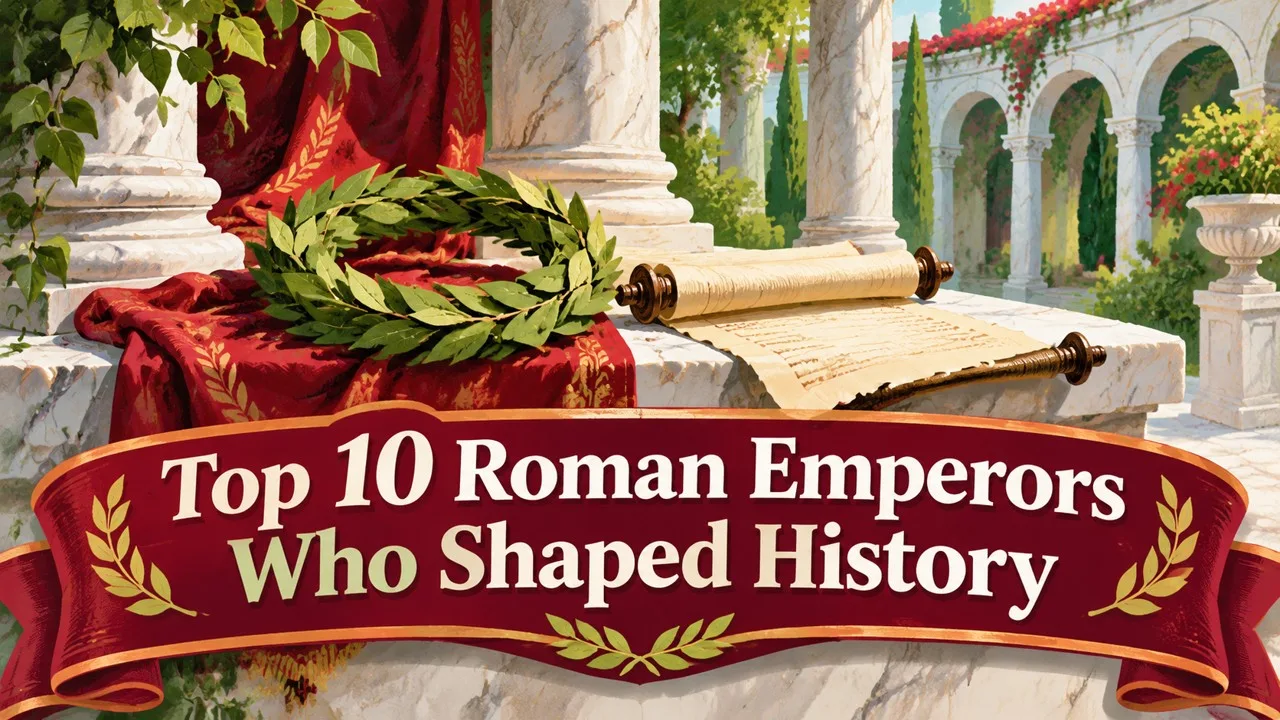
From Augustus, the first emperor, to Constantine and his new capital, these ten Roman emperors who shaped history left marks still visible in today's world. The Roman Empire lasted in the west for about five centuries and in the east, as the Byzantine Empire, for nearly fifteen. At its head stood the emperor, who controlled the army, made laws and was often honoured as divine after death.
Some emperors were wise administrators, others were cruel or incompetent, and many died violently. This list looks at ten emperors whose decisions changed the empire and left legacies that still shape law, religion, architecture and even the calendar.
Key Facts
The ten emperors below ruled between 27 BC and AD 337.
Influential Roman Emperors at a Glance
| # | Emperor | Reign | Dynasty or period | Lasting legacy |
|---|---|---|---|---|
| 1 | Augustus | 27 BC to AD 14 | Julio-Claudian | Founded the Roman Empire |
| 2 | Claudius | AD 41 to 54 | Julio-Claudian | Conquered Britain |
| 3 | Nero | AD 54 to 68 | Julio-Claudian | The emperor of the Great Fire |
| 4 | Vespasian | AD 69 to 79 | Flavian | Restored order and began the Colosseum |
| 5 | Trajan | AD 98 to 117 | Nerva-Antonine | Brought the empire to its greatest extent |
| 6 | Hadrian | AD 117 to 138 | Nerva-Antonine | Secured the frontiers |
| 7 | Marcus Aurelius | AD 161 to 180 | Nerva-Antonine | The philosopher emperor |
| 8 | Caracalla | AD 198 to 217 | Severan | Made nearly all free people citizens |
| 9 | Diocletian | AD 284 to 305 | Tetrarchy | Reorganised the empire |
| 10 | Constantine the Great | AD 306 to 337 | Constantinian | Embraced Christianity and founded Constantinople |
1. Augustus
Augustus, born Gaius Octavius, was the great-nephew and adopted heir of Julius Caesar. After Caesar's murder in 44 BC, he fought a series of civil wars and defeated Mark Antony and Cleopatra at the Battle of Actium in 31 BC. [1]
In 27 BC the Senate gave him the name Augustus. While keeping the outward forms of the Republic, he held real power and became Rome's first emperor. [1]
His long reign began the Pax Romana, about two centuries of relative peace and stability across the empire. He reformed the army, taxes and government of the provinces.
The historian Suetonius records that Augustus boasted he found Rome a city of brick and left it a city of marble. The month of August is named after him.
Augustus recorded his achievements in the Res Gestae, an inscription copied across the empire.
Key Figures
- Born: Gaius Octavius
- Became Augustus: 27 BC
- Reign: 41 years
- Legacy: the Pax Romana
Why It Made the List
Augustus created the system of imperial rule. The empire he founded lasted for centuries.
2. Claudius
Claudius became emperor after the murder of his nephew Caligula in AD 41. According to ancient writers, soldiers of the Praetorian Guard found him hiding behind a curtain and declared him emperor. [2]
Claudius had a limp and a stammer, and many people had considered him unfit to rule. However, he proved to be a capable administrator. [2]
In AD 43 he launched the Roman conquest of Britain, visiting the island himself to celebrate the capture of Camulodunum, now Colchester.
He built a new harbour near Ostia to improve Rome's grain supply and completed major aqueducts. He also supported giving Roman citizenship and Senate seats to men from Gaul.
Claudius died in AD 54, possibly poisoned by his wife Agrippina, who wanted her son Nero to rule.
He was also a scholar who wrote histories of the Etruscans and Carthaginians, now lost.
Key Figures
- Became emperor: AD 41
- Conquest of Britain: AD 43
- Projects: harbour near Ostia, aqueducts
- Successor: Nero
Why It Made the List
Claudius added Britain to the empire. His reign showed that an underestimated ruler could govern well.
3. Nero
Nero became emperor at sixteen. His early reign was guided by advisers such as the philosopher Seneca, but he became increasingly erratic. [3]
Related: Top 10 Ancient Rome Myths and What the Evidence Shows
In July AD 64, the Great Fire of Rome destroyed much of the city. Nero blamed the Christians and had many of them executed, one of the first persecutions of Christians by Rome. [3]
He used land cleared by the fire to build a vast palace called the Domus Aurea.
Nero loved performing as a singer and actor, and he competed at the Olympic Games in Greece, where he was declared winner of several contests.
Facing revolts in AD 68, Nero took his own life. His death led to the Year of the Four Emperors and the end of the Julio-Claudian dynasty.
Rumours that he played music while Rome burned are not supported by reliable evidence.
Key Figures
- Became emperor: aged sixteen
- Great Fire of Rome: AD 64
- Palace: the Domus Aurea
- Died: AD 68
Why It Made the List
Nero's reign ended Rome's first imperial dynasty. His name became a byword for tyranny.
4. Vespasian
Vespasian was a successful general who emerged as the winner of the Year of the Four Emperors in AD 69. He founded the Flavian dynasty. [4]
He came from a modest family, unlike the aristocratic Julio-Claudians, and showed that a soldier from outside the old nobility could become emperor. [4]
Vespasian restored the empire's finances after Nero's spending. He even taxed public urinals, reportedly telling his son that money does not smell.
He began building the Flavian Amphitheatre, now known as the Colosseum, on the site of Nero's palace lake. It was completed by his son Titus in AD 80.
During his reign his son Titus captured Jerusalem in AD 70, destroying the Second Temple.
He was known for his blunt humour and practical style, and he died of illness, a rare natural death for an emperor of that era.
Key Figures
- Dynasty founded: Flavian
- Became emperor: AD 69
- Monument begun: the Colosseum
- Famous saying: money does not smell
Why It Made the List
Vespasian rebuilt stability after civil war. His Colosseum became the symbol of Rome.
5. Trajan
Trajan was born in Italica, in Roman Spain, making him the first emperor from outside Italy. He was a popular soldier-emperor. [5]
He conquered Dacia, in present-day Romania, in two wars between 101 and 106. Its gold mines brought great wealth to Rome. [5]
Related: Top 10 Colosseum Facts and Myths: What Really Happened in Rome's Arena
Trajan's campaigns against Parthia added Mesopotamia briefly, and in AD 117 the empire reached its largest extent.
He funded public building, including Trajan's Forum and Markets, and supported a welfare scheme called the alimenta to help poor children in Italy.
The Senate gave him the title Optimus, meaning the best. Trajan's Column in Rome shows scenes from his Dacian wars.
Later Romans wished new emperors to be luckier than Augustus and better than Trajan. He died in 117 on his way back from the east, and his ashes were placed in the base of his column.
Key Figures
- Born: Italica, Spain
- Conquered: Dacia, 101 to 106
- Empire's largest extent: AD 117
- Title: Optimus, the best
Why It Made the List
Trajan made the empire as large as it would ever be. He was remembered as one of Rome's best rulers.
6. Hadrian
Hadrian, Trajan's successor, gave up some of Trajan's eastern conquests, believing the empire was too large to defend. [6]
He focused on securing the frontiers. In Britain, construction of Hadrian's Wall began in about AD 122, stretching about 117 kilometres from coast to coast. [6]
Hadrian travelled across the empire more than almost any other emperor, inspecting armies and cities.
He was a passionate admirer of Greek culture and architecture. The Pantheon in Rome was rebuilt during his reign, and he built a huge villa at Tivoli.
His reign also saw the Bar Kokhba revolt in Judea between 132 and 136, which was brutally crushed.
He is often described as the first emperor to wear a full beard, setting a fashion for later rulers. His mausoleum in Rome later became a fortress known today as the Castel Sant'Angelo.
Key Figures
- Wall begun: about AD 122
- Wall length: about 117 km
- Rebuilt: the Pantheon
- Villa: Tivoli
Why It Made the List
Hadrian shifted Rome from expansion to defence. His wall still crosses northern England.
7. Marcus Aurelius
Marcus Aurelius was emperor from 161 to 180, at first sharing power with Lucius Verus. [7]
He was a devoted follower of Stoic philosophy. During military campaigns, he wrote personal reflections in Greek, later published as the Meditations, which remain widely read today. [7]
Related: Top 10 Punishments and Rewards in the Roman Army
His reign was troubled by wars along the Danube against Germanic tribes, known as the Marcomannic Wars, and by a deadly epidemic called the Antonine Plague.
He is often counted as the last of the Five Good Emperors.
His bronze equestrian statue in Rome survived because people mistakenly believed it showed the Christian emperor Constantine.
Unlike the emperors before him, he chose his own son, Commodus, as heir. Commodus proved to be a poor ruler, and his reign is often seen as the start of the empire's troubles.
Key Figures
- Reign: 161 to 180
- Philosophy: Stoicism
- Book: the Meditations
- Crisis: the Antonine Plague
Why It Made the List
Marcus Aurelius combined power with philosophy. His Meditations are still read as a guide to life.
8. Caracalla
Caracalla was the son of Septimius Severus and ruled jointly with his father and brother before becoming sole emperor in 211. [8]
He had his brother Geta murdered in 211 and ordered the killing of many of Geta's supporters. [8]
In 212 he issued the Constitutio Antoniniana, which granted Roman citizenship to nearly all free men in the empire. This vastly expanded the number of citizens.
He built the huge Baths of Caracalla in Rome, whose ruins are still used as a venue for summer opera.
Caracalla was assassinated in 217 while on campaign in Mesopotamia.
His nickname came from a hooded Gallic cloak he liked to wear. Ancient writers suggest the citizenship edict may also have aimed to increase tax income, since only citizens paid certain inheritance taxes. The baths could hold about 1,600 bathers at a time.
Key Figures
- Father: Septimius Severus
- Citizenship edict: AD 212
- Monument: the Baths of Caracalla
- Assassinated: 217
Why It Made the List
Caracalla's citizenship edict transformed the empire. It made Roman identity open to most free people.
9. Diocletian
Diocletian came to power in 284 after decades of chaos known as the Crisis of the Third Century. He restored order and reorganised the empire. [9]
In 293 he created the Tetrarchy, a system of four rulers, two senior emperors and two junior ones, to share the burden of governing and defending the empire. [9]
He also reformed the army, taxes and provinces, and in 301 issued an edict fixing maximum prices to fight inflation.
Related: Top 10 Roman Aqueducts That Still Stand
In 303 he began the Great Persecution, the last and most severe persecution of Christians in the empire.
In 305 Diocletian voluntarily abdicated, a rare act for a Roman emperor, and retired to his palace at Split on the Adriatic coast.
His palace at Split was so large that the medieval town grew up inside its walls.
Key Figures
- Came to power: 284
- Tetrarchy created: 293
- Price edict: 301
- Abdicated: 305
Why It Made the List
Diocletian saved the empire from collapse. His reforms shaped the late Roman state.
10. Constantine the Great
Constantine was proclaimed emperor by his troops in York, Britain, in 306. After years of civil war, he defeated his rival Maxentius at the Battle of the Milvian Bridge in 312. [10]
He credited his victory to the Christian God. In 313 he and his co-emperor Licinius issued the Edict of Milan, granting religious tolerance to Christians. [10]
In 325 Constantine called the Council of Nicaea, the first great council of the Christian church.
In 330 he dedicated a new capital, Constantinople, on the site of the Greek city of Byzantium. It remained the capital of the eastern empire for over a thousand years.
Constantine was baptised shortly before his death in 337 and became the first Christian emperor.
He also introduced a new gold coin, the solidus, which stayed in use for centuries.
Key Figures
- Proclaimed: York, 306
- Milvian Bridge: 312
- Edict of Milan: 313
- Constantinople dedicated: 330
Why It Made the List
Constantine changed the religion of the Roman world. His new capital shaped the history of Europe and Asia.
Conclusion
The emperors of Rome shaped the empire through conquest, reform, building and belief. Their choices still affect laws, languages and religions today.
From Augustus to Constantine, these ten rulers show the empire's journey from Republic to Christian empire, and from expansion to survival.
- ^ [1] "Augustus". Wikipedia. Wikipedia: Augustus Wikipedia: Pax Romana
- ^ [2] "Claudius". Wikipedia. Wikipedia: Claudius Wikipedia: Roman conquest of Britain
- ^ [3] "Nero". Wikipedia. Wikipedia: Nero Wikipedia: Great Fire of Rome
- ^ [4] "Vespasian". Wikipedia. Wikipedia: Vespasian Wikipedia: Colosseum
- ^ [5] "Trajan". Wikipedia. Wikipedia: Trajan Wikipedia: Trajan's Column
- ^ [6] "Hadrian". Wikipedia. Wikipedia: Hadrian Wikipedia: Hadrian's Wall
- ^ [7] "Marcus Aurelius". Wikipedia. Wikipedia: Marcus Aurelius Wikipedia: Meditations
- ^ [8] "Caracalla". Wikipedia. Wikipedia: Caracalla Wikipedia: Constitutio Antoniniana
- ^ [9] "Diocletian". Wikipedia. Wikipedia: Diocletian Wikipedia: Tetrarchy
- ^ [10] "Constantine the Great". Wikipedia. Wikipedia: Constantine the Great Wikipedia: Edict of Milan



















Discussion
Log in with