


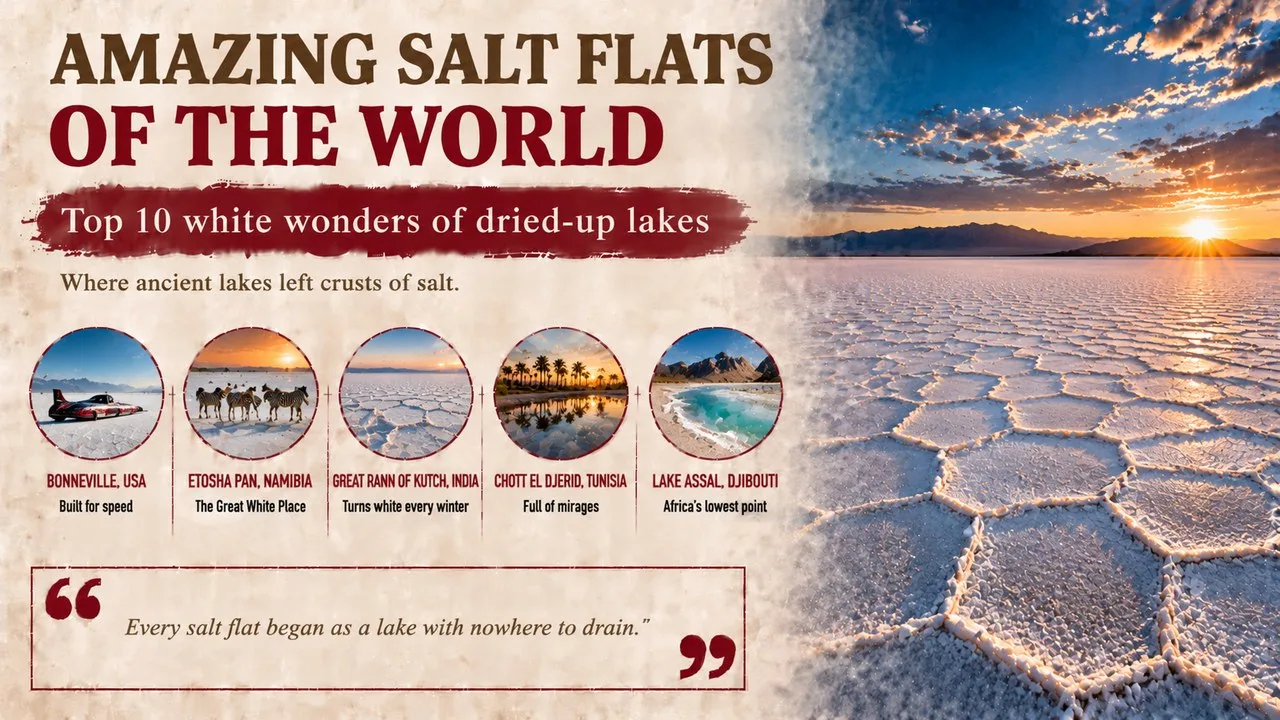
Amazing salt flats of the world range from Utah's Bonneville speed track to Namibia's Etosha Pan and the Andes, where white crusts stretch to the horizon.
This Finepedia guide, written in October 2026, explores 10 remarkable salt flats and salt pans on four continents, from record-breaking racetracks to scorching depressions below sea level. Every entry covers where the flat lies, how big it is and what makes it worth seeing. For more dramatic dry landscapes, see the Finepedia guides Most Breathtaking Desert Landscapes: Top 10 and Most Silent Places in the World: Top 10.
How We Chose These
A salt flat forms where a lake with no outlet dries up in a hot, dry climate, leaving a hard crust of salt and other minerals. We picked flats and salt pans known for sheer scale, wildlife, history or strange scenery. Bolivia's Salar de Uyuni, Death Valley and Botswana's Makgadikgadi Pans are left out here because Finepedia already features them in the two guides linked above. Facts come from national park agencies, geological surveys and encyclopaedias. Sizes change with the seasons, so figures are approximate, and the order is a guide, not a scientific ranking.
The 10 Amazing Salt Flats at a Glance
| Rank | Salt flat | Country | Approximate size | Known for |
|---|---|---|---|---|
| 1 | Bonneville Salt Flats | United States | about 19 by 8 km | land speed records |
| 2 | Etosha Pan | Namibia | about 4,800 km² | wildlife park and flamingos |
| 3 | Great Rann of Kutch | India | about 7,500 km² | Rann Utsav white desert festival |
| 4 | Chott el Djerid | Tunisia | over 5,000 km² | mirages and Star Wars sets |
| 5 | Salar de Atacama | Chile | the biggest in Chile | flamingos and lithium |
| 6 | Salinas Grandes | Argentina | high plateau at 3,450 m | salt pools beside a highway |
| 7 | Salar de Arizaro | Argentina | about 1,600 km² | the Cono de Arita |
| 8 | Danakil salt flats and Dallol | Ethiopia | about 120 m below sea level | salt caravans and acid pools |
| 9 | Lake Assal | Djibouti | 155 m below sea level | Africa's lowest point |
| 10 | Namak Lake | Iran | about 1,800 km² | salt crust near Qom |
1. Bonneville Is Built for Speed
The Bonneville Salt Flats lie in north-western Utah, beyond the western shore of the Great Salt Lake, and are what remains of the vast Ice Age Lake Bonneville. The crust is so hard and level that drivers have raced across it since the early 1900s.
Key Facts
- Size: about 19 km long and 8 km wide
- Crust: almost 1.5 metres thick in the middle
- Salt: an estimated 147 million tonnes, mostly halite
- First land speed record: set in 1914 by Teddy Tetzlaff
Did You Know?
In 1970 Gary Gabelich's rocket car, the Blue Flame, became the first car to average more than 1,000 km/h on the flats. The salt crust has grown thinner since then, and Speed Week was called off in 2014 and 2015.
2. Etosha Pan Is the Great White Place
Etosha Pan is a huge dry lakebed in northern Namibia, about 120 km long. Its name means "Great White Place" in the Oshindonga language, and it forms the heart of Etosha National Park, one of Africa's best places to watch big game.
Key Facts
- Pan area: about 4,800 square kilometres
- National park: about 22,270 square kilometres
- Age: formed by tectonic movement over about ten million years
- Surface: cracked clay that splits into six-sided tiles as it dries
Why It Matters
After heavy rains, a thin sheet of salty water covers part of the pan, and thousands of flamingos and great white pelicans arrive to breed. In the dry season, elephants, lions and rhinos gather at the waterholes around its edge.
3. The Great Rann of Kutch Turns White Every Winter
The Great Rann of Kutch is a vast salt marsh in Gujarat, western India, on the edge of the Thar Desert. During the monsoon it floods with shallow water; when the water dries, it leaves a sparkling white crust that stretches as far as the eye can see.
Key Facts
- Area: about 7,500 square kilometres
- State: Gujarat, near the border with Pakistan
- Name: from a Sanskrit word for barren or salty ground
- Wildlife: the Indian wild ass and huge flocks of flamingos
Did You Know?
Every winter, Gujarat holds the Rann Utsav festival near the village of Dhordo, on about 500 square kilometres of white salt desert. Visitors stay in tent cities and watch the salt glow under the full moon.
4. Chott el Djerid Is Full of Mirages
Chott el Djerid is a giant salt lake in south-western Tunisia and the biggest salt pan in the Sahara. Its Arabic name refers to a lagoon in palm country, after the date oases that ring it.
Key Facts
- Length: about 250 km
- Area: over 7,000 square kilometres by some measures, 5,000 by others
- Summer heat: sometimes 50 °C or more
- Colours: patches of white, green and purple from minerals and algae
Why It Matters
In summer the lake almost completely dries out, and the shimmering heat creates frequent mirages. The flat landscape near the town of Nefta served as Luke Skywalker's home planet, Tatooine, in the Star Wars films.
5. Salar de Atacama Is Chile's Giant Salt Basin
Salar de Atacama lies about 55 km south of the oasis town of San Pedro de Atacama in northern Chile. It is ringed by volcanoes, including Licancabur and the restless Láscar, which erupts more often than almost any other Chilean peak.
Key Facts
- Region: Antofagasta, northern Chile
- People: home of the Indigenous Likan Antay
- Wildlife: Andean, Chilean and James's flamingos
- Resource: lithium, discovered in its brines in 1962
Did You Know?
Salar de Atacama has become one of the world's main sources of lithium, used in batteries for phones and electric cars. Local communities and scientists are concerned that pumping brine may harm the lagoons where the flamingos feed.
6. Salinas Grandes Sit High in the Andes
Straddling the Jujuy-Salta border in north-western Argentina, the Salinas Grandes lie on a high plateau about 3,450 metres above sea level. A mountain road crosses the white plain, making it one of the easiest Andean salt flats to visit.
Key Facts
- Location: Jujuy and Salta provinces, Argentina
- Altitude: about 3,450 metres
- Resources: sodium, potassium and lithium
- Nearby: the colourful hills of the Quebrada de Humahuaca
Why It Matters
Local workers cut rectangular pools into the crust to harvest salt, and these bright blue-green pools are a favourite photo stop. Indigenous leaders have raised concerns that lithium mining could lower the groundwater their farms depend on.
7. Salar de Arizaro Hides a Perfect Cone
Salar de Arizaro covers about 1,600 square kilometres in Salta Province, high on the Puna de Atacama plateau of north-western Argentina. Few salt flats anywhere are bigger, and it forms part of South America's "lithium triangle".
Key Facts
- Area: about 1,600 square kilometres
- Ranking: often placed sixth in the world by size
- Nearest village: Tolar Grande
- Landmark: the Cono de Arita, a near-perfect cone-shaped hill
Did You Know?
The Cono de Arita rises from the white salt like a pyramid, and people have long debated whether it is a volcano. Arizaro is also crossed by the Salta-Antofagasta railway, which links Argentina with Chile's Pacific coast.
8. Ethiopia's Danakil Salt Flats Are Among the Hottest Places on Earth
The Danakil Depression in Ethiopia's Afar Region lies more than 100 metres below sea level. Its salt plains surround Lake Karum, also called Lake Asale, and the bizarre hot springs of Dallol, with their yellow, green and orange mineral crusts.
Key Facts
- Lake Karum: about 120 metres below sea level
- Dallol: average temperature of 35 °C recorded from 1960 to 1966
- Hot springs: extremely acidic, below pH 1
- Volcano nearby: Erta Ale, with its lava lake
Why It Matters
Afar miners still cut blocks of salt from the flats by hand. Camel caravans then carry them to market, a trade that has gone on for centuries.
9. Lake Assal Is Africa's Lowest Point
Lake Assal in central Djibouti sits at the northern tip of the Great Rift Valley, about 120 km west of Djibouti city. Its turquoise water is ringed by a wide shore of glittering white salt.
Key Facts
- Elevation: about 155 metres below sea level
- Ranking: nowhere in Africa is lower
- Salinity: about ten times saltier than the ocean
- Name: means "honey lake" in Arabic
Did You Know?
Lake Assal is the third-lowest point on land on Earth, after the Dead Sea and the Sea of Galilee. The salt on its shores is harvested commercially, and visitors can float easily in its dense, salty water.
10. Namak Lake Is Iran's Great Salt Plain
Namak Lake, whose name simply means "salt lake" in Persian, lies on the western edge of Iran's Great Salt Desert, the Dasht-e Kavir, roughly 100 km east of Qom. Through much of the year it is a dazzling crust of salt rather than a lake.
Key Facts
- Area: about 1,800 square kilometres
- Water: often covers only about 1 square kilometre
- Depth: from 45 cm to 1 metre when wet
- Elevation: about 790 metres above sea level
Why It Matters
Old caravanserais, the roadside inns of the Silk Road era, stand near the lake. Today they make the salt plain a popular day trip from Qom and Kashan.
Frequently Asked Questions
How is a salt flat formed?
A salt flat forms when water collects in a basin with no outlet and then evaporates faster than rain can refill it. Over thousands of years, the dissolved minerals are left behind as a hard, white crust.
Which salt flat is the biggest?
Bolivia's Salar de Uyuni, covering more than 10,000 square kilometres, is the biggest salt flat anywhere. It is featured in Finepedia's guide to the most breathtaking desert landscapes.
Conclusion
From the speed trials of Bonneville to the salt caravans of the Danakil, salt flats are among the strangest and most beautiful landscapes on Earth. Many are fragile, so visitors should stay on marked tracks and follow local guidance. For more dramatic dry landscapes, read the Finepedia guides Most Breathtaking Desert Landscapes: Top 10 and Most Silent Places in the World: Top 10.
- US Bureau of Land Management, Bonneville Salt Flats.
- Namibia Ministry of Environment, Etosha National Park.
- Gujarat Tourism, Rann Utsav.
- Wikipedia (accessed October 2026): Salt pan (geology), Bonneville Salt Flats, Bonneville Speedway, Etosha Pan, Great Rann of Kutch, Chott el Djerid, Salar de Atacama, Salinas Grandes (Jujuy and Salta), Salar de Arizaro, Danakil Depression, Dallol, Lake Karum, Lake Assal (Djibouti) and Namak Lake.
- 10 Most Today, 10 Most Amazing Salt Flats in the World, 10mosttoday.com (topic reference).














Log in with