


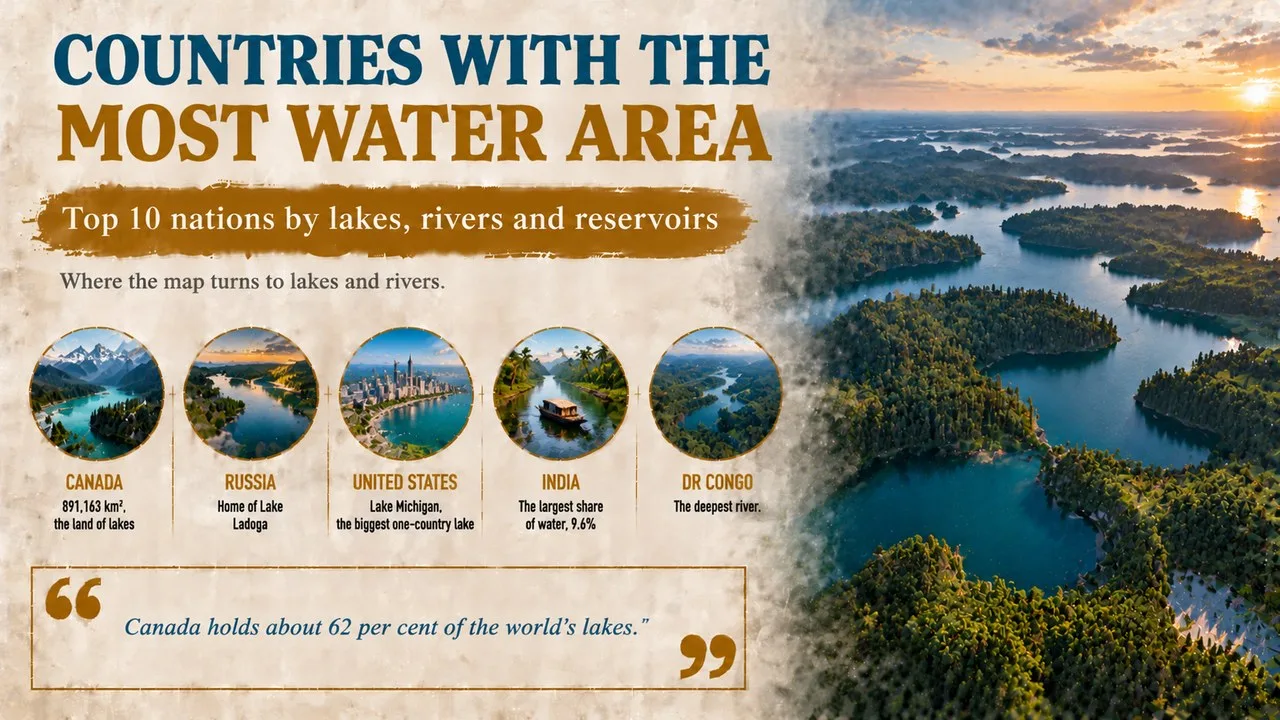
Countries with the most water area are led by Canada, with about 891,000 square kilometres of lakes and rivers, ahead of Russia and the United States.
This Finepedia guide, written in October 2026, ranks the 10 countries with the largest inland water area, meaning the lakes, reservoirs and rivers inside their borders. Every entry gives the official figure, the share of the country it covers and a famous body of water to know. For more on the world's waters, see the Finepedia guides Top 10 Deepest Lakes in the World and Longest Rivers in the World: Top 10 by Length.
How We Chose These
Water area is measured in different ways, so rankings disagree. We used inland water as listed by the UN Food and Agriculture Organization and the CIA World Factbook, as compiled on Wikipedia's list of countries by area in October 2026. Seas along the coast, territorial waters and exclusive economic zones are left out. For the United States we use the Census Bureau figure, which counts inland water and the American part of the Great Lakes but not coastal water; with coastal and territorial water added, the American figure rises to about 686,000 square kilometres. Some older lists show much bigger numbers for Iran and Ethiopia, but current FAO data puts both well outside the top 10.
The 10 Countries With the Most Water at a Glance
| Rank | Country | Inland water (km²) | Share of total area | Water to know |
|---|---|---|---|---|
| 1 | Canada | 891,163 | 8.9% | Great Bear Lake |
| 2 | Russia | 721,380 | 4.2% | Lake Ladoga |
| 3 | United States | 377,424 | 4.0% | Lake Michigan |
| 4 | India | 314,070 | 9.6% | Chilika Lake |
| 5 | China | 270,550 | 2.8% | Qinghai Lake |
| 6 | Colombia | 100,210 | 8.8% | Magdalena River |
| 7 | Indonesia | 93,000 | 4.9% | Lake Toba |
| 8 | DR Congo | 77,810 | 3.3% | Congo River |
| 9 | Tanzania | 61,500 | 6.5% | Lake Victoria |
| 10 | Australia | 58,920 | 0.8% | Kati Thanda-Lake Eyre |
1. Canada Is the Land of Lakes
Canada holds more inland water than any other nation. A 2016 study by McGill University researchers counted nearly 880,000 Canadian lakes larger than 10 hectares, about 62 per cent of all such lakes on Earth, a legacy of ice sheets that scoured the land and then melted about 10,000 years ago.
Key Facts
- Inland water: 891,163 square kilometres
- Share of the country: about 8.9 per cent
- Largest lake wholly in Canada: Great Bear Lake, 31,153 square kilometres
- Shared giants: Lake Superior and Lake Huron, split with the United States
Did You Know?
Great Bear Lake sits right on the Arctic Circle in the Northwest Territories. Its name comes from a Chipewyan word meaning "grizzly bear-water people", and the Sahtu Dene who live around it take their name from the lake.
2. Russia Holds Europe's Largest All-European Lake
Russia, the largest country on Earth, comes second for water, with about 721,000 square kilometres of lakes, reservoirs and rivers. Siberia's Lake Baikal is the best known, but the western lake Ladoga, near Saint Petersburg, is the biggest lake found entirely within Europe.
Key Facts
- Inland water: 721,380 square kilometres
- Share of the country: about 4.2 per cent
- Lake Ladoga: about 17,900 square kilometres, with some 660 islands
- Largest island in Ladoga: Valaam, home to an old monastery
Why It Matters
During the wartime siege of Leningrad from 1941 to 1944, a route across Ladoga's frozen surface, the Road of Life, carried food into the city and people out of it. In summer the lake is still a busy route for boats linking Saint Petersburg with the north.
3. The United States Shares the Great Lakes
The United States has about 377,000 square kilometres of inland water, counting its part of the Great Lakes. Four of the five Great Lakes are shared with Canada, but Lake Michigan lies wholly within American borders.
Key Facts
- Inland water: 377,424 square kilometres (Census Bureau)
- Share of the country: about 4.0 per cent
- Lake Michigan: about 57,757 square kilometres
- States on Lake Michigan: Wisconsin, Illinois, Indiana and Michigan
Did You Know?
No lake on Earth that sits inside just one country is larger than Lake Michigan. Its name is thought to come from an Ojibwe phrase meaning "great water", and Chicago and Milwaukee both grew up on its shores.
4. India Has the Largest Share of Water
India comes fourth, with about 314,000 square kilometres of inland water. That is about 9.6 per cent of its area, the highest share in this top 10, spread across mighty rivers such as the Ganges, huge reservoirs and coastal lagoons.
Key Facts
- Inland water: 314,070 square kilometres
- Share of the country: about 9.6 per cent
- Chilika Lake: India's largest brackish lagoon, in Odisha
- Chilika's size: about 900 square kilometres in the dry season, swelling greatly in the monsoon
Why It Matters
In 1981 Chilika became one of India's first two Ramsar wetlands of international importance. It hosts more than 225 bird species in winter and a population of rare Irrawaddy dolphins, and about 200,000 fishing people depend on it.
5. China's Largest Lake Is Salty
China has about 270,000 square kilometres of inland water, from the Yangtze and Yellow rivers to thousands of high plateau lakes. Its biggest lake, Qinghai, lies on the Tibetan Plateau and gave its name to the province around it.
Key Facts
- Inland water: 270,550 square kilometres
- Share of the country: about 2.8 per cent
- Qinghai Lake: about 4,300 square kilometres, an alkaline salt lake
- Other name: Koko Nor, its Mongolian name
Did You Know?
The name Qinghai can be translated as "blue-green sea", since classical Chinese used a single word for blue and green. After shrinking through much of the 20th century, the lake has been growing again since 2004.
6. Colombia Is Rich in Rivers
Colombia has about 100,000 square kilometres of inland water, nearly 9 per cent of its land. Rain falling on the Andes feeds rivers running north to the Caribbean, west to the Pacific and east into the Amazon basin.
Key Facts
- Inland water: 100,210 square kilometres
- Share of the country: about 8.8 per cent
- Main river: the Magdalena, about 1,528 km long
- Mouth of the Magdalena: Bocas de Ceniza, near Barranquilla
Why It Matters
The Magdalena basin covers about a quarter of Colombia, yet roughly two in three Colombians live in it. For centuries the river was the main highway between the coast and the cities of the Andes.
7. Indonesia Holds a Supervolcano Lake
Indonesia, the world's largest island country, has about 93,000 square kilometres of inland water. Its most famous lake, Toba in North Sumatra, fills the crater left by one of the biggest volcanic eruptions known.
Key Facts
- Inland water: 93,000 square kilometres
- Share of the country: about 4.9 per cent
- Lake Toba: about 100 km long and up to 505 metres deep
- Island in the lake: Samosir, home to the Toba Batak people
Did You Know?
Toba is the largest volcanic lake on Earth. The eruption that formed it, about 74,000 years ago, is thought to be the most violent blast the planet has seen for about 25 million years.
8. DR Congo Has the Deepest River
The DR Congo has about 78,000 square kilometres of inland water, much of it in the vast Congo River basin and in the lakes of the Great Rift Valley along its eastern border.
Key Facts
- Inland water: 77,810 square kilometres
- Share of the country: about 3.3 per cent
- Congo River depth: measured at about 220 metres, the deepest recorded river
- Congo River rank: second-longest river in Africa after the Nile
Why It Matters
The Congo is the only major river that crosses the Equator twice, and only the Amazon and the Ganges-Brahmaputra carry more water. The capitals Kinshasa and Brazzaville face each other across it.
9. Tanzania Holds Half of Lake Victoria
Tanzania has about 61,500 square kilometres of inland water. It borders three of Africa's great lakes, Victoria, Tanganyika and Malawi, which together give it one of the longest lake shorelines in Africa.
Key Facts
- Inland water: 61,500 square kilometres
- Share of the country: about 6.5 per cent
- Lake Victoria: Africa's largest lake, about 59,947 square kilometres
- Tanzania's part: about 49 per cent, with Uganda and Kenya sharing the rest
Did You Know?
No tropical lake is bigger than Lake Victoria. Explorer John Hanning Speke, from Britain, named it after Queen Victoria in 1858, and it is the main source of the White Nile, which leaves the lake near Jinja in Uganda.
10. Australia Has a Lake That Is Usually Dry
Australia, the driest inhabited continent, still makes the list with about 59,000 square kilometres of inland water, much of it in reservoirs, rivers such as the Murray, and shallow salt lakes that fill only after rare floods.
Key Facts
- Inland water: 58,920 square kilometres
- Share of the country: about 0.8 per cent
- Largest lake when full: Kati Thanda-Lake Eyre, up to about 9,500 square kilometres
- Lowest natural point in Australia: about 15 metres below sea level, at the lake
Why It Matters
Records show Kati Thanda-Lake Eyre brimming over its whole bed on just three occasions from 1860 to 2025. Since 2012 its official name has included Kati Thanda, the Arabana people's own name for it, and the Arabana hold native title across most of the basin.
Frequently Asked Questions
Which country has the most lakes?
Canada, by a wide margin. Its almost 880,000 lakes of 10 hectares or more make up about 62 per cent of the world's total, according to the HydroLAKES study. Russia and the United States come next.
Why do water area rankings differ?
Some sources include coastal waters, territorial seas or shared lakes such as the Caspian, while others count only inland lakes, rivers and reservoirs. The choice can move a country, such as the United States or Iran, many places up or down.
Conclusion
From Canada's endless lakes to Australia's rarely full salt pans, the water inside a country shapes its wildlife, its towns and the way people travel. These figures will keep shifting as reservoirs are built and lakes grow or shrink with the climate. For more on the world's waters, read the Finepedia guides Top 10 Deepest Lakes in the World and Longest Rivers in the World: Top 10 by Length.
- UN Food and Agriculture Organization, FAOSTAT land use data.
- CIA World Factbook, area definitions and country figures.
- Messager, M. L. et al. (2016), Estimating the volume and age of water stored in global lakes, Nature Communications.
- Ramsar Convention Secretariat, Chilika Lake site information.
- Wikipedia (accessed October 2026): List of countries and dependencies by area, Great Bear Lake, Lake Ladoga, Lake Michigan, Chilika Lake, Qinghai Lake, Magdalena River, Lake Toba, Congo River, Lake Victoria and Lake Eyre.
- 10 Most Today, 10 Countries With Largest Water Area, 10mosttoday.com (topic reference).














Log in with