


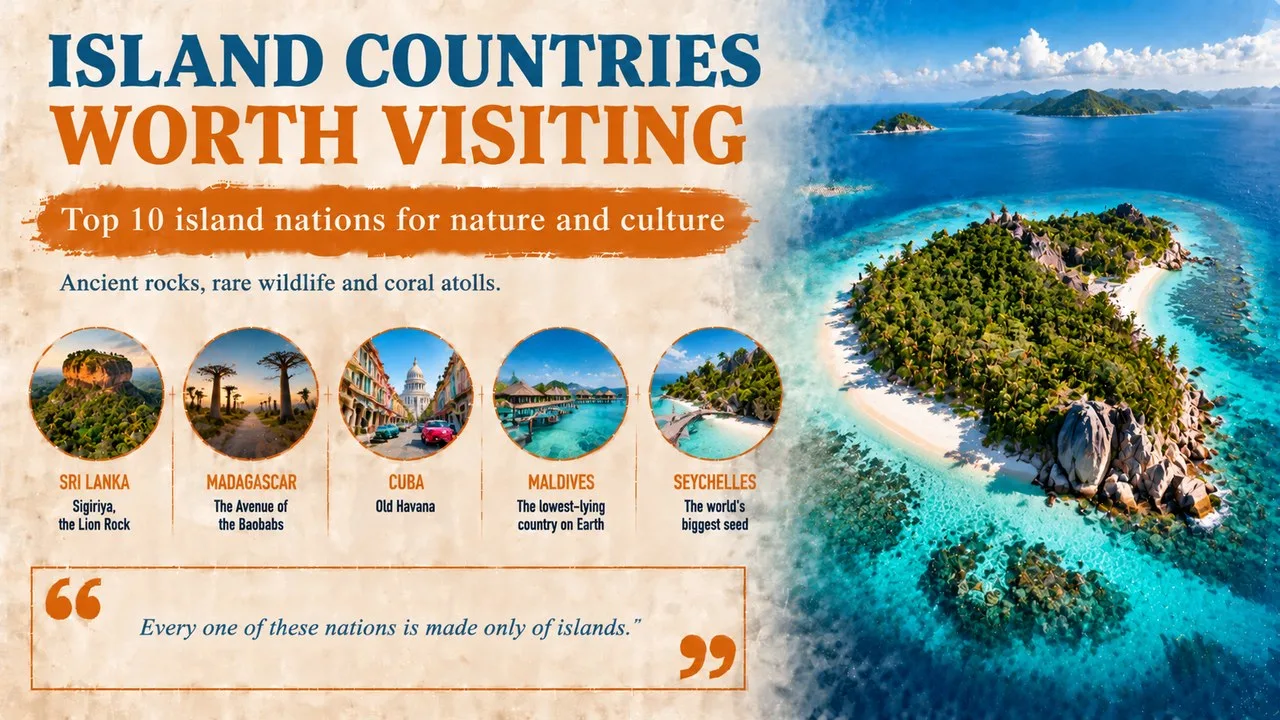
Island countries worth visiting include Sri Lanka with its ancient Lion Rock, Madagascar's giant baobabs, Cuba's old Havana and the atolls of the Maldives.
This Finepedia guide, written in October 2026, picks 10 island nations in the Indian Ocean, the Caribbean, the Pacific and the Atlantic that reward travellers with nature, history and culture. Every entry covers what makes the country special, a highlight not to miss and a few useful facts. For more island and coastal travel, see the Finepedia guides Top 10 Largest Islands in the World and Most Popular Beaches in the World: 10 Icons to Visit.
How We Chose These
Every country here is an independent nation whose territory is all islands. We looked for variety, from huge Madagascar to tiny Barbados, and for places where a visit offers more than a beach: wildlife, heritage sites, music or food. To avoid repeating earlier Finepedia guides, we left out island nations that already feature in other Finepedia lists, such as Iceland, Japan, New Zealand and the Philippines. Facts come from UNESCO, national tourism boards and encyclopaedias. The order is a guide, not a scientific ranking, and travel advice can change, so check official guidance before you book.
The 10 Island Countries at a Glance
| Rank | Country | Ocean or sea | Capital | Don't miss |
|---|---|---|---|---|
| 1 | Sri Lanka | Indian Ocean | Colombo | Sigiriya rock fortress |
| 2 | Madagascar | Indian Ocean | Antananarivo | Avenue of the Baobabs |
| 3 | Cuba | Caribbean Sea | Havana | Old Havana |
| 4 | Maldives | Indian Ocean | Malé | coral atolls and reefs |
| 5 | Mauritius | Indian Ocean | Port Louis | Le Morne Brabant |
| 6 | Seychelles | Indian Ocean | Victoria | Vallée de Mai |
| 7 | Jamaica | Caribbean Sea | Kingston | Blue Mountains |
| 8 | Fiji | Pacific Ocean | Suva | island hopping |
| 9 | Cabo Verde | Atlantic Ocean | Praia | Pico do Fogo |
| 10 | Barbados | Atlantic edge of the Caribbean | Bridgetown | historic Bridgetown |
1. Sri Lanka Packs a Lot Into One Island
Sri Lanka, once known as Ceylon, sits off the southern tip of India across the narrow Palk Strait. In a single trip, visitors can see ancient royal cities, tea-covered hills, elephants in national parks and long tropical beaches.
Key Facts
- Capital: Colombo, with Sri Jayawardenepura Kotte as the seat of parliament
- Population: about 22 million
- Independence: 1948
- Must-see: Sigiriya, the Lion Rock
Did You Know?
Sigiriya is a granite column about 180 metres high near Dambulla. In the 5th century King Kashyapa built a palace on its flat summit, painted its sides with frescoes and placed a giant lion gateway halfway up, which gave the rock its name.
2. Madagascar Is a World of Its Own
Madagascar parted from Africa some 180 million years back, then split from India roughly 90 million years ago. Left alone for so long, its plants and animals evolved into forms found nowhere else, which makes it a dream trip for wildlife lovers.
Key Facts
- Ranking: only three islands on Earth are bigger
- Capital: Antananarivo
- Wildlife: more than 90 per cent of species are endemic
- Baobabs: home to six baobab species that grow wild nowhere else, out of nine worldwide
Why It Matters
The Avenue of the Baobabs, on a dirt road near Morondava in western Madagascar, is lined with giant Grandidier's baobabs about 30 metres tall. Sunset there is among the island's most photographed sights.
3. Cuba Is the Caribbean's Biggest Island Nation
No Caribbean nation covers more ground than Cuba, which is made up of one main island and more than 4,000 smaller islands and cays. Its mix of Spanish colonial towns, African rhythms and vintage American cars makes it like nowhere else.
Key Facts
- Capital: Havana
- Islands: the main island plus about 4,195 islets and cays
- Heritage towns: Trinidad, Cienfuegos and Camagüey, all on the UNESCO list
- Must-see: Old Havana, listed by UNESCO in 1982
Did You Know?
Old Havana keeps the outline of the city walls that once circled it. UNESCO listed it for its Baroque and neoclassical buildings and its forts, which guarded Spanish fleets sailing between the Americas and Europe.
4. The Maldives Barely Rises Above the Sea
The Maldives is a nation of 1,192 low coral islands arranged in 26 atolls, strung across the Equator south-west of Sri Lanka. With crystal-clear lagoons and resort islands, it ranks among the planet's top places for diving and snorkelling.
Key Facts
- Capital: Malé
- Land area: only about 298 square kilometres
- Average height: about 1.5 metres above sea level
- Title: the lowest-lying country on Earth
Why It Matters
Because so little of the land stands more than a metre or two above the waves, rising seas are a real threat. The Maldives has become a leading voice in climate talks for small island states.
5. Mauritius Was Home to the Dodo
Mauritius lies about 2,000 km off south-east Africa, east of Madagascar. Its mix of Indian, African, French and Chinese cultures shows in its food and festivals, and a ring of coral reef shelters warm turquoise lagoons.
Key Facts
- Capital: Port Louis
- Land area: about 2,040 square kilometres
- Other islands: Rodrigues, Agaléga and St Brandon
- Must-see: Le Morne Brabant, a 556-metre rock on the south-west tip
Did You Know?
The flightless dodo lived only on Mauritius and vanished soon after people arrived in the 17th century. The bird now appears on the national coat of arms. Le Morne, where runaway slaves once hid, joined UNESCO's heritage list in 2008.
6. Seychelles Has the World's Biggest Seed
Seychelles is an archipelago of 115 islands lying about 1,500 km east of mainland Africa. No African country is smaller, with around 100,000 people, and its granite inner islands are famous for their boulder-strewn beaches.
Key Facts
- Capital: Victoria, on Mahé
- Islands: 115
- Population: about 100,600 (2022 estimate)
- Must-see: Vallée de Mai on Praslin, a UNESCO site
Why It Matters
The palm forest of Vallée de Mai is home to the coco de mer, whose double nut is the largest seed of any plant. The forest also shelters the rare Seychelles black parrot, which lives nowhere else.
7. Jamaica Is the Home of Reggae
Only Cuba and Hispaniola are bigger than Jamaica among Caribbean islands, and it lies about 145 km south of Cuba. It has given the world reggae, ska and dancehall music, and it is famous for jerk cooking and white-sand beaches.
Key Facts
- Capital: Kingston
- Area: about 10,991 square kilometres
- Independence: 6 August 1962
- Must-see: the Blue Mountains, home of a famous coffee
Did You Know?
The Blue and John Crow Mountains, at Jamaica's eastern end, won UNESCO World Heritage status in 2015. Coffee grown on their misty slopes is sold as Jamaica Blue Mountain, one of the most prized coffees anywhere.
8. Fiji Has More Than 330 Islands
Fiji lies in the South Pacific, about 2,000 km north-north-east of New Zealand. Its more than 330 islands, about 110 of them lived on all year, offer coral reefs, rainforest and a famously warm welcome, summed up in the greeting "bula".
Key Facts
- Capital: Suva, on Viti Levu
- Land area: about 18,300 square kilometres
- Main islands: Viti Levu and its neighbour Vanua Levu, home to about 87 per cent of people
- Independence: 1970
Why It Matters
Most of Fiji's islands were built by volcanoes, and hot springs still bubble on Vanua Levu and Taveuni. The old port of Levuka, Fiji's first European-style town, is protected on UNESCO's World Heritage list.
9. Cabo Verde Is Africa's Atlantic Archipelago
Cabo Verde, also called Cape Verde, is a nation of ten volcanic islands in the Atlantic, between 600 and 850 km west of Senegal. Each island has its own feel, from the beaches of Sal and Boa Vista to the green valleys of Santo Antão.
Key Facts
- Capital: Praia, on Santiago
- Land area: about 4,033 square kilometres
- Independence: 1975
- Must-see: Pico do Fogo, an active volcano that last erupted in 2014
Did You Know?
Cabo Verde's soulful national music, the morna, gained UNESCO Intangible Cultural Heritage status in 2019. Its most famous singer was Cesária Évora, nicknamed the "barefoot diva" because she performed without shoes.
10. Barbados Is the Caribbean's Easternmost Island
Barbados sits farther east than any other Caribbean island, facing the open Atlantic. It is known for calm west-coast beaches, Atlantic surf on its east coast and a long tradition of cricket and rum.
Key Facts
- Capital: Bridgetown
- Independence: 30 November 1966
- Republic: since 30 November 2021, with an elected president replacing the Queen
- Must-see: Historic Bridgetown and its Garrison, a UNESCO site
Why It Matters
Barbados became a republic in 2021, exactly 55 years after independence, while staying in the Commonwealth. Its capital's old streets and military garrison show its long colonial past.
Frequently Asked Questions
What is the largest island country in the world?
Indonesia is the largest island country by area and population. Madagascar, in this list, ranks second among island countries by area.
Which island country is best for wildlife?
Madagascar is hard to beat, since most of its animals and plants live nowhere else, including lemurs and baobabs. Sri Lanka is also excellent, with elephants, leopards and whales in season.
Conclusion
From the ancient rock palace of Sri Lanka to the reggae of Jamaica and the morna of Cabo Verde, island nations offer far more than sand and sea. Each one has a story shaped by the ocean around it. For more island and coastal travel, read the Finepedia guides Top 10 Largest Islands in the World and Most Popular Beaches in the World: 10 Icons to Visit.
- UNESCO World Heritage Centre: Ancient City of Sigiriya, Old Havana and its Fortification, Le Morne Cultural Landscape, Vallée de Mai Nature Reserve, Blue and John Crow Mountains, Levuka Historical Port Town, Historic Bridgetown and its Garrison.
- UNESCO Intangible Cultural Heritage: Morna, musical practice of Cabo Verde (2019).
- Wikipedia (accessed October 2026): Sri Lanka, Madagascar, Cuba, Maldives, Mauritius, Seychelles, Jamaica, Fiji, Cape Verde, Barbados, Sigiriya, Avenue of the Baobabs and Old Havana.
- 10 Most Today, 10 Island Countries You Should Visit, 10mosttoday.com (topic reference).













Log in with